FSSAI Labelling Amendment 2026: What Changes for Indian Consumers

FSSAI's 2026 labelling amendment bans '100% natural' claims and reforms nutrition disclosures. Here's what Indian consumers need to know about reading food labels.

Apr 5, 2026|10 min read
FSSAI Labelling Amendment 2026: What Changes for Indian Consumers

You are standing in a grocery aisle, holding a packet of fruit juice. The front label says "100% Natural." The ingredient list says "reconstituted fruit juice, sugar, citric acid, artificial colour." These two things cannot both be true, and until recently, Indian food law gave the company little reason to reconcile them.

That changed in 2026.

India's Food Safety and Standards Authority of India (FSSAI) has issued its first major amendment to the country's food labelling framework since the FSS (Labelling and Display) Regulations came into force in 2020. The changes build on an earlier crackdown on deceptive marketing claims and introduce new rules around nutritional disclosures and packaging for specific food categories. If you buy packaged food in India, these reforms affect what you see on the label and, more importantly, how much you can trust it.
What FSSAI Is and Why It Matters

FSSAI is India's central food regulator, established under the Food Safety and Standards Act of 2006. It sets the rules for how food is manufactured, stored, distributed, sold, and labelled across the country. If a food product is sold in India, FSSAI has jurisdiction over what goes on its label, including ingredient lists, nutritional information, health claims, and warning symbols.

Every packaged food in India must carry an FSSAI licence number, giving consumers a way to trace the product back to a licensed manufacturer. Think of it as the Indian equivalent of FDA approval in the United States or EFSA oversight in the European Union, though FSSAI operates as both regulator and enforcement body within a single national framework.

The regulator's consumer-facing campaign, Eat Right India, has spent several years pushing for cleaner labelling, simpler nutrition information, and harder enforcement against misleading marketing. The 2026 amendment is one of the most concrete outcomes of that long campaign.

The 2026 Amendment: What Actually Changed

On March 30, 2026, FSSAI released the Food Safety and Standards (Labelling and Display) First Amendment Regulations, 2026. The amendment targets three specific gaps in the existing rules.

Non-Retail Container Labelling

The original 2020 regulations focused primarily on consumer-facing retail packaging. Bulk and institutional packaging sold between businesses (caterers, hotels, food service operators) was subject to lighter disclosure requirements. The 2026 amendment tightens these requirements for non-retail containers, bringing commercial and institutional supply chains into closer alignment with what retail consumers already see.

For most shoppers, this change is invisible at the supermarket level. But it matters for anyone who buys in bulk from wholesale markets, and it closes a gap that food service businesses had used to source ingredients with minimal labelling accountability.

Nutritional Information Exemptions — More Targeted Than Before

The amendment also revises exemptions from mandatory nutritional labelling. Under the original 2020 rules, certain categories including single-ingredient raw foods were exempt from declaring full nutritional panels. The 2026 revision tightens these exemptions, specifically clarifying the rules for infant nutrition products and raw agricultural commodities.

For infant nutrition products, the amendment aligns disclosure requirements with international standards, requiring clearer declaration of energy, macronutrients, and specific micronutrients that matter for early development. For raw foods, the exemption is preserved but more precisely defined, so manufacturers cannot claim "raw food" status for products that have been meaningfully processed.

Logo and Warning Symbol Updates

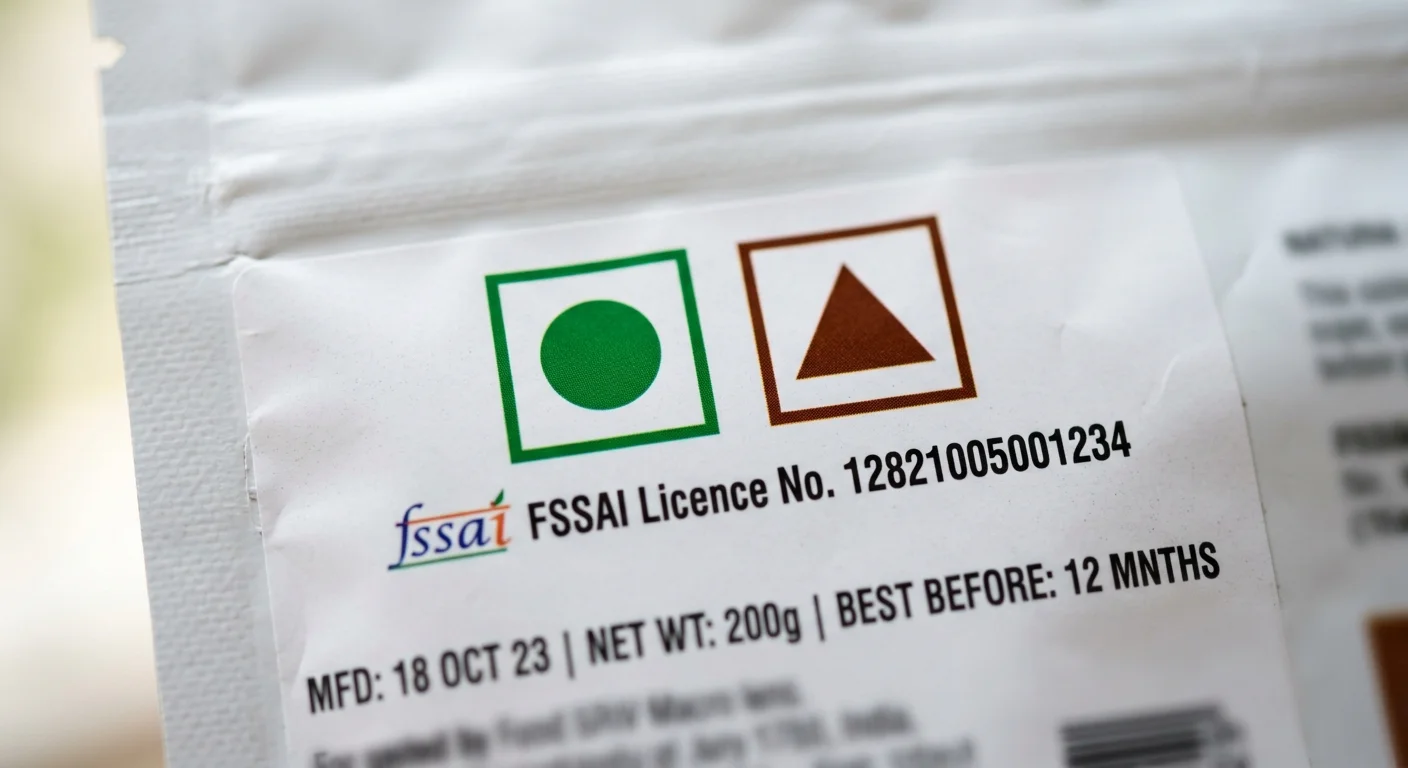
The amendment also updates specifications for the mandatory veg/non-veg symbols that Indian consumers are most familiar with. The green circle (vegetarian) and brown triangle (non-veg) have been part of Indian food labelling since 2011. The 2026 update standardizes their size, placement, and colour specifications more precisely to prevent brands from shrinking or obscuring them.

The regulations governing allergen declarations in bold type are unchanged, but the amendment reinforces their mandatory status.

The "100% Natural" Ban: The Bigger Story

The "100% Natural" Ban: The Bigger Story

While the March 2026 amendment addresses structural gaps in labelling rules, the change that will have the most immediate impact on what you see on store shelves is actually from a few months earlier.

In May 2025, FSSAI formally banned the use of the words "100%" in food marketing claims. Under the updated FSS (Advertising and Claims) Regulations 2018, food manufacturers can no longer label their products as "100% natural," "100% pure," "100% organic," or any similar absolute claim unless the product genuinely meets those criteria in full. Violations can attract fines of up to Rs 10 lakhs (approximately USD 12,000).

This matters because "100%" claims had become among the most abused in Indian packaged food marketing. A product described as "100% whole grain" might contain whole grain flour as its first ingredient but still include refined flour, artificial flavours, and preservatives. A "100% natural" claim could appear on a product with synthetic additives, provided the base ingredient was technically natural.

The ban does not mean brands cannot make any claims. It means they cannot use "100%" as a blanket descriptor for the whole product when it only applies to one component. A cereal can still say "made with 100% whole grain oats" if that is literally true of the oat content, but it cannot put "100% Natural" across the front of pack as a general characterization.

For Indian consumers who had learned to discount these claims anyway, the ban formalizes what was already a reasonable skepticism. For those who took them at face value, the enforcement creates a legal backstop that did not previously exist.

What Front-of-Pack Labelling Would Actually Mean

The most significant unresolved question in Indian food labelling is the front-of-pack (FOP) framework for High Fat, Sugar, and Salt (HFSS) foods.

In February 2026, India's Supreme Court pushed FSSAI to finalize its HFSS labelling framework, which has been in consultation for years. The court's intervention followed petitions arguing that the absence of prominent warning labels on unhealthy foods was contributing to rising rates of obesity, diabetes, and cardiovascular disease in India.

As of April 2026, FSSAI has not finalized this framework. The regulator is still consulting stakeholders, including the food industry, public health bodies, and consumer groups, on what an HFSS warning label should look like, which nutrients it should flag, and what thresholds should trigger a warning.

The international landscape offers several models. Chile uses black octagonal stop signs for products high in calories, saturated fat, sugar, or sodium. The United Kingdom uses a traffic light system with green/amber/red color coding. Several Latin American countries have adopted warning labels modelled on Chile's approach. In total, 44 countries now have some form of mandatory front-of-pack labelling.

India's population of 1.4 billion, with growing rates of non-communicable disease and a rapidly expanding packaged food market, represents exactly the context where front-of-pack labels have shown the most benefit in international studies. What India decides will also influence how other large developing economies approach this question.

"Front-of-pack labels are most effective when they are simple, prominent, and based on a clear nutritional threshold. The evidence from Chile and Mexico shows significant behavior change when warning labels are mandatory and prominent." — Pan American Health Organization, 2023

Whether FSSAI adopts a warning-label approach or a softer traffic-light system will shape how millions of buying decisions are made at the shelf, particularly for lower-literacy consumers for whom text-based ingredient lists are not practically useful.

Reading an Indian Food Label: What to Look For Right Now

Reading an Indian Food Label: What to Look For Right Now

While the regulatory debate continues, here is what Indian food labelling rules require today and how to use them.

The FSSAI Licence Number

Every packaged food must display its FSSAI licence or registration number. This 14-digit number tells you which state the manufacturer is registered in (digits 3 and 4) and confirms the product has passed at least a baseline registration process. A missing FSSAI number is a red flag.

The Veg/Non-Veg Symbol

The green filled circle means vegetarian. The brown or maroon filled triangle means non-vegetarian. Crucially, these symbols apply to the product as a whole including additives, flavours, and processing aids, not just the primary ingredient. A product that uses a non-vegetarian gelatin as a coating agent must carry the non-veg symbol even if the base food is plant-based.

The Ingredient List

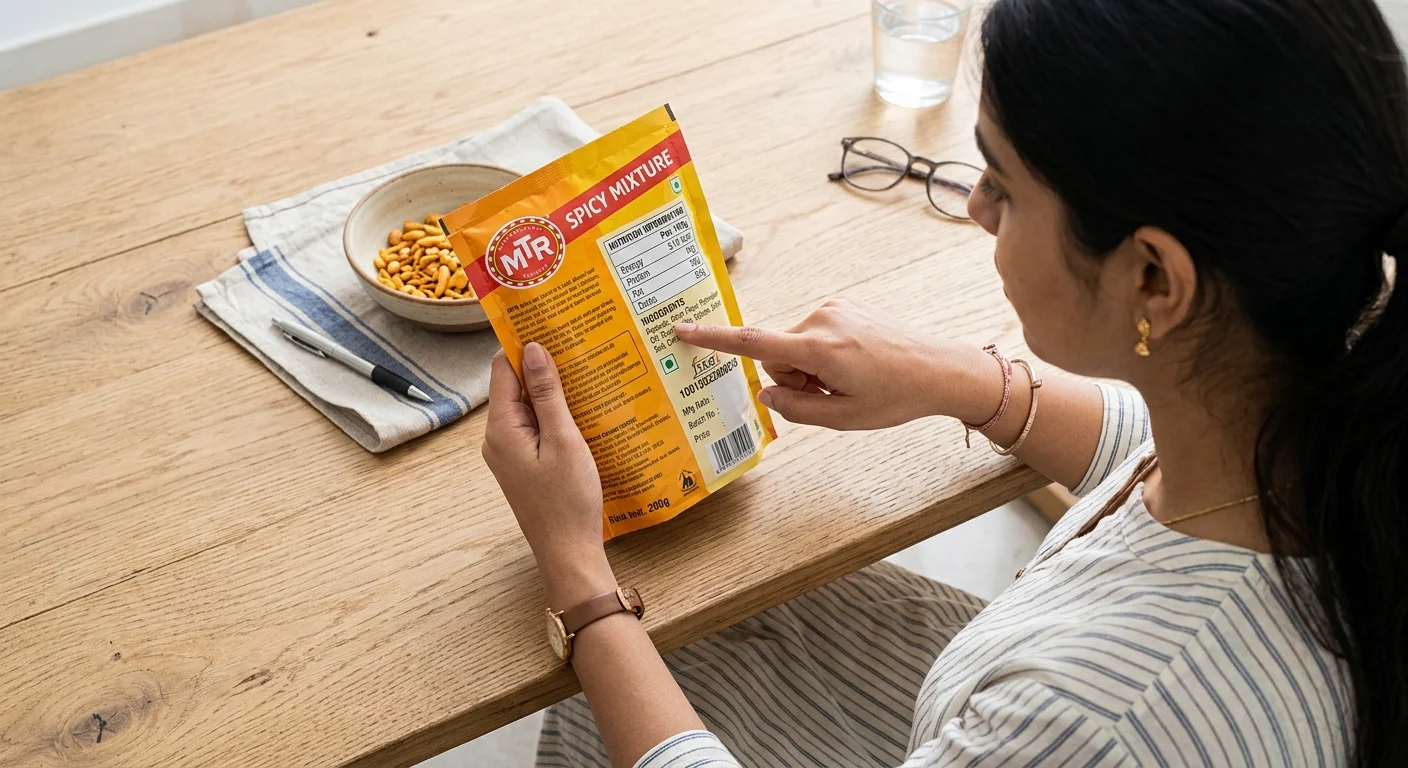
Ingredients must be listed in descending order of weight (by weight at the time of manufacture). The first ingredient is the largest by weight. This single rule is more informative than most marketing copy on the front of the pack. If sugar appears first or second on a product marketed as a health food, the front-of-pack claim tells you less than the ingredient list does.

Allergen Declaration

The eight major allergens under Indian food law (cereals containing gluten, crustaceans, eggs, fish, peanuts, soybeans, milk, and tree nuts) must be declared in bold in the ingredient list or in a separate "Contains:" statement. This requirement has been in place since 2020 and has not changed in the 2026 amendment.

Date Marking

"Best before" and "use by" dates are both used in Indian labelling. "Best before" indicates quality and is a guideline. "Use by" indicates safety and should be treated as a hard cutoff. The 2020 regulations require that date marking be prominent and not hidden.

The Transition Period: When Does This Take Effect?

The March 2026 First Amendment Regulations carry a transition period of 365 days from the date of publication, placing the mandatory compliance deadline at approximately July 1, 2027. Manufacturers have just over a year to update their packaging to meet the new requirements.

This transition period is standard practice for labelling changes, as it allows manufacturers to exhaust existing stock and update printing workflows without being forced into immediate waste. For consumers, it means that 2026 and early 2027 store shelves may carry both old-format and new-format labels on the same product depending on production batch.

The "100%" claims ban from May 2025 had its own transition period, and enforcement began in late 2025. Brands were expected to update their labels before transitioning to the enforcement phase.

What These Changes Mean in Practice

The 2026 amendments are incremental rather than transformative. They close gaps, sharpen definitions, and strengthen enforcement teeth rather than introducing a fundamentally new labelling philosophy. The bigger transformation, if it comes, will be the HFSS front-of-pack framework.

But incremental changes have real effects. The "100% Natural" ban removes one of the most commonly used pieces of marketing misdirection on Indian shelves. The tighter non-retail labelling brings commercial food supply chains under closer scrutiny. And the nutritional disclosure reforms for infant products address an area where information gaps have real health consequences.

For Indian consumers, the practical takeaway is not to wait for regulation to tell you what is in your food. The ingredient list, FSSAI number, veg/non-veg symbol, and date marking are already there. The tools exist. Using them is the best consumer strategy regardless of what the front of the pack says.

IngrediCheck can help you go further. Scan any packaged food label and IngrediCheck's AI will analyze the ingredient list against your dietary preferences, allergies, and intolerances, flagging problematic ingredients instantly. Whether you are watching for HFSS ingredients, allergens not declared prominently enough, or additives you want to avoid, IngrediCheck reads what regulators do not yet require brands to highlight for you.

Start making confident food choices today!

Scan food and understand what's right for you and your family, with AI.

IngrediCheck app