Dietary Guides

Buddhist Diet Guide: Pungent Vegetables, Alcohol Derivatives, and Animal Ingredients in Packaged Foods

Buddhist dietary rules vary significantly by tradition. Many traditions prohibit meat, fish, and eggs. Most East Asian Buddhist traditions also prohibit the five pungent vegetables: garlic, onion, leek, chive, and shallot: which appear as powders and extracts in nearly all savory packaged foods.

Jun 11, 2026|11 min read
By Sanket Patel|Updated 2026-06-11|6 sources|Editorial standards
Buddhist Diet Guide: Pungent Vegetables, Alcohol Derivatives, and Animal Ingredients in Packaged Foods

Buddhist dietary practice is one of the most misunderstood areas of religious food restriction. Ask ten Buddhists what they eat and you will likely receive ten different answers. That variation is not inconsistency, it reflects genuine doctrinal differences across traditions that span more than two millennia and half the globe. For someone navigating packaged food labels while observing Buddhist dietary precepts, the complexity is compounded by an industrial food system that routinely dissolves prohibited ingredients into spice blends, flavor compounds, and processing aids that appear nowhere on the front of the package.

This guide untangles the traditions, maps the hidden ingredients, and gives you a concrete label-reading method.

What the Buddhist Diet Actually Requires

The single most important fact about Buddhist dietary rules is that they are not uniform. Three major branches of practice each approach food differently, and within each branch, monastic rules differ from lay guidelines.

Theravada Tradition (South and Southeast Asia)

Theravada monks follow the Vinaya, the monastic code codified from early Buddhist oral traditions. The Vinaya permits monks to eat meat under what are called the "three pure kinds of flesh": meat the monk has not seen killed, has not heard being killed for him, and does not suspect was killed for him. In practice, monks in Thailand, Sri Lanka, Myanmar, Cambodia, and Laos eat whatever is placed in their alms bowls, including meat and fish. Laypeople in Theravada countries face no formal prohibition on meat, though many choose vegetarianism on Uposatha observance days, the lunar calendar days of intensified practice.

There is no Theravada prohibition on alliums (the onion family) or on alcohol in flavorings. That prohibition belongs to a different branch entirely.

Mahayana Tradition (China, Japan, Korea, Vietnam)

The Mahayana branch, which became dominant across East Asia, took a sharply different path. The Lankavatara Sutra, a foundational Mahayana text, contains an extended argument for vegetarianism rooted in the doctrine of universal Buddha-nature: all sentient beings have been your mother in past lives, and consuming them is therefore consuming your own kin. This reasoning drove Chinese Buddhist monasteries to adopt strict vegetarianism from roughly the fifth century CE onward, a practice formalized under Emperor Wu of Liang in 517 CE.

The same tradition added a second prohibition that has no parallel in Theravada: the five pungent vegetables, called wu hun (五葷) in Chinese. These are:

  1. Garlic (da suan, 大蒜)
  2. Onion (cong, 葱)
  3. Leek / Chinese leek (jiu cai, 韭菜)
  4. Chive
  5. Shallot

The doctrinal reasoning, drawn from the Shurangama Sutra, holds that these vegetables, when eaten cooked, excite sexual passion; when eaten raw, they excite anger. Both states obstruct meditation and moral conduct. The prohibition applies both to eating the vegetables directly and to any food prepared with them.

Some traditions, particularly those influenced by Indian texts, include asafoetida (hing) as a sixth pungent root. Asafoetida is the dried gum-resin of Ferula species and shares the sulfur-compound chemistry that characterizes the allium family.

Korean and Japanese Mahayana practice developed distinct culinary traditions around this prohibition. Korean temple food (사찰음식, sachal eumsik) eliminates all five pungent roots entirely and forms the basis of an increasingly influential culinary movement that UNESCO recognized within Korean intangible cultural heritage. Japanese shojin ryori (精進料理), the cuisine of Zen monasteries, applies the same principles with Japanese culinary technique.

Vajrayana / Tibetan Tradition

Tibetan Buddhist practice developed in a high-altitude environment where plant foods were historically scarce for much of the year. The Vajrayana texts contain provisions permitting meat in certain tantric ritual contexts, and Tibetan monks have historically consumed meat and dairy. Contemporary Tibetan Buddhist teachers vary considerably: some advocate vegetarianism, others see it as contextually appropriate, and the Dalai Lama has spoken publicly about his own efforts toward vegetarianism while acknowledging the complexity.

Lay Practice and the Five Precepts

For lay Buddhists across all traditions, the First Precept, to refrain from taking life, provides the ethical foundation for vegetarianism, but its application is left to individual interpretation. Many laypeople who observe the precepts strictly are effectively vegan plus no-pungent-roots, while others eat meat but avoid killing animals directly. This variance is doctrinally legitimate in most traditions.
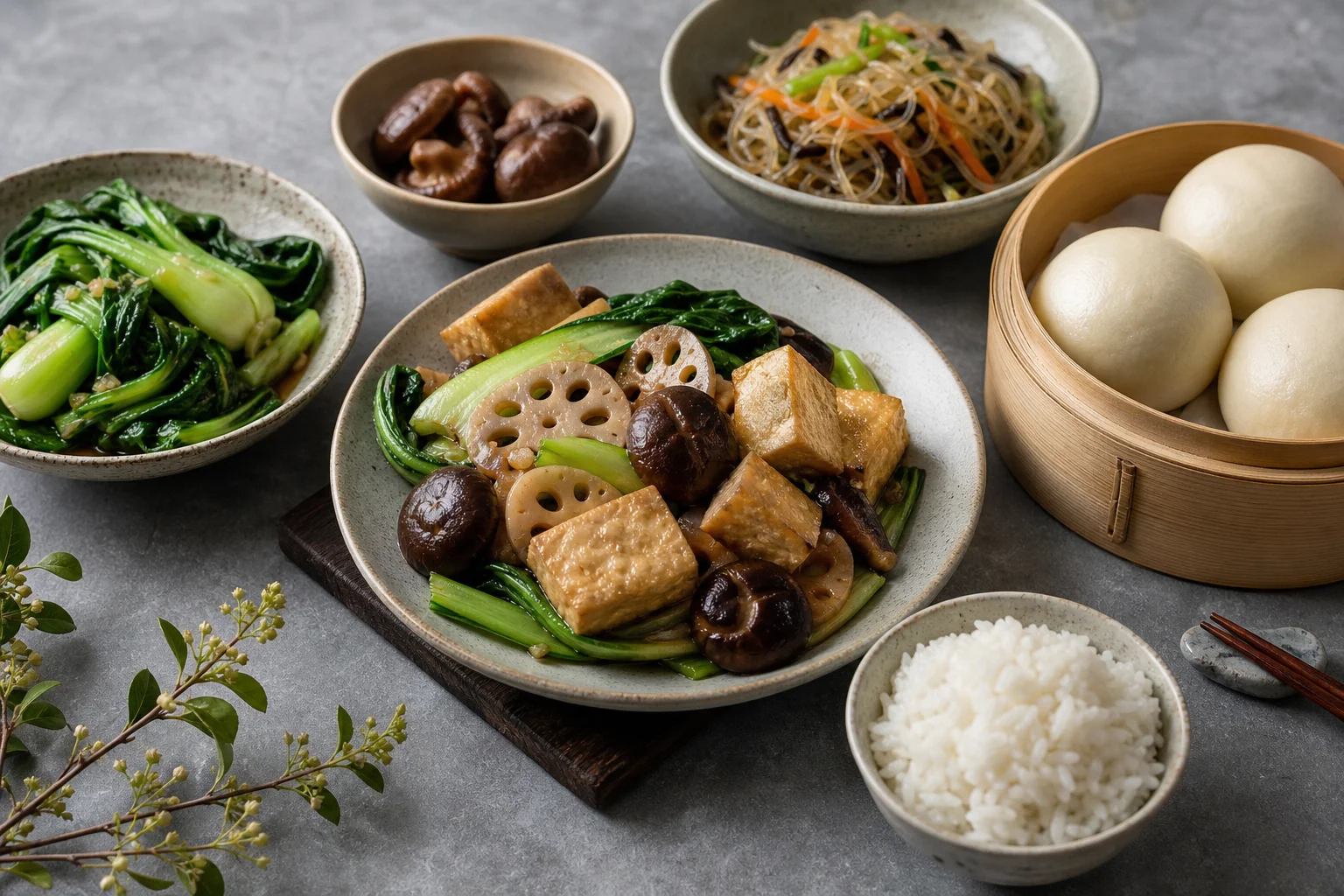
The Five Pungent Vegetables in Packaged Foods

The practical problem for Mahayana practitioners reading packaged food labels is that garlic and onion are among the most widely used flavoring agents in the global food industry. They appear in forms that are rarely obvious.

Aliases and Derived Ingredients

Garlic appears on ingredient labels as: garlic powder, garlic salt, garlic extract, garlic oil, dehydrated garlic, roasted garlic, garlic juice, garlic flavor, natural garlic flavor.

Onion appears as: onion powder, dehydrated onion, onion extract, onion juice, onion salt, caramelized onion, dried onion, onion flavor, onion oil.

Leek and chive appear less frequently as isolated ingredients but show up in: vegetable seasoning blends, herb mixes, freeze-dried vegetable ingredients, and soup base powders.

Shallot appears occasionally in: French-style sauces, salad dressing bases, and gourmet seasoning packets.

Asafoetida (for traditions that include it) appears as: asafoetida, hing, heeng, asafetida, devil's dung (an archaic name), Ferula extract. It is a staple ingredient in Indian cooking and appears in many South Asian packaged foods.

The "Natural Flavors" Problem

Under 21 CFR 101.22, the US FDA permits manufacturers to label any flavoring substance derived from plant or animal sources as "natural flavor" without naming the specific source. This means garlic extract, onion extract, and leek concentrate can all legally appear on a label as "natural flavor" or "natural flavors" with no further disclosure. The same regulation applies to animal-derived flavoring compounds discussed in the next section.

This single regulatory provision makes label reading for Buddhist dietary purposes genuinely difficult. A product that appears onion-free based on the ingredient list may contain significant onion-derived flavoring compounds disclosed only as "natural flavor."

Animal Derivatives in Packaged Foods

Buddhist traditions that practice vegetarianism prohibit all flesh foods, but the animal derivatives that appear in packaged foods extend well beyond the obvious.

Gelatin

Gelatin is derived from the collagen of cattle and pig bones, skin, and connective tissue. It appears in: marshmallows, gummy candies, gel capsules for vitamins and supplements, some yogurts, panna cotta mixes, mousse powders, certain ice cream formulations, and many commercial dessert mixes. Kosher and halal certifications do not indicate gelatin-free status; they indicate the source species and slaughter method.

Carmine (E120)

Carmine is a red pigment derived from the dried bodies of the cochineal insect (Dactylopius coccus). It provides the vivid red and pink coloring in: fruit juices, yogurts, some candies, ice creams, maraschino cherries, and cosmetics. The FDA requires carmine to be declared by name on food labels since 2011, it cannot hide as "artificial color." It may appear as: carmine, cochineal extract, carminic acid, E120, natural red 4.

Isinglass

Isinglass is a fining agent made from dried fish swim bladders, used to clarify beer and some wines. It does not appear on the finished product label because it is considered a processing aid, not an ingredient. Many craft beers, commercial lagers, and non-organic wines are processed with isinglass.

Lard and Tallow

Animal fats appear in: some commercial pie crusts, certain tortillas, refried beans, biscuit mixes, crackers, and fried snack foods. They may be labeled as: lard, tallow, beef tallow, rendered animal fat, or simply "animal shortening."

Rennet

Animal rennet, derived from calf stomach lining, is used to coagulate milk in cheesemaking. Hard cheeses made with animal rennet are not vegetarian. Labels may say: rennet, animal rennet, calf rennet. Many commercial cheeses now use microbial rennet or fermentation-produced chymosin, which are vegetarian. Labels may say: vegetable rennet, microbial rennet, or FPC (fermentation-produced chymosin).

L-Cysteine

L-cysteine is an amino acid used as a dough conditioner in commercial bread, pizza dough, and bagels. It is commonly derived from duck or chicken feathers, though synthetic and plant-derived forms exist. Labels list it as: L-cysteine, cysteine, E920.

Other Animal Derivatives

  • Casein and caseinate: milk proteins used as emulsifiers and protein additives
  • Whey: dairy byproduct in protein powders, bread, crackers
  • Lactose: milk sugar used as a filler in tablets and some processed foods
  • Anchovy and fish paste: in Worcestershire sauce, some Caesar dressings, certain Asian condiments
  • Shellac (E904): insect-derived resin used as a glaze on candies and pharmaceutical tablets
  • Bone char: used to filter some refined cane sugars; not an ingredient but relevant to strict vegans

Alcohol in Packaged Foods

Many Buddhist traditions extend the Fifth Precept (avoiding intoxicants) to food ingredients that contain alcohol, even in trace amounts. Others hold that cooking volatilizes the alcohol and removes the ethical concern. The doctrinal question remains unresolved across traditions.

Practically, alcohol appears in packaged foods as:

  • Vanilla extract: the standard form contains ethanol as a solvent; pure vanilla extract in the US must contain at least 35% alcohol by volume under 21 CFR 169.175. Vanilla flavor or imitation vanilla may be alcohol-free.
  • Other flavor extracts: almond, peppermint, lemon, and similar extracts typically use ethanol as a carrier
  • Mirin: a Japanese sweet rice wine used in sauces, marinades, and prepared Asian foods; labeled as mirin, hon mirin, or aji-mirin
  • Sake-derived ingredients: sake, sake lees (kasu), rice wine, rice wine vinegar
  • Wine and beer in sauces: some pasta sauces, cooking sauces, and marinades contain wine
  • Fermented soy sauces: traditional soy sauce fermentation produces trace alcohol; most commercial soy sauces contain residual alcohol

Regulatory Context: Is There an Official Buddhist Food Standard?

No government regulatory agency, not the US FDA, USDA, European Food Safety Authority, or any national food standards body, defines or enforces a "Buddhist diet" food standard. This contrasts with kosher and halal certification, which are governed by private religious certification bodies with their own inspection and auditing systems.

The absence of a regulated standard creates two consequences. First, any product can claim to be "Buddhist-friendly," "temple food," or "suitable for Buddhists" without independent verification. Second, Buddhist practitioners must independently verify every ingredient against their own tradition's rules, which vary.

The EU's food labeling framework under Regulation (EU) No 1169/2011 requires disclosure of 14 major allergens by name, which covers some animal derivatives (milk, eggs, fish, shellfish), but it does not require disclosure of alliums or other pungent vegetables. Garlic and onion can still appear as "natural flavoring" without species-level disclosure.

Certification Marks That May Indicate Compliance

Because no universal Buddhist food standard exists, practitioners often rely on adjacent certifications:

  • Certified Vegan (Vegan Action's "V" mark): covers meat, poultry, fish, eggs, dairy, honey, and other animal derivatives. Does not address pungent roots or alcohol in flavorings.
  • Vegetarian Society Approved (UK): similar scope to Certified Vegan, with stricter processing standards.
  • Taiwan's Vegetarian Label (素食): Taiwan has a government-regulated vegetarian food labeling system that distinguishes between vegan (全素 or 純素), lacto-ovo vegetarian (蛋奶素), and "plant-based but with pungent vegetables" (植物五辛素). This is the only government system in the world that addresses pungent vegetables specifically.
  • Korean Temple Food Certification: administered by the Korean Temple Food Center, this certification covers traditional sachal eumsik standards including no-pungent-root requirements.
  • Japan's Shojin Mark: no standardized national system; individual restaurants and producers use this term without uniform standards.

A Practical Label-Reading Strategy

Strictly Avoid:

  • Garlic powder: concentrated allium, prohibited in Mahayana traditions
  • Garlic extract: same prohibition, concentrated form
  • Garlic oil: oil infused with garlic compounds
  • Garlic salt: garlic powder combined with salt
  • Dehydrated garlic: same prohibition
  • Onion powder: prohibited allium in powdered form
  • Onion extract: concentrated allium flavoring
  • Dehydrated onion: prohibited allium
  • Onion salt: onion powder with salt
  • Leek: prohibited pungent root, fresh or dried
  • Chive: prohibited pungent root
  • Shallot: prohibited pungent root
  • Asafoetida / hing / heeng: prohibited pungent resin (in traditions that include it)
  • Gelatin: derived from animal bones and skin
  • Lard: rendered pig fat
  • Tallow / beef tallow: rendered beef fat
  • Carmine / cochineal extract / carminic acid / E120 / natural red 4: insect-derived colorant
  • Isinglass: fish-derived fining agent (primarily in beer and wine)
  • Rennet / animal rennet / calf rennet: animal-derived cheesemaking enzyme
  • L-cysteine / cysteine / E920: commonly feather-derived dough conditioner
  • Shellac / E904: insect-derived glaze on candies and tablets
  • Anchovy / fish paste / fish sauce: present in many savory sauces and dressings
  • Mirin / hon mirin / aji-mirin: rice wine (alcohol content, plus often in dishes with other prohibited ingredients)
  • Vanilla extract: contains ethanol as carrier solvent (for traditions avoiding all alcohol)
  • Natural flavor / natural flavors: may conceal garlic, onion, or animal-derived flavoring compounds

Limit / Caution:

  • Natural flavor: cannot be verified without contacting the manufacturer; must be queried specifically for allium and animal sources
  • Spice blends: rarely list individual spices; contact manufacturer or avoid
  • Vegetable broth / vegetable stock: frequently contains onion and garlic as base ingredients even when labeled "vegetable"
  • Bouillon / broth powder: nearly always contains onion and garlic
  • Worcestershire sauce: typically contains anchovies and tamarind; some vegan versions exist
  • Soy sauce: most contain alcohol; tamari may be lower but check labels
  • Vinegar: rice wine vinegar and malt vinegar may contain alcohol residues; distilled white vinegar is alcohol-free by the time it reaches label concentrations
  • Cheese: must verify rennet type; hard aged cheeses more likely to use animal rennet
  • Wine and beer: isinglass and gelatin used as fining agents; look for certified vegan versions
  • Fortified foods and supplements: gel capsules often contain gelatin; look for vegetable capsule designation

Safe:

  • Fruits and vegetables (excluding the five pungent roots)
  • Whole grains: rice, oats, quinoa, millet, barley, buckwheat
  • Legumes: lentils, chickpeas, black beans, kidney beans, soybeans (whole or as tofu/tempeh)
  • Nuts and seeds
  • Plant oils: olive oil, coconut oil, sunflower oil, sesame oil (check for added flavors)
  • Distilled white vinegar (alcohol-free residual)
  • Tamari labeled gluten-free (typically lower alcohol, often no wheat)
  • Microbial rennet / vegetable rennet / FPC (fermentation-produced chymosin) cheeses
  • Pectin: plant-derived gelling agent, safe alternative to gelatin
  • Agar-agar: seaweed-derived, safe gelling agent
  • Carrageenan: seaweed-derived, used as thickener and emulsifier
  • Annatto / E160b: plant-derived orange-red colorant from achiote seeds
  • Turmeric / E100: plant-derived yellow colorant
  • Beet juice / beet powder: plant-derived red colorant, safe alternative to carmine
  • Vanilla bean / vanilla paste (alcohol-free) / imitation vanilla (check carrier)

Ignore these label claims:

  • "Natural": this term has no regulatory definition relevant to Buddhist dietary compliance; natural flavors can include onion, garlic, and animal derivatives
  • "Plant-based": no regulated definition; does not exclude alliums or alcohol-based flavorings
  • "Vegetarian": no US federal standard; manufacturers self-certify; may include eggs and dairy but still contain hidden animal derivatives like isinglass in production
  • "Buddhist-friendly": no regulatory definition or third-party verification standard in most countries outside Taiwan

Scanning Checklist for Store Shopping

  1. Read the complete ingredient list top to bottom before checking anything else. The first five ingredients by weight are the most significant.
  2. Search specifically for "natural flavor" or "natural flavors", if present, the product requires direct manufacturer contact to confirm allium and animal-derivative status.
  3. Scan for all garlic and onion aliases: garlic powder, onion powder, garlic extract, onion extract, dehydrated garlic, dehydrated onion, garlic salt, onion salt.
  4. Check for animal-derived additives: gelatin, carmine (E120), L-cysteine (E920), shellac (E904), lard, tallow, isinglass, and animal rennet.
  5. For alcohol-avoiding traditions, scan for vanilla extract, mirin, sake, wine, beer, and any "extract" in the flavoring section that may use ethanol as a carrier.
  6. For any broth, bouillon, seasoning packet, spice blend, or "vegetable seasoning," assume allium presence unless the manufacturer confirms otherwise.
  7. Look for the Taiwan vegetarian label (全素/純素) on imported Taiwanese products, or Korean Temple Food certification marks on Korean imports, these are the most reliable third-party signals for pungent-root-free status.

IngrediCheck scans ingredient lists and flags pungent vegetables, animal derivatives, and alcohol-based flavorings specific to Buddhist dietary practice. Scanning a barcode takes seconds and surfaces the aliases and hidden derivatives that make manual label reading unreliable.

The hidden-ingredient challenges in Buddhist eating share considerable ground with Jain dietary restrictions, both traditions prohibit the five pungent alliums, making garlic powder and onion extract a shared concern for consumers following either practice.

Buddhist dietary practice spans a wide spectrum, from Theravada monks eating whatever fills their alms bowls to Chinese temple cooks producing intricate meals with no meat, no alliums, and no alcohol-based flavorings. For practitioners navigating a modern supermarket, the challenge is not philosophical, it is chemical. Garlic lives inside "natural flavor." Onion dissolves into "vegetable seasoning." Gelatin hides in vitamin capsules and marshmallows. Carmine colors the yogurt that bears no visible animal on its label. IngrediCheck is built to surface exactly this kind of hidden ingredient: scan a barcode, specify your Buddhist dietary tradition, and the app identifies every ingredient that conflicts with your precepts, including the aliases and processing aids that never make it to the front of the package.

Next Label Check

Follow the scanner, hub, and ingredient paths connected to this guide

Get the app for clearer label decisions.

Scan labels, see what fits your food notes, and read the why in plain English.

IngrediCheck app