Certified Gluten-Free vs Gluten-Free: What Celiacs Should Trust

For a shopper with celiac disease, the difference between gluten-free and certified gluten-free is not just packaging trivia. It changes how much confidence you can reasonably place in a product before it goes into the cart.

Both labels can be meaningful. Neither one should make you stop reading completely.

The useful question is not, "Is certification the only safe option?" The better question is, "What kind of evidence does this package give me, and what still deserves review?" Once you separate the legal claim, the certifier mark, the ingredient list, and the warning language, the shelf gets a lot less confusing.

What the FDA Gluten-Free Claim Actually Means

In the United States, gluten-free is a regulated claim. If a packaged food uses gluten-free, no gluten, free of gluten, or without gluten, it has to meet the FDA rule for that claim.

The core standard is less than 20 parts per million of gluten. The food also cannot be intentionally made with wheat, rye, barley, triticale, or ingredients from those grains unless the ingredient has been processed to remove gluten and the finished food still meets the rule. The common example is wheat starch that has been processed to remove gluten.

That makes an FDA gluten-free claim a real signal. It is not just marketing language. It gives celiac shoppers a baseline standard that did not exist nationally before the rule.

But there are limits:

  • the claim is voluntary
  • a safe product might not carry the claim
  • a claimed product still needs an ingredient review
  • the allergen statement only helps with wheat, not barley or rye
  • advisory language such as may contain wheat is not the same kind of regulated claim

So a plain FDA gluten-free claim should not be dismissed. It is meaningful. It is just not the same thing as independent certification.

What Certified Gluten-Free Adds

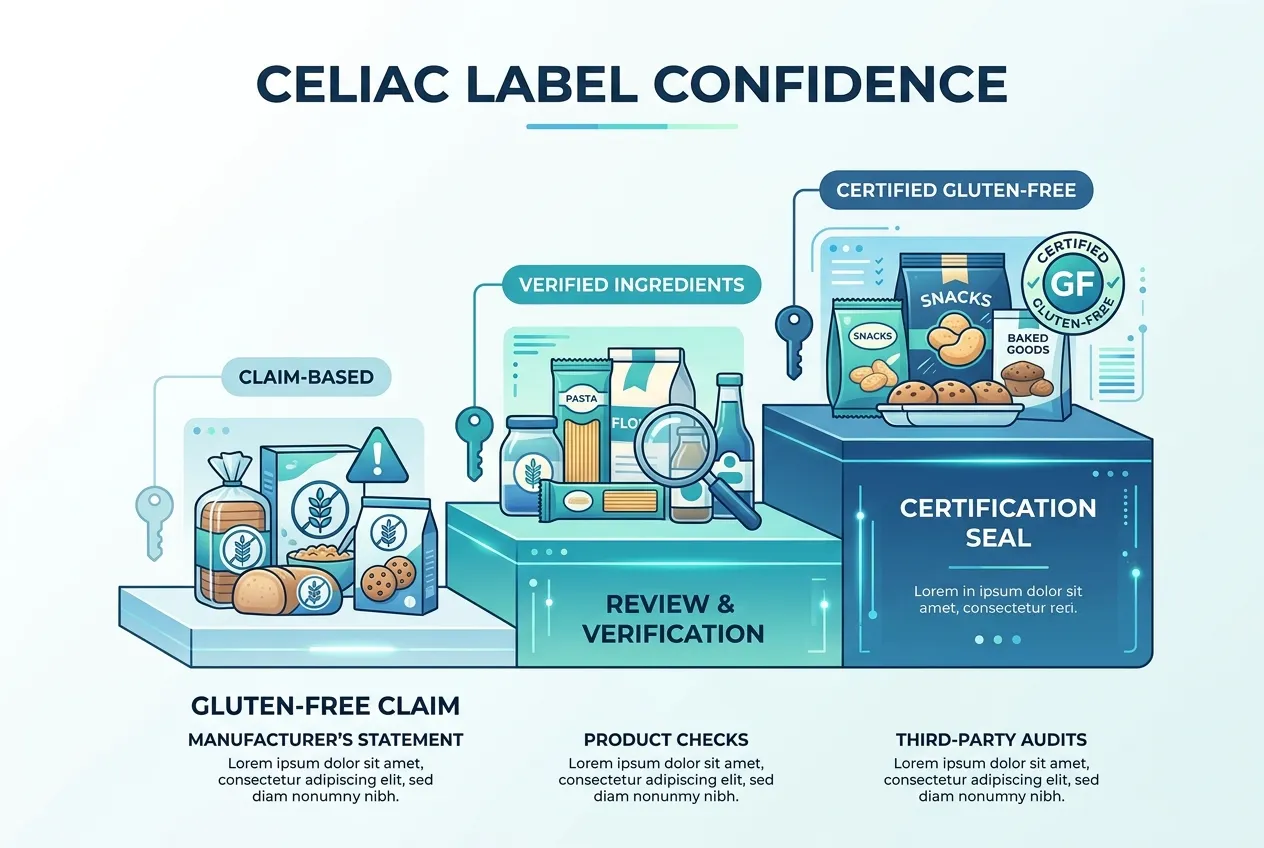
Certified gluten-free marks are usually third-party programs. The certifier sets a standard, reviews the product or facility, and gives the brand permission to use a certification mark if the product meets the program requirements.

That extra layer can matter because it adds process checks beyond the brand simply deciding to make a gluten-free claim. Depending on the certifier, the program may include ingredient review, facility audits, finished-product testing, supplier controls, packaging approval, complaint handling, and ongoing surveillance.

Two examples show why shoppers should read the certifier, not just the word certified.

GFCO's 2025 manual defines gluten-free for its program as gluten at 10 ppm or less, or the regulatory threshold of the country of sale if that threshold is lower. NSF's P404 protocol defines NSF Certified Gluten-Free products through formula and document review, facility audit, and product testing, with finished food or product containing no more than 15 ppm of gluten.

Both are stricter than the FDA's 20 ppm ceiling. That does not mean every product without those marks is unsafe. It means a recognized certification mark can give you a stronger evidence trail when two otherwise similar products are sitting side by side.

A Practical Trust Ladder for Celiac Shopping

A Practical Trust Ladder for Celiac Shopping

It helps to think in layers rather than absolutes.

Strongest signal: recognized certification plus a sensible ingredient list

This is usually the cleanest packaged-food scenario. A recognized gluten-free certification mark gives you an independent program behind the claim. The ingredient list still matters, but you are starting from a stronger place.

Use this category for products where cross-contact risk is higher, such as oats, baking mixes, flours, cereals, granola, snack bars, and multi-ingredient processed foods.

Strong signal: FDA gluten-free claim without third-party certification

This is still a meaningful label. If the product says gluten-free, it has to meet the FDA rule. Many ordinary packaged foods fall here, and celiac shoppers often use them successfully.

The key is to keep reading:

  • does the ingredient list conflict with the claim?
  • are oats present?
  • does wheat starch appear?
  • is there warning language that changes your comfort level?
  • is the product from a category where cross-contact is common?

The label gives you a baseline. The rest of the package tells you whether the baseline is enough for this product.

Review case: no gluten-free claim but simple ingredients

Some foods are naturally gluten-free and do not bother to say so. Plain milk, eggs, fresh produce, unseasoned meat, plain beans, and simple oils may not need a gluten-free claim to be ordinary choices.

Packaged products get harder. A jar of single-ingredient peanut butter is not the same situation as a cereal, seasoning blend, frozen meal, or oat-containing snack. Once the product gets more processed, the missing gluten-free claim becomes more important.

Weak signal: wheat-free, grain-free, keto, paleo, clean, or plant-based

These claims do not equal gluten-free. Wheat-free can still leave barley, rye, malt, and some oat concerns on the table. Grain-free and paleo are diet-positioning claims, not celiac label rules. Clean label is even looser.

For celiac shopping, these claims can be context. They are not enough by themselves.
The Warning Label Problem

May contain wheat, made in a facility that also processes wheat, and made on shared equipment statements create a lot of anxiety because they sound precise but often are not.

The FDA explains that advisory allergen statements are not required by law. They can be used to address unavoidable cross-contact, but they cannot replace good manufacturing practices. In practice, that means warning statements do not work like a reliable risk scale.

A product with no advisory statement is not automatically safer than one with a shared-facility statement. A product with a shared-facility statement is not automatically above the gluten-free threshold either.

The most practical celiac workflow is this:

  • if the product is certified gluten-free, treat the certifier's program as the stronger signal
  • if the product is FDA-labeled gluten-free, read the warning language as context, not as a separate legal verdict
  • if the product has no gluten-free claim and also carries wheat or shared-equipment language, put it in the review bucket
  • if you cannot explain the package to yourself clearly, choose a simpler product

That last point is not fear. It is aisle efficiency.

Oats Deserve Their Own Rule

Oats are naturally gluten-free, but celiac shoppers cannot treat generic oats as automatically safe. Cross-contact can happen in fields, transport, mills, and packaging lines.

The FDA allows oats to be labeled gluten-free if they contain less than 20 ppm gluten. The Celiac Disease Foundation's label guidance gives the practical version: people with celiac disease should choose oats that carry a gluten-free label.

Certification adds even more confidence for oat-heavy products because oats are one of the categories where cross-contact is not an edge case. If you are choosing between two granolas, one certified gluten-free and one only marketed as wholesome oats, the certified product is the cleaner choice.

Wheat Starch Is the Nuance People Miss

Wheat on a label usually ends the conversation for celiac shoppers. Wheat starch is the important exception to understand.

Under the FDA gluten-free rule, an ingredient derived from a gluten-containing grain can be used in a food labeled gluten-free only if it has been processed to remove gluten and the finished food meets the less-than-20-ppm standard. Wheat starch is the example shoppers run into most often.

That does not mean every wheat-starch product is fine. It means the words wheat starch and gluten-free can legally appear together when the product meets the rule.

Your practical response should be measured:

  • if wheat starch appears with a clear gluten-free claim, slow down and confirm the package
  • if it also carries recognized certification, that adds confidence
  • if wheat starch appears without a gluten-free claim, do not treat it as safe by default

This is exactly where blanket rules can mislead. The ingredient matters, but the claim and testing context matter too.

What Celiacs Should Actually Trust

Trust the strongest combination of signals, not one magic phrase.

For higher-risk packaged foods, the best combination is:

  1. a recognized gluten-free certification mark
  2. a clear gluten-free claim
  3. an ingredient list that matches the claim
  4. no unexplained oats, malt, barley, rye, or wheat-derived ingredients
  5. warning language that fits your household's risk rule

For simpler foods, you may not need all five. For oat products, baking mixes, cereals, and snack bars, you probably want more of them.

The mistake is treating all labels as equal. A certified gluten-free oat bar and a wheat-free oat bar are not giving you the same information. A gluten-free frozen meal and a clean-label frozen meal are not giving you the same information. A product with a certifier mark and facility audits is not the same as a brand's unsupported front-of-pack claim.

If you want the broader first-pass system, start with Gluten-Free Scanner App: Catch Hidden Gluten Faster. If you are still building the habit of reading labels in order, use The Celiac Label-Reading Checklist: Hidden Sources You Can't Miss. For the bigger difference between celiac disease and symptom-based gluten avoidance, read Celiac vs Gluten Sensitivity: What's Actually Different on Your Label.

Use the Strongest Signal You Can Find

Certified gluten-free is not the only meaningful label, but it is often the strongest one. FDA gluten-free claims still matter. Ingredient lists still matter. Warning language still deserves context. The best celiac shopping system uses all of those signals together instead of asking one phrase to do all the work.

With IngrediCheck, you can scan packaged foods against your saved gluten-free or celiac rules, surface ingredients and label clues that deserve review, and choose products with more confidence when certification, claims, and ingredients do not all say the same thing.

Get the app for clearer label decisions.

Scan labels, see what fits your food notes, and read the why in plain English.

IngrediCheck app