Gluten-Free Shopping Made Easy: Your 2026 Guide

Master gluten-free grocery shopping in 2026: decode labels, spot hidden gluten, avoid cross-contamination, and use the best barcode apps. Practical tips inside.

Mar 17, 2026|10 min read
Gluten-Free Shopping Made Easy: Your 2026 Guide

If you or someone in your family has celiac disease or non-celiac gluten sensitivity, grocery shopping can feel like defusing a bomb. Every aisle holds potential landmines — products that look safe but contain barley malt, ambiguous "natural flavorings," or a cross-contamination warning buried in the smallest font possible. And just when you think you've learned the rules, the rules change.

The good news? 2026 is genuinely one of the better years to be a gluten-free shopper. The market has matured, technology has caught up, and regulators are finally paying closer attention to the gaps in the system. This guide cuts through the noise and gives you a practical, up-to-date roadmap for shopping confidently — whether you're newly diagnosed or just tired of second-guessing every label.

This article is for informational purposes only and should not be considered medical advice. Consult a healthcare professional for personalized guidance.
Why This Matters More Than Ever

Celiac disease affects roughly 1% of the global population — about 1 in 100 people — though many remain undiagnosed for years. For those who do have it, even tiny amounts of gluten trigger an autoimmune response that damages the small intestine, leading to nutrient malabsorption and a cascade of long-term health problems. Non-celiac gluten sensitivity is harder to quantify but is estimated to affect significantly more people, causing fatigue, bloating, and cognitive symptoms without the intestinal autoimmune damage.

The global gluten-free food market reflects this demand. It was valued at over $8 billion in 2025 and is projected to exceed $13.6 billion by 2030. That growth means more products, more certifications, more marketing — and unfortunately, more confusion about what's actually safe.

Decoding the "Gluten-Free" Label

The first thing every gluten-free shopper needs to understand is what the FDA's "gluten-free" label actually guarantees — and what it doesn't.

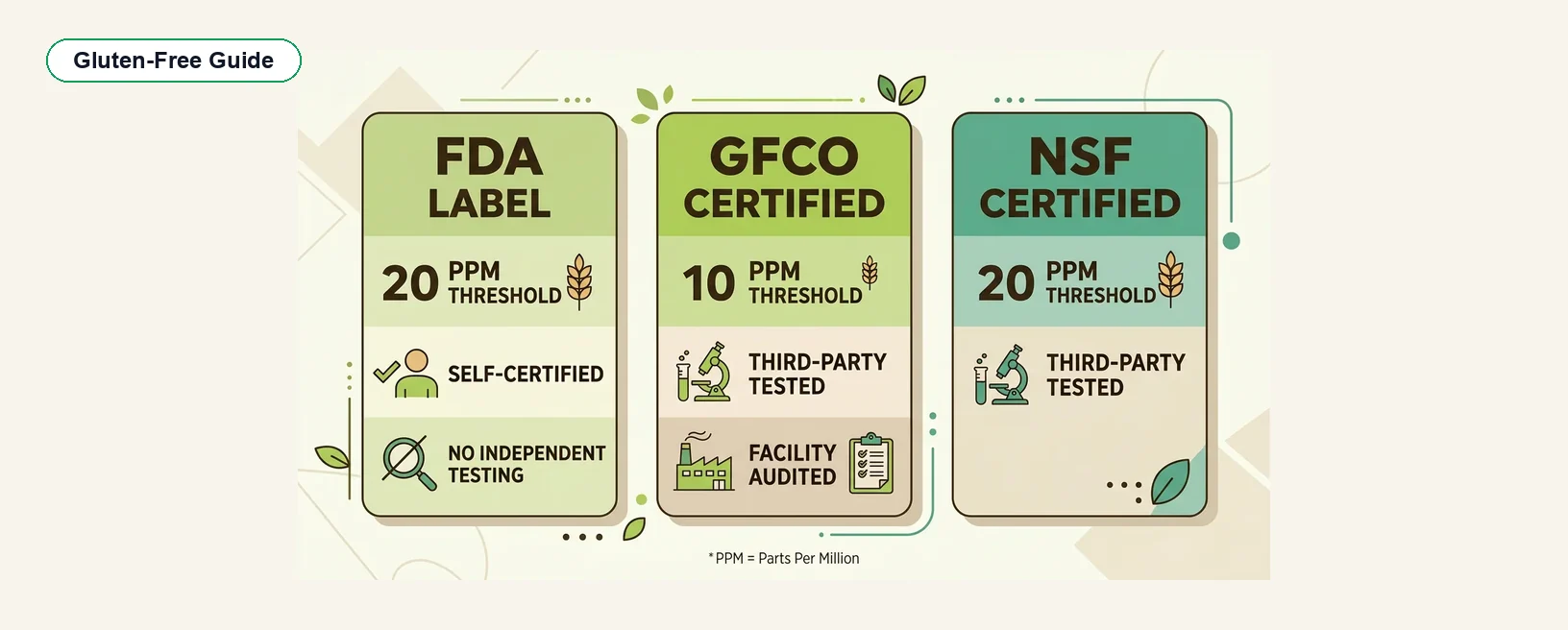
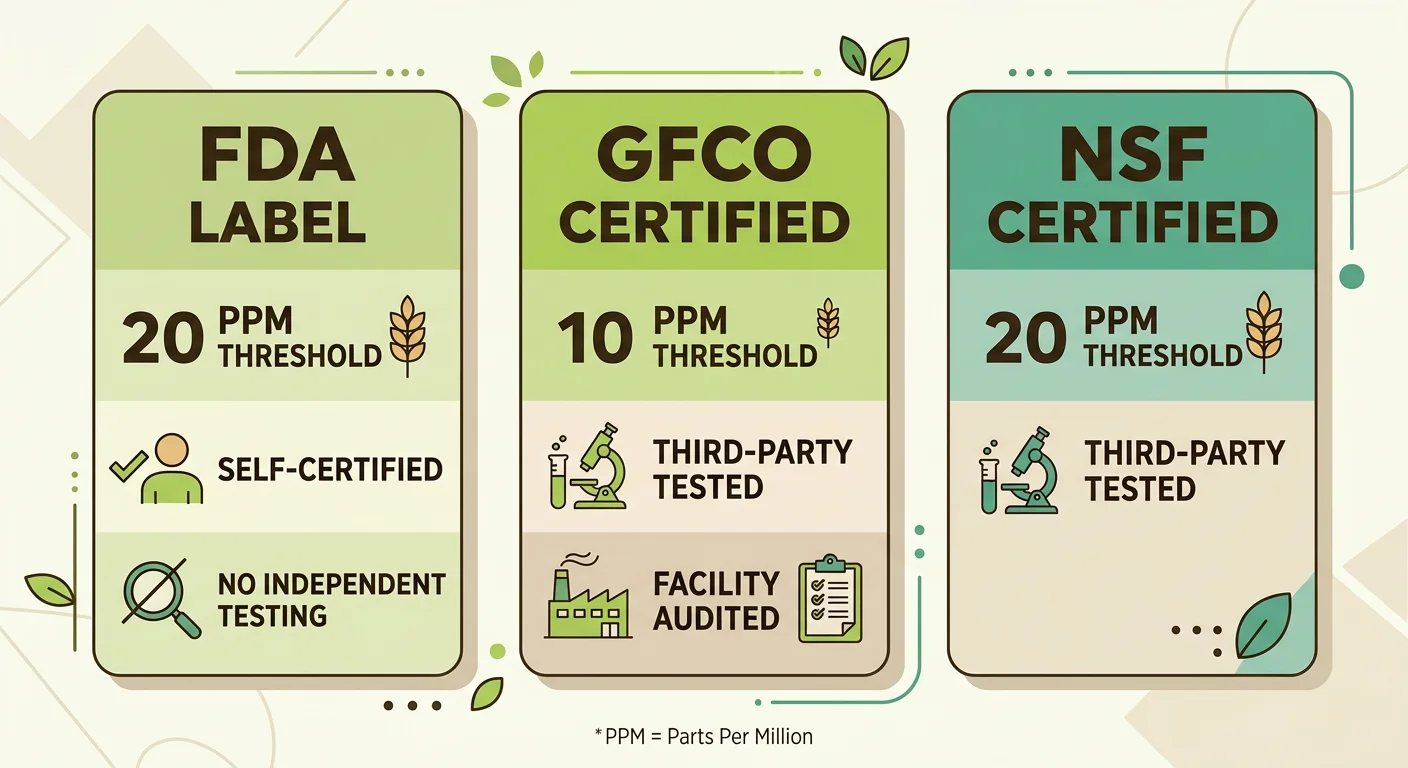
What it means: Under FDA regulations (21 CFR 101.91), any food labeled "gluten-free" must contain less than 20 parts per million (ppm) of gluten. This threshold is backed by scientific evidence that most people with celiac disease can tolerate up to 20 ppm without triggering intestinal damage. The European Union holds the same standard under Commission Regulation No. 828/2014.

What it doesn't mean: The label is voluntary. Manufacturers choose whether to use it, but if they do, they must comply. Critically, manufacturers are not required to test their products before slapping on that label. A "gluten-free" claim without a third-party certification logo is self-certified — which means you're taking the company's word for it.

The allergen statement gap: Here's the legal blind spot most shoppers don't know about. The FDA requires wheat to be declared in allergen statements. But barley, rye, and oats? Not required. A product could contain barley malt extract and never trigger a wheat allergen warning. That's why you can't rely on the allergen box alone — you have to read the full ingredient list.

2026 update: In January 2026, the FDA initiated a Request for Information seeking public input on how often barley and rye appear on food labels — and on gluten content in oats due to widespread cross-contamination. This is described by the agency as "a first step to improve transparency in disclosures of ingredients that impact certain health conditions," with potential regulatory action to follow. It's a welcome development, but it means the rules aren't changing yet.

Third-Party Certification: Your Best Friend

Third-Party Certification: Your Best Friend

Because manufacturer self-certification isn't independently verified, third-party certification marks carry real weight.

The most rigorous and widely recognized in the US is the GFCO (Gluten-Free Certification Organization) mark. Where the FDA requires products to test below 20 ppm, GFCO certifies products that test below 10 ppm — twice as strict. Certified products must also meet sourcing and manufacturing process standards, not just finished product testing.

Other recognized certifiers include:

  • NSF International — offers ANSI-accredited gluten-free certification
  • Celiac Support Association (CSA) — one of the oldest certifiers in the US
  • AOECS (Association of European Coeliac Societies) — the EU equivalent, with its Crossed Grain trademark

Practical rule: When choosing between two similar products, always prefer the one with a recognized third-party certification mark. It means an independent body has audited the facilities and tested the product — not just taken the manufacturer's word for it.

Hidden Gluten: The Ingredients That Trip People Up

Reading labels fluently is the single most important skill for a gluten-free shopper. Gluten doesn't always announce itself as "wheat" — it hides in ingredient names that sound harmless.

Watch out for these red flags:

  • Malt, malt flavoring, malt vinegar, malt syrup — all derived from barley. Commonly found in cereals, rice crisps, chips, and flavored beverages. This is one of the most frequent hidden sources.
  • Soy sauce and teriyaki sauce — traditional soy sauce is fermented with wheat. Look for tamari (often GF) or products specifically labeled "gluten-free soy sauce."
  • Modified food starch — usually corn-derived in the US, but not always. It's only safe if wheat is absent from the allergen statement.
  • Natural flavoring — a catch-all category that may include barley malt extract. Manufacturers aren't required to break this down further.
  • Canned soups and broths — many use wheat-based thickeners or flavoring.
  • Oats — oats are inherently gluten-free, but they're almost always grown and processed alongside wheat, barley, and rye. Unless the label says "certified gluten-free oats," assume cross-contamination.
  • Processed meats — hot dogs, sausages, and deli meats may contain wheat-based fillers or binders.
  • Condiments and sauces — BBQ sauce, ketchup, salad dressings, and marinades are frequent offenders.

Descriptor words that signal risk: "fried," "crispy," "coated," "breaded," or "crusted" — these usually mean the product was dusted with flour or dredged in a batter.

One critical rule: never assume. A product you've safely eaten for years may have been reformulated without notice. Manufacturers change recipes, change suppliers, and change manufacturing lines — none of which requires them to alert you.

Navigating the Store Safely

The store itself presents cross-contamination risks that go beyond what's in the package.

High-risk zones to approach with caution:

Bulk bins are the highest-risk area in any grocery store. Shared scoops carry gluten particles between bins — a scoop that just touched wheat flour can deposit traces into the bin of certified gluten-free oats next to it. Avoid bulk bins entirely. The convenience isn't worth the risk.

Deli counters use shared slicers, shared surfaces, and shared gloves. Cross-contamination is common. If you need deli meat, ask staff to change gloves before handling your order — and consider whether the products themselves contain gluten-based fillers.

Hot bars and salad bars present similar hazards: shared serving spoons, shared prep surfaces, and items prepared in proximity to gluten-containing foods. Unless you can verify that items were prepared in a dedicated gluten-free environment, avoid them.

Pre-packaged products from the perimeter — fresh produce, plain meats, eggs, and plain dairy — are generally your safest choices. They're naturally gluten-free, and when buying unprocessed foods you bypass the entire label-reading challenge.

Apps and Tech Tools for 2026

Apps and Tech Tools for 2026

One of the most significant changes for gluten-free shoppers in recent years is the maturation of barcode-scanning apps. Instead of memorizing ingredient lists or second-guessing every label, you can now scan a product in-store and get an instant answer.

Top apps to know in 2026:

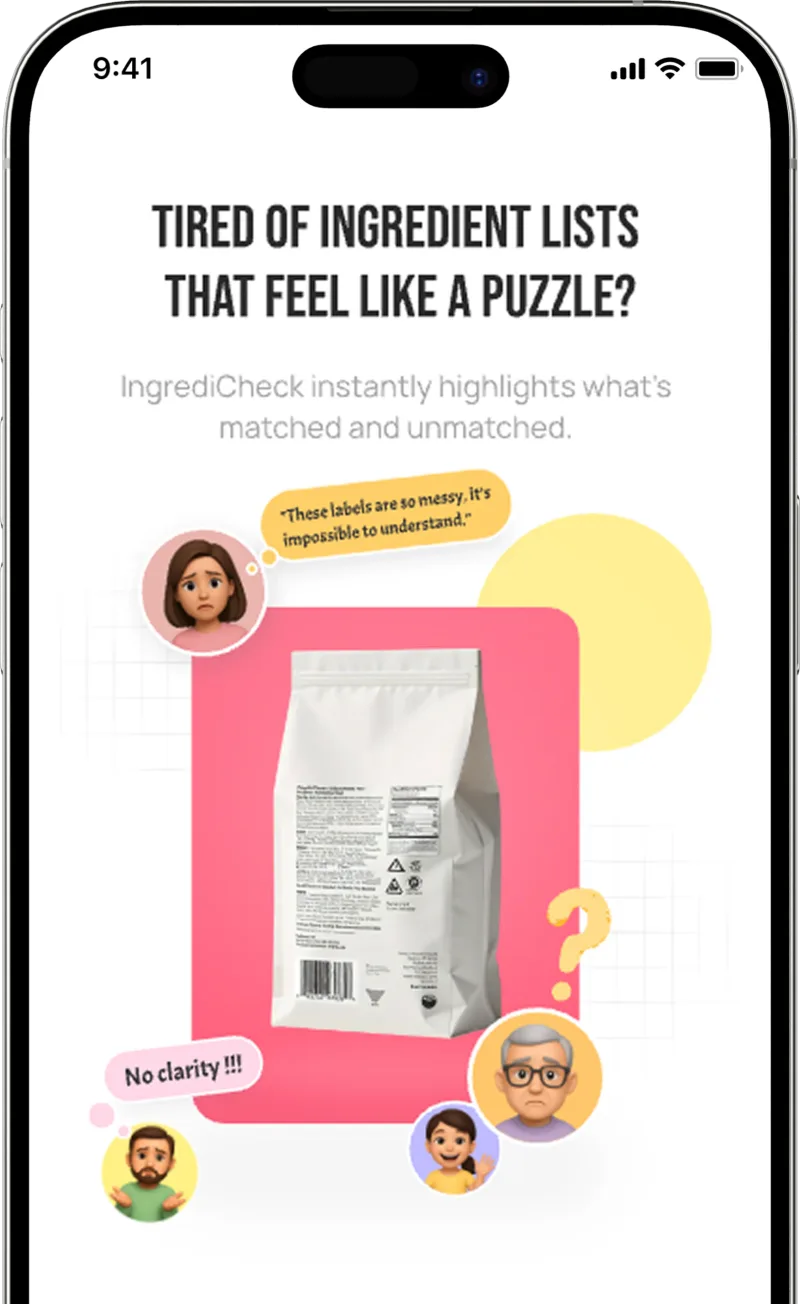
  • IngrediCheck (top pick) — goes beyond a simple gluten flag. IngrediCheck analyzes the full ingredient list against your personal dietary profile, so it catches hidden gluten sources like malt, barley derivatives, and ambiguous "natural flavoring" — not just products labeled as containing wheat. It covers 3M+ products and tailors every scan to your specific combination of dietary needs, making it the most relevant tool for anyone managing multiple restrictions alongside a gluten-free requirement.
  • Gluten Free Scanner — one of the largest dedicated GF databases (3M+ products), works offline, no registration required
  • Fig — tracks hundreds of dietary needs and allergens; free for 5 scans/month, with a subscription for unlimited scans
  • ShopWell — 400K+ products with personalized dietary recommendations
  • Spoonful — specifically designed for gluten sensitivity, with ingredient-level analysis

Beyond apps, the Nima Sensor remains one of the only portable physical testing devices. It uses a food sample and antibody-based chemistry to detect gluten — useful in restaurants where you can't verify kitchen practices.

What's coming: AI-powered label readers that analyze the ingredient list from a photo (no barcode needed) are emerging in 2026. These are particularly useful for store-brand products that may not appear in standard barcode databases.

Common Mistakes That Undermine a Gluten-Free Diet

Even experienced GF shoppers fall into these traps:

1. Trusting the "gluten-free" label without checking for certification. As we've covered, self-certified labels aren't independently tested. The certification mark matters.

2. Assuming naturally GF products are always safe. Plain rice, plain oats, and plain nuts can all be cross-contaminated in facilities that also process wheat. Look for "processed in a dedicated gluten-free facility" language, or stick to certified brands.

3. Over-relying on processed GF substitutes. GF bread, cookies, and pasta are widely available — but many are made with refined starches (white rice flour, tapioca starch, potato starch) that are low in fiber and nutrients. The Mayo Clinic notes that people switching to a GF diet often see a drop in fiber, iron, folate, and B vitamins because wheat-based products are typically fortified. Compensate intentionally with naturally GF whole foods: legumes, quinoa, buckwheat, amaranth, nuts, seeds, and plenty of vegetables.

4. Not re-reading labels regularly. Manufacturers reformulate products without announcement. A product that was safe last year may not be safe today. Make a habit of scanning or reading labels on every shopping trip, even for products you've bought before.

5. Getting tested after going gluten-free. If you suspect celiac disease and haven't been tested, go to your doctor before eliminating gluten. Celiac blood tests (tTG-IgA) and biopsies require active gluten consumption to detect the autoimmune response. Once you go gluten-free, testing becomes unreliable.

Putting It All Together: A Practical Checklist

Putting It All Together: A Practical Checklist

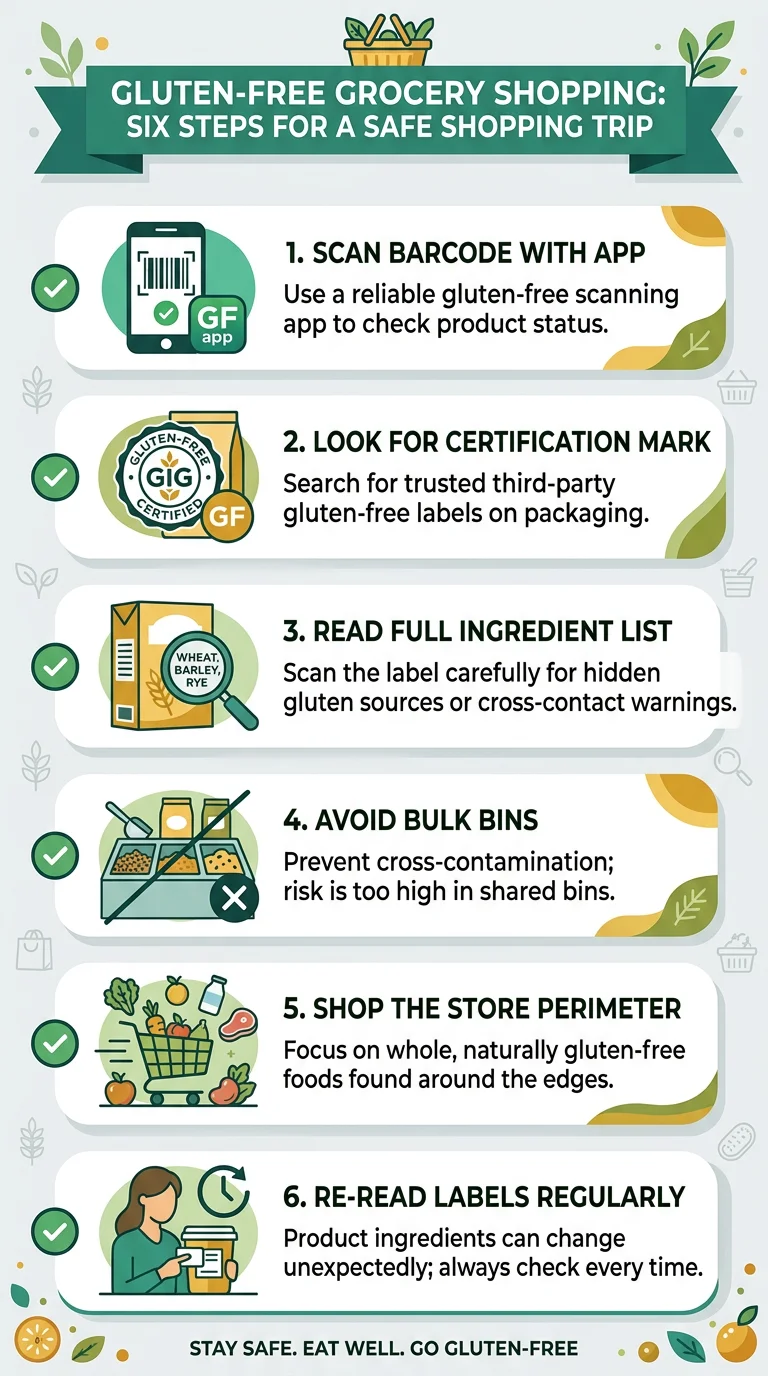
Here's a simple in-store framework you can apply on every shopping trip:

  1. Scan first, read second. Use a barcode app to flag products instantly, then read the full ingredient list to confirm.
  2. Check for the certification mark. GFCO, NSF, or CSA marks indicate third-party testing to stricter standards.
  3. Read the full ingredient list — not just the allergen statement. Look for malt, barley, rye, oats (unless certified GF), and modified food starch with wheat.
  4. Skip the bulk bins and hot bar entirely.
  5. Prioritize the perimeter. Fresh produce, plain proteins, and plain dairy require no label analysis.
  6. Set a label re-read reminder for products you buy on autopilot. Formulations change.

The Regulatory Landscape Is Moving — Slowly

If you've been frustrated by labeling gaps — particularly the fact that barley and rye don't have to appear in allergen statements — 2026 brings some cautious optimism. The FDA's January 2026 Request for Information on barley, rye, and oat disclosure signals awareness at the regulatory level that the current system has gaps for celiac consumers. Whether that leads to binding rule changes remains to be seen, but the conversation is moving.

In the EU, the framework is more explicit: all gluten-containing grains and their derivatives must be declared under Regulation (EU) No 1169/2011, which closes the barley/rye gap that still exists in US law. If you're shopping in Europe, allergen statements are more comprehensive.

How IngrediCheck Makes Gluten-Free Shopping Easier

Navigating gluten-free grocery shopping requires vigilance at every step — and that's exactly where IngrediCheck helps. By scanning a product's barcode, IngrediCheck instantly analyzes the full ingredient list and flags any gluten-containing ingredients, including hidden sources like malt, barley derivatives, and wheat starch. Whether you're trying to catch an ambiguous "natural flavoring" or confirm that oats in a product are certified gluten-free, IngrediCheck takes the guesswork out of the ingredient list so you can shop with confidence rather than anxiety.

Start making confident food choices today!

Scan food and understand what's right for you and your family, with AI.

IngrediCheck app