Label Reading Guides

Cottage Food Labels and Major Allergens: What to Check

Cottage food labels can look informal, but allergen information still matters. Learn how state rules, FDA Big 9 allergens, and retail label checks fit together.

Apr 30, 2026|10 min read
Cottage Food Labels and Major Allergens: What to Check

A wrapped brownie at a school fundraiser, a jam jar at a farmers market, and a bag of cookies from a home baker can all look less formal than the packaged foods you buy at a grocery store. That does not make the label unimportant. For families managing food allergies, the cottage food label may be the only written clue between "probably fine" and "needs a direct question before buying."

The tricky part is that cottage food is not one national category with one national label rule. It is usually governed by state cottage-food laws, local registration systems, approved food lists, and required disclosure language. The federal packaged-food allergen baseline still matters, but shoppers should not assume that every home-kitchen product follows the same process as a retail package with a barcode.

That is the practical question this guide answers: what should you check on a cottage food label, how do the major allergen rules fit in, and where does retail barcode scanning still help?

First, Separate Retail Packaged Food From Cottage Food

The FDA explains that it regulates foods introduced into interstate commerce, while many retail food establishments, farmers markets, and home-based businesses are regulated by state and local government. The FDA also notes that a private residence is not a food facility required to register with FDA under federal facility-registration rules when it meets the customary expectations for a private home.

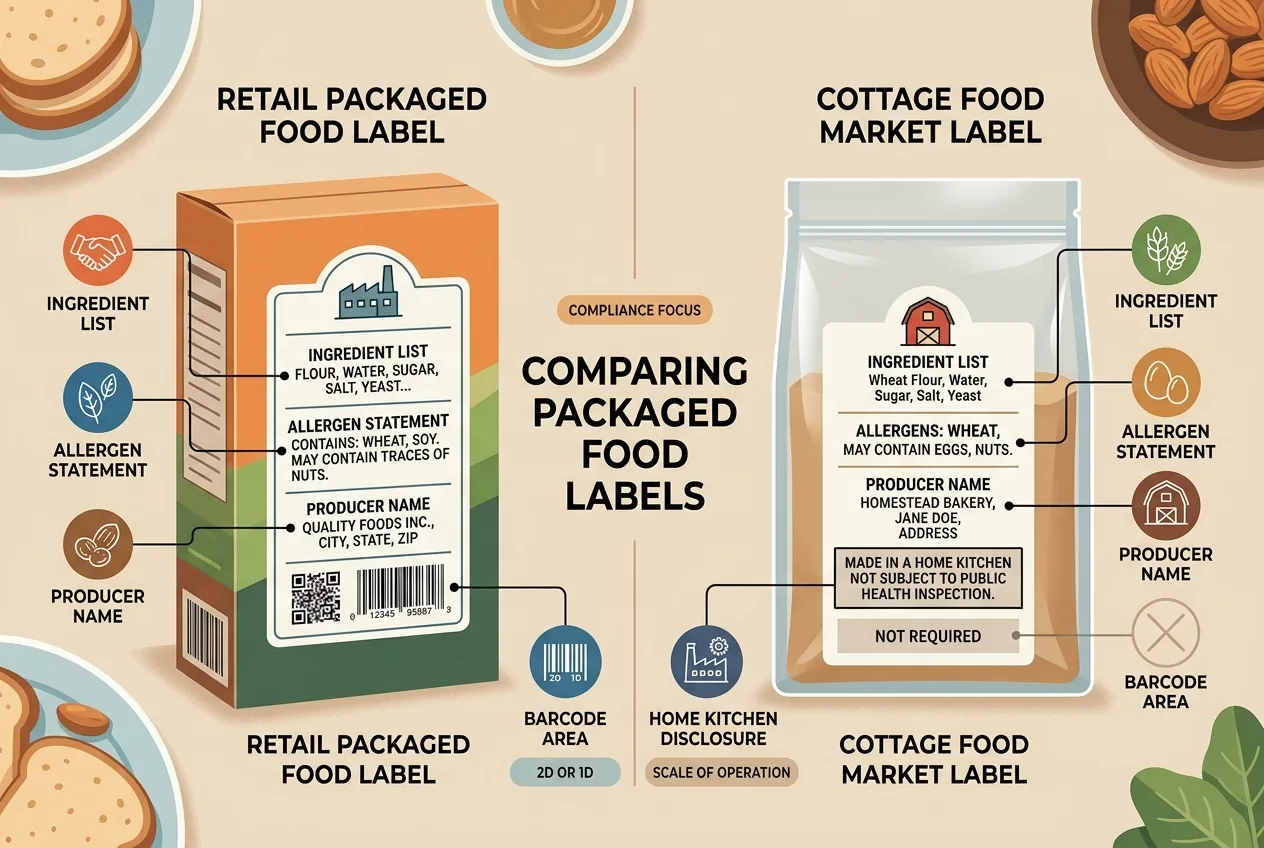
That distinction is why cottage food rules vary so much. A muffin sold by a home baker under a state cottage food law is not the same regulatory situation as a muffin box sold nationally in grocery stores. Both labels may list ingredients. Both may mention allergens. But the enforcement structure, permitted foods, sales channels, and required disclosures can differ by state.

If you have heard a rule framed as "the 11 major allergens must be listed," treat that as something to verify against the exact state or program you are discussing. At the federal retail packaged-food level, the current U.S. major allergen baseline is the Big 9, not 11.

The Federal Baseline Is the Big 9

The Federal Baseline Is the Big 9

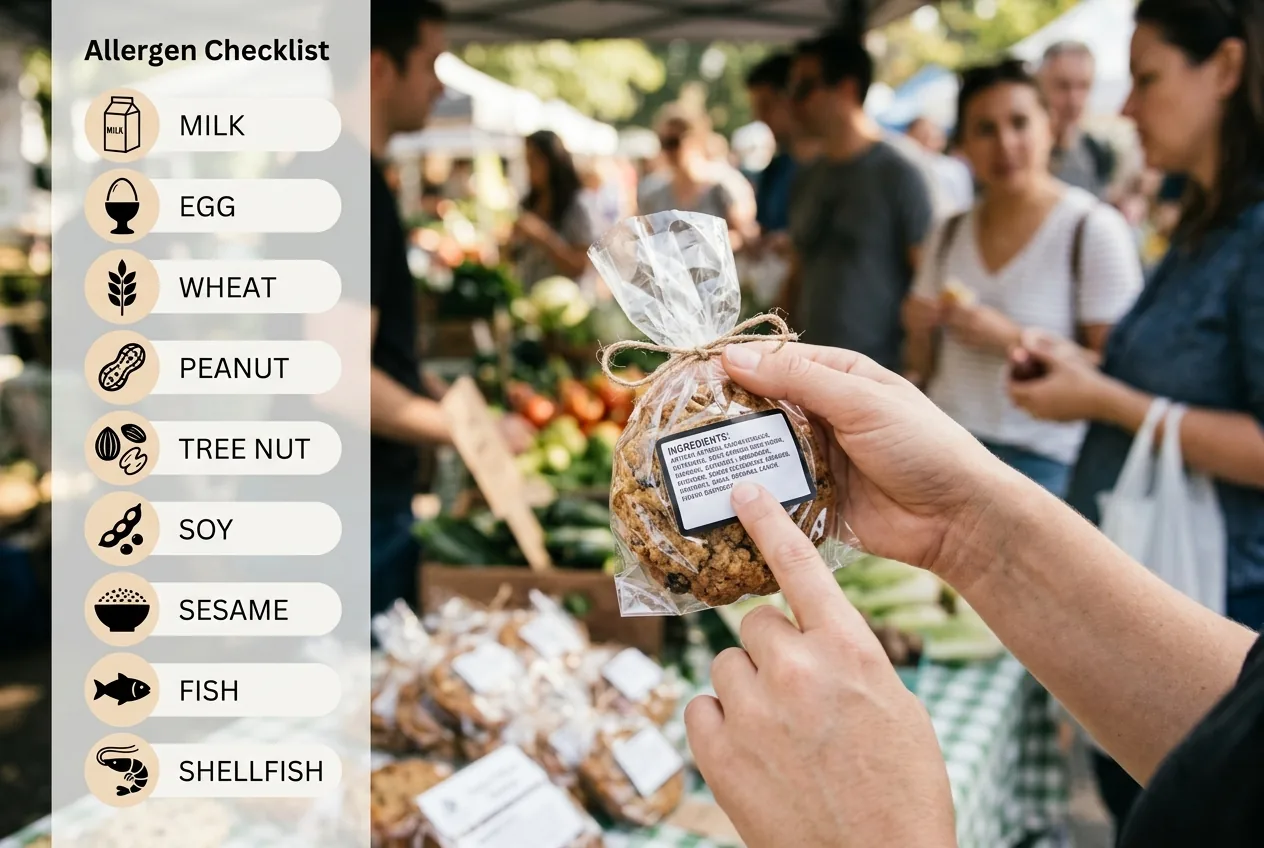
For FDA-regulated packaged foods, U.S. law identifies nine major food allergens. The FDA lists them as milk, eggs, fish, crustacean shellfish, tree nuts, peanuts, wheat, soybeans, and sesame. Sesame became the ninth major food allergen under the FASTER Act, with allergen labeling requirements taking effect on January 1, 2023.

That matters for cottage food shopping because many state programs mirror or reference the same allergen framework, even when the cottage food program itself is administered locally. If a home-baked cookie contains butter, egg, wheat flour, walnuts, soy lecithin, or sesame seeds, those ingredients are not minor details for an allergic shopper. They are the center of the decision.

It also matters because allergen labels do not answer every risk question. The FDA says advisory statements such as "may contain" or "produced in a facility that also uses" are not required by law and should not be used as a substitute for good manufacturing practices. That point is important for grocery-store packaged foods, and it is just as practical at a market table. A label can identify an ingredient without fully answering how a small kitchen handles shared equipment, flour dust, nut storage, or batch-to-batch variation.

What State Cottage Food Rules Commonly Ask For

State cottage food programs do not all use identical wording, but the pattern is clear: the label usually needs to tell the buyer what the product is, who made it, what ingredients it contains, and whether important allergens are present.

Texas, for example, says a cottage food label must include legible writing, the name of the cottage food production operation, an address or unique identification number in place of address, the common or usual name of the product, major allergen ingredients when present, and a disclosure that the product was produced in a private residence not subject to governmental licensing or inspection.

New York's home processing page says labels are required to include the common or usual product name, ingredient list in predominance by weight, net quantity, processor name, and full address. It also says allergens including eggs, milk, fish, shellfish, soybeans, peanuts, tree nuts, wheat, and sesame must be clearly identified in the product ingredient statement. New York also recommends home-kitchen wording such as "Made at Home" or "Made in a Home Kitchen."

Illinois describes cottage food operations as home-based food businesses that sell directly to consumers and says cottage food products generally must be packaged and labeled with ingredients and allergens. California says cottage food operators may prepare and package certain non-potentially hazardous foods in a private home kitchen, and that operators must follow label requirements compliant with state and federal requirements while registering or obtaining permits through local environmental health departments. Washington tells operators to make sure each label accurately reflects the ingredients used in each batch and points producers to guidance on ingredient statements and allergen declarations.

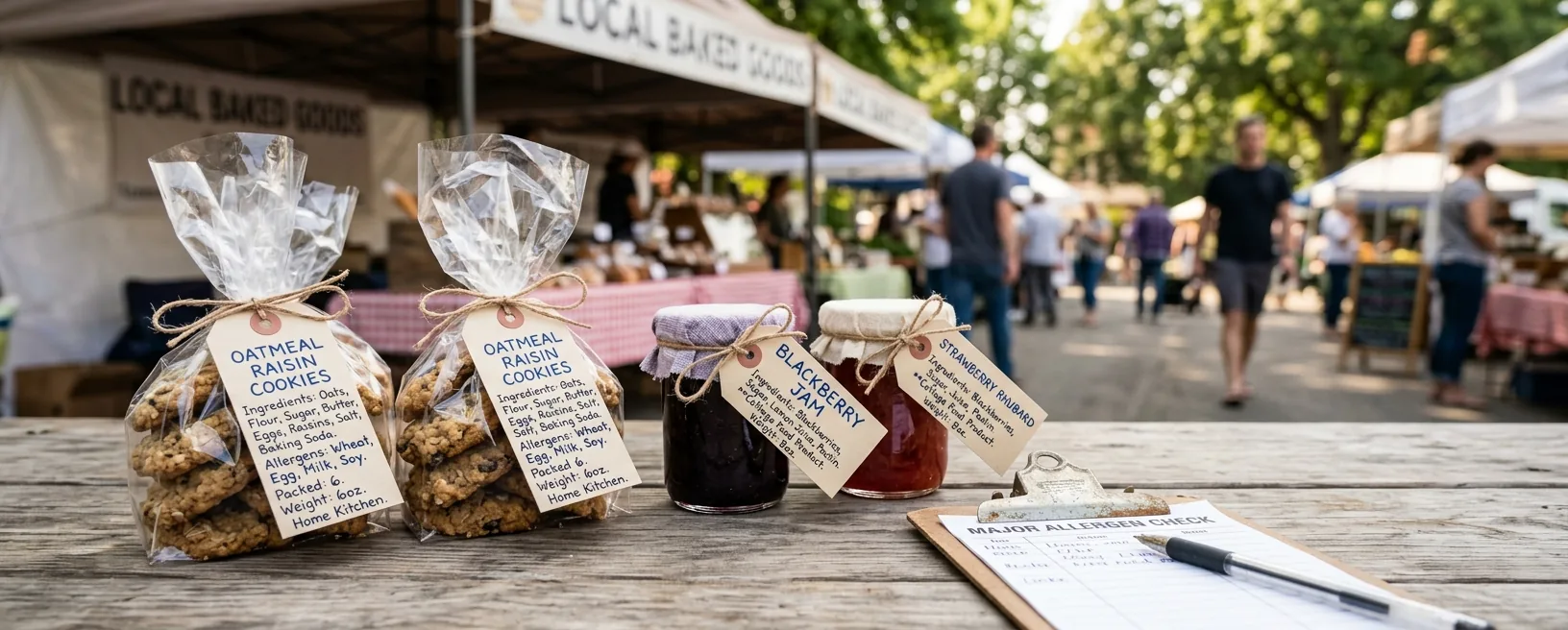
Those examples do not create one universal national checklist. They do show what shoppers should expect from a serious cottage food label: a product name, a real ingredient list, allergen clarity, producer identification, and some version of home-kitchen or cottage-food disclosure where the state requires it.
The Market-Table Questions Labels Do Not Always Answer

The Market-Table Questions Labels Do Not Always Answer

Cottage food labels can be helpful and still incomplete for a specific household's threshold. A package may list wheat, milk, and eggs clearly, but still leave you wondering about shared bowls, shared baking sheets, nut storage, sesame-containing toppings, or whether the same recipe changes from one batch to the next.

That is not a reason to treat every home-baked product as unsafe. It is a reason to slow down and ask better questions.

The questions that matter most are practical:

  • Was this made in the same kitchen as peanuts, tree nuts, sesame, or shellfish?
  • Are the ingredient brands the same every week?
  • Did the recipe change from the last batch?
  • Are decorations, fillings, glazes, sprinkles, or toppings included in the ingredient list?
  • Is the product packaged, or is label information only available on a sign, receipt, invoice, or menu card?
  • Does the seller understand the difference between "contains" ingredients and cross-contact?
  • Is the product sold under a cottage-food exemption, a retail food permit, or another local approval?

For buyers, the point is not to become a regulator in the aisle. The point is to recognize when a label has enough information for your household and when it does not.

A Shopper's Cottage Food Allergen Checklist

Use this checklist when you are buying home-produced or small-batch foods from a market, school event, fundraiser, roadside stand, or direct seller.

  1. Find the ingredient list first. If there is no ingredient list on the package, look for a sign, card, invoice, or receipt. If none exists, ask before buying.
  1. Look for the Big 9 allergens by name. Check for milk, eggs, fish, crustacean shellfish, tree nuts, peanuts, wheat, soybeans, and sesame. Remember that these can appear inside compound ingredients such as chocolate chips, icing, spice blends, tahini, nut extracts, or enriched flour.
  1. Check whether allergens are repeated clearly. A separate "Contains" statement is useful, but the ingredient list still matters. Do not rely only on front-label claims such as "homemade," "natural," or "farm fresh."
  1. Ask about shared equipment when your household needs that level of caution. A cottage food label may not answer cross-contact questions. Ask whether the product was made with shared bowls, pans, mixers, cutting boards, fryers, storage bins, or decorating tools.
  1. Confirm batch consistency. Small producers may change suppliers, substitute ingredients, or use seasonal add-ins. That is normal for small-batch food, but it means last month's answer may not apply to today's package.
  1. Look for required state disclosures. Many states require wording that tells buyers the product was made in a home kitchen or private residence. That disclosure helps you understand the regulatory context.
  1. Use extra caution with unpackaged foods. If a cake slice, cookie, or bread is sold without individual packaging, the label information may live elsewhere. Do not assume the absence of a label means absence of allergens.

What Home Producers Should Not Assume

For home cooks and micro-producers, the safest editorial summary is simple: do not guess. Check your state's cottage food page, your local health department, and any product-specific guidance before selling.

The differences can be meaningful. Some states require registration. Some distinguish direct sales from indirect sales through stores or restaurants. Some restrict which foods can be sold. Some require a home-kitchen disclosure. Some allow certain non-potentially hazardous foods but prohibit refrigerated fillings, meat products, low-acid canned foods, or other higher-risk categories.

Allergen labeling is only one part of that system. A good cottage food label is not just a courtesy to buyers. It is a trust signal. It tells shoppers that you know what went into the food, that you understand which ingredients matter for allergy decisions, and that you are not asking the buyer to rely on memory or verbal explanation alone.

Where Retail Barcode Scanning Still Helps

IngrediCheck is built for packaged retail foods, not for certifying a farmers market cookie or auditing a private kitchen. That boundary matters. A barcode scan can help with grocery-store products because there is a packaged item, a label, and usually a product record to compare against saved food rules.

Cottage food is different. Many products do not have a retail barcode. Some are labeled by hand. Some are sold from a table, a local pickup, a fundraiser, or a direct order. In those cases, the best workflow is still human label review and direct questions to the producer.

But the same label-reading habits transfer. If you use an ingredient checker app for retail packages, you are training the same skill you need at a market table: look for the ingredient list, identify the allergen signals, understand where the label stops, and slow down when the product needs a second look. For families managing allergy rules, the food allergy scanner app guide is the retail-package version of this workflow. For broader label literacy, compare this with how to understand food labels quickly and the guide to hidden ingredients labels do not always explain directly.

The line is clear: use cottage food labels and direct producer questions for home-kitchen products. Use retail barcode and ingredient-label scanning for grocery-store packaged foods. Both workflows depend on the same discipline of reading what is actually on the label.

Make the Label Do Real Work

A cottage food label should not be treated as decoration. For allergy-aware households, it is the first evidence trail: what the food is, what it contains, who made it, and what still needs a question. When the product is a retail packaged food instead, IngrediCheck helps you scan the barcode or ingredient label and compare that product against the food rules your household already saved, so the same careful label-reading habit becomes faster and more consistent.

Get the app for clearer label decisions.

Scan labels, see what fits your food notes, and read the why in plain English.

IngrediCheck app