Hidden Ingredients: 5 Sneaky Things Food Labels Don't Tell You

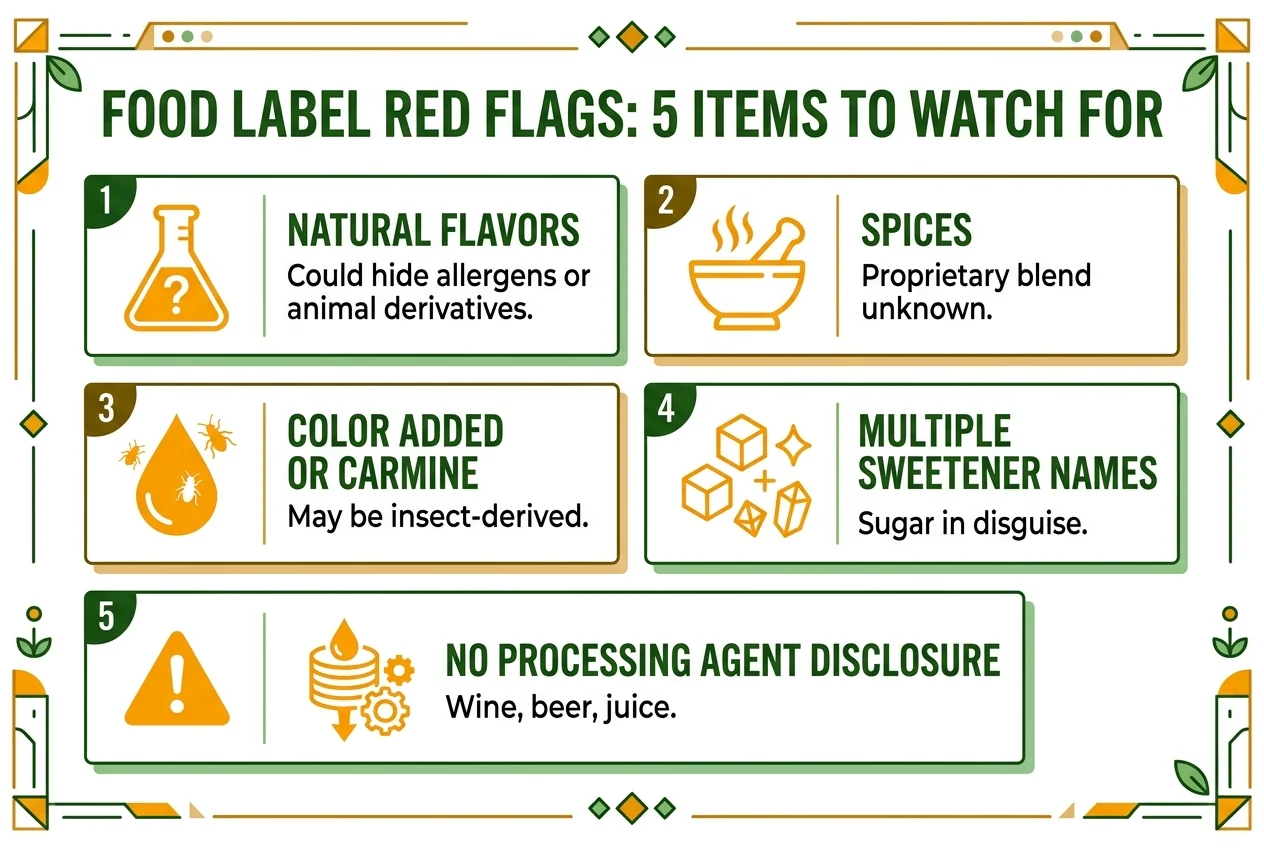
Think food labels tell you everything? Five types of ingredients routinely hide behind vague terms like 'natural flavors' and 'spices'. Here's what to watch for.

Mar 19, 2026|9 min read
Hidden Ingredients: 5 Sneaky Things Food Labels Don't Tell You

Food labeling law in the United States is built on a simple idea: consumers have the right to know what they're eating. Every packaged food must carry an ingredient list. It sounds comprehensive. It isn't.

Federal regulations contain a number of legal exemptions that allow manufacturers to describe dozens — sometimes hundreds — of individual substances using a single vague term. The result is that certain categories of ingredients routinely hide in plain sight on food labels, shielded by terminology that tells you something is there without telling you what it actually is.

This isn't necessarily malicious. Much of it reflects outdated regulatory language written before modern food processing existed. Some of it reflects trade secrecy protections for proprietary formulas. But regardless of the reason, the effect is the same: the label you're reading often leaves out information that would matter to you.

Here are five of the most common categories where this happens — and what to actually look for.

1. "Natural Flavors" — A Legal Black Box

1. "Natural Flavors" — A Legal Black Box

"Natural flavors" is the fourth most common ingredient listed on packaged food in the United States. It appears in everything from breakfast cereals to sparkling water to baby food. And it tells you almost nothing.

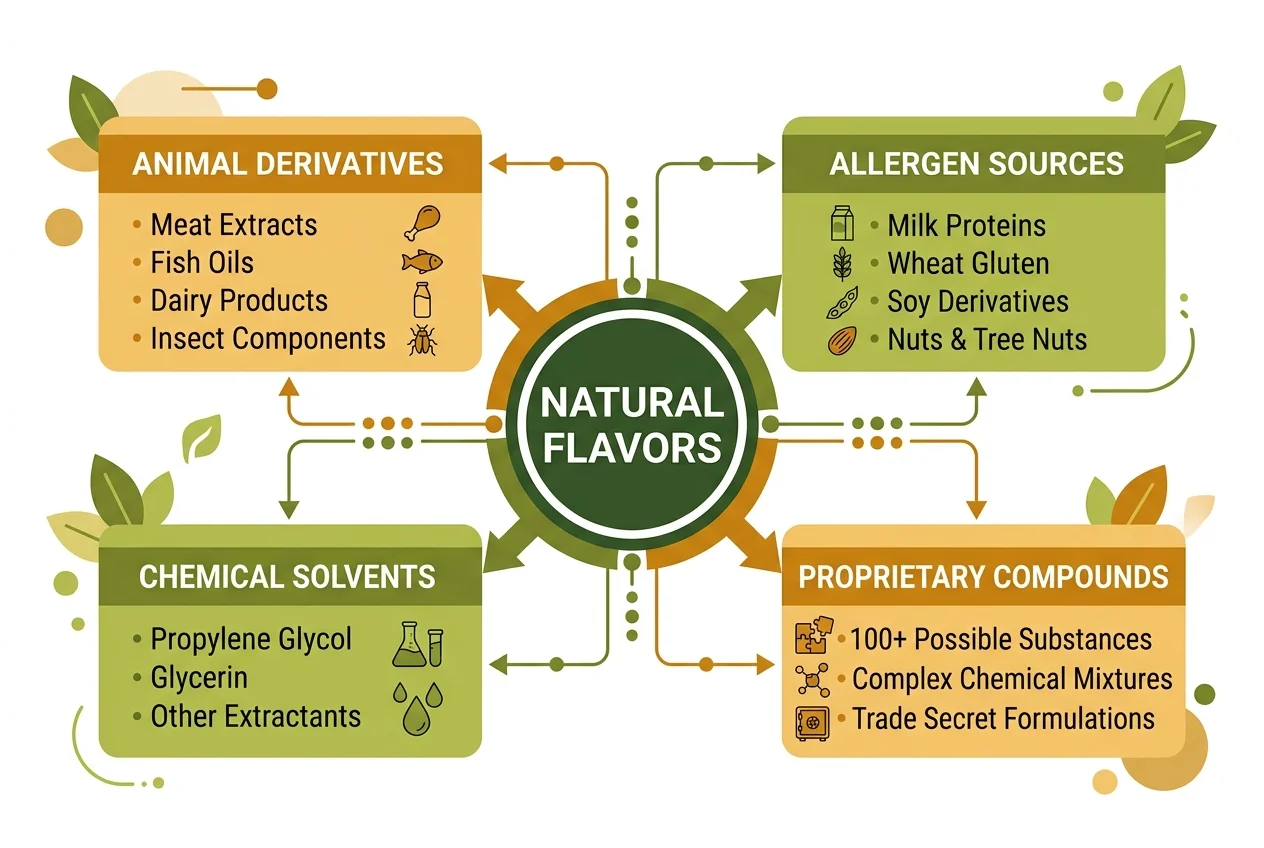
The FDA defines a natural flavor as any flavoring substance derived from a plant or animal source — fruit, vegetables, herbs, spices, meat, fish, seafood, dairy, or fermentation products. That sounds reasonable. The problem is what the definition leaves out: it places no limit on the number of individual substances a single "natural flavor" entry can conceal, and it doesn't require manufacturers to disclose what those substances are.

A single "natural flavors" entry can contain a complex blend of dozens of individual compounds. One food product can contain more than 100 individual flavor substances, all legally rolled into those two words. The FDA doesn't know which substances are being used — only the manufacturer and their flavor supplier do.

"The food industry hides ingredients behind vague terms like 'flavor' that don't tell consumers what they're actually consuming." — Center for Science in the Public Interest, 2024 Flavor Report

This matters for several reasons:

For people with allergies: Natural flavors can be derived from any of the major allergens — milk, eggs, wheat, peanuts, tree nuts, soy, fish, or shellfish — and do not have to identify the source. The FDA's allergen labeling rules technically require that allergens be declared even when they appear in flavors, but enforcement relies on manufacturers self-reporting, and errors occur.

For people avoiding animal products: Natural flavors can be derived from animal sources — including meat, fish, dairy, or insect derivatives — without any indication that they're animal-based. A product marketed to vegetarians may contain a natural flavor derived from beef or shrimp.

For people following religious dietary guidelines: Halal and kosher compliance depend on ingredient sourcing, which "natural flavors" does not disclose.

If knowing what you're eating matters to you, "natural flavors" is the most important three words to scrutinize on any label.
2. "Spices" — The Proprietary Recipe Shield

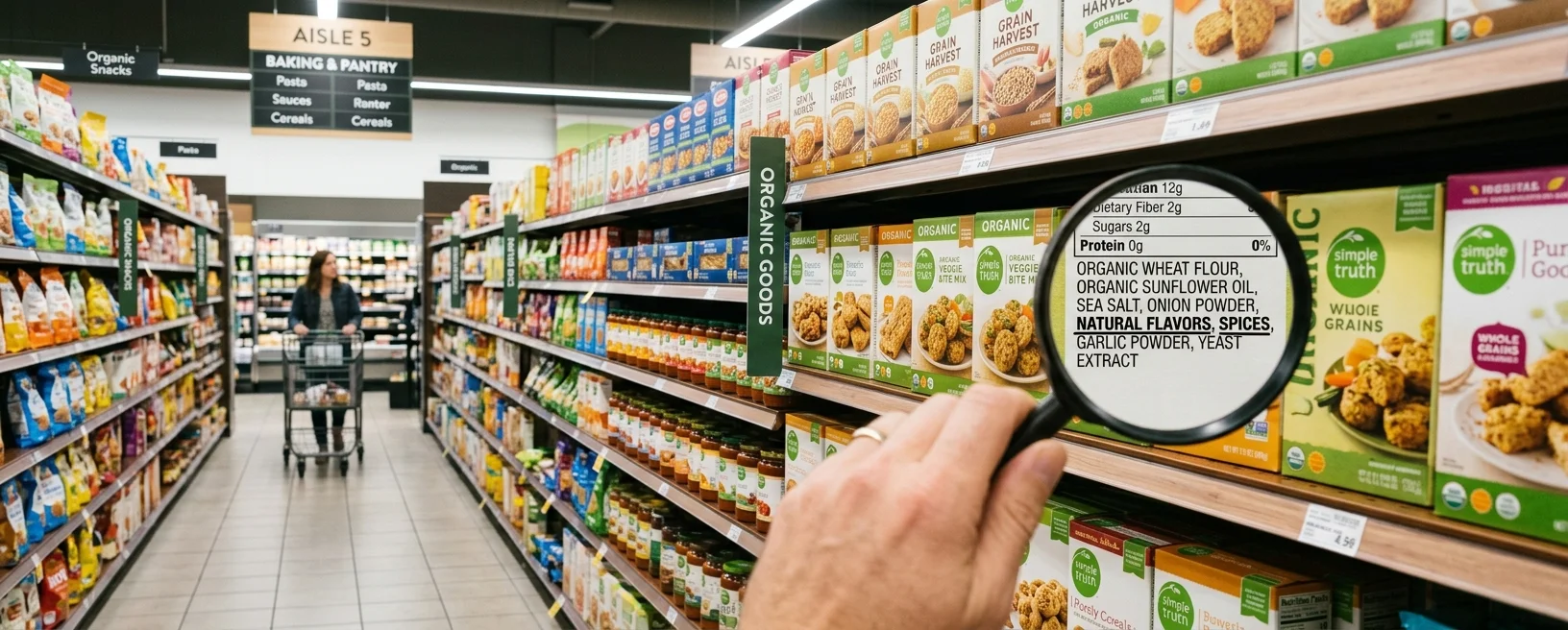
"Spices" is the sibling loophole to "natural flavors." Under 21 CFR § 101.22 — the FDA's food labeling regulations — manufacturers are permitted to declare spices collectively without naming each individual spice. The rationale is that spice blends are proprietary formulas and requiring full disclosure would effectively hand competitors a recipe.

The practical result: when you see "spices" on a label, you don't know if it contains pepper and cumin, or if it also contains paprika, mustard seed, fenugreek, or any of dozens of other possibilities.

For most consumers, this isn't a serious issue — a paprika-versus-pepper distinction rarely matters. But for specific groups, it matters considerably:

People with spice allergies: Spice allergies are notoriously underdiagnosed and difficult to manage precisely because spices are rarely individually identified on labels. Celery seed, mustard, and sesame — all of which can trigger allergic reactions — may all appear under "spices" without further identification. (Sesame was added as the ninth major allergen in the United States in 2023, requiring separate declaration, but this applies to sesame specifically — other spice allergens remain unprotected.)

People on low-FODMAP diets: Onion and garlic are among the highest-FODMAP foods — common triggers for people with IBS and other gastrointestinal conditions. But here's a critical FDA distinction: onion powder and garlic powder are classified as foods rather than spices under FDA regulations and therefore must be declared by name. However, the terms "spices" can still include other FODMAP-relevant ingredients like shallot or leek derivatives that don't have the same explicit carve-out.

People following sattvic, Jain, or certain religious diets: Many of these traditions exclude onion, garlic, and specific spices. Knowing only that a product contains "spices" is insufficient for compliance.

3. Carmine — The Insect-Derived Red Dye That Took Decades to Name

Carmine is a vivid red pigment derived from Dactylopius coccus, a scale insect that feeds on prickly pear cacti. To produce one pound of red dye, approximately 70,000 insects are harvested, dried, and crushed. The pigment — carminic acid — is chemically stable, heat-resistant, and produces a deep, reliable red that synthetic dyes struggle to replicate.

Carmine has been used in food, cosmetics, and textiles for centuries. What's relatively recent is the requirement to actually name it on food labels.

For years, carmine and its related form, cochineal extract, were allowed to hide under catchall terms like "artificial color" or "color added" on food labels — despite being derived from insects, not synthesized chemically. This caused repeated problems, particularly for:

  • Vegetarians and vegans, who were unknowingly consuming an insect-derived ingredient
  • People with certain religious dietary restrictions (carmine is considered non-halal and non-kosher by many authorities)
  • Consumers who experienced allergic reactions to carmine and couldn't identify the source

After years of advocacy — including documented cases of severe allergic reactions — the FDA issued a final rule in 2009 requiring that carmine and cochineal extract be declared by their specific names in ingredient lists, rather than hiding under generic color terms.

Today, you'll see it listed as "carmine," "cochineal extract," or the E-number E120 on products sold in the EU. You'll find it in yogurt, fruit juices, candy, maraschino cherries, processed meat products, and some beverages — anywhere that vivid red or pink coloring is needed.

The lesson isn't that carmine is dangerous (for most people, it isn't). The lesson is that it took the regulatory system decades to require basic transparency about what was in the food supply, and that transparency only came after sustained consumer pressure.

4. Sugar's Fifty Aliases

The average packaged food contains added sugar. That's not a secret. What is less obvious is how thoroughly that sugar can be fragmented, renamed, and redistributed across an ingredient list to minimize how significant it appears.

FDA regulations require ingredients to be listed in descending order by weight. A manufacturer who adds large amounts of a single sweetener will see it appear near the top of the list — potentially alarming to health-conscious consumers. A manufacturer who adds several smaller quantities of different sweeteners can spread sugar across the list, pushing each individual entry lower while the total added sugar content remains the same.

Sugar appears on labels under more than 50 different names, including:

  • Obvious variants: cane sugar, brown sugar, raw sugar, powdered sugar, beet sugar, coconut sugar
  • Syrup forms: high-fructose corn syrup, corn syrup, rice syrup, agave syrup, malt syrup, maple syrup, barley malt syrup, brown rice syrup
  • "-ose" sugars: dextrose, fructose, glucose, lactose, maltose, sucrose, galactose
  • Juice concentrates: apple juice concentrate, grape juice concentrate, date paste — these are functionally sugar but often carry a health halo
  • Less obvious: dehydrated cane juice, evaporated cane juice, molasses, treacle, muscovado, panela, rapadura

Since 2020, FDA regulations require a separate line for "Added Sugars" on the Nutrition Facts panel, which helps. But the ingredient list itself remains a place where sugar can be systematically obscured — multiple sweeteners, each individually small, each listed separately, collectively making up a significant proportion of the product.

The practical rule: count the number of sweetener-related entries in the ingredient list. A product listing brown rice syrup, cane sugar, and agave nectar has likely added more sugar than any single entry suggests.

5. Processing Agents That Never Appear on the Label at All

The previous four items at least appear on the label in some form — vague, but there. This fifth category is different: it describes substances that are used in food production and genuinely do not appear on the label, because they are classified as processing aids rather than ingredients.

Under FDA rules, processing aids are substances used during manufacturing that are removed before the finished product, or that remain only in insignificant quantities with no functional effect in the final food. Because they're not "in" the final product in a meaningful sense, they don't require declaration.

This creates some striking real-world examples:

Isinglass: A clarifying agent made from the dried swim bladders of fish, isinglass is widely used in beer and wine production to filter out yeast and sediment and produce a clearer final product. The isinglass itself is filtered out at the end of the process. The label on that beer or wine may say nothing about fish. For vegans, vegetarians, people with fish allergies, and observant Jews observing kosher requirements, this matters — and there's no way to know from the label alone.

Gelatin: Used as a fining agent in wine, juice, and some vinegars, gelatin is derived from animal collagen (typically pork or beef bones). Like isinglass, it's used during processing and filtered out, and typically doesn't appear on the label.

Casein: A milk protein sometimes used to clarify wine. Again, largely absent from labels.

Carryover ingredients: If an ingredient used to make a sub-ingredient was present below a certain threshold, it may not require declaration in the final product. A flavoring compound might contain a small amount of a known allergen; if the allergen concentration in the finished food is below the threshold, it may not appear on the label.

This category is particularly difficult to navigate because there's no label to read — you have to know which products typically use which processing agents, and then research whether specific brands use them.

The Bigger Picture: Regulatory Gaps and Consumer Advocacy

The Bigger Picture: Regulatory Gaps and Consumer Advocacy

The existence of these loopholes isn't a secret. Consumer advocacy organizations — particularly the Center for Science in the Public Interest — have documented them extensively, including in a 2024 report that found thousands of individual flavor substances currently in commercial use that have never been formally evaluated by the FDA for safety, hidden behind the terms "natural flavor," "artificial flavor," or "spices."

The GRAS (Generally Recognized as Safe) system allows manufacturers to self-certify that new ingredients are safe, without submitting that determination to FDA review. Because flavors are hidden inside opaque ingredient terms, neither the FDA nor the public can know which substances are being used — making independent safety verification effectively impossible.

Reform proposals exist. A bill being considered in New York would require companies selling food in the state to disclose all secret GRAS substances to state regulators — a potential model for federal reform. The FDA has also been examining allergen thresholds in 2025 and 2026, holding public meetings to gather input on whether stricter "may contain" labeling standards are needed.

But regulatory change moves slowly. In the meantime, the most practical defense is knowing what to look for.

What You Can Actually Do

No one expects consumers to memorize 50 names for sugar or maintain a mental database of which wines use fish-derived fining agents. But a few practical habits significantly improve your label-reading accuracy:

  1. Treat "natural flavors" as a question, not an answer. If you have an allergy, intolerance, or dietary restriction, contact the manufacturer to ask about flavor sourcing. Many will answer.
  1. Count sweetener entries. More than two sweetener-related entries in the ingredient list usually signals a product that's using name fragmentation to downplay its sugar content.
  1. Check for carmine by name if you're vegetarian, vegan, or avoiding insect-derived ingredients — it appears in far more products than most people expect.
  1. Research your alcohol. Beer and wine made without animal-based fining agents often label themselves "vegan-friendly" — look for this if animal derivatives are a concern.
  1. Be especially cautious with spice blends and seasonings. These products can contain onion, garlic, mustard, celery, and sesame derivatives that matter for allergy, intolerance, and dietary preference reasons — and "spices" tells you none of that.

The label is the beginning of the conversation, not the end of it. Understanding what it isn't telling you is as important as reading what it does.

IngrediCheck takes the guesswork out of hidden ingredients. Scan any packaged product and instantly surface what's inside — including common label obscurities like natural flavor sources, multiple sugar aliases, carmine, and spice-hidden allergens. Instead of decoding a 40-ingredient list while standing in a grocery aisle, IngrediCheck flags exactly the ingredients that matter for your specific dietary needs, so you always know what you're actually buying.

Start making confident food choices today!

Scan food and understand what's right for you and your family, with AI.

IngrediCheck app