DASH Diet Label Reading: Sodium, Potassium & Hidden Salt

Learn how to read food labels for the DASH diet: spot hidden sodium additives, find potassium, and identify which 'healthy' packaged foods are salt bombs.

Apr 8, 2026|10 min read
DASH Diet Label Reading: Sodium, Potassium & Hidden Salt

The DASH diet has an unusually strong track record. Since the landmark trial published in the New England Journal of Medicine in 1997, it has been tested in hundreds of studies and consistently lowers blood pressure in people who follow it. In 2025, U.S. News & World Report ranked it the best heart-healthy diet and the best diet for high blood pressure for the eighth consecutive year.

The problem is not the diet. The problem is the food supply.

The DASH eating plan was designed around whole foods: fruits, vegetables, low-fat dairy, whole grains, lean proteins. But most people also eat packaged food, and packaged food is where sodium hides. If you are trying to follow DASH while also buying jarred pasta sauce, deli turkey, canned soup, or store-bought salad dressing, you need to be able to read a label. Without that skill, you can eat what feels like a DASH-compliant diet while consuming two to three times the sodium target every day.

This guide covers exactly that: how sodium appears on labels, where it hides, how to find potassium, and which foods routinely catch people off guard.

This article is for informational purposes only and should not be considered medical advice. Consult a healthcare professional for personalized guidance.
What DASH Actually Requires

What DASH Actually Requires

DASH stands for Dietary Approaches to Stop Hypertension. It is a dietary pattern, not a single food rule. The NHLBI, which developed and funds DASH research, describes it as a flexible eating plan built around daily servings of fruits, vegetables, whole grains, low-fat dairy, and lean protein, with limits on red meat, sweets, and added fats.

Two numbers drive most of the blood pressure benefit: sodium down, potassium up.

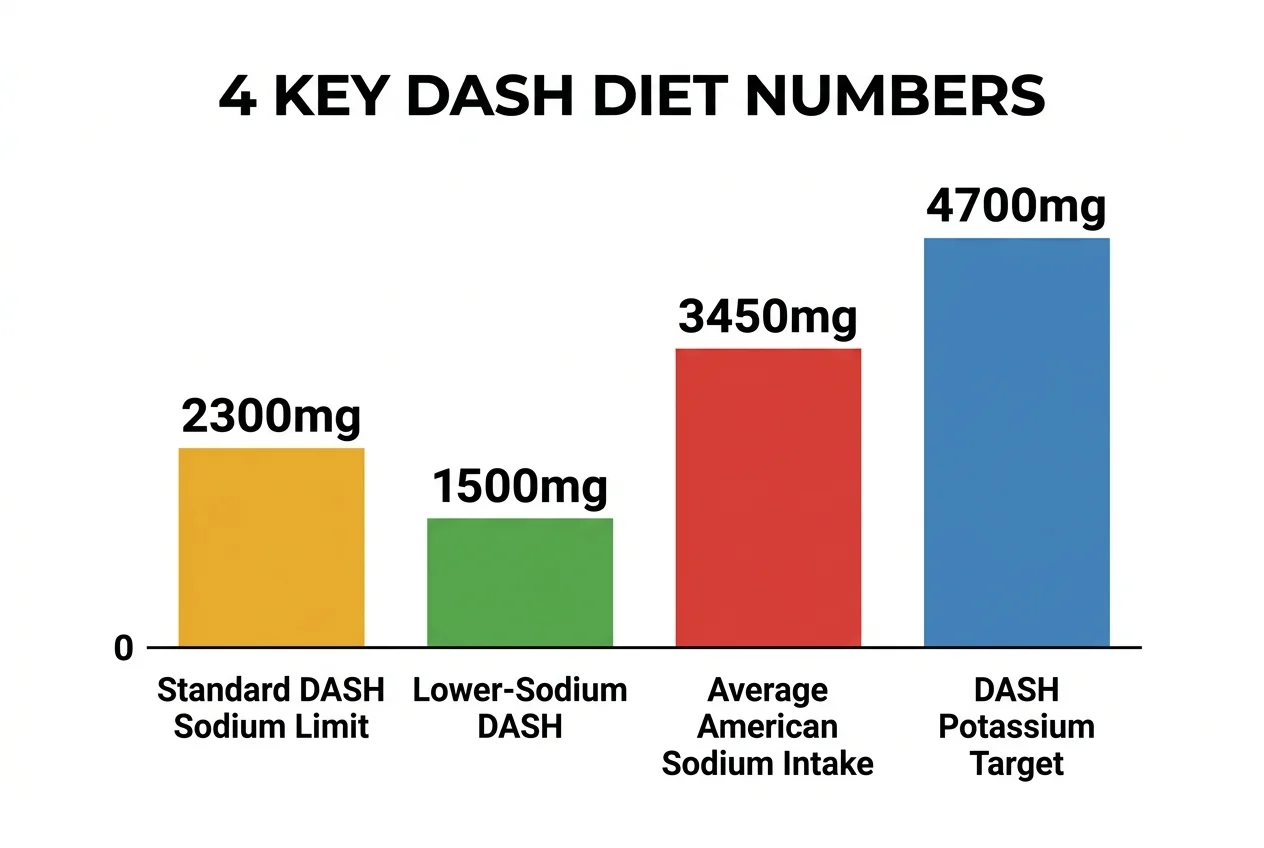
The standard DASH sodium target is 2,300 mg per day. The lower-sodium version — recommended for people with existing hypertension or those wanting stronger blood pressure reduction — brings that to 1,500 mg per day. The average American currently consumes around 3,450 mg daily. Getting from 3,450 to 1,500 mg is a significant change, and it cannot happen without reading labels.

On the potassium side, DASH targets 4,700 mg per day — which is also the FDA's Daily Value for potassium on food labels. The average American intake sits around 2,640 mg per day, well short of the goal.

The DASH-Sodium trial, published in the New England Journal of Medicine in 2001, found that combining DASH with a sodium reduction to 1,500 mg/day produced an 11.5 mmHg drop in systolic blood pressure in people with hypertension. That is a meaningful clinical result without any medication.

A 2025 study published in Preventing Chronic Disease added a practical data point: people who regularly use Nutrition Facts Labels are 52% more likely to adhere to the DASH dietary pattern than those who do not. Label reading is not just useful for DASH; it is measurably connected to whether people actually follow it.

How to Read the Sodium Line

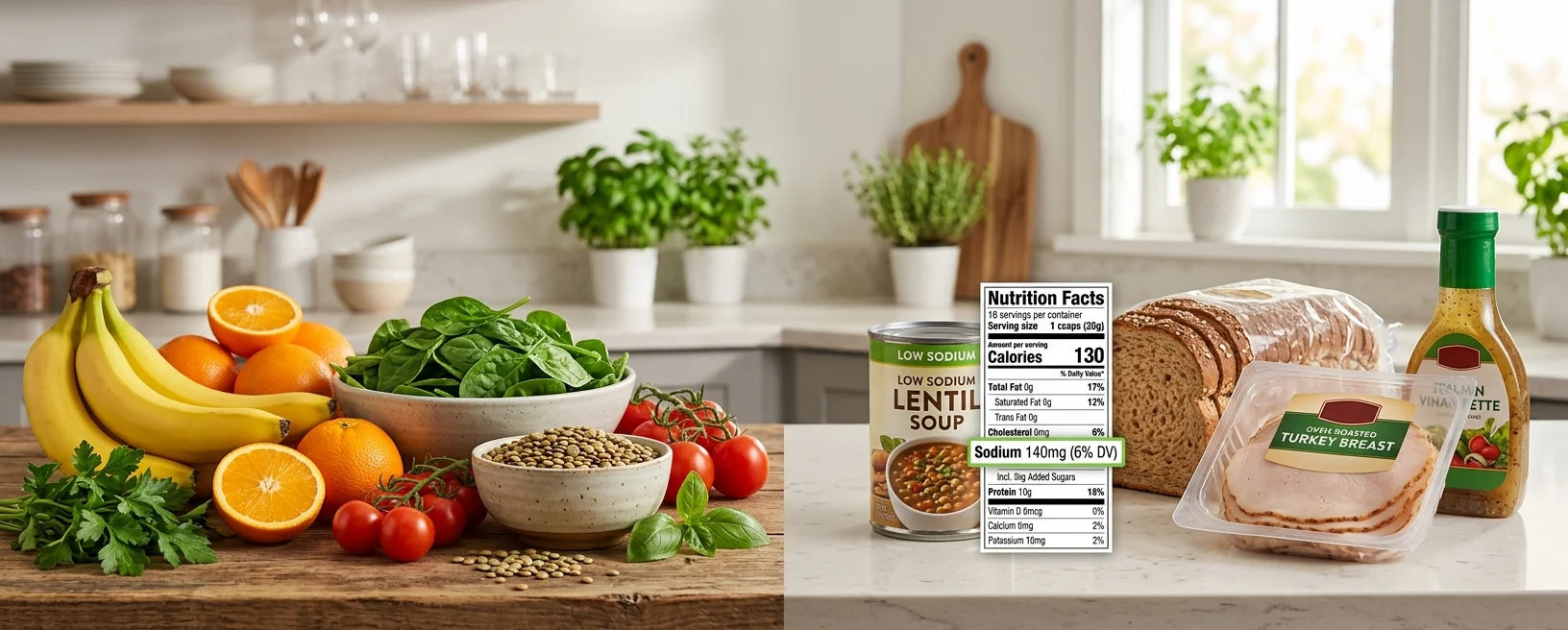
The Nutrition Facts panel gives you three pieces of information about sodium: the milligrams per serving, the percent Daily Value, and the serving size.

The serving size is the first thing to check. Sodium numbers on labels apply to one serving, and serving sizes are often smaller than what people actually eat. A can of soup frequently lists the serving as one cup, but the can contains two cups. A bag of chips might list 1 oz as a serving, but a typical snacking session can easily exceed that. Double the servings, double the sodium.

The %DV gives you a quick read on whether a food is high or low in sodium:

  • 5% DV or less = low sodium (140 mg or less per serving) — a green light for DASH
  • 20% DV or more = high sodium (460 mg or more per serving) — a caution flag

For the standard DASH target of 2,300 mg across a full day, you want to budget roughly 460 mg per meal if you eat five times per day, or 575 mg per meal across four eating occasions. For the 1,500 mg target, that math tightens to around 300 mg per meal. If a single food takes up most of that budget, you have very little room left.

Front-Label Claims and What They Actually Mean

The front of the package is marketing territory. Labels like "natural," "organic," "heart-healthy," and "light" carry no sodium implications unless they are backed by a specific FDA-regulated claim. The ones that do carry legal meaning:

  • Low sodium = 140 mg or less per serving
  • Reduced sodium = at least 25% less sodium than the original product. The original may have been extremely high, so a "reduced sodium" product can still easily clear 600–700 mg per serving.
  • No salt added = no salt was added during processing. This is not the same as sodium-free. Other sodium-containing additives can still be present, and their sodium contributes to the total.
  • Light in sodium = at least 50% less sodium than the original
  • Very low sodium = 35 mg or less per serving

The "reduced sodium" claim is the one that most commonly misleads DASH followers. A soup with 800 mg per cup reduced to 600 mg per cup is still high — it just qualifies for a claim.

Potassium: The Other Side of the DASH Equation

Until January 2020, potassium was optional on Nutrition Facts panels. The FDA's updated labeling rules made it mandatory, which is a significant change for DASH followers. You can now find potassium on every packaged food label.

The potassium %DV is based on 4,700 mg per day — the same number DASH targets. The same 5%/20% interpretation applies:

  • 5% DV or less = low potassium (235 mg or less per serving)
  • 20% DV or more = high potassium (940 mg or more per serving) — seek these out

Most packaged foods are poor potassium sources. They are also typically high in sodium. The gap works both ways. This is why DASH places strong emphasis on whole fruits, vegetables, and low-fat dairy: these are the categories that reliably deliver potassium without loading sodium.

Some whole foods worth knowing by potassium content:

  • Dried apricots: 755 mg per ½ cup
  • Cooked lentils: 731 mg per cup
  • Baked potato: 610 mg per medium potato
  • Orange juice: 496 mg per cup
  • Banana: 422 mg per medium banana
  • Low-fat milk: 366 mg per cup

When you do buy packaged food, the potassium line tells you whether it is contributing anything useful to the DASH equation or just adding to your sodium load.

The Hidden Sodium Problem: Additives on Ingredient Lists

The Hidden Sodium Problem: Additives on Ingredient Lists

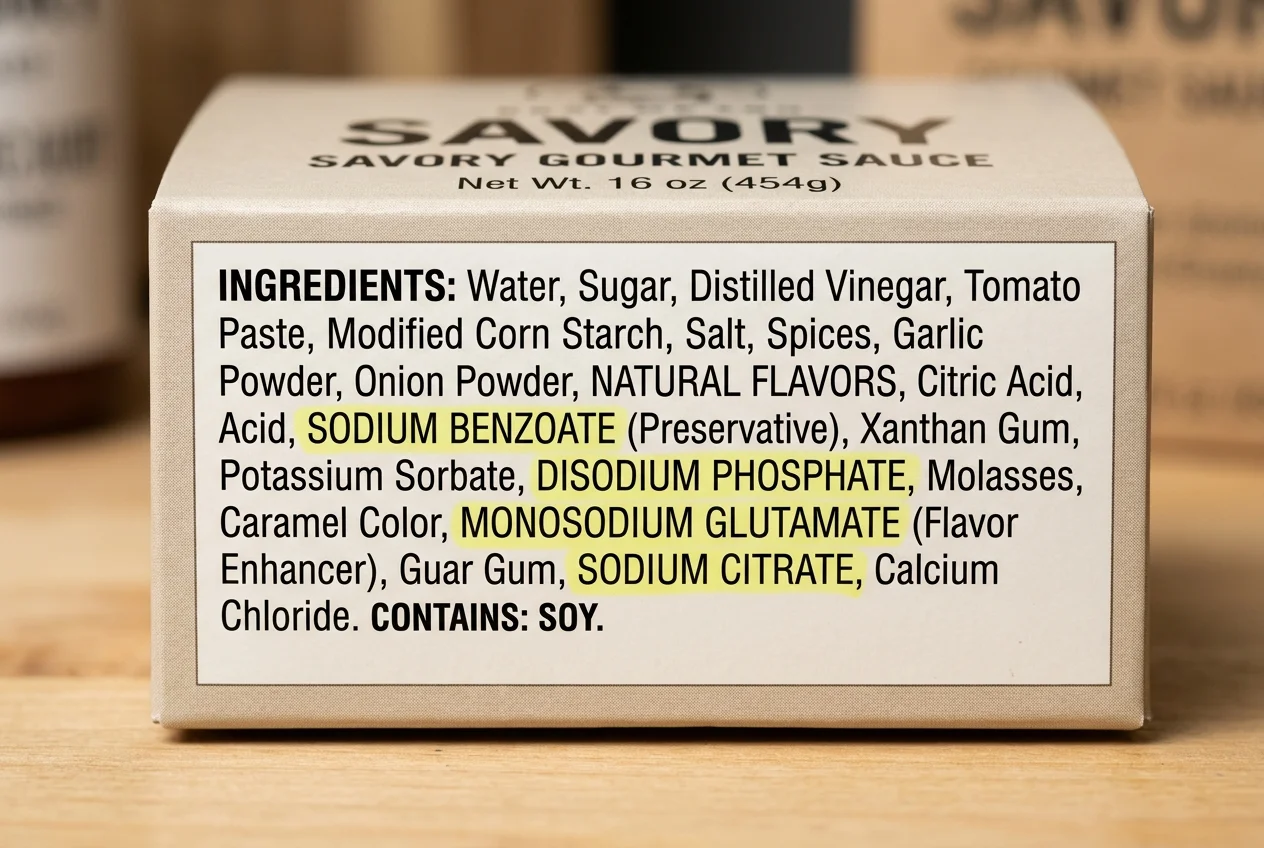
The ingredient list is where sodium's full footprint becomes visible. Sodium is not only table salt. It appears as a component of dozens of preservatives, flavor enhancers, leavening agents, and processing chemicals. Each one contributes to total sodium intake, and multiple sodium compounds can appear in a single product.

Here are the most common sodium aliases to look for on ingredient labels:

Preservatives:

  • Sodium benzoate — found in soft drinks, fruit juices, salad dressings, condiments
  • Sodium nitrate / sodium nitrite — found in deli meats, hot dogs, bacon, cured meats
  • Sodium erythorbate — found in "nitrate-free" and "uncured" deli meats, often alongside sodium nitrate
  • Disodium EDTA — a chelating preservative found in canned vegetables, spreads, and dressings

Flavor enhancers:

  • Monosodium glutamate (MSG) — found in chips, instant noodles, fast food seasonings, broths
  • Disodium inosinate (IMP) — often paired with MSG in savory snacks
  • Disodium guanylate (GMP) — also paired with MSG; their combined effect multiplies the flavor impact at lower individual doses

Texture and processing agents:

  • Sodium phosphate / disodium phosphate — used in deli meats, processed cheese, and canned goods to retain moisture and improve texture
  • Sodium citrate — an acidity regulator in soft drinks, flavored sparkling water, and some cheeses
  • Sodium alginate — a thickener in sauces, dressings, and ice cream
  • Sodium caseinate — a milk protein additive in coffee creamers and protein bars
  • Sodium carbonate — used in ramen noodles and certain baked goods for pH control

Leavening:

  • Sodium bicarbonate (baking soda) — found in breads, crackers, baked goods, and anything leavened

The more of these appear in a single ingredient list, the higher the overall sodium load, even if the Nutrition Facts panel does not look alarming at first glance. Some products combine four or five sodium compounds, each at individually small amounts, in a way that adds up significantly.

The "Nitrate-Free" Labeling Trap

Deli meats labeled "uncured," "no nitrates added," or "nitrate-free" are a common source of confusion. These labels refer specifically to the absence of added sodium nitrate. They do not mean the product is sodium-free, and they do not prevent the use of other sodium compounds. Most "nitrate-free" deli meats still contain sodium erythorbate, sodium phosphate, and sodium chloride. Two ounces of oven-roasted "natural" turkey breast can still deliver around 580 mg of sodium — more than a quarter of the lower-sodium DASH target in a single small portion.

Packaged Foods That Consistently Catch People Out

These are not obscure products. They are everyday staples that DASH followers routinely underestimate.

Canned soup. A single cup of minestrone from a major brand can carry 1,550 mg of sodium — more than the entire lower-sodium DASH daily target in one bowl. Even soups marketed as "healthy," "organic," or "low-fat" frequently clear 800 mg per cup. Always check the Nutrition Facts panel, and check how many cups are in the container.

Bread. Two slices of standard sandwich bread contribute 300–400 mg before any filling is added. A single bagel can reach 500 mg. A large flour tortilla wraps up 400+ mg. These are not intuitive sodium sources, but bread is the largest single contributor to sodium intake in the American diet, according to the American Heart Association.

Breakfast cereal. Cornflakes: around 200 mg per cup. Bran flakes marketed as heart-healthy: up to 300 mg per cup. Instant oatmeal packets: around 365 mg. The "whole grain" and "heart-healthy" front labels do not say anything about sodium.

Cottage cheese. A half-cup serving can range from 300 to 900 mg depending on the brand. Salt is used heavily as a preservative, and variation between brands is dramatic. This is one food where brand comparison is genuinely worthwhile.

Bottled salad dressing. Two tablespoons of a standard bottled dressing typically carries 300–500 mg. A salad built on a good foundation of vegetables can easily be undone by the dressing.

Sports drinks and flavored water. Sodium is added for electrolyte replenishment, typically in the 100–200 mg range per serving. It is unexpected in what looks like a hydration product, and the serving size listed is often smaller than what people drink in one sitting.

Reading a Label for DASH, Step by Step

This is the practical sequence for any packaged food:

  1. Start with serving size. Adjust all numbers if you plan to eat more than one serving.
  1. Check the sodium line. Is it below 140 mg (5% DV) — a good DASH option? Is it above 460 mg (20% DV) — a food to use sparingly or skip? Place it in the context of your daily budget: 1,500 or 2,300 mg spread across all meals and snacks.
  1. Check the potassium line. Is this food contributing anything toward 4,700 mg, or is it purely taking from your sodium budget? A 10% DV or higher for potassium is meaningful.
  1. Scan the ingredient list for sodium compounds. Count how many appear. One or two sodium additives is common; five or six in a single product is a signal that the total sodium is likely higher than it looks.
  1. Cross-reference front-label claims. "Reduced sodium" and "no salt added" have specific definitions. "Natural" and "heart-healthy" do not restrict sodium content.

Only 28% of participants in the PREMIER Trial reached the 1,500 mg sodium target at six months — the lowest documented compliance in the clinical literature. The barrier is not motivation; it is practical label literacy in a food supply where sodium compounds are pervasive. Applying this sequence consistently is what closes that gap.

IngrediCheck scans packaged food ingredient lists and flags sodium compounds, hidden additives, and dietary conflicts in seconds. For anyone following the DASH diet, it removes the manual work of hunting through ingredient lists and helps you quickly identify whether a product fits your sodium budget — before it ends up in your cart.

Start making confident food choices today!

Scan food and understand what's right for you and your family, with AI.

IngrediCheck app