Low FODMAP Diet: Label Reading Guide for IBS Sufferers

Hidden FODMAPs lurk in processed foods under unexpected names. This label reading guide reveals what to look for and how to shop safely on a low FODMAP diet.

Apr 2, 2026|10 min read
Low FODMAP Diet: Label Reading Guide for IBS Sufferers

About one in seven people worldwide lives with irritable bowel syndrome. That's not a minor inconvenience. For many, IBS means unpredictable cramping, bloating, diarrhea, constipation, or some miserable combination of all four, often with no obvious explanation. Medications help some people. Others spend years trying to identify which foods are responsible.

The low FODMAP diet was developed specifically to answer that question. Created by researchers at Monash University in Melbourne in 2005, it's now the most evidence-backed dietary intervention for IBS available. Three out of four people who follow it properly experience meaningful symptom relief. That's a striking success rate in an area where very few things work reliably.

But "following it properly" is harder than it sounds once you move beyond home-cooked meals. Packaged food is full of high-FODMAP ingredients hiding under names that don't signal any obvious danger. This guide explains what FODMAPs actually are, how the diet works, and, most practically, what to look for when you're standing in a supermarket aisle trying to decide whether a product is safe.

This article is for informational purposes only and should not be considered medical advice. Work with a registered dietitian experienced in IBS when starting a low FODMAP diet.

What FODMAP Actually Stands For

FODMAP is an acronym for a group of short-chain carbohydrates and sugar alcohols that share a key property: they are poorly absorbed in the small intestine, ferment rapidly in the gut, and draw water into the bowel. In people with IBS, this fermentation process triggers the symptoms the diet is designed to relieve.

The letters break down as follows:

  • F ermentable
  • O ligosaccharides (fructans and galacto-oligosaccharides, found in wheat, rye, onion, garlic, legumes)
  • D isaccharides (lactose, found in milk, soft cheese, yogurt)
  • M onosaccharides (excess fructose, found in honey, high-fructose corn syrup, some fruits)
  • A nd
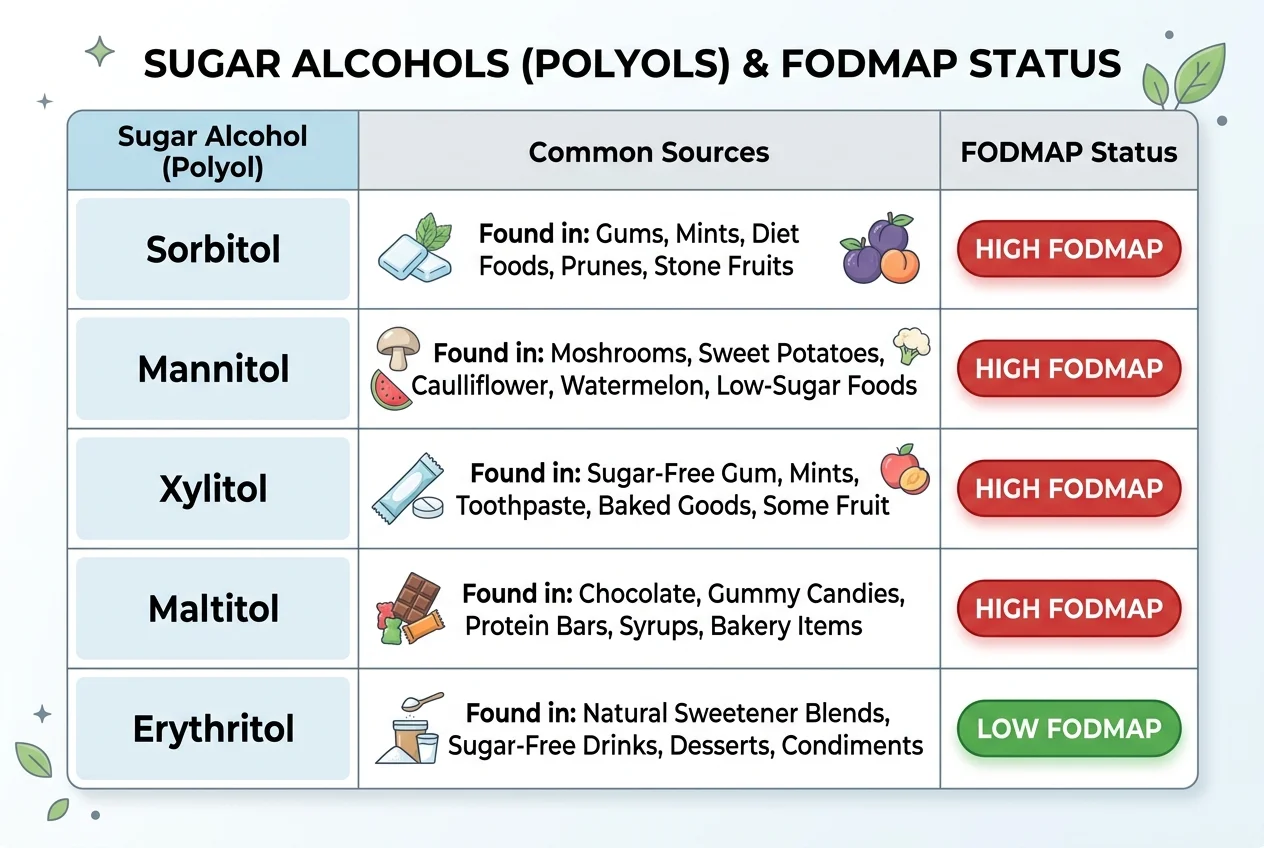
  • P olyols (sugar alcohols including sorbitol, mannitol, xylitol, found in some fruits, vegetables, and "sugar-free" products)

Each of these categories contains multiple individual compounds, and your personal tolerance varies by compound, by quantity, and by what else you've eaten that day. Two people with IBS following a low FODMAP diet can end up with quite different lists of trigger foods, which is exactly why the diet includes a structured reintroduction phase rather than treating all restrictions as permanent.

How the Diet Actually Works

How the Diet Actually Works

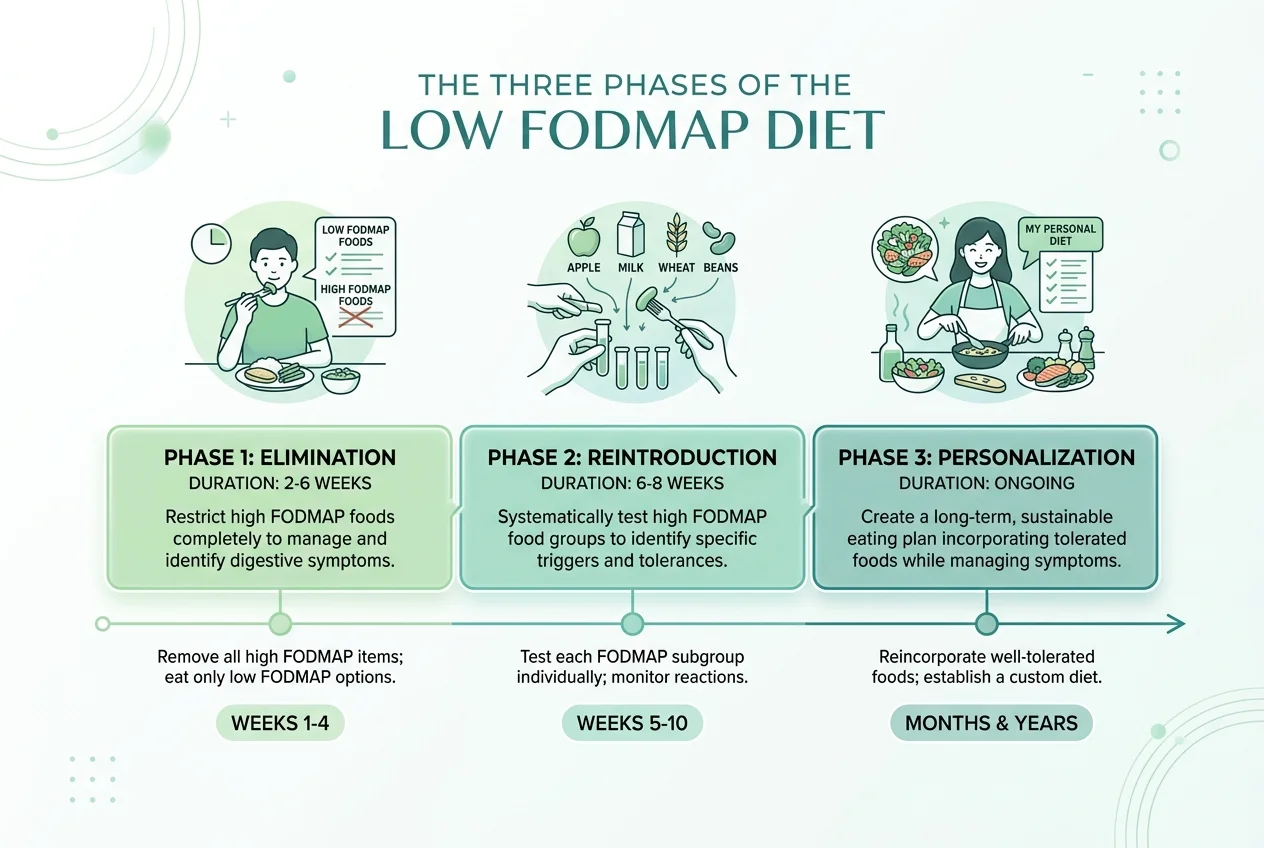
The low FODMAP diet has three distinct phases. Jumping straight to a vague "I'll try to avoid these foods" approach is a common mistake that produces inconclusive results.

Phase 1: Elimination (2 to 6 weeks). You avoid all high-FODMAP foods for a defined period, typically two to four weeks. The goal is to establish a symptom-free baseline. If your symptoms don't improve during this phase, the diet may not be the right tool, and further investigation with a gastroenterologist makes sense.

Phase 2: Reintroduction (6 to 8 weeks). You reintroduce one FODMAP category at a time in controlled amounts, testing your response to each type of fermentable carbohydrate individually. This is the most important phase. Most people are not sensitive to every FODMAP type; they have specific triggers. Without systematic reintroduction, you stay on an unnecessarily restricted diet indefinitely.

Phase 3: Personalization. Based on your reintroduction results, you establish a long-term eating pattern that excludes only the specific FODMAPs that cause problems for you. Most people can reintroduce the majority of foods they eliminated.

The architecture of the diet matters. Phase 1 is not meant to be a permanent lifestyle. It's a diagnostic tool.

The Science Behind It

The evidence base has grown substantially over the past decade. A 2025 umbrella review published in Frontiers in Nutrition pooled findings from 16 meta-analyses involving more than 9,900 IBS patients and confirmed significant improvements in abdominal pain, bloating, and overall quality of life for people following the low FODMAP diet compared to control diets. Earlier Monash research put the positive response rate at 75%.

That said, the diet is not a cure. It manages symptoms rather than addressing any underlying cause of IBS. It also requires clinical supervision, particularly during reintroduction, because self-directed approaches often result in people staying on the elimination phase far longer than intended, which can affect gut microbiome diversity and nutritional intake over time.

Where Label Reading Gets Complicated

Where Label Reading Gets Complicated

Home cooking on a low FODMAP diet is manageable once you know which ingredients to avoid. The difficulty arrives when you reach for packaged food.

High-FODMAP ingredients appear throughout the processed food supply, often in forms that don't immediately read as problematic. The most consistent hidden sources are the following.

Garlic and Onion: Everywhere, Always

Onion and garlic are among the most concentrated sources of fructans in the food supply. Even small amounts in powder form can be enough to trigger symptoms. Yet garlic powder and onion powder appear in a vast range of products: spice blends, soups, broths, ready meals, deli meats, snack chips, sauces, salad dressings, and packaged seasonings.

The bigger challenge is "natural flavors." In the US, the FDA allows garlic and onion to be classified as natural flavors on ingredient lists. This means a product can contain garlic or onion extract without those words appearing anywhere in the ingredient list. There is no reliable way to identify garlic or onion within "natural flavors" without contacting the manufacturer directly.

For savory packaged products, assume that "natural flavors" or "spices" may contain garlic or onion unless the manufacturer confirms otherwise.

Inulin and Chicory Root: The Prebiotic Trap

Inulin is a type of fructan. It's also one of the most popular prebiotic fiber additives in the packaged food industry, added to everything from protein bars and breakfast cereals to dairy-alternative yogurts and low-carbohydrate snacks. Chicory root is the most common source of commercial inulin and is essentially synonymous with it on ingredient labels.

The marketing around inulin-fortified products tends to emphasize digestive health and fiber content. For most people, that's accurate. For someone with IBS following a low FODMAP diet, it's a serious trigger dressed up as a health benefit.

Watch for these names on ingredient labels:

  • Inulin
  • Chicory root extract
  • Chicory root fiber
  • Chicory fiber
  • Fructooligosaccharides (FOS)
  • Oligofructose
  • Agavin (from agave)

Any of these on a label means the product is high in fructans and should be avoided during the elimination phase.

Polyols: The "Sugar-Free" Problem

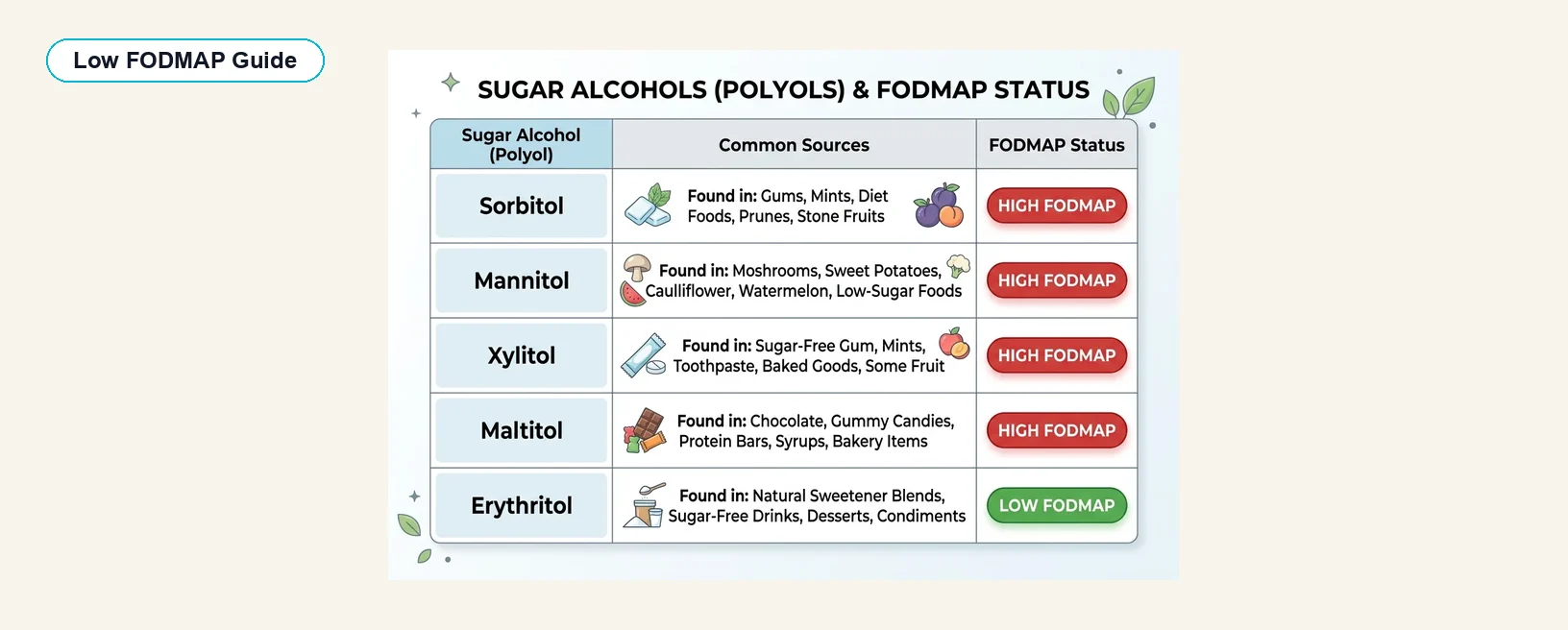
Sugar alcohols are used extensively in reduced-sugar, diabetic-friendly, and "diet" products. Several of them are high-FODMAP.

The problematic ones are sorbitol, mannitol, xylitol, isomalt, maltitol, and lactitol. You'll find them in:

  • Sugar-free chewing gum and mints
  • Diet confectionery and chocolates
  • "Low sugar" protein bars
  • Some cough lozenges and medications
  • Sugar-free jams and preserves

In the EU, these are listed with E-numbers: sorbitol is E420, mannitol is E421, xylitol is E967, isomalt is E953, maltitol is E965. In the US and elsewhere, they appear by their common names.

One exception: erythritol (E968) is generally well tolerated on a low FODMAP diet because it's absorbed more efficiently in the small intestine before reaching the colon. It does not cause the same fermentation effect as the others.

Practical shortcut: If a product label says "may have a laxative effect," it almost certainly contains high doses of polyols.

Excess Fructose: Not Just About Fruit

High-fructose corn syrup is the most obvious source of excess fructose in packaged food, but it's not the only one. Honey and agave syrup are also high in fructose and are high-FODMAP, which surprises many people who view them as natural alternatives to refined sugar.

Concentrated fruit juice, used as a sweetener in many products marketed as "no added sugar," can add significant fructose load depending on the fruit source. Apple juice concentrate, pear juice concentrate, and mango puree are common examples worth watching.

Ingredients to flag for excess fructose:

  • High-fructose corn syrup
  • Honey
  • Agave nectar or agave syrup
  • Fruit juice concentrates, especially apple and pear
  • Crystalline fructose

Lactose: Not Just Dairy

Lactose is high-FODMAP, but not all dairy products are created equal. Hard aged cheeses like cheddar, parmesan, and brie are naturally very low in lactose and are generally fine. Milk, soft cheeses, ice cream, and most yogurts are high-lactose and high-FODMAP.

The complication in packaged food is that lactose appears in products you wouldn't necessarily think of as dairy: processed meats, ready-made soups, bread, and even some medications. On labels, look for milk, milk powder, milk solids, whey, and lactose as ingredients.

Wheat, Rye, and Barley: The Gluten Confusion

These grains are high in fructans, which is a FODMAP issue rather than a gluten issue. Many people with IBS find that following a low FODMAP diet reduces their reaction to wheat-containing foods significantly, and assume they have a gluten problem when fructans are actually the driver.

This matters for label reading because a "gluten-free" product is not automatically low FODMAP. Gluten-free products often substitute wheat flour with lupin flour, soy flour, or other high-FODMAP alternatives. The absence of gluten does not mean the absence of FODMAPs.
A Practical Label-Reading Framework

When evaluating any packaged product for FODMAP content:

  1. Scan the first five ingredients. The closer to the top, the higher the quantity. High-FODMAP items early in the list mean a significant dose.
  1. Check for garlic and onion by any name. Garlic powder, onion powder, garlic extract, onion extract, dehydrated garlic, dehydrated onion. Also flag "natural flavors" and "spices" in any savory product.
  1. Look for inulin and chicory root. Any appearance on the label, regardless of position, is a fructan flag.
  1. Identify polyols. Any ingredient ending in "-ol" (sorbitol, mannitol, xylitol, maltitol) except erythritol is high-FODMAP. Isomalt is also high-FODMAP.
  1. Check for honey, agave, and fruit juice concentrates. Often found in products marketed as "natural" or "no added sugar."
  1. Be skeptical of "gluten-free" claims. Check the full ingredient list rather than relying on front-of-pack labeling.
  1. Flag "prebiotic fiber," "contains prebiotics," or "high fiber" claims. These frequently indicate added inulin or chicory root.
  1. Contact manufacturers about "natural flavors." For savory products you eat regularly, asking directly whether natural flavors contain garlic or onion is worth the effort.

What Makes This Genuinely Hard

The challenge with the low FODMAP diet isn't that the rules are complicated. It's that the ingredient labeling system was not designed with FODMAP-sensitive people in mind.

"Natural flavors" concealing garlic is legal. Inulin marketed as a fiber benefit is accurate for most people. Gluten-free claims say nothing about FODMAP content. A product can be vegetarian, organic, non-GMO, and still be full of inulin, garlic powder, and sorbitol.

The result is that label reading on a low FODMAP diet requires significantly more attention than most dietary restrictions. You're not just looking for one or two clearly named ingredients. You're cross-referencing a long list of FODMAP compounds against ingredient names that are sometimes obscure, often abbreviated, and occasionally hidden inside catch-all categories.

IngrediCheck makes the low FODMAP label-reading process far more manageable. Scan any packaged product and instantly see whether it contains inulin, chicory root, high-fructose corn syrup, garlic or onion powder, sugar alcohols, or other common high-FODMAP triggers, without having to decode a 30-ingredient list while standing in the supermarket aisle. For anyone navigating the elimination or reintroduction phase of a low FODMAP diet, knowing exactly what's in a product before it ends up in your cart takes one major source of stress out of the process.

Start making confident food choices today!

Scan food and understand what's right for you and your family, with AI.

IngrediCheck app