Ingredient Deep Dives

Methylcellulose in Food: Why Plant-Based Burgers Use E461

Learn how methylcellulose helps a plant-based burger hold together, why E461 differs from cellulose gum, and what its name does not prove about a product.

Sep 5, 2026|8 min read
By Sanket Patel|Updated 2026-09-05|3 sources|Editorial standards
Methylcellulose in Food: Why Plant-Based Burgers Use E461

Methylcellulose helps a plant-based patty hold together as it cooks. It is a modified form of plant cellulose, identified as E461 in the European additive system. Its useful trick is heat-triggered gel formation: a formulation can become more cohesive when warmed, rather than simply melting apart.

That explains why the ingredient appears in some meat alternatives. Pea or soy protein, water, oil, and seasonings do not automatically behave like a ground-meat patty. A binder helps turn those components into something that survives a pan, a spatula, and a bite.

It also explains what this article is not. Methylcellulose is not the same as carboxymethylcellulose, often called cellulose gum. This guide focuses on E461's food role and label interpretation, using evidence reviewed on September 5, 2026. It does not transfer another additive's health claims or drug instructions onto your burger.

The Most Important Distinctions

TermIdentityWhy the distinction matters
MethylcelluloseE461Heat-gelling cellulose derivative used in food formulations
Hydroxypropyl methylcellulose, HPMCE464A related but different modified cellulose
Cellulose gum, carboxymethylcellulose, CMCE466Different substitution chemistry; much cited gut research concerns this ingredient
CellulosePlant structural carbohydrateA starting material or different ingredient, not automatically E461
GelatinAnimal collagen-derived proteinNot another name for methylcellulose

Similar spelling does not establish equivalent manufacturing behavior, dietary classification, or biological effects. When evaluating a claim, first check the exact ingredient tested. A headline that says only "cellulose additive" may leave out the distinction that matters most.

The EFSA review of food celluloses explicitly lists multiple identities, including E461, E464, and E466. Their inclusion in one assessment does not make the names interchangeable on a label or in a later experiment.

Why Heat-Setting Helps a Burger

Why Heat-Setting Helps a Burger

Think about the job a plant-based patty must do. Before cooking, the mixture has to be shaped. During cooking, it needs to retain enough structure to turn over. During eating, the texture should be cohesive rather than falling into loose protein particles and oil.

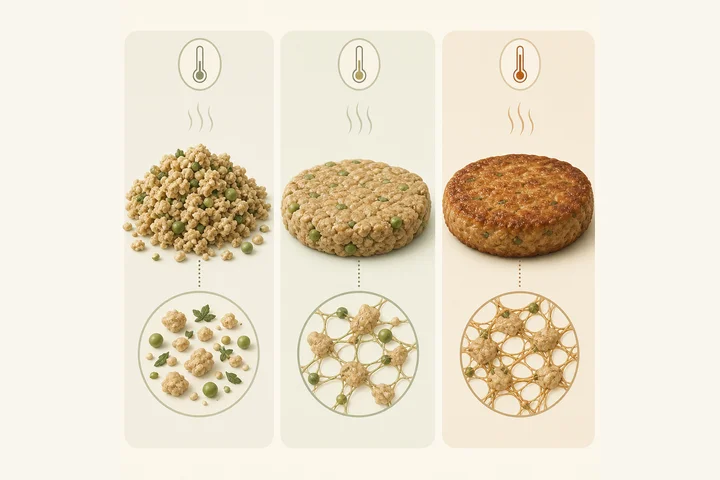
Methylcellulose can help through thermal gelation. Water and polymer interactions change as the formulation heats, creating a temporary supporting network. The behavior differs from ingredients that gel mainly during cooling, and the exact temperature and strength depend on the grade and recipe.

The network can assist with binding and retention of water and fat. It does not independently determine every aspect of the burger's texture. Protein choice, particle size, fat composition, water amount, processing, and cooking conditions all contribute.

A 2026 study of methylcellulose-protein mixtures examined how pea and potato proteins affected gel formation. The different mixtures behaved differently, illustrating why the complete formulation matters. This is food-structure research, not evidence of a health benefit or proof that every plant-based product needs the ingredient.

A home bean burger might use oats, starch, or another binder. That is a different recipe, not necessarily a direct replacement at equal weight. Manufacturers balance texture, allergens, flavor, cost, stability, and cooking performance. Removing one binder can require changing several other ingredients.

Is Methylcellulose Made From Plants?

Cellulose is a structural carbohydrate in plants. Methylcellulose is produced by chemically modifying purified cellulose. The resulting food ingredient is not simply ground plant material, but neither is it animal gelatin.

Both parts of that description matter. Calling it "just a vegetable" hides the processing that gives it useful properties. Calling it an animal binder because it forms a gel is also incorrect. A gelling function does not determine an ingredient's biological origin.

For most ingredient-based vegan and vegetarian checks, methylcellulose itself does not indicate an animal source. If you require certification that covers processing aids and the complete manufacturing chain, use the relevant product certification or manufacturer documentation. The identity of a binder is not a certificate for every other ingredient in the patty.

Our gellan gum guide covers a different vegan-compatible texturizer made by fermentation. Keeping these identities separate is more useful than categorizing every unfamiliar thickener as a hidden animal ingredient.

What the Food Rules Say

In the United States, 21 CFR 182.1480 identifies methylcellulose meeting the specified composition and recognizes its use under good manufacturing practice. The specification is part of the rule. The word on a label does not authorize using an arbitrary industrial powder as a food ingredient.

EFSA's 2018 assessment concluded that a numerical acceptable daily intake was not needed and that reported food uses and use levels for the assessed celluloses did not raise a safety concern. That conclusion has a defined scope: the evaluated food additives, specifications, exposure, and evidence available to the assessment.

It does not mean every amount is appropriate, every person responds identically, or every later scientific question is settled. It also does not support the claim that a product is healthier simply because the ingredient has legal food uses.

If you encounter a claim that methylcellulose is "banned in Europe," ask for the exact legal instrument, substance, and food category. E461's inclusion in the European assessment is not consistent with treating it as an inherently prohibited food substance. Restrictions or debates involving a different cellulose derivative should not be substituted for an E461 rule.

Do Not Borrow E466's Gut-Health Headlines

Do Not Borrow E466's Gut-Health Headlines

The existing cellulose gum article concerns carboxymethylcellulose, E466. A study involving CMC is not automatically a study of methylcellulose, E461.

This is more than a vocabulary correction. Changing a polymer's chemical groups can change how it interacts with water and biological systems. A shared cellulose backbone gives researchers a reason to compare substances, not permission to assume identical outcomes before testing them.

When reading an alarming summary, ask four questions: Which additive was tested? Was the work in people, animals, or a laboratory model? What amount and duration were used? Did the study measure an actual clinical outcome or a marker that needs further interpretation?

Those questions also protect against overreassurance. A broad regulatory review and a small experiment can coexist without either proving that a specific meal caused or prevented a particular illness. A product-level decision should reflect your needs and the strength of evidence, rather than a name association.

Food Ingredient Versus Fiber Medicine

You may encounter methylcellulose in a pharmacy as well as on food packaging. An ingredient having uses in more than one setting does not make the settings equivalent. Dose, preparation, instructions, and purpose are important.

Do not use the instructions for a bulk-forming fiber product to infer the amount in a burger. Do not expect a patty containing methylcellulose to treat constipation. And do not assume that a food application's safety discussion provides instructions for swallowing a concentrated ingredient powder.

The nutrition-label question is also distinct. "Derived from cellulose" is not sufficient evidence that every gram of an additive can be counted as dietary fiber under every jurisdiction's rules. The FDA's dietary-fiber guidance distinguishes qualifying fibers and specifically names hydroxypropylmethylcellulose among them. That is not a reason to silently replace E464 with E461 when reading the list.

For the burger in front of you, read its declared fiber and other nutrients. Do not reconstruct them from an ingredient name and an internet description of what a related polymer does.

Does a Burger Without Methylcellulose Fit You Better?

It can, if avoiding methylcellulose is one of your preferences. But removal of E461 is not a complete nutritional or allergen comparison. A replacement binder could introduce wheat, egg, another gum, or a different combination of starches.

A plant-based patty may contain wheat protein even when methylcellulose itself is not a gluten source. Another may use soy protein. The FDA's allergen overview explains why the actual allergen sources need their own declarations and assessment.

Compare protein, sodium, saturated fat, and portion size where those matter to your diet. A shorter ingredient list may appeal to you, but it does not mathematically determine these values. Likewise, choosing a whole-food bean patty can be a reasonable preference without making a claim that every formulated meat alternative is harmful.

An honest comparison names the criterion: fewer additives, a specific texture, verified vegan status, no wheat ingredients, or a nutrition target. It then checks that criterion directly rather than using methylcellulose as a proxy for everything else.

A Label-Reading Checklist for Plant-Based Patties

  1. Locate methylcellulose or E461 in the complete ingredient list.
  2. Keep E461 separate from E464 and E466 when reading research or applying saved rules.
  3. Check the protein source and the actual allergens in the recipe.
  4. Review product-level vegan or vegetarian certification if your standard requires it.
  5. Compare nutrition at the same serving size, rather than comparing one small patty with one large patty.
  6. Follow the product's cooking directions; a binder does not establish food safety or doneness.
  7. Recheck reformulated versions, since a different binder can change both texture and ingredient suitability.

If a manufacturer does not explain every formulation detail, that does not prevent you from using the information it does provide. Record the known ingredient, apply your own rules, and reserve questions about undisclosed processes for the manufacturer or certifier.

IngrediCheck helps identify methylcellulose in the listed ingredients and compare it with your saved vegan, vegetarian, or custom preferences. It does not infer the ingredient's dose, diagnose a reaction, or turn a plant-based claim into proof of allergen suitability. Use it to make the label easier to evaluate, not to replace missing evidence with certainty.

Frequently Asked Questions

What does methylcellulose do in a plant-based burger?

Methylcellulose can form a gel when heated, helping bind water, fat, and plant-protein particles into a cohesive cooked patty. Its performance depends on the grade and formulation.

Is methylcellulose the same as cellulose gum?

No. Methylcellulose is E461. Cellulose gum usually refers to carboxymethylcellulose, E466. They are different cellulose derivatives, and research on E466 cannot automatically establish effects of E461.

Is methylcellulose vegan?

Methylcellulose is made by modifying plant-derived cellulose rather than extracting animal gelatin. The finished product's other ingredients and any certification requirements still need checking.

Does E461 make a burger gluten-free?

No. A methylcellulose-containing patty can also contain wheat protein or other gluten sources. Read the complete label and relevant gluten-free claim separately.

Next Label Check

Follow the scanner, hub, and ingredient paths connected to this guide

Get the app for clearer label decisions.

Scan labels, see what fits your food notes, and read the why in plain English.

IngrediCheck app