Peanut Allergy Safe Snacks: Top Picks for Kids and Adults

Peanut allergy safe snacks for kids and adults: decode 'may contain' labels, spot hidden peanut ingredients, and find trusted peanut-free brands for every occasion.

Mar 18, 2026|11 min read
Peanut Allergy Safe Snacks: Top Picks for Kids and Adults

Snack time shouldn't feel like a minefield. But for the roughly 2% of US children and nearly 3% of adults living with a peanut allergy, every packaged snack involves a label audit, a mental cross-reference of manufacturing facilities, and a judgment call about whether "may contain traces of peanuts" is a meaningful warning or regulatory boilerplate.

This guide cuts through that uncertainty. We'll explain what food labels are actually required to tell you, what they are not required to tell you, which snack categories carry the most risk, and which brands have earned a strong safety track record for peanut-allergic consumers. Whether you're packing a school lunch, stocking an office snack drawer, or just trying to find something safe at a gas station, this is what you need to know.

This article is for informational purposes only and should not be considered medical advice. Consult an allergist for personalized guidance on managing peanut allergy.

The Scale of the Problem — And a Rare Piece of Good News

Peanut allergy is the most common cause of fatal food-induced anaphylaxis. Research puts the fatal anaphylaxis incidence at 2.13 per million person-years — higher than for any other food allergen. Between 7% and 14% of people with peanut allergy experience an accidental exposure every year, and up to half of those exposures result in anaphylaxis.

The prevalence numbers tell a sobering story: peanut allergy among US children increased 3.5-fold over two decades, from 0.4% in 1997 to over 2% today.

But 2025 brought a genuinely encouraging counterpoint. A study published in Pediatrics by the American Academy of Pediatrics found a 43% reduction in peanut allergy prevalence among children born after the 2015 LEAP trial guidelines were adopted — guidelines that recommended early introduction of peanuts to infants rather than avoidance. Researchers estimated this change in approach prevented peanut allergies in at least 40,000 children over the past decade.

That's meaningful progress on the prevention side. For the tens of millions already living with the allergy, though, the daily challenge of identifying safe food remains unchanged.

What Labels Are Required to Tell You

The Food Allergen Labeling and Consumer Protection Act of 2004 (FALCPA) requires all packaged foods in the US to clearly declare the presence of any of the eight major allergens — including peanuts — either in the ingredient list or in a separate "Contains" statement (e.g., "Contains: Peanuts"). The word "peanut" or "peanuts" must appear using the common name; trade names, Latin names, or processing derivatives don't satisfy the requirement.

This is the protection the law provides. It's meaningful but incomplete.

What FALCPA does not cover:

  • Barley, rye, and most seeds (sesame became the 9th required allergen in 2023 under the FASTER Act)
  • Cross-contact during manufacturing — this is entirely voluntary to disclose
  • Products exempt from standard FDA labeling (e.g., certain meat products regulated by USDA)

The EU operates under a stricter framework. EU Regulation No. 1169/2011 mandates declaration of 14 allergens (including peanuts) with visual emphasis — bold, italic, or contrasting color — within the ingredient list. And as of January 2026, a new EU Precautionary Allergen Labelling (PAL) policy requires that voluntary "may contain" statements be backed by a documented risk assessment showing the contamination level actually exceeds a reference dose. This is far more rigorous than the current US approach.

The "May Contain Peanuts" Problem

Here's the label that causes the most confusion and the most risk for peanut-allergic consumers: "May contain peanuts," "processed in a facility that also handles peanuts," and "made on shared equipment with peanut products."

These warnings are entirely voluntary and completely unregulated in the United States. No law requires them. No law defines what level of risk they must represent. Two products from different companies can carry identical "may contain" warnings while presenting wildly different actual contamination risks — because one manufacturer runs a rigorous allergen cleaning protocol and tests its lines, while another simply adds the warning as a liability hedge.

Research on baked goods found that of 154 randomly selected grocery store samples, 2.6% had detectable peanut contamination — at levels ranging from trace amounts up to 650 mg per 100g, well above the threshold that can trigger reactions in sensitive individuals.

FARE (Food Allergy Research & Education) recommends contacting manufacturers directly when a "may contain" label appears on a product you want to eat regularly. Ask specifically: Do you test finished products for peanut? What is your cleaning protocol between production runs? Do you produce peanut-containing products on the same lines?

As a general rule: If you or your child has a history of severe reactions, treat all precautionary labels as real warnings.

Peanuts Are Not Tree Nuts — This Distinction Matters for Snack Shopping

Peanuts Are Not Tree Nuts — This Distinction Matters for Snack Shopping

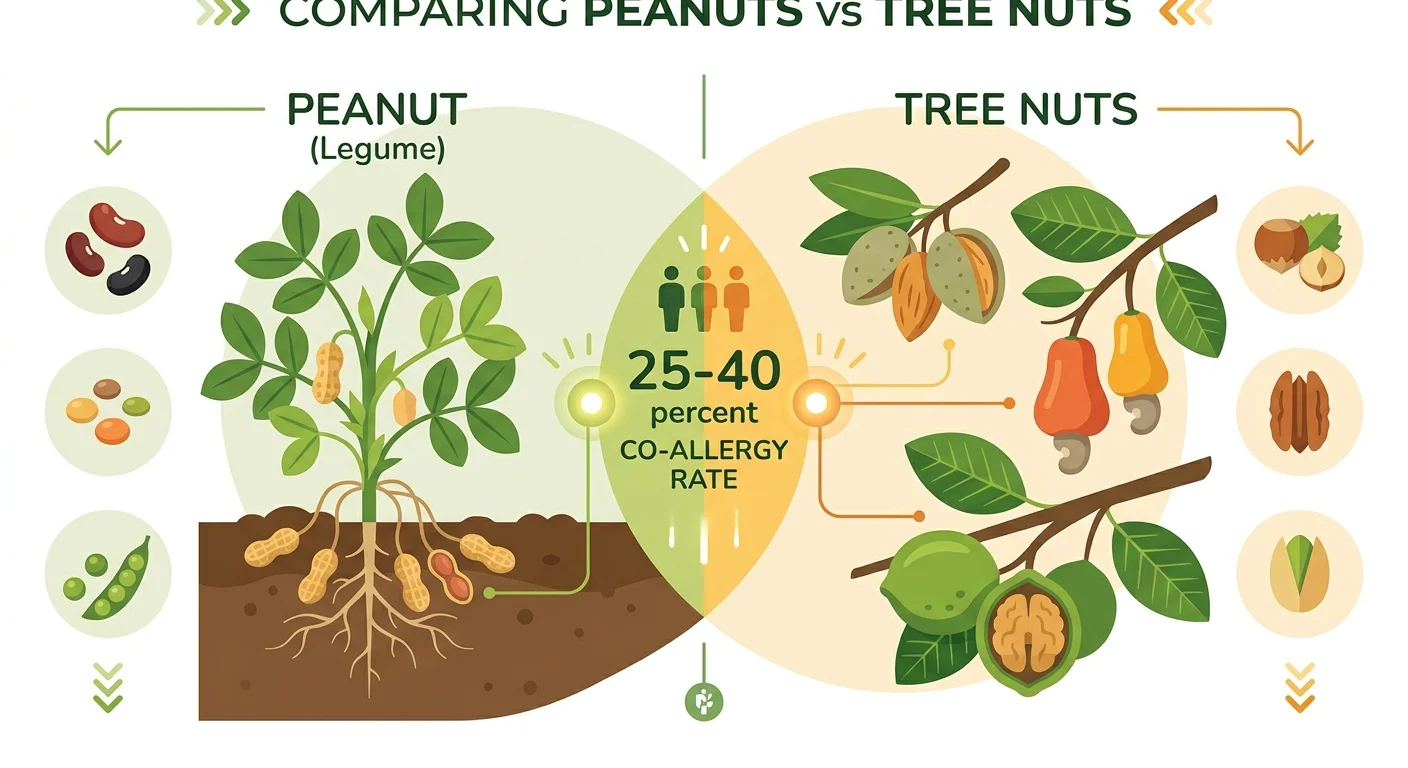
Peanuts are legumes. Botanically, they belong to the same family as beans, lentils, peas, and soybeans — not nuts. They grow underground, not on trees.

Tree nuts — almonds, cashews, walnuts, pecans, pistachios, hazelnuts, Brazil nuts, macadamias — are a completely separate allergen class.

Why does this matter when shopping for snacks? Because a product labeled "peanut-free" is not necessarily tree-nut-free, and a product labeled "nut-free" is ambiguous — it may mean peanut-free, tree-nut-free, both, or neither, depending on who wrote the label.

About 25–40% of people allergic to peanuts also react to at least one tree nut, but this cross-reactivity is not guaranteed. If you or your child has only a peanut allergy confirmed by an allergist, many products that contain tree nuts may be perfectly safe. Consult your allergist to understand your specific cross-reactivity profile before ruling out entire product categories.

When label shopping: Look specifically for "peanut-free" language and check the allergen statement. "Nut-free" alone requires a follow-up read of the full ingredient list.

Hidden Peanut Ingredient Names to Know

Beyond the standard "peanuts" listing, peanut protein can appear on labels under names that don't obviously signal danger:

  • Arachis oil — Latin-derived name for peanut oil
  • Ground nuts / groundnuts — common name in UK and Commonwealth markets
  • Beer nuts, mixed nuts, monkey nuts — casual names that indicate whole peanuts
  • Mandelonas — peanuts processed to resemble tree nuts
  • Cold-pressed peanut oil / expeller-pressed peanut oil — retain peanut protein (unlike highly refined peanut oil, which is usually safe)

Note on peanut oil: highly refined peanut oil has peanut proteins removed during processing and is generally considered safe for most peanut-allergic individuals. However, cold-pressed, expeller-pressed, or unrefined peanut oil retains those proteins and is NOT safe. The FDA recognizes highly refined oils as exempt from allergen labeling — so if an ingredient simply says "peanut oil" without specifying refinement, contact the manufacturer.

Snack Categories by Risk Level

Not all snack categories carry equal risk. Here's a practical framework:

Highest risk — approach with caution:

  • Baked goods (cookies, brownies, cakes) — high cross-contact risk, especially from bakeries and bulk bins
  • Trail mix and mixed nuts — peanuts are often present alongside tree nuts on shared equipment
  • Asian foods (satay sauces, pad thai, spring rolls) — peanuts are foundational ingredients in many cuisines
  • Candy and chocolate bars — shared production lines are extremely common
  • Ice cream and frozen desserts — shared scoops and mix-ins

Moderate risk — read labels carefully:

  • Crackers and pretzels — check for manufacturing line disclosures
  • Granola bars and energy bars — facility-level cross-contact is common
  • Flavored popcorn — caramel and nut varieties often share lines with peanut products

Lower risk — generally safer starting points:

  • Plain fresh fruit and vegetables
  • Single-ingredient whole foods (cheese sticks, plain yogurt)
  • Products from certified peanut-free or top-9-allergen-free facilities

Our Top Peanut-Free Snack Picks

Our Top Peanut-Free Snack Picks

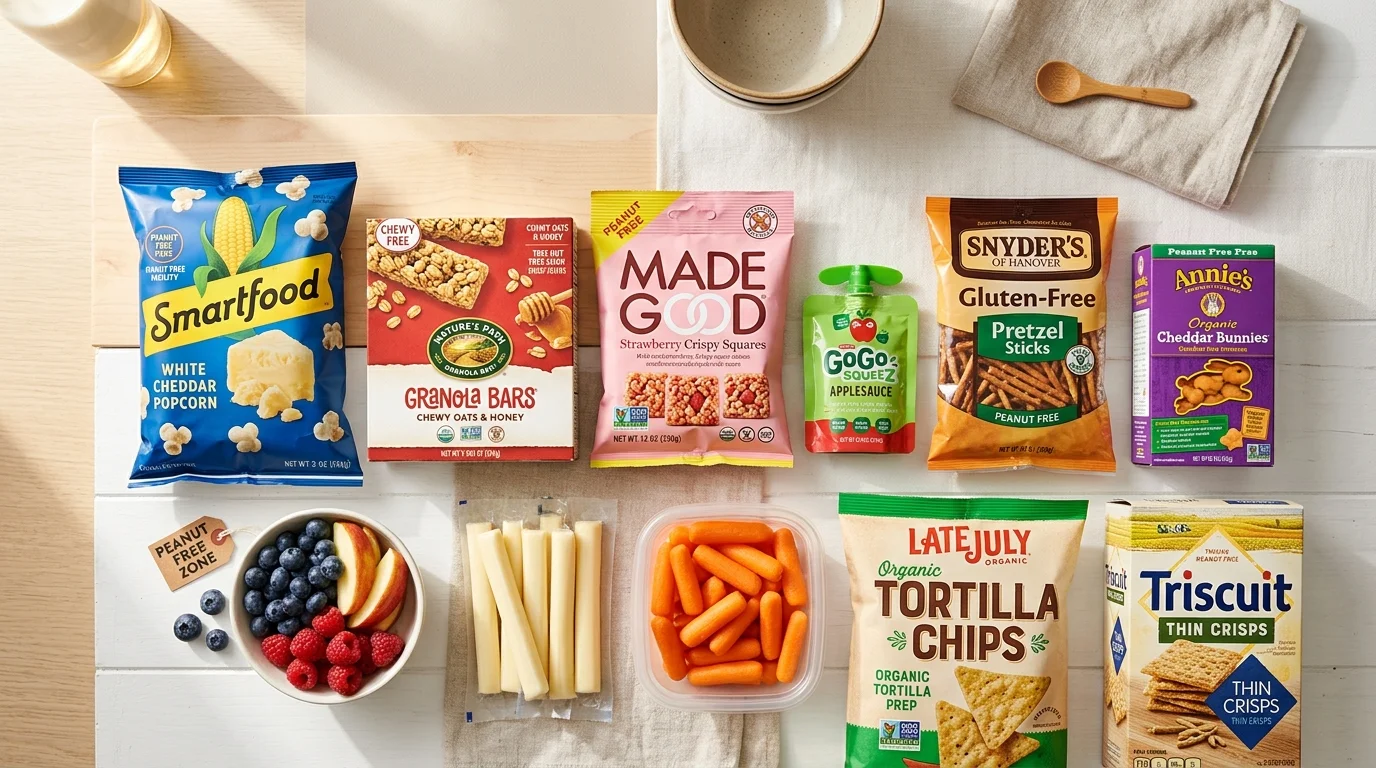
The brands below are consistently cited by allergy advocacy organizations and are known for transparent allergen manufacturing practices. Always verify current labeling — formulations and facilities change.

For Kids (school-safe and lunchbox-friendly)

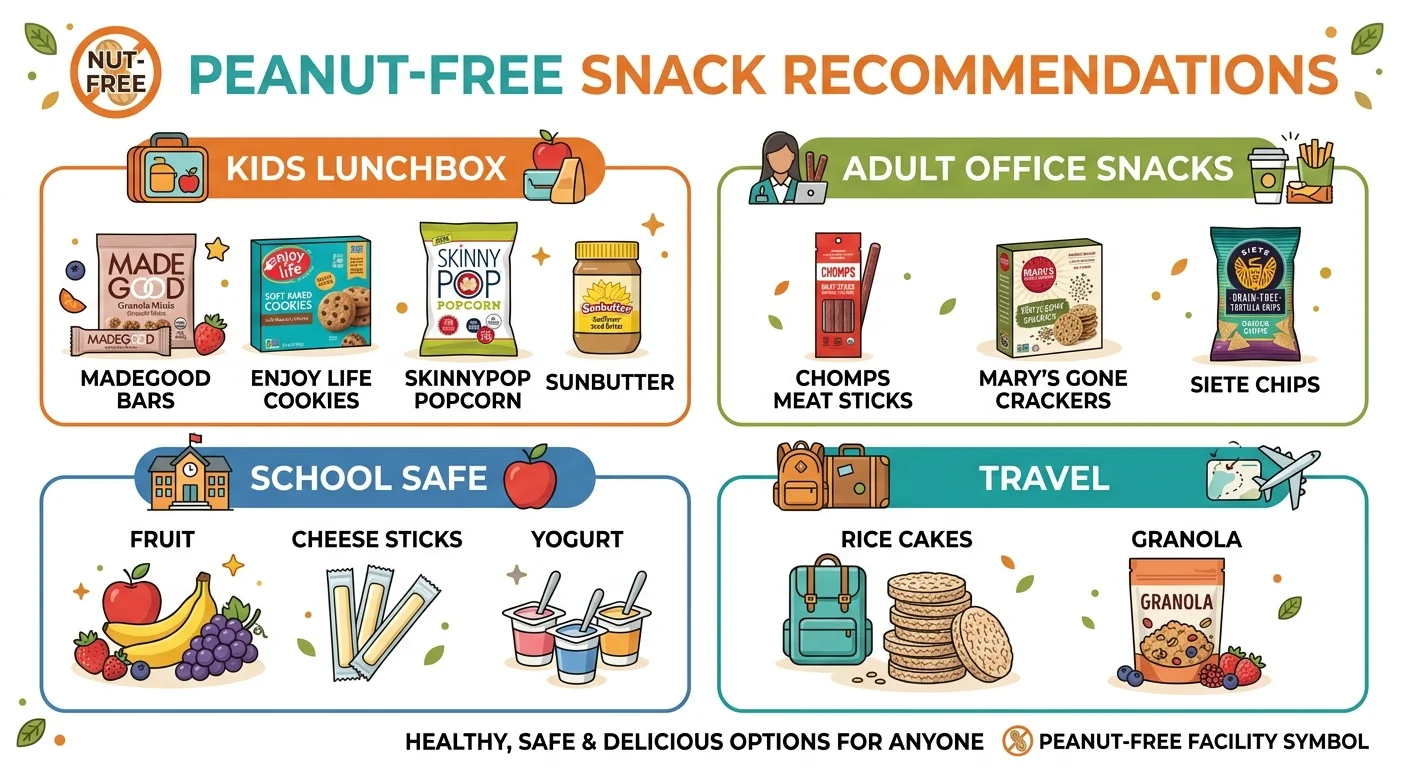
MadeGood Granola Bars and Granola Minis — manufactured in a facility free from all top-9 allergens including peanuts and tree nuts. A go-to for nut-free classrooms.

Enjoy Life Foods (cookies, soft-baked bars, trail mixes) — all products are made in a dedicated allergen-free facility, certified free from the top 14 allergens recognized by food allergy organizations.

SkinnyPop Original Popcorn — made in a peanut-free and tree-nut-free facility. One of the most widely recommended classroom snacks by school allergy policies.

Annie's Homegrown Bunny Crackers and Graham Crackers — peanut-free; the original flavors are consistently included on school approved snack lists.

SunButter Natural Sunflower Butter — made in a dedicated top-8-allergen-free facility. An excellent peanut butter substitute for school lunches where nut-based spreads are prohibited.

Fresh fruit, cheese sticks, plain yogurt — naturally peanut-free with no labeling complexity. Stonyfield Organic and Chobani are commonly cited brands with peanut-free production.

For Adults (office, travel, and everyday)

Chomps Meat Sticks — peanut-free facility, high-protein, no allergen ambiguity. A solid desk snack.

Mary's Gone Crackers — gluten-free and peanut-free; made in a dedicated facility. Popular with multiple dietary restriction profiles.

Nature's Garden Nut-Free Trail Mix — specifically formulated for nut-allergic consumers, made without peanuts or tree nuts.

Siete Foods Grain-Free Tortilla Chips — peanut-free; clean ingredient list with no shared-facility concerns for peanuts.

Plain rice cakes (Lundberg, Quaker original) — minimally processed, low cross-contact risk. Check flavored varieties individually.

Resource to bookmark: SnackSafely.com maintains a continuously updated Safe Snack Guide — refreshed every 4–6 weeks — with separate peanut-free and peanut-and-tree-nut-free editions. It's one of the most reliable ongoing references for allergy-safe packaged snacks.
Five Myths About Peanut Allergy — Debunked

"Smelling peanuts can trigger anaphylaxis." Not supported by clinical evidence. The smell of peanuts comes from volatile organic compounds, not allergenic proteins. Severe systemic reactions almost always require ingestion. Airborne exposure in enclosed spaces (like a plane) may cause mild symptoms in highly sensitive individuals, but fatal anaphylaxis from smell alone is not documented.

"Peanut oil is always dangerous." Highly refined peanut oil has the allergenic proteins removed. The FDA specifically exempts highly refined oils from allergen labeling. Most allergic individuals tolerate it. Cold-pressed and expeller-pressed oils, however, retain proteins and are genuinely dangerous.

"All nut allergies are the same." Peanut allergy and tree nut allergies are biologically distinct, with different proteins, different cross-reactivity patterns, and different typical onset ages. An almond allergy doesn't automatically mean a peanut allergy, and vice versa.

"Touching peanuts will cause anaphylaxis." Skin contact carries extremely low anaphylaxis risk. Serious reactions nearly always require ingestion. Skin contact may cause local hives in sensitive individuals, but systemic anaphylaxis from touch is rare.

"Peanut allergy is always for life." Research suggests up to 20% of children with peanut allergy outgrow it. Regular allergist monitoring, including supervised oral food challenges, is the appropriate path to determine if tolerance has developed.

Using IngrediCheck to Shop Safely

Peanut allergy management comes down to one thing at the grocery store level: knowing exactly what's in the package before you open it. IngrediCheck lets you scan any packaged food's barcode and instantly see whether peanuts or peanut-derived ingredients appear anywhere in the ingredient list — including under their less obvious names like arachis oil, ground nuts, or mandelonas. For families managing a peanut allergy, IngrediCheck removes the label-reading guesswork and gives you a clear, immediate answer at the moment it matters most: standing in the snack aisle.

Start making confident food choices today!

Scan food and understand what's right for you and your family, with AI.

IngrediCheck app