Dietary Guides

AIP Dietary Guide: Nightshades, Seed Spices, Legumes, and Hidden Autoimmune Triggers on Labels

An encyclopedic guide to the Autoimmune Protocol covering nightshade derivatives hidden in spice blends, seed-based spices, legume gums, grain derivatives, egg forms, food additives, and how to read labels when following AIP.

Jun 11, 2026|12 min read
By Sanket Patel|Updated 2026-06-11|5 sources|Editorial standards
AIP Dietary Guide: Nightshades, Seed Spices, Legumes, and Hidden Autoimmune Triggers on Labels

What Is the Autoimmune Protocol?

The Autoimmune Protocol, commonly abbreviated as AIP, is a dietary framework developed to reduce systemic inflammation and support immune regulation in people living with autoimmune conditions. It evolved as a stricter extension of the Paleo diet, built on the hypothesis that certain food compounds contribute to intestinal permeability, sometimes called leaky gut, and that increased gut permeability allows partially digested proteins to enter the bloodstream and trigger immune responses.

The theoretical underpinning draws on research into gut barrier function, including work on zonulin pathways and the role of dietary lectins in modulating tight junction proteins in the intestinal lining. Proponents argue that by removing foods that contain lectins, saponins, protease inhibitors, and other bioactive compounds, the gut lining has the opportunity to heal. This, in turn, may reduce the antigenic load reaching the immune system and dampen autoimmune activity over time.

AIP was popularized by researchers and clinicians including Dr. Sarah Ballantyne, whose 2013 book systematized the protocol and provided the mechanistic rationale. Clinical pilot studies have since examined AIP specifically in inflammatory bowel disease, including a 2017 study published in Inflammatory Bowel Diseases and a subsequent multi-site trial, both of which reported clinically meaningful reductions in disease activity scores. The protocol is structured in two phases: a strict elimination phase, followed by a systematic reintroduction phase during which individual foods are added back one at a time to identify personal triggers.

What the Autoimmune Protocol Actually Bans

The list of excluded foods on AIP is substantially longer than most elimination diets. Understanding the full scope matters because many of the excluded items appear in surprising places on ingredient lists.

Grains and grain derivatives are entirely excluded. This covers wheat, rye, barley, oats, corn, rice, millet, sorghum, teff, amaranth, buckwheat, and quinoa. All grain-based flours, starches, and derivatives follow. Maltodextrin derived from corn or wheat, dextrose, glucose syrup, modified starch, and malt extract are all disqualifying ingredients.

Legumes are excluded across the board. This includes soybeans and all soy products (tofu, edamame, miso, soy sauce, tempeh, soy lecithin), peanuts, lentils, chickpeas, kidney beans, black beans, navy beans, pinto beans, adzuki beans, and all other pulses. Legume-derived additives such as guar gum, locust bean gum, carob, pea protein, and pea starch carry the exclusion into packaged food.

Nightshades form one of the most distinctive AIP exclusions. The nightshade family (Solanaceae) includes tomatoes, bell peppers, chili peppers of all varieties, eggplant (aubergine), goji berries, ashwagandha, and potatoes (though sweet potatoes are permitted). All forms of these foods are excluded, meaning fresh, dried, powdered, juiced, and extracted forms are equally off-limits.

Dairy in all forms is excluded during the elimination phase. This covers milk, cream, butter, ghee, cheese, yogurt, kefir, whey protein, casein, lactalbumin, and lactose. Products labeled "dairy-free" may still contain caseinates derived from milk, so the exclusion requires careful label inspection.

Eggs are excluded entirely, including whole eggs, egg whites, egg yolks, and all egg-derived compounds. Eggs appear in many places beyond obvious baked goods and mayonnaise.

Nuts and seeds are excluded without exception during the elimination phase. This covers almonds, cashews, walnuts, pecans, pistachios, macadamias, Brazil nuts, hazelnuts, pine nuts, and chestnuts. Seeds excluded include sunflower seeds, pumpkin seeds, hemp seeds, flaxseed, chia seeds, sesame seeds, and poppy seeds. Seed oils such as sunflower oil, canola oil, sesame oil, and safflower oil are excluded alongside them. Seed-derived spices form a separate and practically significant category discussed in detail below.

Alcohol is excluded. So are coffee, refined sugars (including cane sugar, beet sugar, agave, corn syrup, and fruit juice concentrates), and most food additives, particularly emulsifiers, thickeners, and artificial colorings.

NSAIDs and certain medications are noted as problematic for gut barrier function in the AIP framework, though this is beyond the scope of dietary label reading.

The Hidden Ingredient Problem

The Hidden Ingredient Problem

The real challenge of AIP compliance with packaged food is not the obvious exclusions. Nobody following AIP accidentally eats a tomato. The challenge is the long list of derivative ingredients that appear under unfamiliar names throughout processed food.

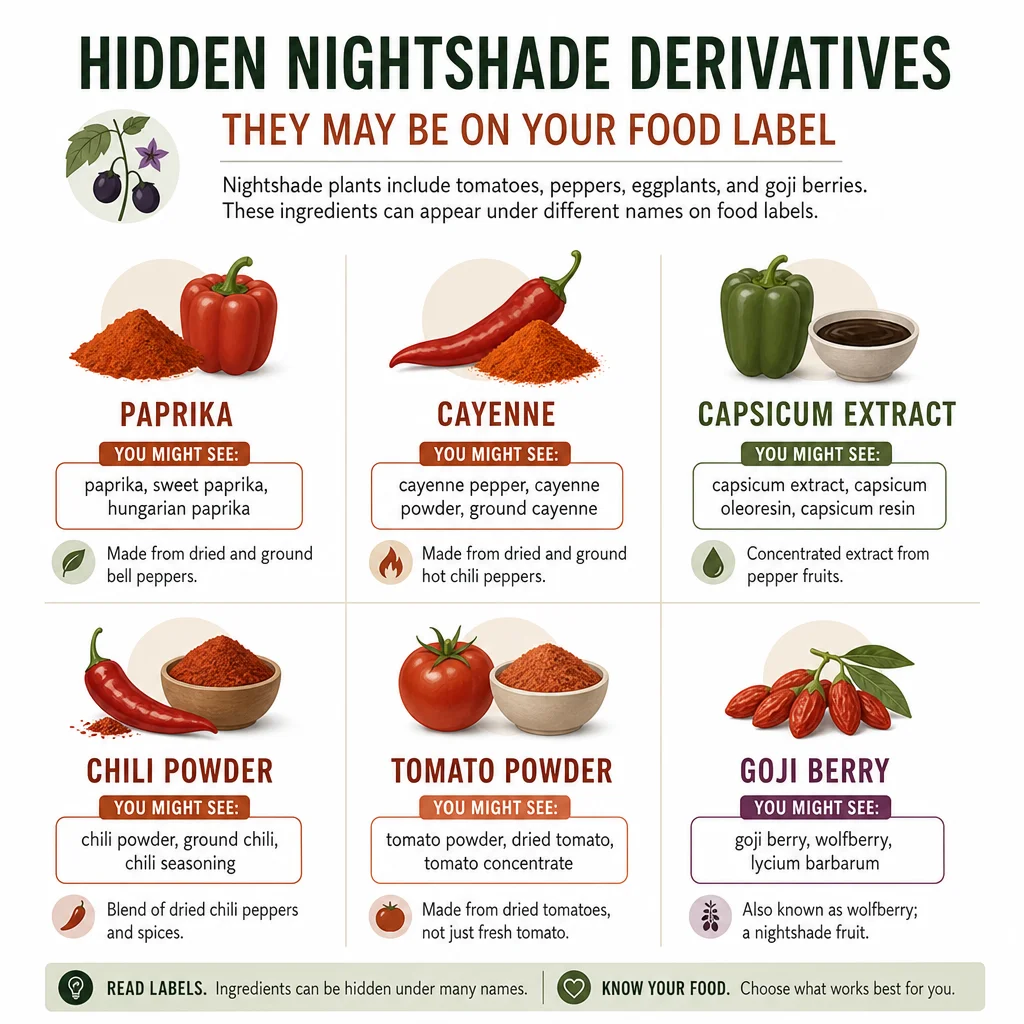
Nightshade derivatives are the single largest hidden risk. Paprika is a spice derived from dried red peppers and is present in virtually every commercial spice blend, barbecue seasoning, chili powder, taco seasoning, and smoked seasoning product. It appears in cured meats, sausages, deli meats, potato chips, crackers, and snack mixes, often listed simply as "paprika" but sometimes appearing as "smoked paprika," "sweet paprika," "Spanish paprika," or the vague term "spices." Capsicum extract and capsaicin are used as flavoring and heat agents and appear in hot sauces, marinades, canned chilis, pickled products, and some meat rubs. Tomato powder is used as a flavor base in soups, ramen seasoning packets, instant noodles, and ready-made pasta sauces. Tomato paste and tomato concentrate appear under those names in canned goods but also as "natural flavors" when used at low inclusion rates. Potato starch appears in gluten-free products, gravies, coating mixes, and many dairy-free cheese alternatives as a thickening agent.

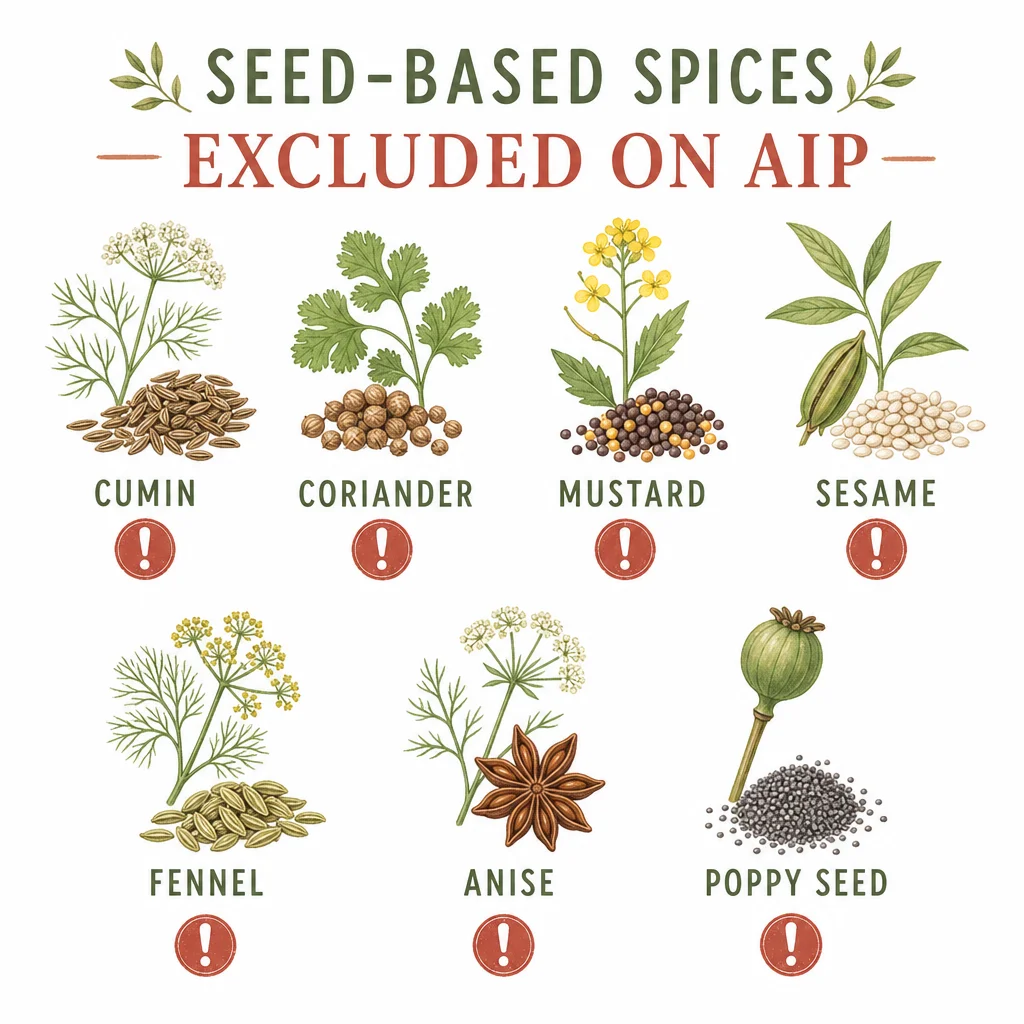
Seed-based spices represent another invisible category. Cumin, coriander, mustard seed, mustard powder, fennel seed, caraway seed, anise seed, fenugreek, nigella (black seed), and celery seed are all derived from seeds and excluded on AIP. These spices appear in curry powders, garam masala, ras el hanout, za'atar, five-spice powder, pickling spice, Italian seasoning, and most commercial "mixed spice" blends. Mustard is particularly pervasive. It appears in salad dressings, vinaigrettes, prepared mustards, deli meats, hot dogs, sausages, and many condiment sauces. In the EU, mustard is a mandatory allergen that must be declared, which helps AIP followers in Europe. In the US, mustard is not a top-9 allergen and may be hidden within "spices" or "natural flavors" on labels.

Legume derivatives are widespread in packaged food. Guar gum is extracted from guar beans and functions as a thickener and stabilizer in ice cream, yogurt alternatives, soups, sauces, gluten-free baked goods, and dairy-free milks. Locust bean gum (also called carob bean gum) comes from carob seeds and performs similar functions in chocolate alternatives, infant formula, and processed cheese products. Pea protein has become a common ingredient in protein bars, protein powders, plant-based meat alternatives, and fortified beverages. It may appear as "pea protein isolate," "yellow pea protein," or simply "vegetable protein." Soy lecithin is used as an emulsifier in chocolate, margarine, baked goods, salad dressings, and nearly any product requiring fat and water to combine. Carob powder and carob syrup appear in health food products as chocolate alternatives.

Grain derivatives are similarly widespread. Maltodextrin, derived from corn, wheat, or tapioca starch, is used as a carrier for powdered flavorings, spice extracts, and spray-dried ingredients. It appears on labels of spice blends, protein powders, seasoning packets, and packaged beverages, often without declaring its source grain. Dextrose is derived from corn or wheat and used as a sweetener and humectant in deli meats, sausages, pickled products, and some table salts. Modified food starch may be derived from corn, wheat, potato, or tapioca and appears in sauces, gravies, canned goods, and low-fat products. Malt extract, malt vinegar, and malt flavoring come from barley and appear in vinegar-seasoned chips, some soy sauce alternatives, and condiments.

Egg derivatives require attention beyond the obvious. Albumin (egg white albumin) is used as a clarifying agent in some wines and fruit juices. Lysozyme, listed on EU labels as E1105, is derived from egg whites and is used as a preservative in some cheeses and processed meats. Ovalbumin and globulin are egg proteins that appear in pharmaceutical coatings, some vaccines, and a small number of processed food products. Mayonnaise, aioli, hollandaise, many salad dressings, pasta (most fresh pasta contains egg), most commercial baked goods, and egg-washed pastries all contain egg in some form.

Food additives excluded on AIP include carrageenan, a seaweed-derived polysaccharide used to thicken dairy and dairy alternatives, infant formula, deli meats, and canned products. Research has raised questions about its potential to increase intestinal permeability, which directly conflicts with AIP's therapeutic goal. Xanthan gum, produced through bacterial fermentation of glucose, appears in gluten-free products, salad dressings, and sauces. Emulsifiers including carboxymethylcellulose (E466), polysorbate 80 (E433), and mono- and diglycerides are used extensively in packaged foods and are excluded under AIP's additive restrictions.

Natural flavors deserve particular scrutiny. In the US, the FDA's definition of natural flavors allows a broad range of ingredients, including nightshade-derived compounds, seed extracts, and legume-derived flavor carriers, to be grouped under this single term. A product labeled "natural flavors" might contain capsicum extract, tomato powder, mustard extract, or soy-derived compounds without specifically naming them.

US vs EU Labeling: What's Different

US vs EU Labeling: What's Different

Label reading on AIP looks meaningfully different depending on which country a product is purchased in, and understanding these regulatory differences saves significant time and frustration.

In the United States, the FDA mandates declaration of nine major allergens: milk, eggs, fish, shellfish, tree nuts, peanuts, wheat, soybeans, and sesame (sesame was added in 2023 under FASTER Act). This is useful for AIP followers tracking eggs and soy, but it leaves out many AIP-relevant ingredients. Mustard, celery, lupin, and sulfites are not required to be declared as allergens in the US. The term "spices" on a US label can legally conceal paprika, capsicum, cumin, coriander, mustard, and other excluded AIP spices. "Natural flavors" can mask an even wider range of AIP-incompatible compounds.

In the European Union, the situation is more favorable for AIP followers in several respects. EU Regulation 1169/2011 mandates declaration of 14 allergens, including mustard, celery, sesame, lupin, and sulfites. This means mustard must be highlighted in the ingredient list whenever it is present, regardless of quantity. Celery, which includes celery seed, must similarly be declared. The EU also requires that additives be listed with their function class name and either their additive name or E-number, making it easier to identify carrageenan (E407), polysorbate 80 (E433), and carboxymethylcellulose (E466) at a glance. The "spices" grouping can still be used in the EU for blends where no single allergen is present, but the mandatory allergen declarations reduce the scope for concealment.

One significant EU-specific consideration is the use of E-numbers. Some E-numbers represent compounds excluded on AIP that may not be obvious without reference. Carrageenan is E407. Locust bean gum is E410. Guar gum is E412. Carob bean gum and locust bean gum share the E410 designation. Xanthan gum is E415. Lysozyme from egg is E1105. For AIP followers shopping across borders or purchasing imported products, familiarity with relevant E-numbers provides an additional layer of protection.

A Practical Label-Reading Strategy

A Practical Label-Reading Strategy

Strictly Avoid

Any product containing the following ingredients is non-compliant with AIP and should not be purchased:

Paprika, capsicum, capsaicin, chili powder, cayenne, red pepper flakes, tomato, tomato powder, tomato paste, tomato concentrate, tomato extract, potato starch, potato flour, eggplant, goji berry. Soy, soy lecithin, soy protein, soybean oil, textured soy protein (TSP/TVP), tofu, miso. Pea protein, pea starch, guar gum, locust bean gum, carob. Wheat, wheat starch, wheat flour, barley, malt, malt extract, malt vinegar, oat, corn, cornstarch, corn syrup, dextrose (when corn-derived and unlabeled). Dairy: milk, cream, casein, caseinate, whey, lactalbumin, lactose, butter, ghee. Egg, egg white, egg yolk, albumin, ovalbumin, lysozyme, E1105. Carrageenan, E407. Cumin, coriander, fennel seed, caraway, anise, mustard, sesame, fenugreek, poppy seed, nigella, celery seed. Any product listing "spices" without full disclosure when the product category commonly contains seed spices or nightshades (spice blends, sausages, cured meats, flavored chips, marinades). "Natural flavors" or "natural flavoring" on savory or spiced products. "Starch" or "modified starch" without a named source. "Vegetable broth" or "vegetable stock." "Mixed spices," "spice blend," or "seasonings" without a complete breakdown. Wine-based products.

Generally Safe

These ingredients are typically compliant with AIP elimination phase requirements:

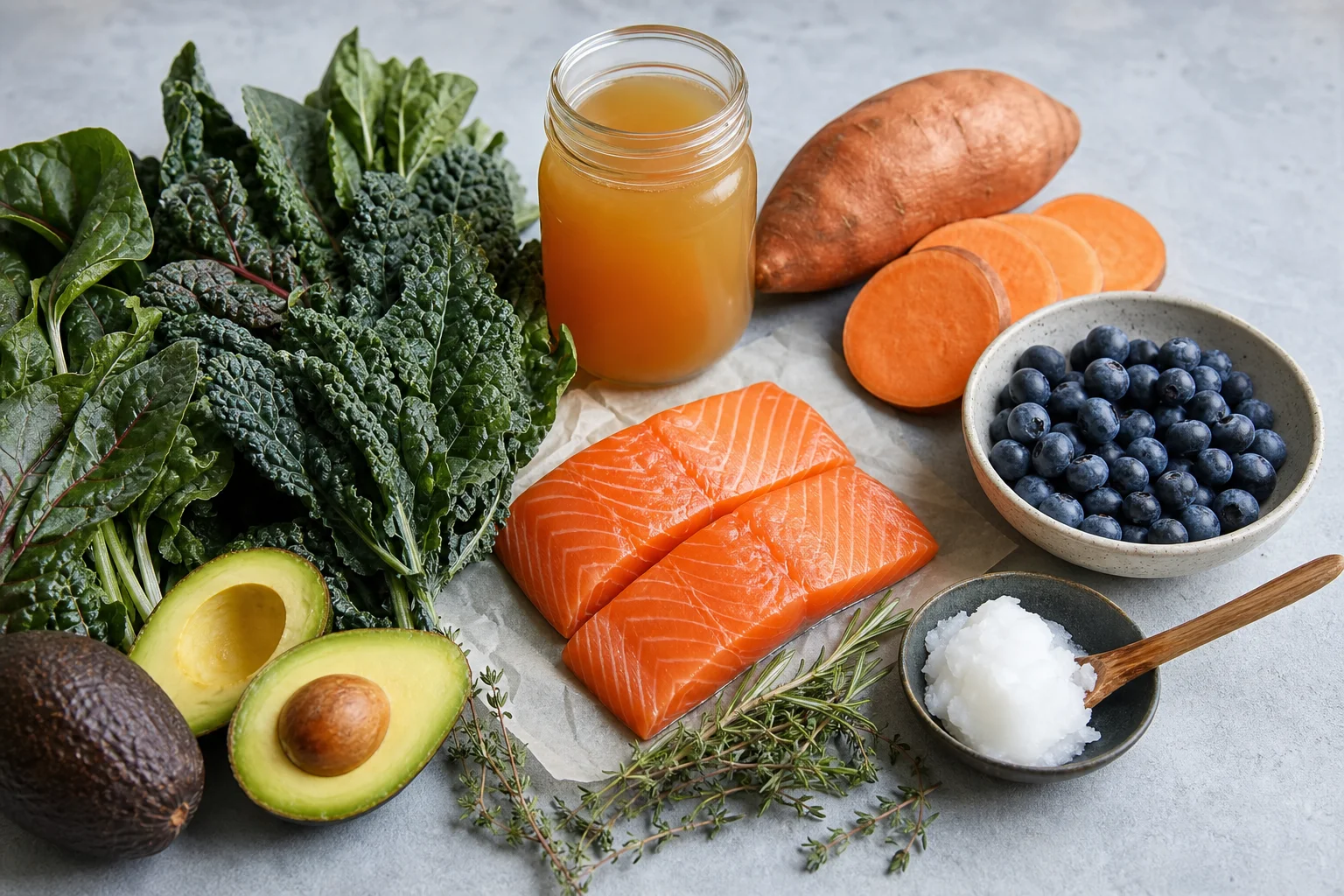
Coconut oil, olive oil, avocado oil, lard, tallow, and duck fat. Tapioca starch and arrowroot starch. Coconut milk and coconut cream when free of carrageenan and guar gum. Fresh or frozen meats, poultry, and seafood without added marinades. Bone broth and gelatin derived from animal bones without additives. Apple cider vinegar and balsamic vinegar in pure form. Leafy herbs such as basil, oregano, thyme, rosemary, sage, parsley, and cilantro (leaf-based, not seed-based). Turmeric (a rhizome, not a seed), ginger (a rhizome), garlic, and onion powder. Sea salt and Himalayan salt without anti-caking additives. Fruit-based vinegars. Coconut aminos. Honey and maple syrup in small amounts once elimination is established.

Ignore on Labels

These labeling terms and claims do not carry direct compliance implications for AIP:

"Gluten-free" (many gluten-free products contain corn, rice, potato, or egg). "Dairy-free" (may still contain caseinates or seed-based thickeners). "Vegan" (typically contains legumes, seeds, and grains). "Paleo" (Paleo does not exclude eggs, nightshades, or seed spices). "Non-GMO" and "organic" (these describe production method, not ingredient composition). "All natural" (no regulatory definition that aligns with AIP). "No artificial flavors" (natural flavors can still contain AIP-excluded compounds). "Healthy" or "clean" labels (marketing terms with no standardized meaning).

Navigating the Autoimmune Protocol in a supermarket is a genuine research task at every shopping trip, and the ingredient categories that cause the most compliance failures are rarely the obvious ones. For people who want to stop manually cross-referencing every label, IngrediCheck was built precisely for this scenario. It scans ingredient lists and flags AIP-incompatible ingredients by name, including the derivatives and renamed compounds covered in this guide. Those also managing related protocols such as Paleo or Whole30 restrictions alongside AIP will find that the overlapping exclusions make a reliable scanning tool even more valuable than maintaining separate mental checklists.
Next Label Check

Follow the scanner, hub, and ingredient paths connected to this guide

Get the app for clearer label decisions.

Scan labels, see what fits your food notes, and read the why in plain English.

IngrediCheck app