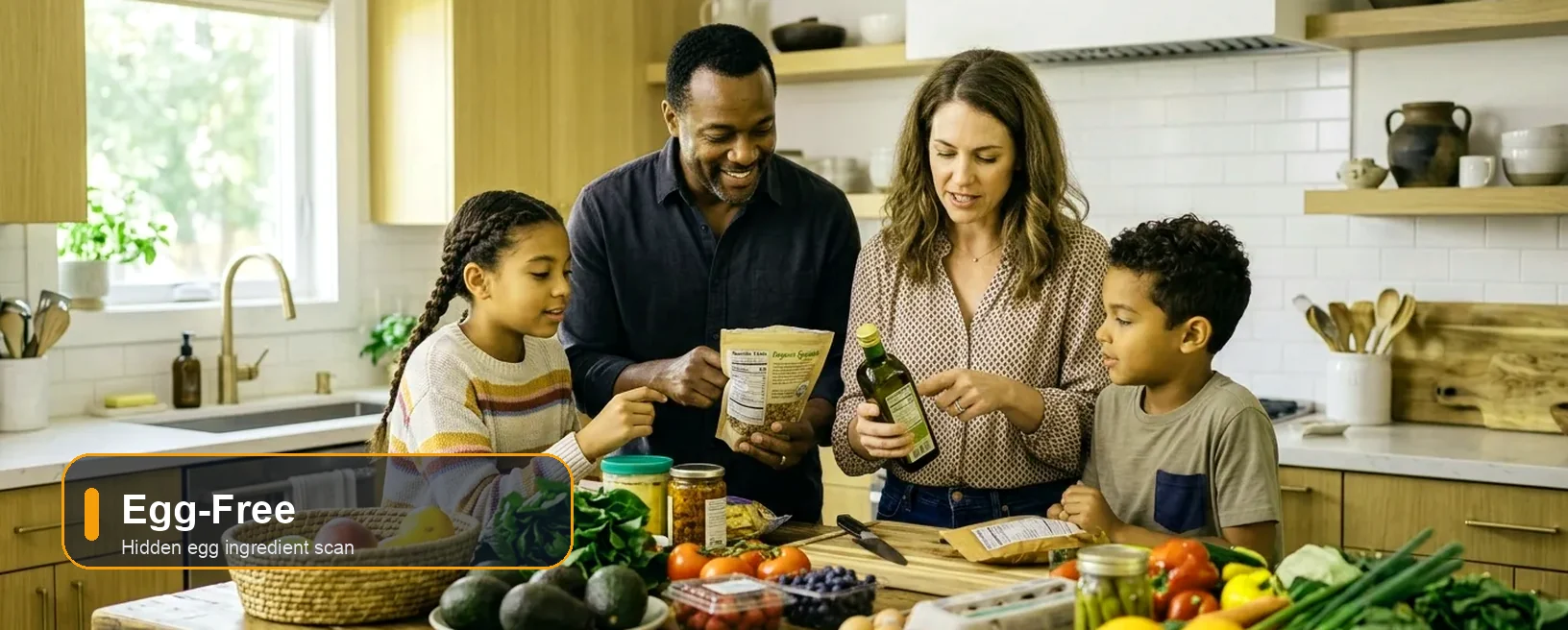
Egg-free shopping usually sounds simpler than it actually is. Everyone expects to avoid omelets and mayonnaise. Fewer shoppers expect to run into albumin, lysozyme, ovalbumin, meringue powder, or other egg-derived terms while reading a label in a hurry.
An egg-free scanner app is useful because it speeds up that first-pass review. Instead of manually translating every ingredient panel, you can scan the product, compare it against your own egg rules, and focus your attention on the labels that actually deserve a second look.
This article is for informational purposes only and should not be considered medical advice. If you are managing a diagnosed egg allergy or another medical condition, follow your clinician's guidance and use label scanning as a support tool rather than a substitute for medical advice.
Why Egg-Free Label Reading Is Harder Than Shoppers Expect
Egg is one of the major allergens covered by FDA food-allergen labeling rules and FALCPA. That means egg has to be declared when it is used as a major allergen ingredient in FDA-regulated packaged food.
That helps. But it still leaves shoppers doing interpretation work.
The FDA specifically tells consumers to read the entire ingredient list every time they buy a product, because a separate Contains statement is not the only place an allergen may appear and formulas can change over time.
In practice, the egg-free challenge is often:
- Is this an obvious egg ingredient or a technical term?
- Is the product fine for one person in the house but not another?
- Is this a familiar product with a new formula?
- Is the label simple enough to trust at a glance, or one I need to slow down for?
That is why egg-free shopping is a strong scanner use case even though the allergen itself is regulated.
Hidden Egg Ingredients Are Where the Real Friction Shows Up
FARE's egg guide is a good reminder that egg-free label reading is really an ingredient-alias problem, not just a Contains egg problem. FARE lists a set of less obvious egg-related terms shoppers often need to catch, including:
- albumin or albumen
- lysozyme
- ovalbumin
- ovomucoid and ovomucin
- meringue or meringue powder
- mayonnaise
- surimi
That is useful because many shoppers know what to do with the word egg, but not every shopper will instantly catch ovalbumin in a longer ingredient list.
This is where scanning earns its keep. A good egg-free scanner should make those hidden terms easier to catch without forcing you to manually decode the whole panel every time.
FDA's 2025 Egg Update Is More Important Than Most Shoppers Realize
One of the more interesting recent changes in allergen guidance is that the FDA now says, for allergen-labeling purposes, egg includes eggs from domesticated chickens, ducks, geese, quail, and other fowl.
That matters because many shoppers implicitly think egg means chicken egg only. FDA's interpretation is broader.
FARE's egg guidance adds the practical point that if you are allergic to chicken eggs, your doctor may recommend avoiding eggs from other domestic birds as well because cross-reaction can happen.
That is exactly the kind of knowledgeable detail a strong scanner workflow should respect. An app should not just look for the most obvious word. It should help reflect the actual rule set a shopper may need to enforce.
What an Egg-Free Scanner App Should Actually Do
If the goal is to make grocery shopping easier without making it sloppy, an egg-free scanner should:
- work from barcodes and ingredient-label photos
- flag both obvious egg ingredients and common aliases
- support multiple saved profiles
- explain why a product was flagged
- help you compare products against your own household rules instead of a generic allergen score
That matters because real households often have combinations like:
- one child with egg allergy
- another person avoiding egg for a separate reason
- a parent who wants extra review for bakery products or imported foods
Without saved rules, one scan still turns into several manual checks. With them, the scan becomes useful.
Why Families Benefit From Faster Egg Checks
Egg-free shopping is a perfect example of why multi-profile scanning matters.
One product may be:
- wrong for a child with egg allergy
- fine for another household member
- something you want to review more carefully because of ingredient aliases or unfamiliar labeling
That is why the best scanner workflow is not one product, one global verdict. It is one scan, multiple household checks, clear reasons.
The value is not just speed. It is consistency.