Ingredient FAQs

Is Stearic Acid Vegan? Stearates, E570 and E572 Explained

Stearic acid and stearates may begin with plant oils or animal fats. Learn what E570 and E572 mean and how to verify source-dependent labels.

Jul 21, 2026|8 min read
By Sanket Patel|Updated 2026-07-21|4 sources|Editorial standards
Is Stearic Acid Vegan? Stearates, E570 and E572 Explained

Quick answer: Stearic acid is not automatically vegan or non-vegan. It is a saturated fatty acid that occurs in both plant oils and animal fats. Food-grade stearic acid, stearates, E570, and E572 can be manufactured from different fat feedstocks, while the label usually names the chemical rather than the source. Plant-origin documentation or vegan certification is the reliable way to settle the question.

The word "acid" can make stearic acid sound synthetic or harsh. In chemistry, it simply describes a type of fatty acid. The real dietary question is not whether stearic acid is a fatty acid. It is which oil or fat supplied it and whether any animal-derived processing inputs were used.

What Stearic Acid Is

Stearic acid is an 18-carbon saturated fatty acid, also called octadecanoic acid. The PubChem record for stearic acid describes its molecular formula as C18H36O2. It occurs naturally as part of triglycerides in many fats and oils.

In manufacturing, stearic acid can help with texture, release, lubrication, emulsification, and flow. Its salts and related compounds are also called stearates. Depending on the product, you may encounter:

  • stearic acid or octadecanoic acid
  • E570, the European additive category for fatty acids
  • magnesium stearate or E572
  • calcium stearate
  • sodium stearate
  • zinc stearate in non-food applications
  • glycerol monostearate, a separate glyceride ingredient

The US food rule for stearic acid recognizes it as a food substance and describes commercial preparation from fats and oils. That wording matters: "fats and oils" can include multiple biological sources.

Why Plant and Animal Sources Share One Name

Why Plant and Animal Sources Share One Name

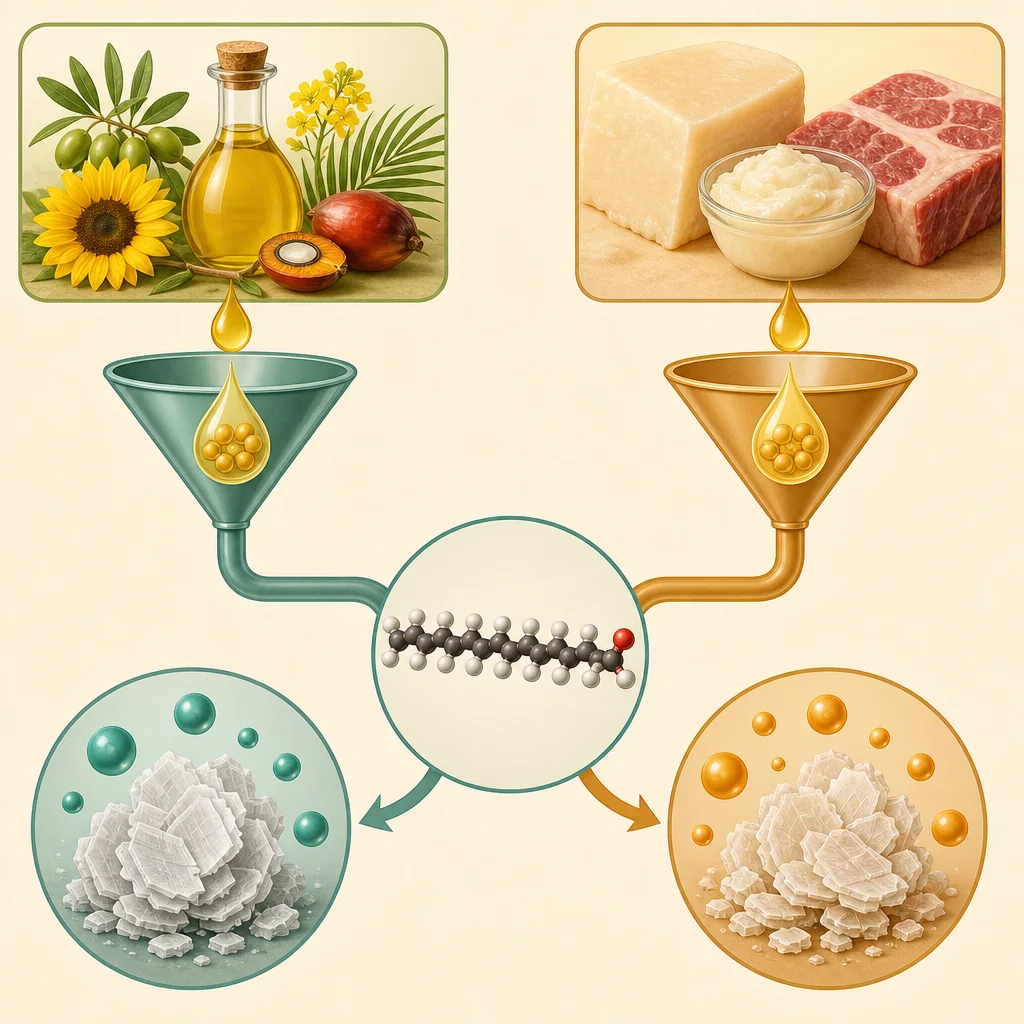
Plants and animals both store energy in triglycerides. Those triglycerides contain fatty acids attached to glycerol. Manufacturers can split, fractionate, distill, and purify the fatty-acid mixture to obtain a stearic-acid-rich material.

Possible plant feedstocks include palm, coconut, soybean, rapeseed, sunflower, and other oils. Possible animal feedstocks include tallow and other rendered fats. The exact commercial mix depends on the supplier, required specification, region, and price.

Once purified, stearic acid from a plant and stearic acid from an animal have the same basic molecular structure. A package cannot communicate origin by writing the chemical name more precisely. The answer lives in the supplier specification and traceability records.

E570 and E572 Are Categories, Not Vegan Marks

E570 identifies fatty acids approved for specified food uses in the European system. Stearic acid can be part of that category. The code does not tell you which feedstock supplied those fatty acids.

E572 is commonly associated with magnesium stearate. Magnesium stearate is a salt formed from magnesium and stearic acid. The magnesium portion is mineral-derived, but the stearic-acid portion can still carry the original source question.

This creates a frequent misunderstanding: "magnesium" sounds mineral, so shoppers assume magnesium stearate must be vegan. The mineral does not determine the source of the attached fatty acid.

The reverse shortcut is also unreliable. Seeing "stearate" does not prove that tallow was used. Many suppliers sell vegetable-derived stearic acid and stearates specifically for vegan, vegetarian, halal, kosher, pharmaceutical, and personal-care markets.

Where Stearic Acid and Stearates Appear

In foods and supplements, these compounds may be used as release agents, binders, emulsifying aids, anticaking agents, or tablet lubricants. Check:

  • vitamin and mineral tablets
  • powdered drink and supplement mixes
  • pressed candies and mints
  • chewing gum
  • bakery-release formulations
  • confectionery and coating systems
  • seasoning blends and powdered ingredients
  • capsule and tablet manufacturing aids

They are also common in cosmetics, soaps, candles, and medicines. A source statement for a cosmetic ingredient does not automatically cover a food or supplement sold under the same brand.

Food labels do not always expose every processing aid. Even when magnesium stearate appears in a supplement's "other ingredients" list, the origin of its stearic acid may remain private supplier information.

Do All Stearates Have the Same Source Question?

They share a family resemblance, but each compound should be checked on its own.

Magnesium, calcium, and sodium stearates

These are salts of stearic acid. Their vegan status depends largely on the fatty-acid source and the production specification.

Glycerol monostearate

Glycerol monostearate joins glycerol with stearic acid. It may raise two source questions: the glycerol source and the stearic-acid source. It is related to the broader mono- and diglycerides family, not another name for free stearic acid.

"Vegetable stearate"

This is stronger evidence because it states a plant origin. Still, check whether the claim applies to the exact ingredient and current product rather than to a company's general sourcing policy.

Stearyl alcohol

Stearyl alcohol is a fatty alcohol, not stearic acid. It can also be produced from plant or animal fatty materials. Similar spelling should not be treated as proof of identical chemistry or sourcing.

Labeling Rules Do Not Usually Reveal Feedstock

Labeling Rules Do Not Usually Reveal Feedstock

Ingredient rules generally require a common or usual name. They do not require "palm-derived stearic acid" or "tallow-derived magnesium stearate" on every package. Allergen statements are not a substitute because animal fat itself is not one of the regulated major-allergen categories.

A vegan certification evaluates a different question. Under the V-Label criteria, vegan products may not use animal-origin ingredients or animal-origin processing aids. That supply-chain requirement can resolve an ambiguity that the ingredient name cannot.

"Plant-based," "natural," "clean," and "non-dairy" are weaker signals. None is a source declaration for stearic acid. Halal and kosher certifications can provide useful manufacturing information, but their rules are not identical to vegan standards. A substance can meet one standard without meeting another.

How to Verify Stearic Acid and E572

1. Identify the exact term

Record whether the label says stearic acid, magnesium stearate, E570, E572, glycerol monostearate, or another compound. A customer-service answer about one does not necessarily cover the others.

2. Check for source wording

Look for "vegetable stearic acid," "plant-derived magnesium stearate," or "vegan capsule/tablet." Confirm that the wording comes from the manufacturer or certifier.

3. Use product-level certification

A recognized vegan mark is more useful than a general brand statement. Verify the exact flavor, dose, package, and country because supplement formulas often differ between markets.

4. Ask the complete sourcing question

Are the stearic acid and all stearates in this product made exclusively from plant-derived fatty acids, with no animal-derived processing aids or alternate animal-fat suppliers?

Ask whether the answer covers the current production lot or specification. A manufacturer may source the same functional ingredient from more than one qualified supplier.

5. Apply your ambiguity policy

Some shoppers accept likely vegetable-derived stearates unless an animal source is disclosed. Strict vegans may require certification or written confirmation. The goal is consistency, not false certainty.

Common Questions

Is magnesium stearate vegan?

It can be. Magnesium is not the problem, but the stearic acid may come from plant or animal fat. Verify the fatty-acid source.

Is E570 always animal-derived?

No. E570 identifies fatty acids, which can come from plant oils or animal fats. The code alone does not distinguish them.

Does stearic acid contain dairy?

Stearic acid is not inherently dairy. It can occur in dairy fat, other animal fats, and vegetable oils. A milk-allergen statement and a vegan-source statement answer different questions.

Is palm-derived stearic acid vegan?

It is animal-free by source and generally compatible with vegan ingredient rules. A shopper may still avoid palm for environmental or labor reasons. That is a separate preference from vegan status.

Why Supplements Need Extra Attention

Stearates are especially common in tablets because a small amount can help powder flow and keep a compressed tablet from sticking to manufacturing equipment. That role often places magnesium stearate near the end of an "other ingredients" list, where shoppers may assume it is too minor to matter.

Vegan standards do not depend on percentage. A low-use processing ingredient can still be animal-derived. At the same time, its minor quantity does not prove that the manufacturer ignored sourcing. Many supplement companies intentionally purchase vegetable magnesium stearate and can provide a suitable-for-vegans statement.

Capsule material is a separate check. A supplement may use plant-derived magnesium stearate inside a gelatin capsule, or an HPMC vegetable capsule with an unresolved stearate. Confirming one component does not settle the other.

The same product name may also have several dosage forms. Tablets, softgels, gummies, powders, and liquids can use different excipients. A vegan answer for the powder should not be carried over to the tablet without checking the exact stock-keeping unit.

What a Supplier Declaration Should Cover

Good documentation names the fatty-acid origin and excludes substitution with animal-derived feedstock. It should cover stearic acid, any mixed fatty acids used to make the stearate, and relevant processing aids. If the declaration says only "vegetable grade," ask what that term means in the supplier's controlled specification.

For products made at multiple sites, ask whether the source rule is global. A company may use vegetable-derived stearates in one country while qualifying a different supplier elsewhere. Current product-level certification remains the simplest evidence because it connects sourcing requirements to the item being sold.

IngrediCheck can flag stearic acid, E570, magnesium stearate, and E572 as source-dependent terms instead of forcing an unsupported verdict. Use the vegan ingredient checker or vegetarian ingredient checker to review the full label, then use certification or manufacturer documentation to resolve the feedstock.

Next Label Check

Follow the scanner, hub, and ingredient paths connected to this guide

Get the app for clearer label decisions.

Scan labels, see what fits your food notes, and read the why in plain English.

IngrediCheck app