Dietary Guides

Celiac Disease Dietary Guide: The 20 PPM Rule, FALCPA Gaps, and Hidden Gluten Sources

An encyclopedic guide to celiac disease dietary management covering the HLA-DQ2/DQ8 autoimmune mechanism, FDA's 20 ppm gluten-free threshold and its analytical basis, the barley/rye FALCPA labeling gap, hidden gluten in oats and medications, EU 'very low gluten' category, GFCO's stricter 10 ppm seal, cross-contamination risks, and refractory celiac disease.

Jun 9, 2026|15 min read
By Sanket Patel|Updated 2026-06-09|9 sources|Editorial standards
Celiac Disease Dietary Guide: The 20 PPM Rule, FALCPA Gaps, and Hidden Gluten Sources

Celiac disease affects approximately 1 percent of the global population, an estimated 2 million Americans, yet only about 30 percent are correctly diagnosed. The average delay between symptom onset and confirmed diagnosis has historically been 6 to 10 years, during which the autoimmune damage to the small intestine accumulates silently. People with undiagnosed celiac disease face a 2-fold greater risk of coronary artery disease, a 4-fold greater risk of small bowel cancers, and significantly elevated risks of osteoporosis, infertility, and type 1 diabetes.

Unlike food intolerances or wheat allergies, celiac disease is an autoimmune condition. There is no dose threshold below which intestinal damage does not occur, any gluten exposure activates the immune cascade. Yet the FDA's gluten-free labeling rule, which was designed to protect celiac patients, was set at a threshold determined by what analytical equipment could reliably detect, not by what is definitively safe for all individuals.

This guide covers the disease mechanism, the regulatory framework, every hidden gluten source, and the certification seals that go beyond FDA's 20 ppm standard.
The Autoimmune Mechanism: HLA-DQ2/DQ8, tTG, and Villous Atrophy

Celiac disease is a hereditary autoimmune condition triggered by the ingestion of gluten, the storage proteins gliadin and glutenin found in wheat, barley, and rye. The genetic predisposition is specific: approximately 90 percent of people with celiac disease carry the HLA-DQ2 allele; approximately 5 percent carry HLA-DQ8. These alleles are common in the general population (about 30 to 40 percent of people carry HLA-DQ2), but they are necessary but not sufficient, additional genetic and environmental factors determine who develops the disease.

The mechanism operates in three steps:

  1. Gliadin peptides enter the intestinal submucosa, where the enzyme tissue transglutaminase (tTG) deamidates specific glutamine residues in gliadin
  2. The resulting deamidated gliadin peptides bind with high affinity to HLA-DQ2 or HLA-DQ8 molecules on antigen-presenting cells, activating CD4+ T cells
  3. This adaptive immune response triggers cytokine release that causes villous atrophy, the flattening of the fingerlike projections lining the small intestine that absorb nutrients

Villous atrophy produces malabsorption of nutrients including iron, calcium, folate, and fat-soluble vitamins. Diagnostic antibodies, anti-tissue transglutaminase IgA (anti-tTG) and anti-endomysial IgA (EMA), are produced as part of this immune response and have specificity above 99 percent when villous atrophy is present.

This mechanism is distinct from:

  • Non-celiac wheat sensitivity (NCWS): triggers an innate (not adaptive) immune response; no villous atrophy; negative tTG and EMA antibodies. The precise trigger may not be gluten itself
  • Wheat allergy: an IgE-mediated allergic response; different mechanism, different treatment, may resolve in childhood

For dietary management purposes, celiac disease requires the strictest gluten avoidance of the three because any gluten exposure reactivates the autoimmune cascade.

The FDA 20 PPM Threshold: How It Was Set and Why It's Controversial

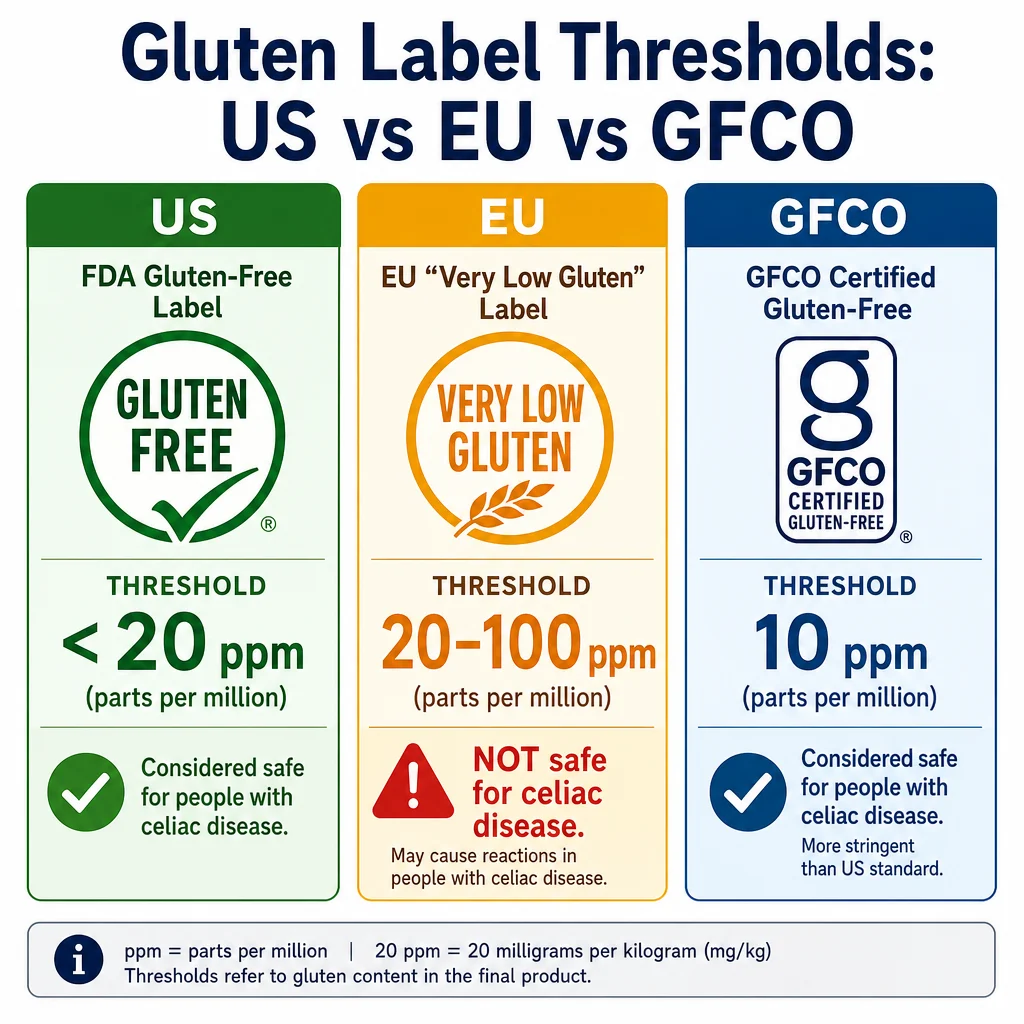
FDA published the Gluten-Free Labeling Final Rule in August 2013 (78 FR 47154), effective for compliance by August 2014. Under 21 CFR § 101.91, a food bearing a "gluten-free" claim must contain less than 20 parts per million (ppm) of gluten, equivalent to 20 milligrams per kilogram of food.

How the 20 ppm threshold was determined: FDA evaluated four possible approaches: safety-based (from a no-observed-adverse-effect level); risk-based; a combination; and analytical methods-based. FDA chose the analytical methods approach. The 20 ppm threshold corresponds to the lower limit of reliable detection using validated ELISA analytical methods (specifically the R5-ELISA). It was not derived from clinical data showing 20 ppm is safe for all celiac patients.

FDA's own language in the rule states the finding applies to "most individuals with celiac disease", an acknowledgment that some patients may react to levels below 20 ppm. The rule was also explicitly designed to harmonize with the international Codex Alimentarius Standard 118-1979 and the European Commission regulation in effect at the time.

The rule prohibits using the terms "gluten-free," "no gluten," "free of gluten," or "without gluten" on any food that fails to meet the 20 ppm standard. A food bearing any of these claims that exceeds 20 ppm is legally misbranded.

The FALCPA Barley and Rye Labeling Gap

The Food Allergen Labeling and Consumer Protection Act of 2004 (FALCPA) requires food manufacturers to declare when a product contains one of the eight major food allergens: milk, eggs, fish, shellfish, tree nuts, peanuts, wheat, and soybeans (the FASTER Act of 2021 added sesame as a ninth).

Wheat is a FALCPA-covered allergen, barley and rye are not.

This creates a critical gap for celiac patients. A product containing barley-derived malt extract, malt syrup, malt flavoring, brewer's yeast, or rye flour has no regulatory obligation to declare these ingredients in a "Contains:" allergen statement. The ingredients will appear in the ingredient list, but there is no requirement to flag them as allergens the way wheat must be flagged.

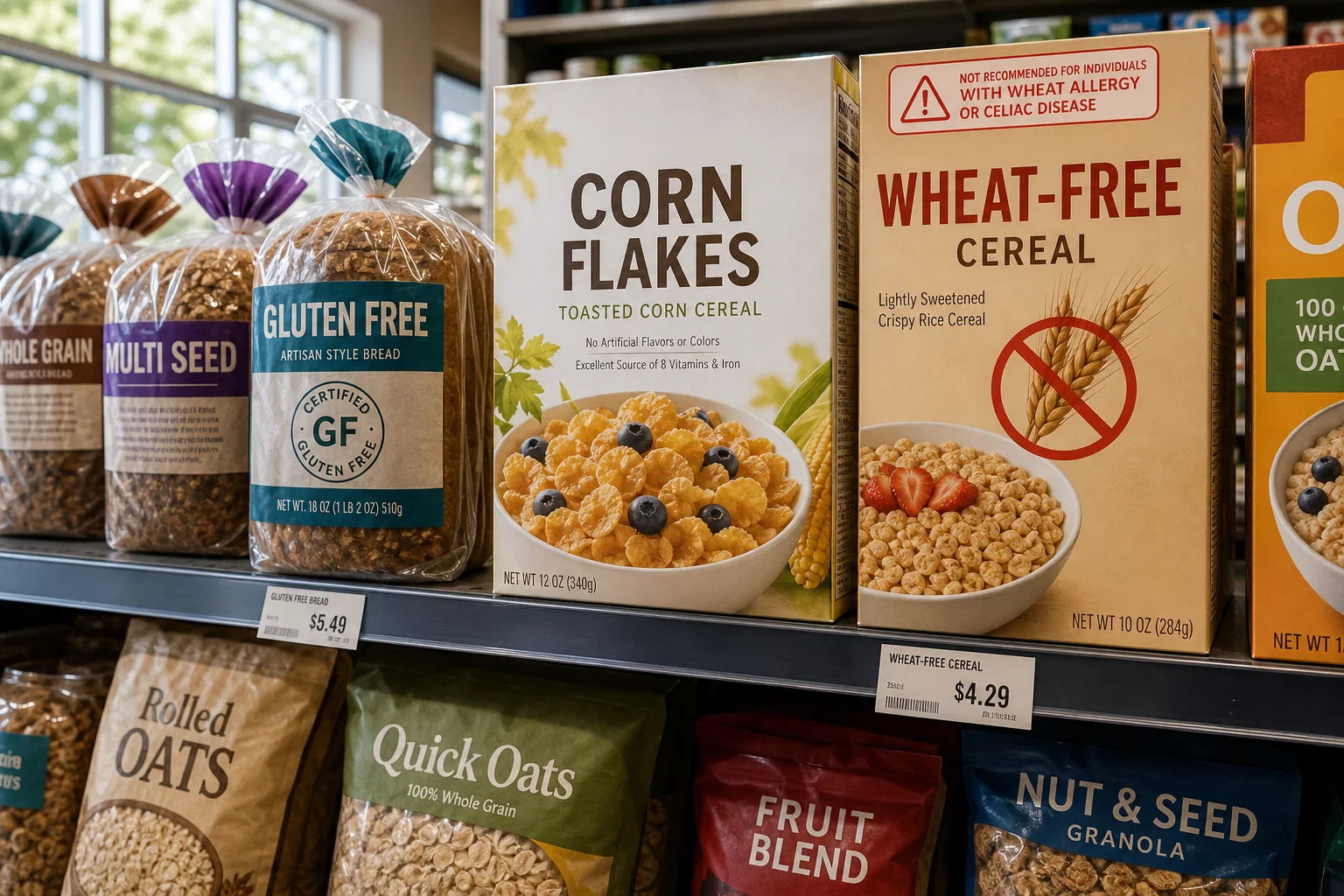
The practical consequence: a celiac patient who relies on the "Contains:" allergen box at the bottom of the label, or who looks only for the word "wheat," can miss barley and rye entirely. A breakfast cereal that contains malt extract from barley but no wheat can have no allergen warning and no "gluten-free" claim while being entirely unsafe for celiac disease.

The only reliable protection is reading the full ingredient list for barley, rye, and their derivatives, regardless of what the allergen statement says.

EU vs. US: The "Very Low Gluten" Category Celiac Patients Must Know About

EU vs. US: The "Very Low Gluten" Category Celiac Patients Must Know About

The US has one standard: "gluten-free" means less than 20 ppm. There is no intermediate category.

The EU, following Codex Standard 118-1979, has two categories under EU Regulation 828/2014:

"Gluten-free": 20 ppm or less, same as US "Very low gluten": above 20 ppm but at or below 100 ppm, this category is permitted only for products made from wheat, barley, rye, or their crossbreeds that have been specially processed to remove gluten

The "very low gluten" category is significant for celiac patients buying European products. A European product labeled "very low gluten" may contain up to 100 ppm of gluten, five times the US "gluten-free" standard. Products in this category are generally made from wheat starch that has been processed to reduce (but not eliminate) gluten, and they are generally considered unsuitable for strict celiac disease management.

If you see a European product labeled "very low gluten" or "poids/gluten très bas" (French) or "sehr geringer Gehalt an Gluten" (German), it is NOT the same as "gluten-free" and should be avoided by people with celiac disease.

Third-Party Certification Seals

Third-Party Certification Seals

Because the FDA 20 ppm standard was set at the analytical detection limit rather than a clinical safety threshold, some independent certification programs use stricter standards:

Gluten-Free Certification Organization (GFCO): managed by the Gluten Intolerance Group (GIG). Requires finished products to test below 10 ppm (or the lower threshold of the country of sale). Also requires individual ingredient testing, not just finished product testing. The GFCO seal is the most widely recognized stricter-than-FDA certification in the US.

Gluten-Free Food Service (GFFS): also managed by GIG. Not a product certification, validates that food service facilities (restaurants, hospitals, bakeries) follow protocols that prevent cross-contamination. Covers training, procedures, and recipes rather than testing finished products.

NSF/ANSI 305: primarily for personal care products and non-food items; uses the 20 ppm FDA standard but requires validated testing methodology.

For highly sensitive celiac patients who experience symptoms even from trace amounts, the GFCO seal (10 ppm) provides an additional margin of safety beyond the FDA standard.

Oats: The Special Case

Oats are naturally gluten-free grains. However, conventional commercial oats are almost always contaminated with wheat, barley, or rye during growing (if grown adjacent to gluten-containing crops), harvesting (shared equipment), transport, and processing. Most conventionally available oats cannot be assumed safe for celiac disease.

Certified gluten-free oats are grown from dedicated seed stocks in isolated fields, harvested and transported with dedicated gluten-free equipment, and processed in dedicated facilities with testing to confirm less than 20 ppm.

An additional complexity: oats contain a protein called avenin that shares structural similarity with gluten proteins. A subset of celiac patients, estimated at 1 to 3 percent, mount an immune response to avenin even from certified gluten-free oats. The NIDDK recommends that celiac patients discuss oat inclusion with their physician before adding them to the diet.

Some countries (Australia and New Zealand) take a more conservative approach and prohibit any oats in gluten-free products regardless of contamination status.

Hidden Gluten Sources

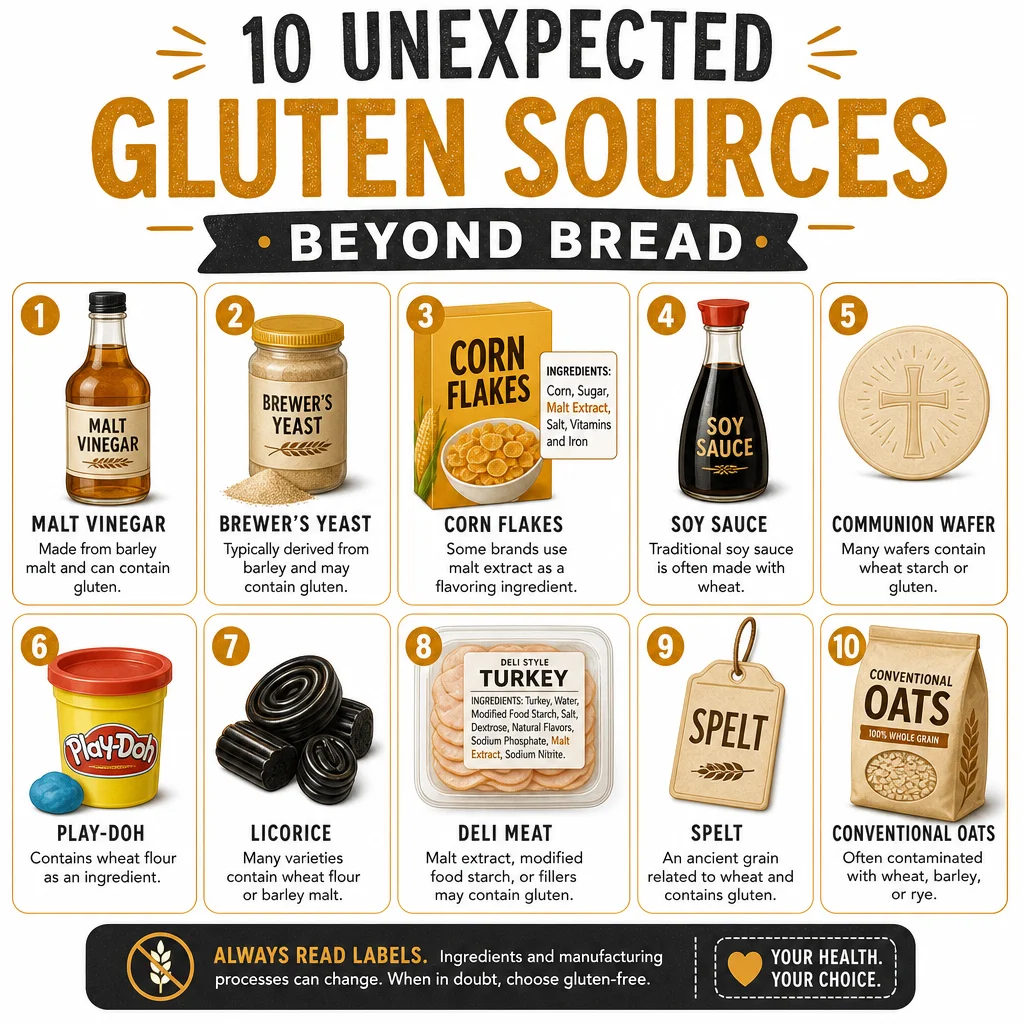
Beyond bread and pasta, gluten appears in many unexpected places:

Barley derivatives in otherwise "wheat-free" products:

  • Malt extract / malt syrup / malt flavoring (from barley), very common in breakfast cereals, even corn-based ones
  • Malt vinegar, common in British-style chips, condiments, and salad dressings
  • Brewer's yeast, used as a nutritional supplement and flavoring; derived from barley fermentation
  • Beer and ale, virtually all contain barley gluten unless specifically labeled gluten-free
  • Whiskey/Scotch/Bourbon, distillation typically removes gluten proteins, but the FDA has not authorized a "gluten-free" claim for products made from gluten-containing grains

Wheat derivatives not always recognized:

  • Soy sauce, traditional soy sauce uses wheat as a fermentation substrate (contains gluten); tamari is typically wheat-free but verify
  • Seitan / "wheat meat" / "wheat protein", pure gluten; appears in vegan meat substitutes
  • Spelt, farro, kamut, einkorn, emmer, ancient wheat varieties; all contain gluten
  • Wheat starch, may appear "gluten-free" if processed to below 20 ppm; check certification
  • Triticale, a wheat-rye hybrid

Processing and manufacturing:

  • "Modified food starch", in the US, if derived from wheat, it must be declared as "modified wheat starch" per FALCPA. If it says only "modified food starch," it is likely corn-based. In imported products, this may not apply.
  • "Natural flavors", may contain wheat-derived ingredients; regulatory requirement to disclose wheat origin applies under FALCPA
  • Communion wafers (religious context), traditional Catholic wafers use wheat; some dioceses permit low-gluten hosts; standard gluten-free wafers are not permitted for Eucharistic use under Vatican rules

Non-food gluten sources:

  • Children's modeling compounds (Play-Doh contains wheat flour), hand-to-mouth transfer
  • Lipstick, lip gloss, lip balm, lip products are ingested in small amounts; gluten in these products can trigger celiac reactions in sensitive individuals
  • Some medications, wheat starch is used as a tablet binder/excipient; ask your pharmacist about inactive ingredients
  • Vitamin and mineral supplements, may use wheat starch as a bulking agent; check excipient lists

Refractory Celiac Disease

Approximately 20 percent of celiac patients who strictly follow a gluten-free diet continue to have symptoms and intestinal damage. The first step in evaluating persistent symptoms is always ruling out inadvertent gluten ingestion (including cross-contamination at home, restaurants, or through medications) and co-existing conditions (lactose intolerance, small intestinal bacterial overgrowth, irritable bowel syndrome, pancreatic insufficiency, microscopic colitis) that can mimic celiac symptoms on a GFD.

True refractory celiac disease (RCD), defined as persistent or recurrent villous atrophy on biopsy despite at least 6 to 12 months of a strict GFD with confirmed dietary adherence, affects fewer than 5 percent of non-responsive patients:

  • RCD Type I: phenotypically normal intraepithelial lymphocytes; managed with immunosuppressants (budesonide, azathioprine). Better prognosis.
  • RCD Type II: clonal expansion of aberrant lymphocytes with abnormal surface markers; pre-malignant. Associated with high risk of enteropathy-associated T-cell lymphoma (EATL), a rare but aggressive intestinal cancer. Requires specialist management.

RCD is a celiac-specific complication with no equivalent in non-celiac gluten sensitivity.

A Practical Label-Reading Strategy

This section is designed to work as a standalone reference when reading food labels with celiac disease.

Ingredients and Additives to Avoid

The following ingredients contain gluten or are derived from gluten-containing grains and must be flagged for celiac disease management:

Wheat and wheat-derived ingredients (strict avoidance)

  • Wheat, wheat flour, whole wheat, enriched wheat flour
  • Wheat starch (unless certified gluten-free and bearing a verified claim)
  • Durum wheat, semolina, farro, spelt, kamut / khorasan wheat, einkorn, emmer
  • Wheat berries, bulgur, farina, graham flour
  • Wheat bran, wheat germ
  • Seitan / wheat gluten / vital wheat gluten / wheat protein
  • Hydrolyzed wheat protein
  • Modified wheat starch (wheat must be declared in US per FALCPA)
  • Triticale (wheat-rye hybrid)

Barley and barley-derived ingredients (strict avoidance; NOT covered by FALCPA)

  • Barley, barley flour, barley flakes
  • Malt / malt extract / malted barley flour / malt syrup
  • Malt flavoring / natural malt flavor
  • Malt vinegar
  • Brewer's yeast (from barley fermentation)
  • Beer-battered ingredients

Rye and rye-derived ingredients (strict avoidance; NOT covered by FALCPA)

  • Rye, rye flour, rye flakes, rye bread ingredients

Oats requiring caution

  • Conventional oats / oat flour / rolled oats (assume contaminated unless certified)
  • "Gluten-free oats" (safe for most with celiac disease, but some react to avenin; physician guidance recommended)
  • Oat bran from conventional sources

Cross-contamination indicators requiring investigation

  • "Manufactured in a facility that also processes wheat", voluntary advisory; verify with manufacturer
  • "May contain wheat", voluntary advisory; the product may contain trace gluten
  • Any product without a verified gluten-free claim made in a facility handling wheat, barley, or rye

Hidden barley/rye sources most frequently missed

  • Soy sauce (most contain wheat; tamari is the safe alternative)
  • Corn flakes and rice cereals with "malt extract" or "malt flavoring" in ingredients
  • Salad dressings and marinades with malt vinegar
  • Licorice candy (often contains wheat flour)
  • Some cold cuts and processed meats with wheat-based fillers
  • Stock cubes and bouillon (may contain barley or wheat)
  • Some medications and supplement capsules (wheat starch excipients)

Misleading claims for celiac disease

  • "Wheat-free" (does not mean gluten-free; may still contain barley or rye)
  • "Gluten-friendly" (not a regulated term; has no defined standard)
  • "Grain-free" (may still contain other gluten sources)
  • "Very low gluten" (EU category up to 100 ppm; NOT safe for celiac disease)

Step-by-step checklist:

  1. Look for a verified "gluten-free" claim. Under FDA rules, this means less than 20 ppm. For stricter protection, look for the GFCO seal (10 ppm), especially for products where cross-contamination is common (oats, grains, shared-facility baked goods).
  1. Read the allergen statement BUT do not stop there. "Contains: wheat" means wheat is present. The absence of a wheat allergen statement does not mean the product is gluten-free, barley and rye are not FALCPA allergens and will not appear in the "Contains" box.
  1. Scan the full ingredient list for barley and rye derivatives. Look specifically for: malt, malt extract, malt flavoring, malt vinegar, brewer's yeast, rye, rye flour, and triticale. These will not be flagged in any allergen statement.
  1. Check oats and oat-containing products. Any oats without a "gluten-free" certification or the GFCO seal should be assumed contaminated. Even certified gluten-free oats may cause reactions in a subset of celiac patients.
  1. Verify "wheat-free" claims. Wheat-free is not gluten-free. A wheat-free product may still contain barley malt, rye flour, or contaminated oats.
  1. Flag EU imported products labeled "very low gluten." This EU category permits up to 100 ppm of gluten, five times the FDA gluten-free standard. Avoid these products.
  1. Check medications and supplements. Ask your pharmacist for the complete excipient list of any medication. Wheat starch is used as a binder/filler in some tablets. Supplements may use wheat-derived ingredients as bulking agents.
  1. Assess non-food items that contact the mouth. Lip products and some toothpastes contain gluten-derived ingredients that can be inadvertently ingested. Review ingredient lists for wheat, barley, and rye derivatives.

IngrediCheck can scan ingredient lists for all gluten-containing grain derivatives, flag malt and malt-derived ingredients that would not appear in an allergen statement, and identify EU "very low gluten" products that are unsafe for celiac disease management.

For PKU patients who also need to avoid aspartame, the labeling rules differ significantly, the PKU Dietary Guide covers the FDA mandatory phenylalanine warning and all hidden protein sources.

Next Label Check

Follow the scanner, hub, and ingredient paths connected to this guide

Get the app for clearer label decisions.

Scan labels, see what fits your food notes, and read the why in plain English.

IngrediCheck app