Dietary Guides

PKU Dietary Guide: Phenylalanine in Aspartame, Protein Hydrolysates, and Every Hidden Source

An encyclopedic guide to phenylketonuria (PKU) dietary management covering the PAH enzyme defect, blood Phe targets, the FDA-mandated aspartame warning, all hidden phenylalanine sources from hydrolysates to collagen peptides, maternal PKU risks, and the sapropterin treatment breakthrough.

Jun 9, 2026|15 min read
By Sanket Patel|Updated 2026-06-09|9 sources|Editorial standards
PKU Dietary Guide: Phenylalanine in Aspartame, Protein Hydrolysates, and Every Hidden Source

Phenylketonuria (PKU) is a rare but serious inborn error of metabolism affecting approximately 1 in 10,000 to 15,000 births in the United States. Without treatment, it causes severe and irreversible intellectual disability. With early diagnosis through newborn screening and strict dietary management, individuals with PKU can live entirely normal lives. The dietary requirement is lifelong and demanding: phenylalanine, an essential amino acid present in virtually every protein-containing food, must be kept within a narrow therapeutic range from birth through adulthood.

This guide explains the biochemistry, all hidden dietary phenylalanine sources, the regulatory framework behind the mandatory aspartame warning, and the clinical thresholds that determine whether a food is safe or dangerous for someone with PKU.

What PKU Is: The PAH Enzyme and Why Phe Accumulates

PKU is caused by biallelic pathogenic variants in the PAH gene, which encodes phenylalanine hydroxylase (PAH), the enzyme responsible for converting the amino acid phenylalanine (Phe) into tyrosine (Tyr). This conversion requires a cofactor called tetrahydrobiopterin (BH4). In PKU, PAH activity is absent or severely reduced.

Without functional PAH:

  • Dietary Phe cannot be converted to Tyr
  • Phe accumulates in the blood and crosses the blood-brain barrier
  • Excess Phe is metabolized via alternative pathways into phenylpyruvate, phenylacetate, and phenyllactate, all neurotoxic compounds
  • Tyr becomes deficient, impairing the synthesis of dopamine, norepinephrine, epinephrine, and melanin

In untreated classic PKU, the progressive accumulation of Phe in the developing brain causes severe intellectual disability, seizures, microcephaly, behavioral problems, and a characteristic "mousy" odor from phenylacetic acid excreted in urine and sweat. The pale skin and light hair seen in some untreated PKU patients reflects melanin deficiency from blocked Tyr production.

PKU is the condition that launched newborn screening. Dr. Robert Guthrie developed the first newborn screening test for PKU in 1960 using dried blood spots. Every US state now mandates PKU screening within 24 to 72 hours of birth, making it detectable before any brain damage occurs. Modern screening uses tandem mass spectrometry to simultaneously measure blood Phe and Tyr.

PKU Classification and Blood Phe Targets

The severity of PKU correlates with the degree of PAH deficiency and the resulting blood Phe level on an unrestricted diet:

  • Classic PKU: untreated blood Phe above 1,000 µmol/L (16.5 mg/dL). Near-zero PAH activity. Requires strictest dietary restriction.
  • Variant PKU: untreated blood Phe 600 to 1,000 µmol/L. Partial PAH activity.
  • Mild HPA (hyperphenylalaninemia): untreated blood Phe 360 to 600 µmol/L. May not require full dietary restriction.

Normal blood Phe is below 120 µmol/L (2.0 mg/dL).

The ACMG 2023 clinical practice guidelines establish a treatment threshold: anyone with untreated blood Phe persistently above 360 µmol/L requires lifelong treatment. The therapeutic target range at all ages is 120 to 360 µmol/L, above normal but below the level that causes neurotoxicity.

The typical adult with classic PKU can tolerate only 200 to 400 mg of phenylalanine per day from all dietary sources. A single 100-gram serving of chicken breast contains approximately 816 mg of Phe, two to four times the entire daily budget.

Phenylalanine in Food: The Phe Exchange System

Because all natural proteins contain Phe (approximately 2.4 to 9 percent of protein by weight), every protein-containing food carries Phe. The UK-developed Phe exchange system, widely used in clinical practice and described in Evans et al. 2020, defines:

1 Phe exchange = 50 mg phenylalanine

A classic PKU adult on a 200 mg/day allowance has a budget of 4 exchanges per day. Most protein foods contain far more Phe than this budget permits.

High-Phe foods requiring near-total avoidance in classic PKU:

  • All meats, poultry, and fish (600-900 mg Phe per 100g)
  • Eggs (~680 mg Phe per 100g)
  • Dairy (milk, cheese, yogurt; 160-530 mg per 100g)
  • Nuts and seeds (1,000-2,000 mg per 100g for peanuts and almonds)
  • Legumes, soybeans, lentils, chickpeas (600-900 mg per 100g)
  • Wheat flour and most grains (~550 mg per 100g)
  • Aspartame (100% bioavailable Phe; see next section)

Low-Phe foods generally permitted in moderation:

  • Most fruits: apple, pear, banana (20-50 mg per 100g)
  • Most vegetables: carrots, lettuce, zucchini (30-75 mg per 100g)
  • Pure fats and oils: butter, olive oil (near zero)
  • Sugar, honey, jams

Per the UK consensus guideline, foods with 75 mg or less Phe per 100g AND with high water or fat content (diluting protein) can generally be consumed without counting exchanges. Foods above 75 mg Phe per 100g must be counted against the daily allowance.

The FDA Aspartame Warning: What the Regulation Actually Requires

The FDA Aspartame Warning: What the Regulation Actually Requires

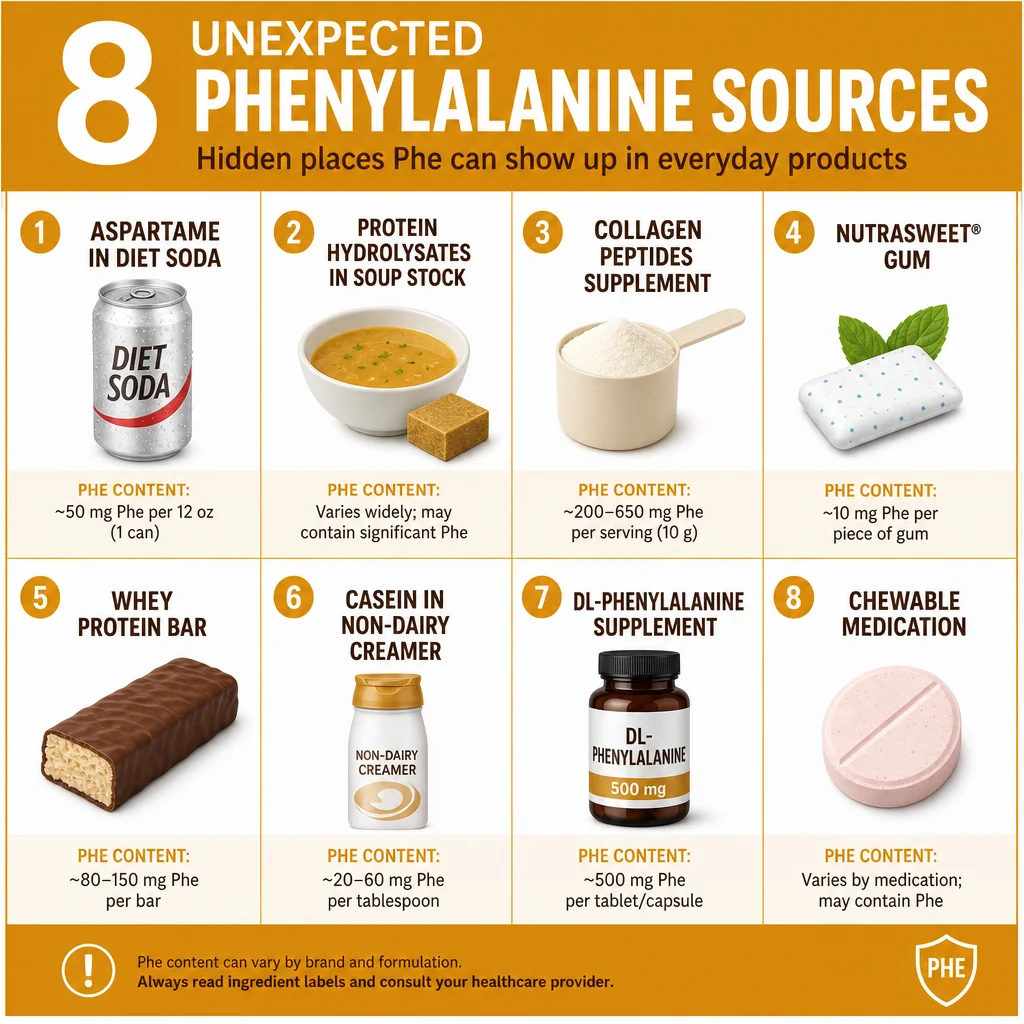
Aspartame is a dipeptide methyl ester of phenylalanine and aspartate. When metabolized in the gastrointestinal tract, it releases phenylalanine with 100 percent bioavailability. A 12-ounce diet soda sweetened with aspartame contains approximately 180 mg of aspartame, yielding approximately 100 mg of phenylalanine, which can represent 25 to 50 percent of a classic PKU patient's entire daily budget from a single beverage.

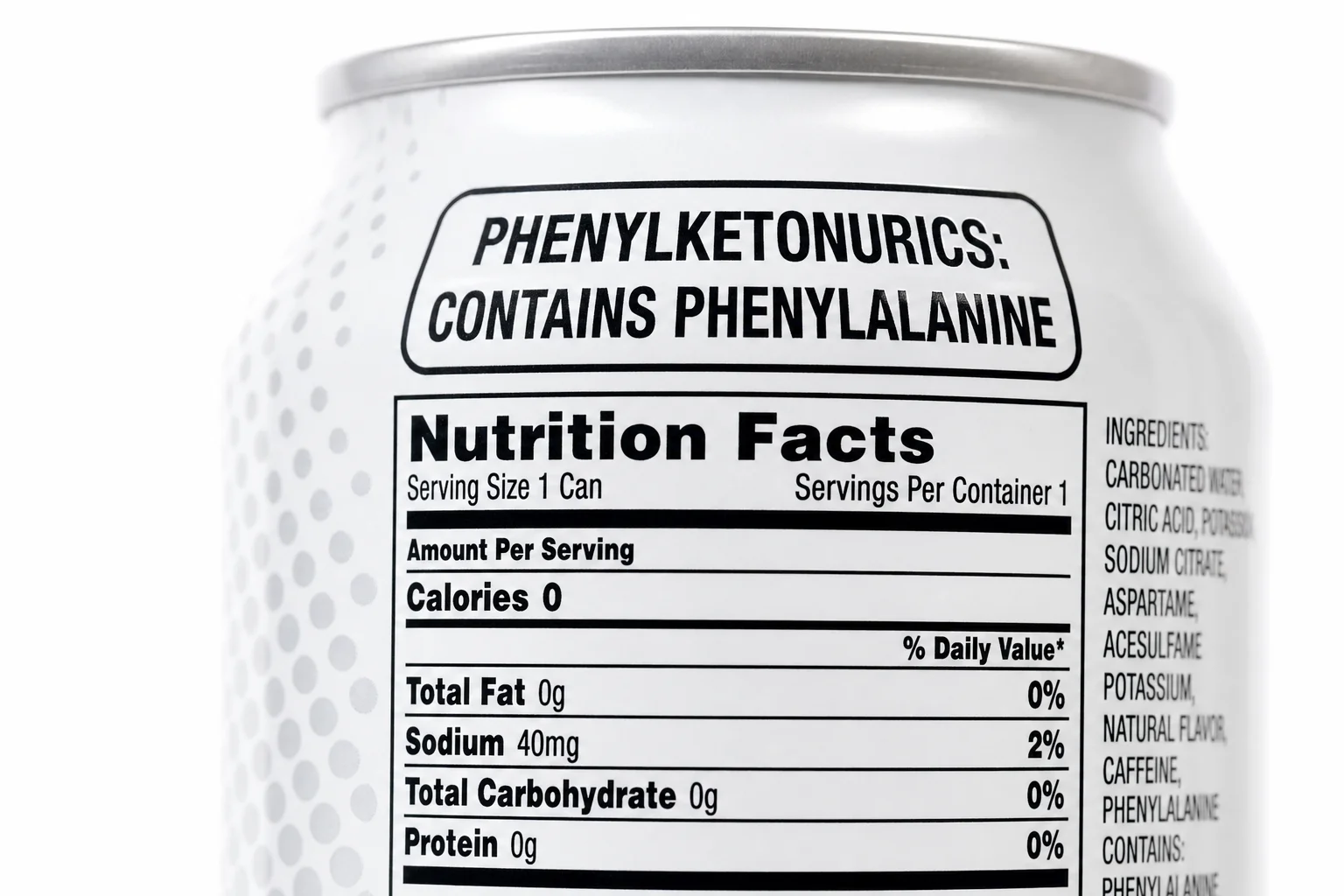
FDA addressed this risk through a mandatory labeling requirement under 21 CFR § 172.804(d)(2):

The label of any food containing the additive shall bear, either on the principal display panel or on the information panel, the following statement:

>

PHENYLKETONURICS: CONTAINS PHENYLALANINE

>

The statement shall appear prominently and conspicuously in bold type on a clear contrasting background.

This applies to every food containing aspartame, including products where aspartame is a component of a blend. The warning must appear in bold, on a contrasting background, on either the front panel or the information panel near the ingredient list.

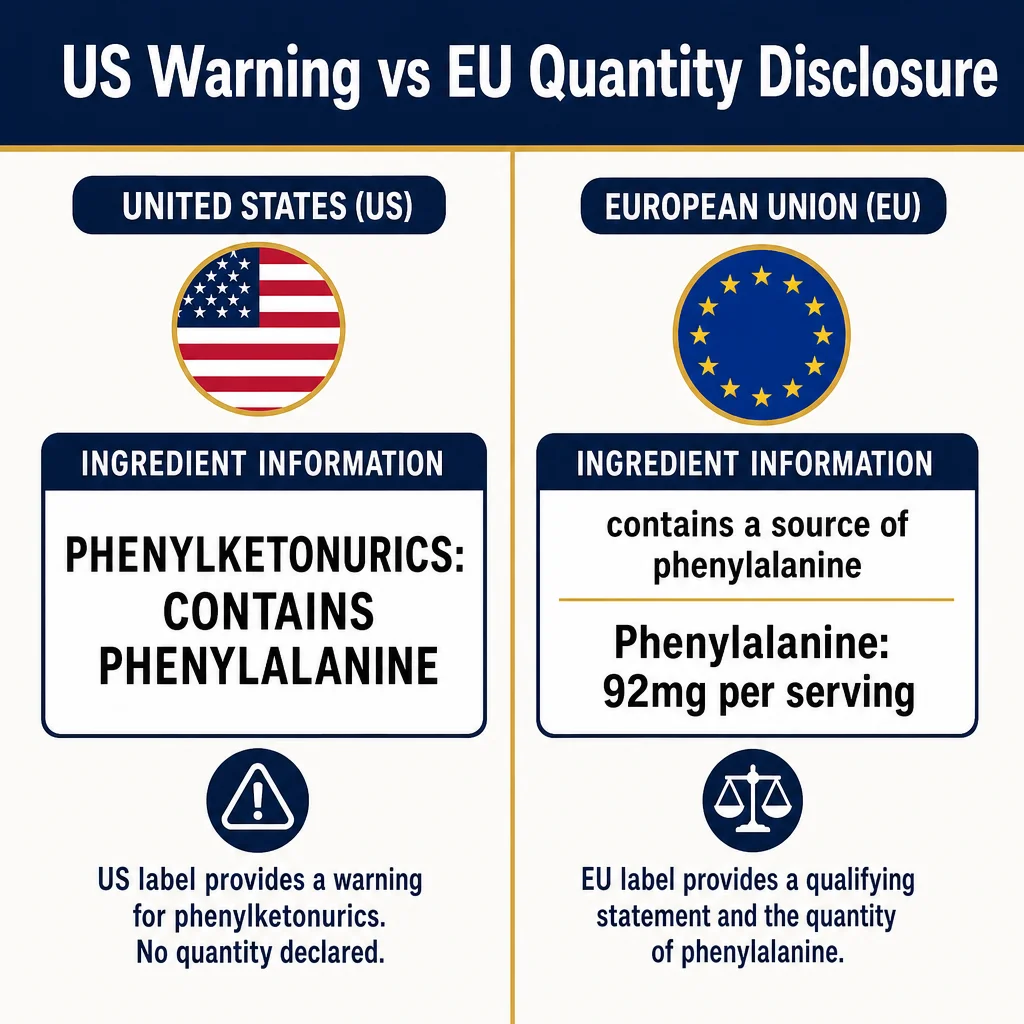
The EU follows a different but more informative standard. Under EU Regulation 1169/2011, Annex III, products containing aspartame must declare "contains a source of phenylalanine" AND provide the quantity of phenylalanine in milligrams per serving. The EU approach gives PKU patients the actual dose, not just a presence warning, a clinically significant difference for patients tracking daily Phe in milligrams.

Aspartame is sold under the brand names NutraSweet, Equal, and Spoonful. It may appear in ingredient lists as aspartame, aspartame-acesulfame salt, or by brand name.

Hidden Phenylalanine Sources

Beyond aspartame, PKU patients must recognize all of the following as significant Phe sources:

Protein hydrolysates: Hydrolyzed vegetable protein (HVP), hydrolyzed soy protein, hydrolyzed wheat protein, and autolyzed yeast extract are all protein fragments containing free amino acids, including phenylalanine. These appear widely in soups, broths, bouillon, savory snacks, sauces, gravies, processed meats, and instant noodles.

Collagen peptides and gelatin: Collagen supplements have become mainstream in wellness products, protein powders, and bone broth products. Collagen contains phenylalanine, though at lower levels than muscle protein. Gelatin, used in marshmallows, gummy candies, Jell-O, and some yogurts, is derived from collagen and carries Phe.

Casein and caseinates: Casein is the dominant milk protein (approximately 80 percent of milk protein). It appears in non-dairy creamers, processed cheeses, and some commercial breads as sodium caseinate or calcium caseinate. Unlike lactose-free dairy alternatives, caseinate-containing products carry significant Phe.

Whey protein: Found in protein bars, protein powders, some breads, and fortified foods. Whey protein concentrate, isolate, and hydrolysate all contain substantial Phe. Even trace amounts added for "protein enrichment" count against the daily budget.

L-Phenylalanine supplements: Products marketed for mood support, pain management, or athletic performance may contain DL-phenylalanine (DLPA) or L-phenylalanine as declared ingredients. These are pure phenylalanine, an acute hazard for PKU patients. Sports supplements and "pre-workout" formulas containing amino acid blends must be individually checked.

Medications containing aspartame: Chewable tablets, orally disintegrating tablets (ODTs), liquid medications, and some vitamins use aspartame as a sweetener. Children's chewable vitamins, antacid tablets, and some prescription medications may contain aspartame without a prominent warning on the dispensing label. Pharmacists should be consulted about inactive (excipient) ingredients.

Natural flavors from protein sources: The regulatory category "natural flavors" can legally include protein-derived compounds. Yeast extracts and meat-based natural flavors may contribute trace Phe. For patients with very tight budgets (under 200 mg/day), even trace sources warrant investigation.
Medical Formulas and the Tyrosine Deficiency Problem

Medical Formulas and the Tyrosine Deficiency Problem

Because the PKU diet eliminates virtually all conventional protein sources, patients require lifelong supplementation with Phe-free amino acid formulas that provide all essential amino acids except phenylalanine. Without these formulas, protein malnutrition is inevitable regardless of how strictly the Phe restriction is maintained.

Two formula types are used:

  1. Phe-free amino acid formulas: Complete protein equivalent from individual amino acids. Examples: PKU Anamix (Nutricia), Phenylade (Applied Nutrition), XPhe (Vitaflo).
  2. Glycomacropeptide (GMP)-based formulas: GMP is a whey fraction naturally very low in Phe. Less bitter taste than amino acid formulas and increasingly used as a complement or alternative. Examples: PKU Periflex (Nutricia), Glytactin (Cambrooke).

Beyond protein, these formulas are the primary source of tyrosine supplementation. Because the PAH pathway is blocked, patients cannot synthesize adequate Tyr from Phe, making Tyr conditionally essential. Tyr is required for dopamine, norepinephrine, epinephrine, melanin, and thyroid hormone synthesis. Low Tyr in PKU contributes to executive function and attention deficits even when blood Phe is controlled.

Patients who reduce or stop formula intake, a pattern common in adolescence, are at high risk of Tyr deficiency and vitamin B12 deficiency (since B12 is primarily found in animal protein, which PKU patients avoid).

Maternal PKU: The Fetal Risk Most Adults With PKU Don't Anticipate

Women with PKU who become pregnant and have inadequately controlled blood Phe expose the developing fetus to a potent teratogen. The fetus inherits one normal PAH gene from the father and does not have PKU, but the mother's elevated blood Phe crosses the placenta and causes irreversible fetal brain damage.

Maternal PKU syndrome consequences:

  • Intellectual disability in the offspring: above 90 percent risk when maternal blood Phe is uncontrolled throughout pregnancy
  • Microcephaly: 67 percent risk if Phe control is not achieved until after 30 weeks gestation; above 90 percent if never controlled
  • Congenital heart defects: 8 to 12 percent risk when maternal Phe exceeds 600 µmol/L in early gestation
  • Low birth weight, behavioral problems, ADHD: elevated risk in all maternal PKU pregnancies with suboptimal control

The ACMG 2023 guidelines require blood Phe to be maintained at 120 to 360 µmol/L throughout pregnancy, with control ideally established at least three months before conception. Timing is critical: the cardiac and neural damage from maternal PKU occurs during organogenesis in the first 10 weeks of pregnancy, before many women know they are pregnant.

Sapropterin: BH4 Therapy for Responsive Patients

Sapropterin dihydrochloride (brand name Kuvan, approved by FDA in 2007) is a synthetic form of tetrahydrobiopterin (BH4), the natural cofactor for PAH. By supplying additional cofactor, it can enhance residual PAH enzyme activity in patients who retain some functional PAH, primarily those with mild-to-moderate PKU.

Approximately 25 to 50 percent of PKU patients respond to sapropterin, defined as a 30 percent or greater reduction in blood Phe after a 4-week trial at 5 to 20 mg/kg/day. Responders can often increase their dietary Phe tolerance significantly, reducing formula dependence and expanding food options.

Sapropterin does not replace dietary management in most cases. Even responsive patients require continued blood Phe monitoring and some degree of dietary restriction.

A Practical Label-Reading Strategy

This section is designed to work as a standalone reference when reading food labels with PKU.

Ingredients and Additives to Avoid

The following ingredients contain phenylalanine and must be flagged when managing PKU. For classic PKU, the daily budget is 200 to 400 mg total from all sources:

Direct phenylalanine sources (strict avoidance)

  • Aspartame (E951), metabolizes to 100% bioavailable Phe; a 355 mL diet soda yields ~100 mg Phe
  • Aspartame-acesulfame salt (E962), contains aspartame component
  • NutraSweet / Equal / Spoonful (brand names for aspartame)
  • L-Phenylalanine (supplement ingredient)
  • DL-Phenylalanine / DLPA (supplement ingredient)

Protein-derived ingredients contributing Phe (strict avoidance in classic PKU)

  • All meat, poultry, and fish ingredients
  • Milk, cheese, cream, butter (beyond permitted exchange amounts)
  • Eggs / egg whites / egg powder / albumin
  • Whey protein / whey protein concentrate / whey protein isolate / hydrolyzed whey
  • Casein / sodium caseinate / calcium caseinate / milk protein
  • Soy protein / isolated soy protein / soy protein concentrate / textured soy protein
  • Pea protein / rice protein / hemp protein / any protein concentrate or isolate
  • Gelatin / hydrolyzed collagen / collagen peptides / bone broth powder
  • Gluten / wheat gluten / vital wheat gluten

Protein hydrolysates (strict avoidance, contain free amino acids including Phe)

  • Hydrolyzed vegetable protein (HVP)
  • Hydrolyzed soy protein
  • Hydrolyzed wheat protein
  • Hydrolyzed corn protein
  • Autolyzed yeast extract / yeast extract
  • Yeast autolysate
  • Torula yeast

Amino acid supplements requiring individual review

  • Any product listing "amino acid blend" without a full amino acid profile
  • Branched-chain amino acids (BCAA), typically do not contain Phe but verify
  • Essential amino acid (EAA) complexes, frequently include Phe; read the label

Medications and non-food items to check

  • Chewable tablets, orally disintegrating tablets (ODTs), liquid medications
  • Children's chewable vitamins and supplements
  • Sugar-free gum and mints (often contain aspartame)
  • Some toothpastes (check for aspartame or NutraSweet)

Safe sweeteners (no phenylalanine)

  • Sucralose (Splenda)
  • Acesulfame potassium (Ace-K / E950)
  • Saccharin (E954)
  • Stevia / steviol glycosides (E960)
  • Monk fruit extract / luo han guo
  • Erythritol, xylitol, sorbitol (sugar alcohols, no Phe)
  • Sucrose / fructose / glucose (sugars, no Phe, but monitor glycemic impact)

How to read a US aspartame warning: FDA requires the statement "PHENYLKETONURICS: CONTAINS PHENYLALANINE" in bold on either the front panel or near the ingredient list. In the EU, the label must also state the milligrams of phenylalanine per serving, a more useful format for Phe budgeting.

Step-by-step checklist:

  1. Scan the ingredient list for aspartame, NutraSweet, and aspartame-acesulfame salt. The FDA-mandated "PHENYLKETONURICS" warning is your first alert on US products. On EU products, check for E951.
  1. Check all protein ingredients. Every protein source, regardless of its plant or animal origin, contributes Phe. Count all protein-containing ingredients against the daily exchange budget.
  1. Identify protein hydrolysates. These are particularly hazardous because they appear in savory processed foods where protein is not expected (soups, sauces, chips, seasonings) and because they contain free amino acids with rapid absorption.
  1. Verify supplements and medications. Ask a pharmacist for the complete excipient list of any medication before a new prescription. Check every supplement for L-phenylalanine or DLPA.
  1. Calculate total daily Phe from all sources. Use the Phe exchange system (1 exchange = 50 mg Phe) or milligram tracking. Apps designed for PKU management can look up Phe content by food and accumulate daily totals.

IngrediCheck can scan ingredient lists for aspartame and all its brand-name equivalents, flag protein hydrolysates and hidden Phe sources, and alert you to the mandatory phenylalanine warning text on US products.

Note that aspartame is also present in many "sugar-free" products targeted at diabetics, the Diabetes Dietary Guide explains the full landscape of sugar aliases and regulated claim definitions that intersect with PKU label reading.

Next Label Check

Follow the scanner, hub, and ingredient paths connected to this guide

Get the app for clearer label decisions.

Scan labels, see what fits your food notes, and read the why in plain English.

IngrediCheck app