Dietary Guides

Artificial Sweeteners Dietary Guide: Every E-Number, Sugar Alcohol, and Hidden Name on the Label

An encyclopedic guide to artificial sweeteners covering all six FDA-approved high-intensity sweeteners, GRAS sweeteners like stevia and allulose, every sugar alcohol and its glycemic index, EU E-numbers, and the aspartame and erythritol safety debates.

Jun 18, 2026|13 min read
By Sanket Patel|Updated 2026-06-18|6 sources|Editorial standards
Artificial Sweeteners Dietary Guide: Every E-Number, Sugar Alcohol, and Hidden Name on the Label

Sugar-free products have moved far beyond diet soda. Sports drinks, protein bars, flavored yogurts, keto baked goods, and even chewable vitamins now rely on one or more of a dozen approved sweeteners, each with its own chemistry, its own regulatory history, and its own name on the label. Some are chemically related to sugar. Some are not sugars at all. A few carry warnings that most shoppers never see printed anywhere on the package.

This guide catalogs every FDA-approved and EU-authorized sweetener, the sugar alcohols that travel alongside them, the safety debates still playing out in 2026, and exactly what to look for the next time you flip a product over.

The Six FDA-Approved High-Intensity Sweeteners

The FDA has approved six high-intensity sweeteners as food additives, each with an Acceptable Daily Intake (ADI): the amount considered safe to consume every day for a lifetime.

Saccharin (E954): roughly 300 times sweeter than table sugar. Approved in 1958, it survived a 1977 proposed ban and a required cancer warning label before being removed from the US National Toxicology Program's carcinogen list entirely in 2000. ADI: 15 mg/kg body weight.

Aspartame (E951): about 200 times sweeter than sugar. Contains phenylalanine, so people with phenylketonuria (PKU) must avoid or restrict it, and US labels are required to carry a PKU warning. ADI: 50 mg/kg (FDA) or 40 mg/kg (JECFA, the WHO/FAO joint expert committee).

Acesulfame potassium, or Ace-K (E950): about 200 times sweeter, heat-stable, frequently blended with aspartame or sucralose to round out the flavor profile. ADI: 15 mg/kg.

Sucralose (E955): roughly 600 times sweeter than sugar, derived from a chemically modified sugar molecule but not metabolized for energy. ADI: 5 mg/kg (FDA) or 15 mg/kg (EFSA).

Neotame (E961): approximately 7,000 to 13,000 times sweeter, structurally related to aspartame but does not require a PKU warning because so little is needed per serving that phenylalanine exposure is negligible. ADI: 0.3 mg/kg.

Advantame (E969): the newest approved sweetener, cleared in 2014, and the most intense at roughly 20,000 times the sweetness of sugar. ADI: 32.8 mg/kg.

Cyclamate, listed under EU code E952, is authorized in more than 55 countries and remains under EFSA re-evaluation, but it has been banned from general food use in the United States since 1969. The FDA acted after a rat study linked a cyclamate-saccharin mixture to bladder tumors; the agency has since said available evidence does not implicate cyclamate as a carcinogen in rodents, but the prohibition has never been lifted.
GRAS Sweeteners That Skip the Additive Approval Process

Three widely used sweeteners reach the market through a different regulatory door: Generally Recognized as Safe (GRAS) self-affirmation rather than formal FDA additive approval.

Steviol glycosides, extracted from the stevia plant, are 200 to 400 times sweeter than sugar. High-purity extracts (such as Reb A and Reb M) have cleared dozens of FDA GRAS notices. Whole-leaf and crude stevia extracts, however, are still subject to an FDA import alert and cannot legally be sold as sweeteners in the US.

Monk fruit extract (also called luo han guo) is 150 to 250 times sweeter than sugar. The FDA has not objected to its GRAS status, but the EU took a stricter path: aqueous monk fruit extract was only authorized as a novel food across the EU in 2024, decades after it reached American shelves.

Allulose, a "rare sugar" found in trace amounts in figs and maple syrup, tastes and behaves like table sugar but is not metabolized for calories. In 2019 the FDA issued guidance exempting allulose from the "Total Sugars" and "Added Sugars" lines on the Nutrition Facts panel, a rare case of a sugar molecule that legally does not count as sugar.

Sugar Alcohols: A Different Category With Its Own Rules

Sugar Alcohols: A Different Category With Its Own Rules

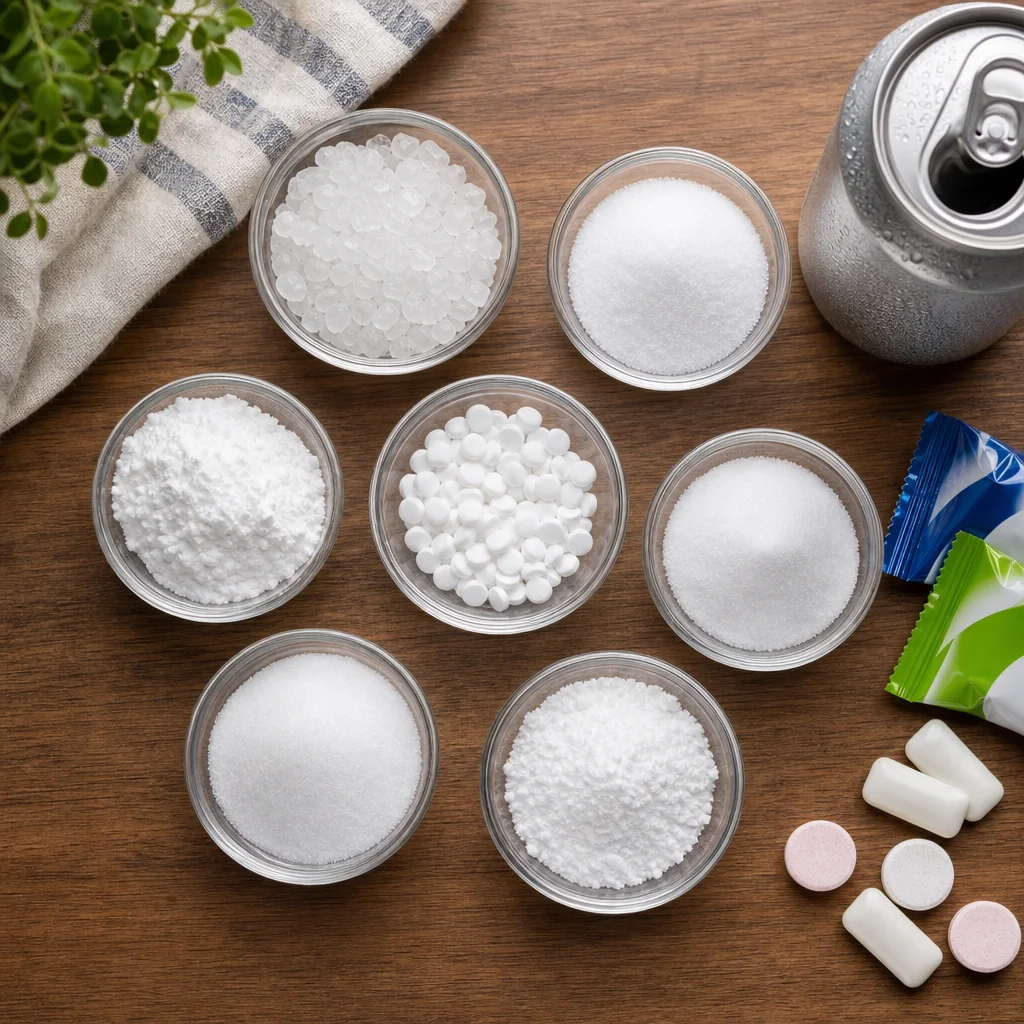
Sugar alcohols, or polyols, are not artificial sweeteners in the high-intensity sense. They provide roughly the same bulk as sugar with fewer calories and a lower glycemic impact, and they show up constantly in "sugar-free" gum, candy, and baked goods.

Erythritol (E968): glycemic index of 0. Almost fully absorbed in the small intestine and excreted unchanged, making it the best-tolerated sugar alcohol for most people digestively.

Xylitol (E967): glycemic index around 7 to 13. Actively inhibits cavity-causing bacteria, which is why it appears in gum and toothpaste. It is highly toxic to dogs even in small amounts and should never be stored where pets can reach it.

Sorbitol (E420): glycemic index around 9. Commonly triggers bloating and a laxative effect in larger amounts because it ferments in the colon.

Maltitol (E965): glycemic index of roughly 35 to 52, the highest among common sugar alcohols. This matters for anyone counting net carbs, since maltitol still produces a real insulin response despite "sugar-free" marketing.

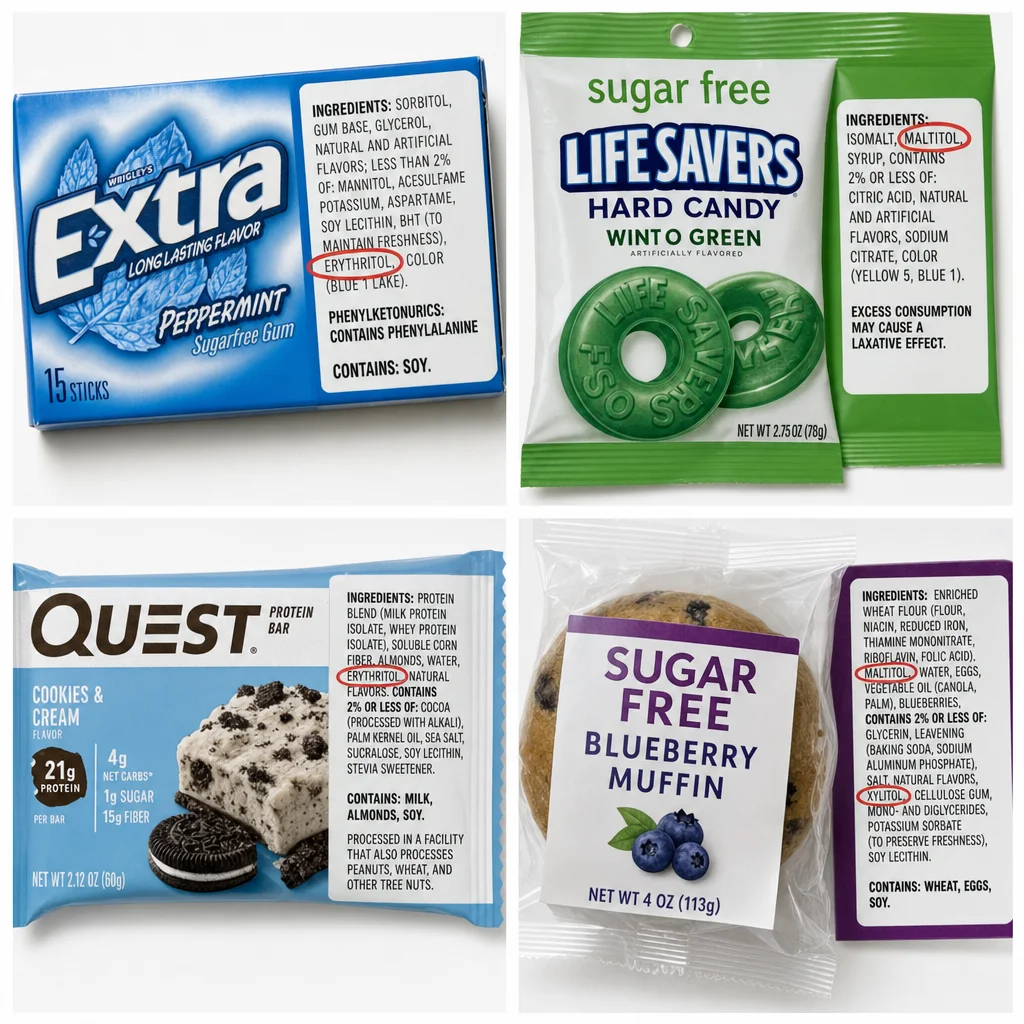
Mannitol (E421) and isomalt (E953) round out the category, both with moderate digestive effects at high doses. The FDA requires manufacturers to disclose that sugar alcohols "may have a laxative effect" when a product would lead to an intake above roughly 20 to 50 grams per day, depending on the specific polyol.

Every E-Number, From E420 to E969

If you shop from EU-labeled products, or scan imported goods, sweeteners appear by E-number rather than by name. Here is the complete authorized list:

E420 Sorbitol, E421 Mannitol, E950 Acesulfame K, E951 Aspartame, E952 Cyclamates, E953 Isomalt, E954 Saccharin, E955 Sucralose, E957 Thaumatin, E959 Neohesperidine DC, E960 Steviol glycosides, E961 Neotame, E962 Aspartame-acesulfame salt, E964 Polyglycitol syrup, E965 Maltitol, E966 Lactitol, E967 Xylitol, E968 Erythritol, and E969 Advantame.

EFSA is currently working through a systematic re-evaluation of every sweetener authorized before January 2009, and the process has been slow: sucralose was not re-evaluated until February 2026, more than 25 years after its original 2000 assessment.

The Aspartame "Possibly Carcinogenic" Headline, Explained

In July 2023, the International Agency for Research on Cancer classified aspartame as "possibly carcinogenic to humans" (Group 2B), citing limited evidence for liver cancer (hepatocellular carcinoma) in human studies. On the same day, the Joint FAO/WHO Expert Committee on Food Additives reviewed the same body of evidence and reaffirmed the existing ADI of 40 mg/kg body weight, concluding there was no sufficient reason to change it.

"The assessments of aspartame have indicated that, while safety is not a major concern at the doses which are commonly used, potential effects have been described that need to be investigated by more and better studies." — Dr Francesco Branca, WHO Director of Nutrition and Food Safety

For context on what that ADI means in practice, WHO notes that a 70-kilogram adult would need to drink more than 9 to 14 cans of diet soda every single day, for life, to exceed the acceptable intake. Group 2B is IARC's third of four hazard tiers; it also includes aloe vera extract, pickled vegetables, and titanium dioxide, agents where the evidence is suggestive but not conclusive. IARC evaluates hazard (can this agent cause cancer at all), not risk (how likely is that at typical exposure), which is the distinction that got lost in most headlines.

Separately, in May 2023, WHO issued broader guidance advising against the use of non-sugar sweeteners generally for weight control, based on a systematic review suggesting a possible association between long-term sweetener use and increased risk of type 2 diabetes and cardiovascular disease, distinct from any cancer question.

Erythritol and the Emerging Cardiovascular Question

Erythritol has the cleanest glycemic profile of any sugar substitute, but a series of Cleveland Clinic studies has complicated that picture. A 2023 study in Nature Medicine, discussed in a research summary from the National Institutes of Health, tracked nearly 4,000 people across three patient groups and found that those in the highest quartile of blood erythritol levels were about twice as likely to experience a cardiovascular event over three years compared to those in the lowest quartile. Lab experiments in the same study showed erythritol increased platelet activity and accelerated blood clot formation in both human platelets and mice.

A follow-up intervention study, covered in an August 2024 Cleveland Clinic research release, gave healthy volunteers a single erythritol-sweetened drink and found measurable increases in platelet clotting sensitivity within hours. Sugar itself did not produce this effect. Under 21 CFR 101.4, erythritol must still be declared by its common or usual name on the ingredient list, so its presence generally cannot be hidden. What is not disclosed is the amount: when erythritol is combined with other sugar alcohols under a single "Sugar Alcohol" line on the Nutrition Facts panel, consumers cannot tell how much of that combined total is erythritol specifically. The research is still developing and no regulatory agency has changed erythritol's approved status, but the lead researcher has explicitly called for long-term safety studies given how quickly erythritol use has grown in "keto" and low-sugar products.

What the Gut Microbiome Research Actually Shows

Headlines about sweeteners "destroying your gut bacteria" oversimplify a genuinely mixed evidence base. A recent review in PMC summarizes the split: some rodent studies at or above typical human intake show measurable shifts in gut bacterial populations and glucose tolerance, particularly with saccharin and sucralose-maltodextrin blends. But controlled human trials at realistic doses have frequently found no significant change in glucose control or microbiome composition. One notable 2019 crossover trial gave healthy adults sucralose for a week and found no measurable metabolic difference versus placebo. The honest summary: individual response may vary based on a person's existing gut bacteria, and the strongest microbiome effects observed so far have come from doses well above what a typical diet soda drinker consumes.

If you are choosing sweeteners specifically to manage blood glucose, the Diabetes Dietary Guide breaks down glycemic index claims, the maltodextrin loophole, and how "sugar-free" and "no added sugar" labels differ in practice.

A Practical Label-Reading Strategy

This section is designed to work as a standalone reference when reading food labels for artificial sweeteners and sugar alcohols.

High-intensity sweeteners to identify on ingredient lists:

  • Saccharin (E954), also sold as Sweet'N Low
  • Aspartame (E951), also sold as Equal or NutraSweet; carries a mandatory PKU warning in the US
  • Acesulfame potassium / Ace-K / Acesulfame K (E950)
  • Sucralose (E955), also sold as Splenda; commercial blends are typically 99 percent maltodextrin by weight
  • Neotame (E961)
  • Advantame (E969)
  • Cyclamate / cyclamic acid / sodium cyclamate (E952): illegal in general foods in the US; may appear on imported products
  • Steviol glycosides / stevia extract / Reb A / Reb M (E960): distinct from "whole-leaf stevia," which is not FDA-approved as a sweetener
  • Monk fruit extract / luo han guo
  • Allulose / D-allulose / D-psicose: exempt from Total and Added Sugars declarations on US labels despite being a sugar

Sugar alcohols to identify (may cause digestive upset in amounts above roughly 20-50 g/day):

  • Erythritol (E968), glycemic index 0
  • Xylitol (E967), glycemic index 7-13; toxic to dogs
  • Sorbitol (E420), glycemic index 9
  • Maltitol (E965), glycemic index 35-52, the highest-impact sugar alcohol
  • Mannitol (E421)
  • Isomalt (E953)
  • Lactitol (E966)
  • Hydrogenated starch hydrolysates (HSH)

Regulatory context to apply while scanning:

  • In the US, the FDA sets an ADI for each of the six approved high-intensity sweeteners; products sold at normal serving sizes are designed to stay well under those limits.
  • Aspartame carries a Group 2B "possibly carcinogenic" hazard classification from IARC (2023), while the WHO/FAO joint committee maintains the ADI is safe at current levels; these are two different, non-contradictory findings (hazard versus risk).
  • Cyclamate (E952) is legal throughout the EU and more than 55 other countries but prohibited in general foods in the United States since 1969.
  • Allulose is chemically a sugar but is exempt from the Added Sugars line on US Nutrition Facts labels, so "0g Added Sugar" claims can still contain allulose.
  • Under 21 CFR 101.9(c)(6)(iv), US labels must break out sugar alcohol grams separately under Total Carbohydrates only when the product makes a sugar alcohol or sugar-related claim (such as "sugar-free"); otherwise the declaration is voluntary and may be omitted. When it is declared and multiple polyols are used, only a combined "Sugar Alcohol" total is shown; a single polyol may be named individually.

Step-by-step scanning checklist:

  1. Check the ingredient list, not just the front-of-package claim. "No Sugar Added" does have an FDA definition (21 CFR 101.60(c)(2)), but it only means no sugar or sugar-containing ingredient was added during processing, not that the product is unsweetened; it can still contain any of the high-intensity sweeteners or sugar alcohols above. "Keto-Friendly" carries no FDA definition at all.
  2. If aspartame appears, check for a PKU statement if you or a family member has phenylketonuria.
  3. If the product markets itself as diabetic-friendly or low-glycemic, scan specifically for maltitol, since it carries a meaningfully higher glycemic index than other sugar alcohols in the same category.
  4. Note whether erythritol is present if you are managing cardiovascular risk factors; current research is preliminary but worth discussing with a physician if erythritol-sweetened products are a daily habit.
  5. If a pet is in the household, treat any product containing xylitol as a household hazard, not just a dietary consideration.
  6. For imported or specialty products, check for E-numbers in the 950-969 and 420-421 range, which cover the full authorized EU sweetener list.

IngrediCheck can scan a product's ingredient list and flag every approved artificial sweetener and sugar alcohol by name or E-number, including blends and aliases that are easy to miss on a crowded label, so you can match what you are eating against your own dietary priorities.

Next Label Check

Follow the scanner, hub, and ingredient paths connected to this guide

Get the app for clearer label decisions.

Scan labels, see what fits your food notes, and read the why in plain English.

IngrediCheck app