Lactose intolerance is the most common food intolerance worldwide, affecting approximately 68% of the global population. Yet the condition is widely misunderstood. It is not an allergy. It is not caused by a pathogen. It is a normal genetic variation in which the small intestine stops producing sufficient lactase, the enzyme required to digest lactose, the natural sugar in milk. This guide provides an encyclopedic reference to the genetics, physiology, diagnosis, global epidemiology, regulatory landscape, and practical management of lactose intolerance.
Dietary Guides
Lactose Intolerance Dietary Guide: Hidden Dairy Names, Lactose-Free Labels, and the EU-US Divide
An encyclopedic guide to lactose intolerance covering genetics, molecular biology, global prevalence, diagnostic methods, hidden dairy ingredients, regulatory differences, and actionable label-reading strategies.
Jun 9, 2026|12 min read
Food IntolerancesLactoseDairyFood LabelingFDAEFSAConsumer HealthIngredient SafetyNutritionGut Health
Start from the cluster

Try it yourself
Does this conflict with Lactose?
The Molecular Biology of Lactose Digestion
Lactose is a disaccharide composed of glucose and galactose linked by a beta-1,4-glycosidic bond. The enzyme lactase-phlorizin hydrolase (LPH), encoded by the LCT gene on chromosome 2, is responsible for breaking this bond in the brush border of the small intestinal epithelium. Once hydrolyzed, the monosaccharides are absorbed through the enterocytes into the bloodstream.
In most mammals, and in most human populations historically, lactase production declines sharply after weaning. This is the default human biological state, known as lactase non-persistence. The ability to continue producing lactase into adulthood, known as lactase persistence, is a derived trait that evolved independently in several populations following the domestication of cattle, sheep, and goats approximately 10,000 years ago.
The Genetics of Lactase Persistence
Lactase persistence is not governed by the LCT gene itself, but by regulatory variants in an enhancer region located in intron 13 of the neighboring MCM6 gene. These single-nucleotide polymorphisms (SNPs) alter the binding of transcription factors and prevent the age-related methylation that normally silences LCT expression after weaning.
The most studied variant is rs4988235, also known as C/T-13910. Individuals with the TT genotype are typically lactase persistent. Those with the CC genotype are lactase non-persistent. Heterozygotes (CT) show intermediate phenotypes. Other relevant variants include rs182549, rs145946881, and rs41304747, which have similar effects in different populations.
A review in PMC explains that the T allele at rs4988235 alters binding of the Oct-1 transcription factor and neighboring GATA-6, HNF-3A, and c-Ets1 factors, maintaining LCT expression into adulthood. This is one of the clearest examples of recent positive selection in the human genome, with lactase persistence alleles reaching frequencies above 90% in some Northern European populations while remaining virtually absent in others.
Global Prevalence and Population Genetics
The global distribution of lactase persistence is one of the most striking examples of human genetic adaptation to dietary practice. According to Cambridge Genetics, approximately 68% of the world cannot digest lactose into adulthood.
Prevalence by region:
- Northern Europe: 5-15% lactose intolerant
- Southern Europe: 40-60% lactose intolerant
- East Asia: 80-100% lactose intolerant
- Sub-Saharan Africa: highly variable, 20-80%
- South Asia: approximately 60-70% lactose intolerant
- Native Americans: approximately 80% lactose intolerant
- African Americans: approximately 75% lactose intolerant
- Hispanics: approximately 50% lactose intolerant
A study cited by Genetic Genie using gnomAD data shows the lactase persistence allele frequency at 60.1% in non-Finnish Europeans, 20.3% in Latinos, 12.3% in Africans, and 0.06% in East Asians. This means that in East Asia, fewer than one in a thousand people retain lactase production into adulthood.
Types of Lactose Intolerance
There are four recognized types of lactose intolerance:
Primary lactose intolerance is the genetic form described above. It is the most common type and develops in childhood or adolescence as lactase production naturally declines.
Secondary lactose intolerance results from damage to the intestinal mucosa, which destroys lactase-producing cells. Causes include celiac disease, Crohn's disease, ulcerative colitis, gastroenteritis, radiation therapy, and chemotherapy. This form may be temporary and can improve as the underlying condition heals.
Congenital lactase deficiency is an extremely rare autosomal recessive disorder in which infants are born with little or no lactase activity. This condition was historically fatal before the development of lactose-free infant formulas.
Developmental lactase deficiency occurs in premature infants because lactase production is a late-developmental feature of the intestinal tract. It usually resolves as the infant matures.
Symptoms and Diagnosis
The clinical presentation of lactose intolerance results from the osmotic effect of unabsorbed lactose and its fermentation by colonic bacteria. Symptoms typically appear 30 minutes to 2 hours after lactose ingestion and include abdominal bloating, cramping, flatulence, diarrhea, and nausea. The severity depends on the amount of lactose consumed, residual lactase activity, gut transit time, and the composition of the colonic microbiome.
Diagnosis is most commonly confirmed by the hydrogen breath test. The patient fasts overnight, then consumes a lactose solution. Breath samples are collected at regular intervals. Normally, lactose is absorbed in the small intestine, so little hydrogen is produced. If lactose reaches the colon, bacterial fermentation produces hydrogen, which is absorbed into the bloodstream and exhaled. An increase in breath hydrogen of more than 20 parts per million above baseline indicates lactose malabsorption.
The lactose tolerance blood test measures blood glucose levels after lactose ingestion. A rise of less than 30 mg/dL suggests impaired lactose digestion. The stool acidity test is used for infants, measuring lactic acid and other fatty acids from bacterial fermentation.
Genetic testing for the LCT enhancer variants is available in some regions and can confirm lactase non-persistence without requiring a dietary challenge.
Lactose Content in Foods
Understanding the lactose content of specific foods is essential for managing the condition. The following table provides approximate values per 100 grams:
| Food | Lactose Content (g/100g) |
|---|---|
| Milk (whole) | 4.8 |
| Milk (skim) | 5.0 |
| Yogurt (plain) | 4.0 |
| Ice cream | 3.6-6.0 |
| Cottage cheese | 2.7-3.5 |
| Cream cheese | 2.6-3.5 |
| Feta | 0.5 |
| Brie and Camembert | <0.1 |
| Cheddar | <0.1 |
| Parmesan | <0.1 |
| Gouda | <0.1 |
| Swiss | <0.1 |
| Mozzarella | 0.1-0.5 |
| Butter | 0.1 |
| Cream (heavy) | 2.8 |
| Whey protein concentrate | 5.0-8.0 |
Hard and aged cheeses are typically well tolerated because most lactose is removed during the cheese-making process and any remaining lactose is consumed by bacteria during aging. According to Sanotact, soft, semi-hard, and hard cheeses contain less than 0.1 g of lactose per 100 g and are often effectively lactose-free.
The Labeling Trap: Lactose-Free vs Dairy-Free vs Non-Dairy
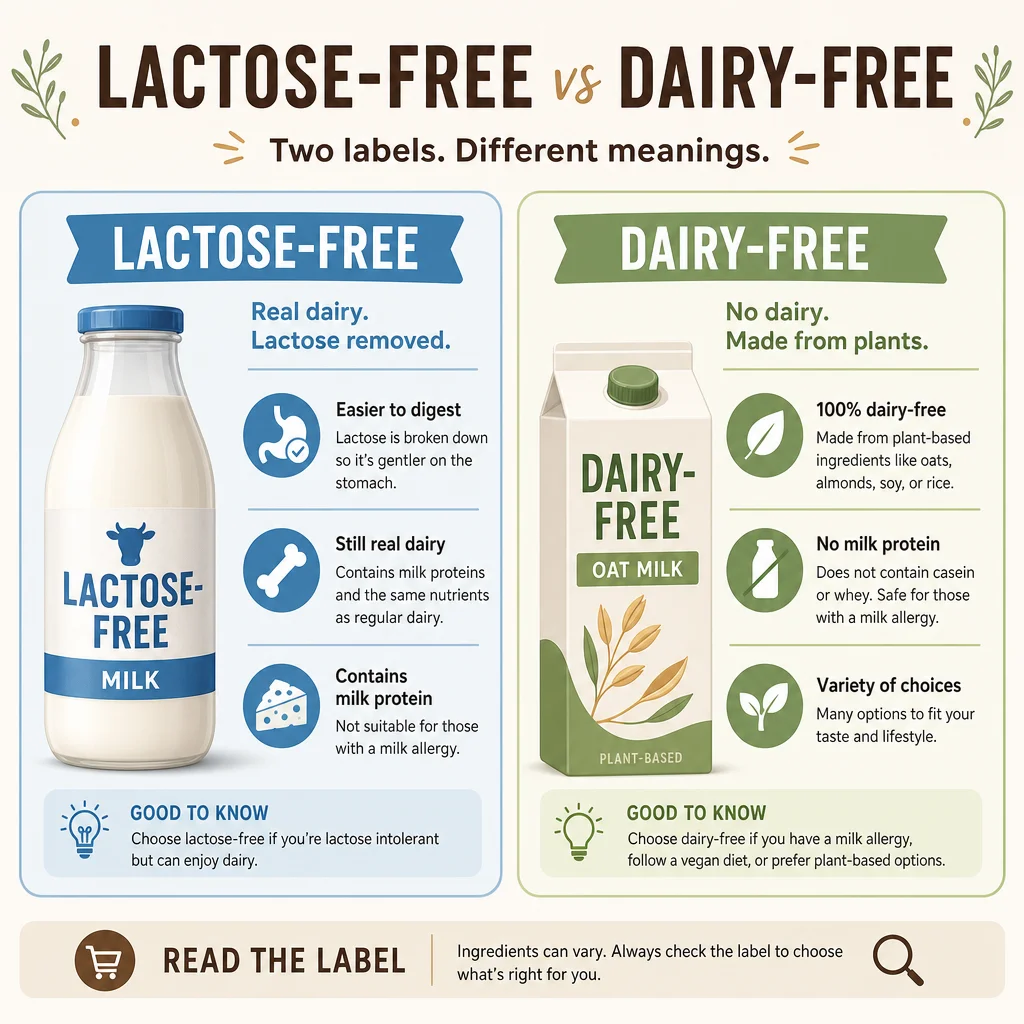
These three terms are frequently confused, but they have distinct regulatory and practical meanings.
Lactose-free products still contain milk proteins. The lactose has been hydrolyzed by adding the lactase enzyme, or has been physically removed. They are safe for lactose intolerance but not for milk protein allergy or vegan diets.
Dairy-free products contain no milk or milk-derived ingredients whatsoever. They are suitable for vegans, milk allergy sufferers, and those with lactose intolerance.
Non-dairy is a particularly misleading term. In the United States, the FDA allows products labeled "non-dairy" to contain caseinates, which are milk-derived proteins. A non-dairy coffee creamer may still contain sodium caseinate. This is usually safe for lactose intolerance but dangerous for milk allergy.
The UK Food Standards Agency has noted that there are currently no EU-wide binding rules on lactose-free claims, meaning standards vary between countries.
Hidden Dairy Ingredients and Their Aliases
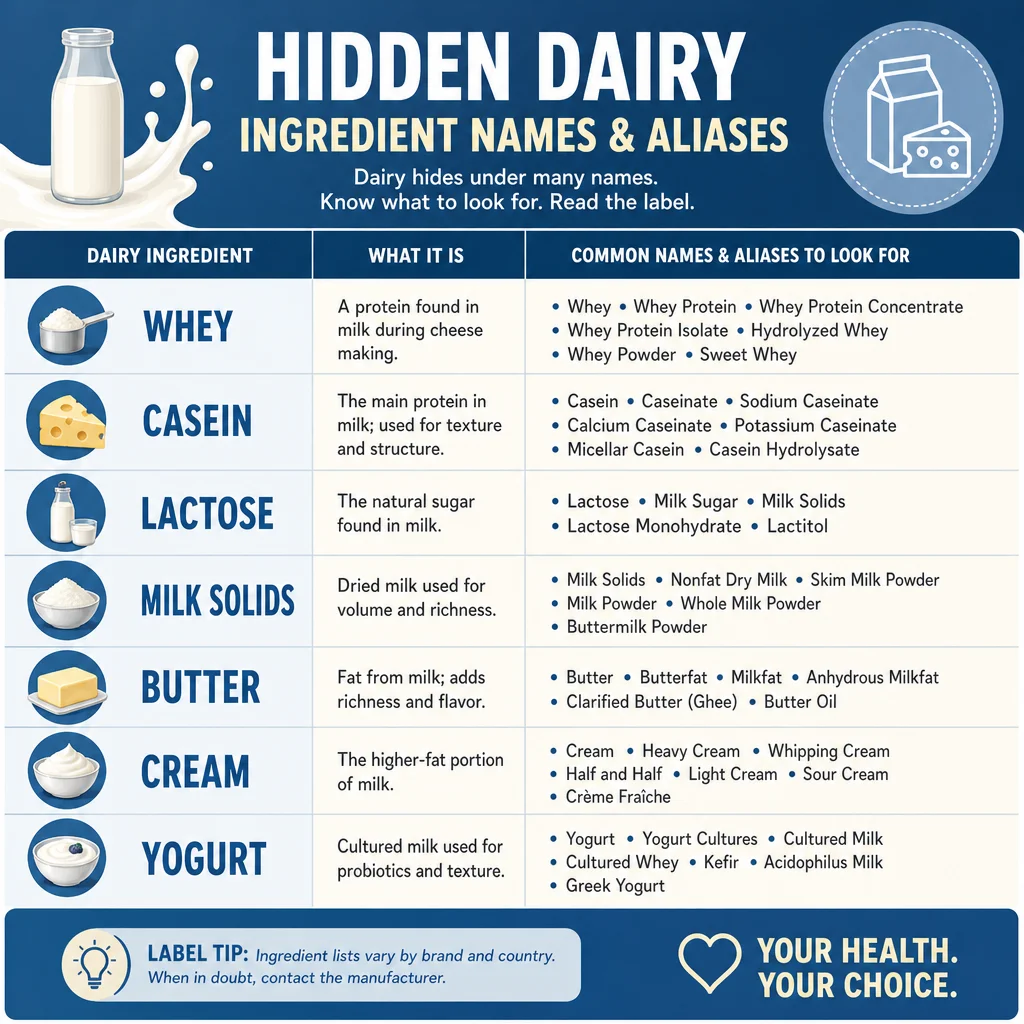
Dairy derivatives appear under dozens of names. The following comprehensive list covers common and less obvious sources.
Primary dairy ingredients:
- Milk, milk powder, milk solids, milk protein, milk fat, anhydrous milk fat
- Cream, butter, buttermilk, butter oil, ghee, clarified butter
- Cheese, cheese powder, cheese culture, processed cheese
- Whey, whey protein, whey protein concentrate, whey protein isolate, hydrolyzed whey
- Casein, caseinate, sodium caseinate, calcium caseinate, hydrolyzed casein, rennet casein
- Lactose, lactose monohydrate, lactose powder, lactose syrup, milk sugar
- Lactalbumin, lactoglobulin, lactoferrin, lactoperoxidase
- Yogurt, yogurt powder, kefir, sour cream, creme fraiche, clotted cream
- Evaporated milk, condensed milk, malted milk, dulce de leche, milk chocolate
- Natural butter flavor, milk-derived flavorings
Derivatives and processing agents:
- Whey permeate, whey solids, demineralized whey
- Milk protein hydrolysate, casein hydrolysate
- Protein hydrolysates derived from milk
- Milk minerals, milk calcium
- Recaldent (casein-derived, used in chewing gum)
- Lactitol, lactobionic acid, lactose esters
According to BioBrief, casein can appear in non-dairy creamers and protein bars, making the "non-dairy" label misleading for anyone with a true milk allergy.
Foods Where Dairy Hides Unexpectedly
Baked goods and bread frequently contain milk powder, whey, or butter to improve texture, browning, and shelf life.
Snack foods including flavored chips, crackers, and popcorn use cheese powder, butter flavoring, or milk solids.
Processed meats such as hot dogs, sausages, and deli meats may contain casein or milk protein as a binder.
Condiments and dressings including ranch, Caesar dressing, mayonnaise, and some mustards may contain milk, cream, or cheese.
Supplements and medications use lactose as a filler or excipient in tablets and capsules.
Dark chocolate is often assumed to be dairy-free, but many brands contain milk fat or milk solids.
Protein powders and meal replacements are frequently whey or casein based.
Regulatory Differences: US vs EU
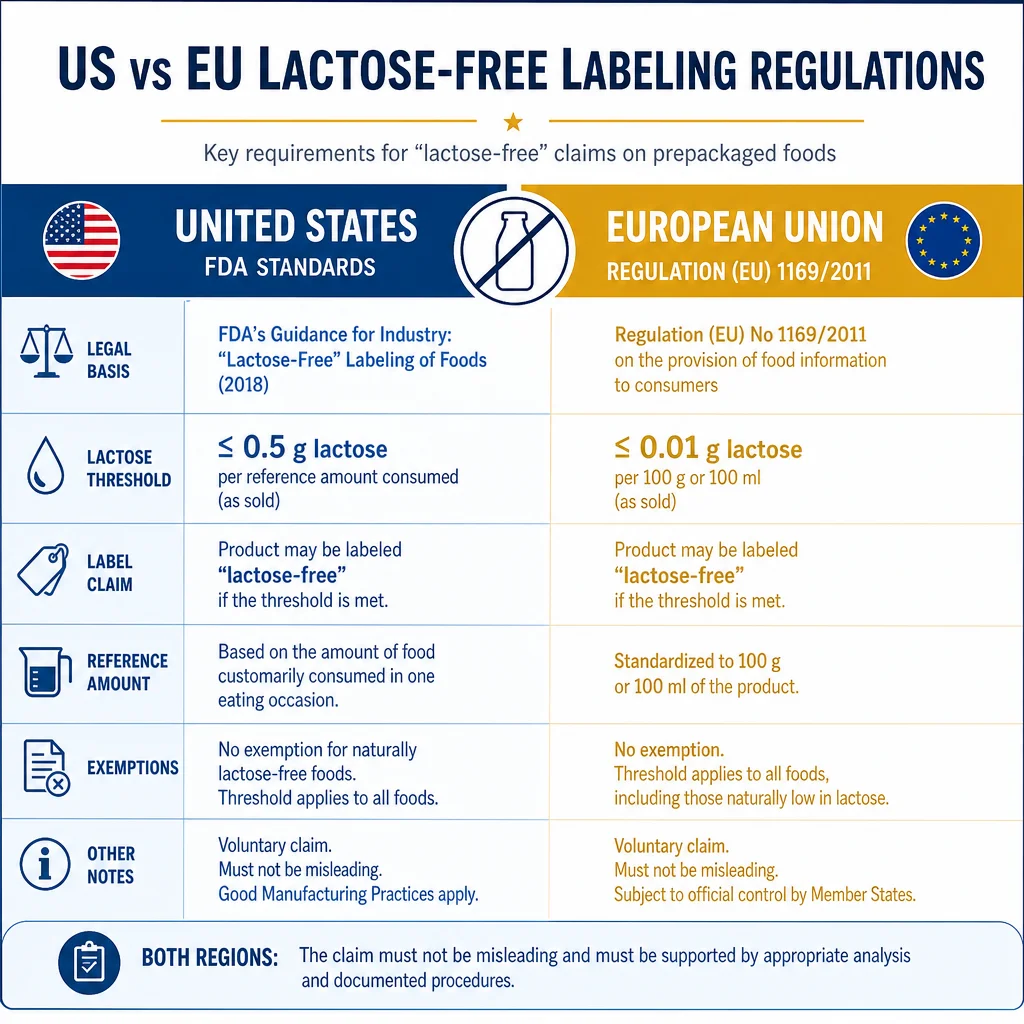
In the United States, FALCPA requires milk to be declared clearly in allergen labeling. However, this applies to milk proteins, not necessarily to lactose itself. The FDA does not have a specific standard for "lactose-free" claims, though products using this claim generally should contain no detectable lactose.
In the European Union, Regulation (EU) No 1169/2011 requires that milk and milk products be highlighted in the ingredient list. The EU regulates "lactose-free" more strictly: products must contain less than 0.01 g lactose per 100 g. The EU also permits a "low lactose" claim for products containing no more than 1 g lactose per 100 g. The US has no equivalent regulated low-lactose claim.
Digestive Enzymes and Lactose-Free Alternatives
Lactase supplements are available over the counter in tablet, capsule, and liquid form. Typical products contain 3,000 to 9,000 FCC units of lactase per dose. The FCC (Food Chemicals Codex) unit measures enzyme activity. Higher doses are needed for larger amounts of lactose.
Lactose-free milk is regular milk treated with lactase to hydrolyze lactose into glucose and galactose. It tastes slightly sweeter because the monosaccharides are sweeter than the disaccharide.
Yogurt with live, active cultures can sometimes be better tolerated because the bacteria partially digest lactose. However, not all yogurts contain sufficient live cultures, and flavored varieties may have added milk solids.
Plant-based milks made from oats, almonds, soy, rice, coconut, and peas are naturally lactose-free. Check labels, though, because some are fortified with calcium and vitamins that are safe, while others may contain added sugars or thickeners that trigger unrelated digestive issues.
Complications and Long-Term Health Considerations
A study published in the American Journal of Clinical Nutrition and cited by USDA ARS found that self-perceived lactose intolerance was associated with significantly lower calcium intake from dairy and higher rates of hypertension and diabetes. This suggests that unnecessary dairy avoidance may have metabolic consequences beyond the digestive system.
People with lactose intolerance who avoid dairy entirely should ensure adequate calcium intake from fortified plant milks, leafy greens, tofu, almonds, and calcium supplements. Vitamin D status should also be monitored, as dairy products are a major dietary source in many countries. For a deeper dive into hidden dairy names, see our Milk Allergy Dietary Guide.
A Practical Label-Reading Strategy
This section is designed to be a standalone, actionable checklist for reading food labels when you have lactose intolerance. Follow these steps every time you shop, and use this list as a reference when scanning ingredients with an ingredient checker or app.
Step 1: Check for the major allergen warning
In the United States, look for the bold allergen statement near the ingredient list. If it says "Contains: Milk," the product has dairy-derived ingredients. In the EU, milk ingredients must be highlighted in the ingredient list itself, often in bold or a different typeface.
Step 2: Scan the ingredient list for hidden dairy names
Look for any of the following ingredients, which indicate the presence of dairy or lactose:
- Milk, milk powder, milk solids, milk protein, milk fat, anhydrous milk fat
- Cream, butter, buttermilk, ghee, butter oil, natural butter flavor
- Cheese, cheese powder, cheese culture, curds, rennet, processed cheese
- Whey, whey protein, whey protein concentrate, whey protein isolate, hydrolyzed whey, whey permeate, whey solids
- Casein, caseinate, sodium caseinate, calcium caseinate, rennet casein, hydrolyzed casein
- Lactose, lactose monohydrate, lactose powder, lactose syrup, milk sugar
- Lactalbumin, lactoglobulin, lactoferrin, lactoperoxidase, lactobionic acid
- Yogurt, yogurt powder, kefir, sour cream, creme fraiche, clotted cream
- Evaporated milk, condensed milk, malted milk, dulce de leche
- Milk chocolate, butterscotch, caramel made with butter or cream
- Milk-derived flavorings, protein hydrolysates derived from milk
- Recaldent, milk minerals, milk calcium
Step 3: Understand "lactose-free" and "dairy-free" claims
A product labeled "lactose-free" should be safe for lactose intolerance but still contains dairy proteins. A product labeled "dairy-free" contains no dairy at all and is safe for both lactose intolerance and milk allergy. "Non-dairy" in the US may still contain casein, so read the ingredient list to confirm.
Step 4: Check for cross-contact warnings
Look for phrases like "May contain milk," "Produced in a facility that processes milk," or "Made on shared equipment with milk products." These are voluntary statements indicating possible cross-contact. For lactose intolerance, the risk is usually lower than for a milk allergy, but highly sensitive individuals should still exercise caution.
Step 5: When in doubt, choose plant-based alternatives
Oat milk, almond milk, soy milk, coconut milk, rice milk, and pea milk are all naturally lactose-free. When choosing a plant-based alternative, check that it is labeled as unsweetened if you are also avoiding added sugars, and verify that the product does not contain any dairy-derived fortifications that might cause issues.
Using IngrediCheck, you can scan any product label and instantly identify hidden dairy ingredients, lactose-containing additives, and cross-contact risks. This takes the guesswork out of grocery shopping and helps you avoid the ingredients that trigger your symptoms.
Related Guides
- Milk Allergy Dietary Guide: Casein, Whey, and Every Hidden Dairy Name on Labels
- Soy Allergy Dietary Guide: 30+ Ingredient Names That Mean Soy on Labels
- Egg Allergy Dietary Guide: Decoding Albumin, Lysozyme, and Sneaky Egg Sources
- Hidden Sources of Dairy: A Checklist for Milk Allergies
- Dairy-Free Ingredient Checker
- FODMAP Intolerance Dietary Guide: Oligosaccharides, Polyols, and the Monash Method
On this page
Sources
Source lists are maintained with our editorial policy.
- Harvard Health - Lactose Intolerance A-to-Z
- PMC - The Molecular Basis of Lactase Persistence
- Genetic Genie - Lactose Intolerance Genetics
- Cambridge Genetics - LCT: Why 68% of the World Can't Digest Milk
- MedlinePlus - Lactose Tolerance Tests
- UK Food Standards Agency - Understanding Labelling Terms
- BioBrief - Hidden Dairy Ingredients
- Sanotact - How Much Lactose Is in Cheese
- USDA ARS - Self-Perceived Lactose Intolerance and Health
- Kreider Farms - Lactose Free vs Dairy-Free
Next Label Check
Follow the scanner, hub, and ingredient paths connected to this guide
Scanner workflows
Gluten-free scannerScanner workflow
Gluten-Free Barcode Scanner
Scan barcodes and labels for gluten clues, hidden wheat, barley, rye, malt, and celiac-relevant ingredient risks with IngrediCheck's gluten-free workflow.
Dairy-free scannerScanner workflow
Dairy-Free Ingredient Checker App
Use IngrediCheck's dairy-free ingredient checker to scan labels for milk, whey, casein, ghee, lactose, and may-contain milk statements.
Low FODMAP scannerScanner workflow
Low FODMAP Ingredient Checker
Scan labels for low FODMAP grocery clues, IBS trigger ingredients, sweeteners, fibers, and related digestive-health guides.
Topic hubs
Topic hub
Ingredient Safety
Explore IngrediCheck's ingredient safety hub for additives, contaminants, preservatives, and evidence-based label guidance.
Topic hub
Gluten-Free Label Reading
Find IngrediCheck's gluten-free topic hub covering hidden gluten, celiac-safe label reading, and ingredient-level guidance.
Topic hub
Food Dyes
Browse food dye guidance for Red 40, Yellow 5, Yellow 6, Blue 1, Blue 2, Green 3, Red 3, and titanium dioxide labels.
Related articles
Dietary GuidesArticle
Nightshades Dietary Guide: Solanine, Hidden Spices, and the Truth About Inflammation
An encyclopedic guide to nightshade vegetables covering the full Solanaceae family, solanine and glycoalkaloid safety thresholds, the arthritis-inflammation claim examined against the evidence, and every hidden nightshade source in spices and processed foods.
Dietary GuidesArticle
PEG Allergy Dietary Guide: Macrogol, E1521, and the Hidden Excipient
Polyethylene glycol is not one of the regulated food allergens, so it never triggers a 'Contains' warning. It hides in supplement coatings, tabletop sweeteners, laxatives, and medications under names like macrogol, E1521, and PEG 3350.
Dietary GuidesArticle
Sulphite Allergy Dietary Guide: 10 PPM Rule & E-Numbers
Sulphite Allergy Dietary Guide to the 10 ppm labeling rule, E220-E228, sulphite sensitivity symptoms, and foods like dried fruit, wine, shrimp, and bottled lemon juice.
Get the app for clearer label decisions.
Scan labels, see what fits your food notes, and read the why in plain English.