Dietary Guides

Milk Allergy Dietary Guide: Casein, Whey, and Every Hidden Dairy Name on Labels

Cow's milk allergy is the most common food allergy in infants and young children. Milk appears on ingredient lists under more than 30 different names, and the FDA's 2025 guidance expanded the milk allergen definition to include milk from all ruminant animals.

Jun 5, 2026|11 min read
By Sanket Patel|Updated 2026-06-05|7 sources|Editorial standards
Milk Allergy Dietary Guide: Casein, Whey, and Every Hidden Dairy Name on Labels

Cow's milk allergy is the most common food allergy in infants and young children. In the United States, it affects roughly 2 to 3 percent of children under age 3. Most children outgrow it, but for those who do not, and for adults who develop it later in life, avoiding milk is a lifelong challenge. The problem is not simply avoiding a glass of milk or a slice of cheese. Milk appears on ingredient lists under more than 30 different names. Some of those names are scientific terms that most consumers would not recognize. Others are ingredients that sound unrelated to dairy but are derived from milk protein.

In January 2025, the FDA issued an updated guidance that expanded the definition of milk as a major allergen. The update clarified that milk from all ruminant animals, not just cows, falls under the milk allergen declaration. This means goat milk, sheep milk, buffalo milk, and other ruminant milks must all be labeled as milk. For consumers who previously relied on goat or sheep milk as a cow's milk alternative, this regulatory clarification is important.

This guide covers everything you need to know about reading labels for milk allergy: the FDA's requirements, the complete list of hidden dairy names, cross-reactivity risks, and the practical steps you can take to identify milk-derived ingredients in packaged food.

What the FDA's Labeling Law Actually Requires

The Food Allergen Labeling and Consumer Protection Act of 2004 (FALCPA) requires that any FDA-regulated packaged food that contains a major food allergen must declare it on the label. Milk is one of the nine major allergens covered under FALCPA, alongside eggs, fish, crustacean shellfish, tree nuts, peanuts, wheat, soy, and sesame.

In practice, this means that when a manufacturer uses a milk-derived ingredient, one of two things must appear on the label:

The ingredient list must use the common or usual name of the food source (e.g., "whey (milk)" or "casein (milk)"), or A "Contains: Milk" statement must appear immediately following or adjacent to the ingredient list.

Both approaches are compliant. Either gives you notice that the product contains a milk-derived ingredient.

The 2025 FDA Expansion: All Ruminant Milk Counts as Milk

In January 2025, the FDA published the 5th edition of its Food Allergen Labeling Guidance. The update clarified that milk from all ruminant animals is covered under the milk allergen declaration. This includes:

Cow's milk (the most common) Goat milk Sheep milk Buffalo milk Camel milk Any other milk from ruminant animals

This is a significant clarification for consumers who may have been using goat or sheep milk as a cow's milk alternative. For most people with cow's milk allergy, the proteins in goat and sheep milk are similar enough to trigger reactions. The FDA's guidance now ensures these milks are explicitly labeled as milk.

Where FALCPA Does Not Apply

FALCPA applies to packaged foods regulated by the FDA. It does not apply to:

Restaurant food and foodservice. No federal law requires restaurants to label allergens. Some states have their own requirements, but at the federal level, you must ask directly. USDA-regulated products. Most meat, poultry, and egg products fall under USDA jurisdiction rather than FDA. These are not covered by FALCPA, though USDA has its own allergen labeling guidance. Alcohol. Beverages regulated by the Alcohol and Tobacco Tax and Trade Bureau (TTB) have separate labeling rules. Wines and beers may use milk-derived processing agents (such as casein for fining) without the same disclosure requirements. Cosmetics and drugs. Topical products containing milk derivatives are not covered by the food allergen labeling law. Non-packaged foods. Foods sold loose, in bulk, or without standard packaging may not carry ingredient labels at all.

The Complete List of Hidden Dairy Names

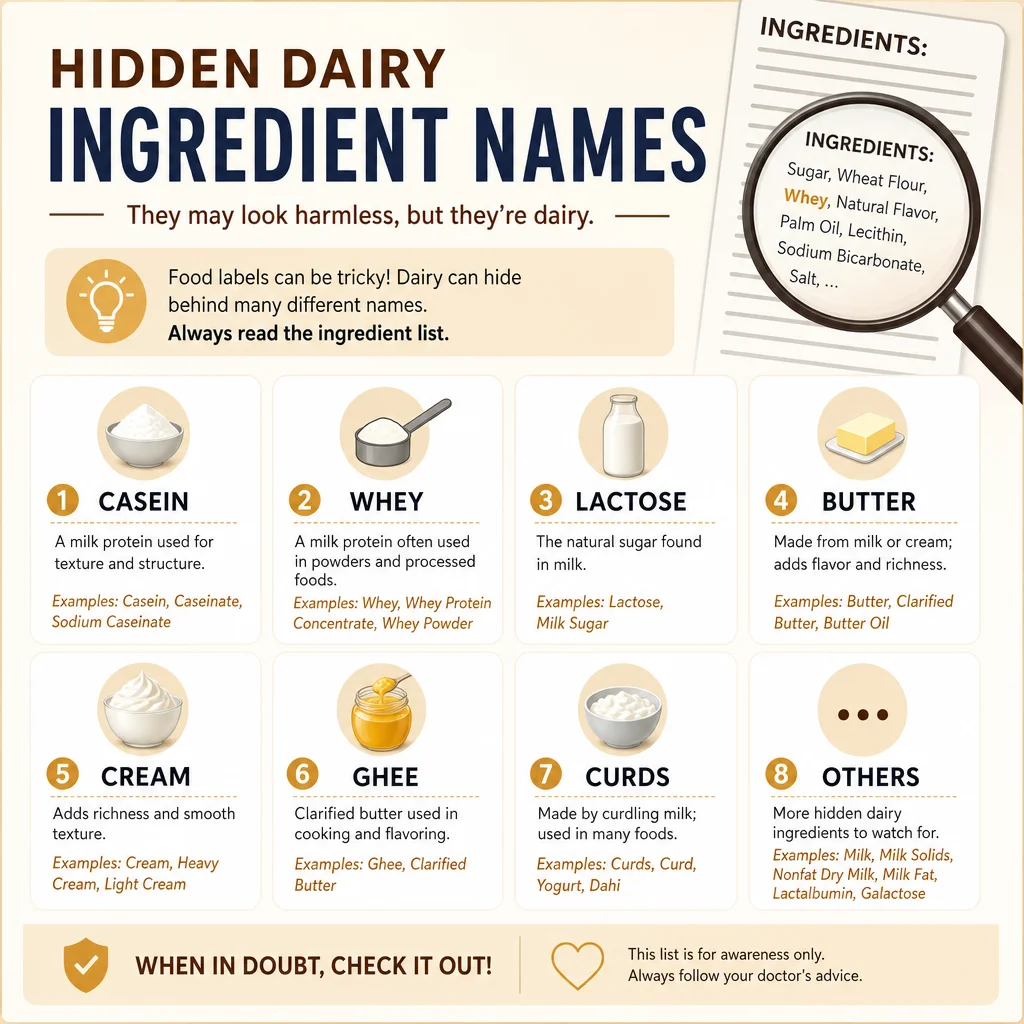
Even on FDA-regulated packaged foods, recognizing milk requires knowing every alias. Manufacturers are not required to use the word "milk" in the ingredient name itself as long as the "Contains" statement is present. In practice, ingredient lists can include any of the following, all of which indicate milk-derived content:

Direct Milk Forms

Acidophilus milk Buttermilk Buttermilk blend Buttermilk solids Cultured milk Condensed milk Dried milk Dry milk solids (DMS) Evaporated milk Fat-free milk Fully cream milk powder Goat's milk (must be labeled as milk per 2025 FDA guidance) Lactaid milk Lactose-free milk Low-fat milk Malted milk Milk derivative Milk powder Milk protein Milk solids Milk solid pastes Nonfat dry milk Nonfat milk Nonfat milk solids Pasteurized milk Powdered milk Sheep's milk (must be labeled as milk per 2025 FDA guidance) Skim milk Skim milk powder Sour milk Sour milk solids Sweet cream buttermilk powder Sweetened condensed milk Sweetened condensed skim milk Whole milk

Butter and Butter-Derived Ingredients

Artificial butter Artificial butter flavor Butter Butter extract Butter fat Butter flavored oil Butter solids Dairy butter Natural butter Natural butter flavor Whipped butter

Casein and Caseinates

Ammonium caseinate Calcium caseinate Casein Hydrolyzed casein Iron caseinate Magnesium caseinate Potassium caseinate Sodium caseinate Zinc caseinate

Cheese and Cheese-Derived Ingredients

Cheese (all types) Cheese flavor (artificial and natural) Cheese food Cottage cheese Cream cheese Imitation cheese Vegetarian cheeses with casein

Cream and Cream-Derived Ingredients

Cream Whipped cream Half & half

Other Milk-Derived Ingredients

Curds Custard Dairy product solids Galactose Ghee Hydrolysates (casein hydrolysate, milk protein hydrolysate, protein hydrolysate, whey hydrolysate, whey protein hydrolysate) Ice cream Ice milk Sherbet Lactalbumin Lactalbumin phosphate Lactate solids Lactitol monohydrate Lactoglobulin Lactose Lactulose Milk fat Anhydrous milk fat Nisin preparation Nougat Pudding Quark Recaldent Rennet Rennet casein Simplesse (fat replacer) Sour cream Sour cream solids Imitation sour cream Whey (acid whey, cured whey, delactosed whey, demineralized whey, hydrolyzed whey, powdered whey, reduced mineral whey, sweet dairy whey, whey protein, whey protein concentrate, whey powder, whey solids) Yogurt (regular or frozen) Yogurt powder

Ingredients That May Contain Milk

Natural flavoring Flavoring Caramel flavoring High protein flour Lactic acid starter culture

"Non-Dairy" Products That May Contain Casein

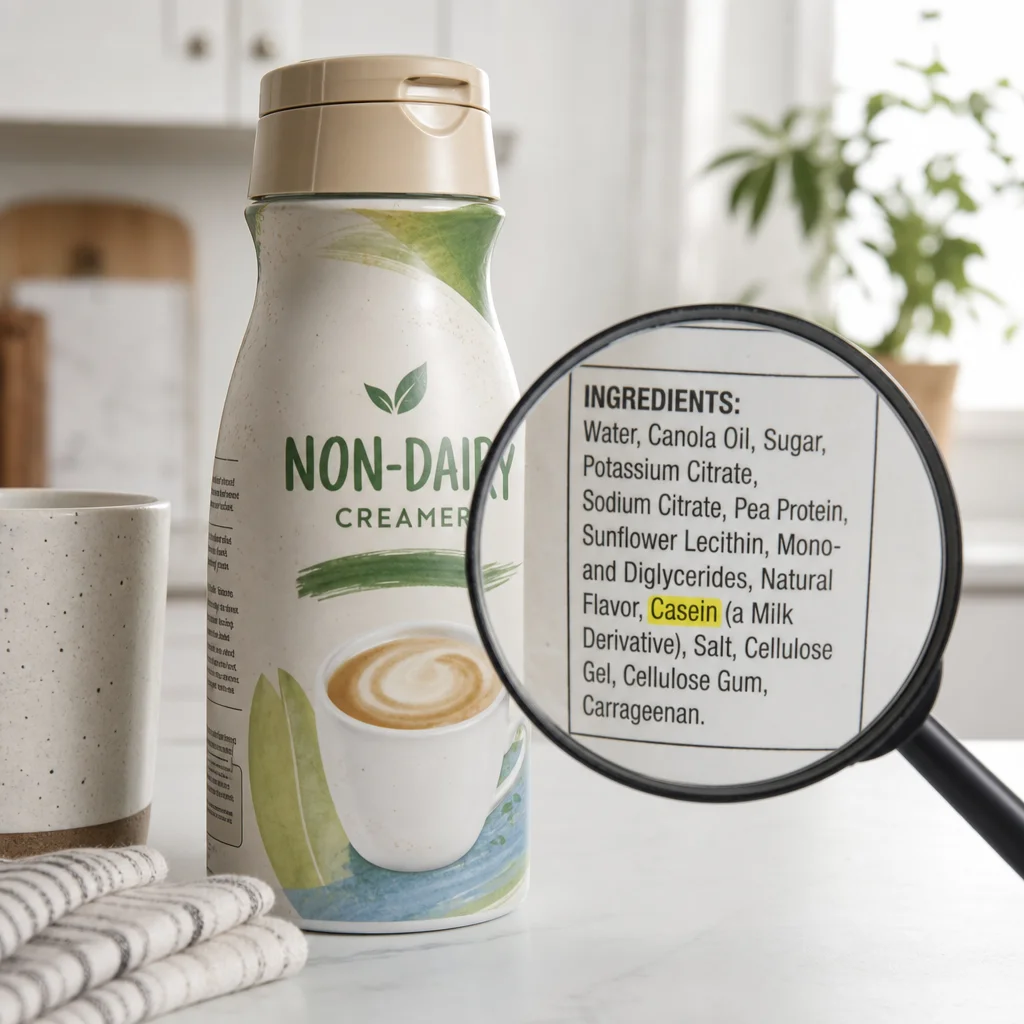
The term "non-dairy" on a food label does not mean the product is milk-free. The FDA allows "non-dairy" products to contain casein, a milk protein. This is common in:

Coffee creamers labeled "non-dairy" Whipped toppings labeled "non-dairy" Some protein powders and shakes

Always check the ingredient list and the "Contains" statement, even on products labeled "non-dairy."

Cross-Reactivity: Goat, Sheep, and Other Animal Milks

For most individuals with cow's milk allergy, the proteins in goat and sheep milk are similar enough to trigger reactions. Studies show that approximately 90 percent of children with cow's milk allergy will also react to goat's milk. The proteins casein and whey are structurally similar across ruminant species.

The FDA's 2025 guidance clarified that all ruminant milk must be labeled as milk. This means that if a product contains goat milk, sheep milk, or buffalo milk, the label must declare "Contains: Milk" or list the ingredient with "milk" in parentheses.

Where Milk Unexpectedly Appears in Food

Even careful shoppers can be caught by milk in products where it is not intuitive. These are the categories most likely to contain milk-derived ingredients that are not obvious from the product name:

Baked Goods and Bread

Bread, rolls, and baked goods often contain milk powder, whey, or casein to improve texture and browning. Some brands of bread, particularly soft white breads, use milk-derived ingredients. Always check the label, even for plain bread.

Processed Meats

Some processed meats, including hot dogs, sausages, and deli meats, use casein or milk protein as a binder. This is not common in all brands, but it is frequent enough that checking the label is essential.

Chocolate and Confectionery

Milk chocolate obviously contains milk, but dark chocolate can also contain milk. Some brands of dark chocolate use milk fat or casein to improve texture. The FDA has found that many dark chocolate products contain undeclared milk. Nougat, caramel, and toffee almost always contain milk or butter.

Caramel and Toffee

Caramel is made by heating sugar with butter or cream. Toffee is made with butter. Both almost always contain milk-derived ingredients.

Salad Dressings and Sauces

Creamy salad dressings, ranch dressing, Caesar dressing, and some vinaigrettes may contain milk, buttermilk, or cheese. Some pasta sauces, particularly Alfredo and carbonara-style sauces, contain cream or cheese.

Instant Mashed Potatoes and Soup Mixes

Some instant mashed potato products contain milk powder or butter powder for flavor. Cream-based soup mixes almost always contain milk or cream.

Medications and Supplements

Some medications and supplements use lactose as a filler or binder. This is not a food labeling issue but is worth noting for individuals with severe milk allergy who need to avoid even trace amounts.

Cosmetics and Personal Care Products

Some cosmetics, lotions, and lip balms contain milk-derived ingredients such as casein or whey. These are not covered by food allergen labeling laws but are worth noting for individuals with contact sensitization.

Reading EU Labels for Milk

If you consume imported European products or travel within the EU, the labeling rules are different in one important respect. Under EU Regulation 1169/2011, milk (listed as "milk and products thereof") is one of 14 allergens that must be declared and must be visually distinct from the rest of the ingredient list, typically through bold text, italic text, or contrasting font color.

This means that on a European product, even if the ingredient appears mid-list among many other items, it should stand out visually. Products sold in the UK after Brexit follow the same rule under retained domestic law.

One EU-specific note: the EU lists milk and products thereof as a major allergen, including lactose as a milk product. The US FALCPA does not specifically list lactose as a milk product, but since lactose is derived from milk, it is covered under the milk allergen declaration.

A Practical Label-Reading Strategy

Milk is one of the nine major food allergens under FALCPA. Any FDA-regulated packaged food that contains milk must declare it either in a "Contains" statement or by using the word "milk" in the ingredient list.

When scanning a product for milk content:

Check the "Contains" statement first. It is the fastest single-line summary. If it says "Contains: Milk," the product is not safe. Scan the ingredient list for every known milk alias. The word "milk" is the most common declaration. But milk also appears under these names: casein, whey, lactose, butter, cream, ghee, curds, custard, milk powder, milk protein, milk solids, nonfat milk, skim milk, sour milk, buttermilk, condensed milk, evaporated milk, malted milk, dried milk, goat milk, sheep milk, and any milk from ruminant animals. Look for hidden dairy ingredients. Caseinate (all forms: calcium caseinate, sodium caseinate, etc.), whey protein, whey powder, lactalbumin, lactoglobulin, lactose, galactose, lactitol, and lactulose all indicate milk-derived content. Check for "non-dairy" products. The term "non-dairy" does not mean milk-free. Check the ingredient list for casein or other milk-derived ingredients. Check the label of dark chocolate. Many brands contain milk fat or casein. The FDA has found that a significant percentage of dark chocolate products contain undeclared milk. Look for precautionary statements. "May contain milk" or "Made in a facility that also processes milk" appear after the ingredient list or in a separate advisory box. For highly sensitive individuals, these statements warrant avoidance. On imported products, look for bold or contrasting allergen text in the ingredient list. European products use boldface for major allergens including milk.

Using IngrediCheck, you can scan any packaged food and immediately flag every known milk-derived ingredient, regardless of which alias the manufacturer used, including hidden names like caseinate and whey protein that do not appear on most consumer allergen reference lists.

For more information on reading labels for other major allergens, see our Peanut Dietary Guide.

Next Label Check

Follow the scanner, hub, and ingredient paths connected to this guide

Get the app for clearer label decisions.

Scan labels, see what fits your food notes, and read the why in plain English.

IngrediCheck app