Dietary Guides

Celery Allergy Dietary Guide: How Uncured Meats Hide Celery Powder

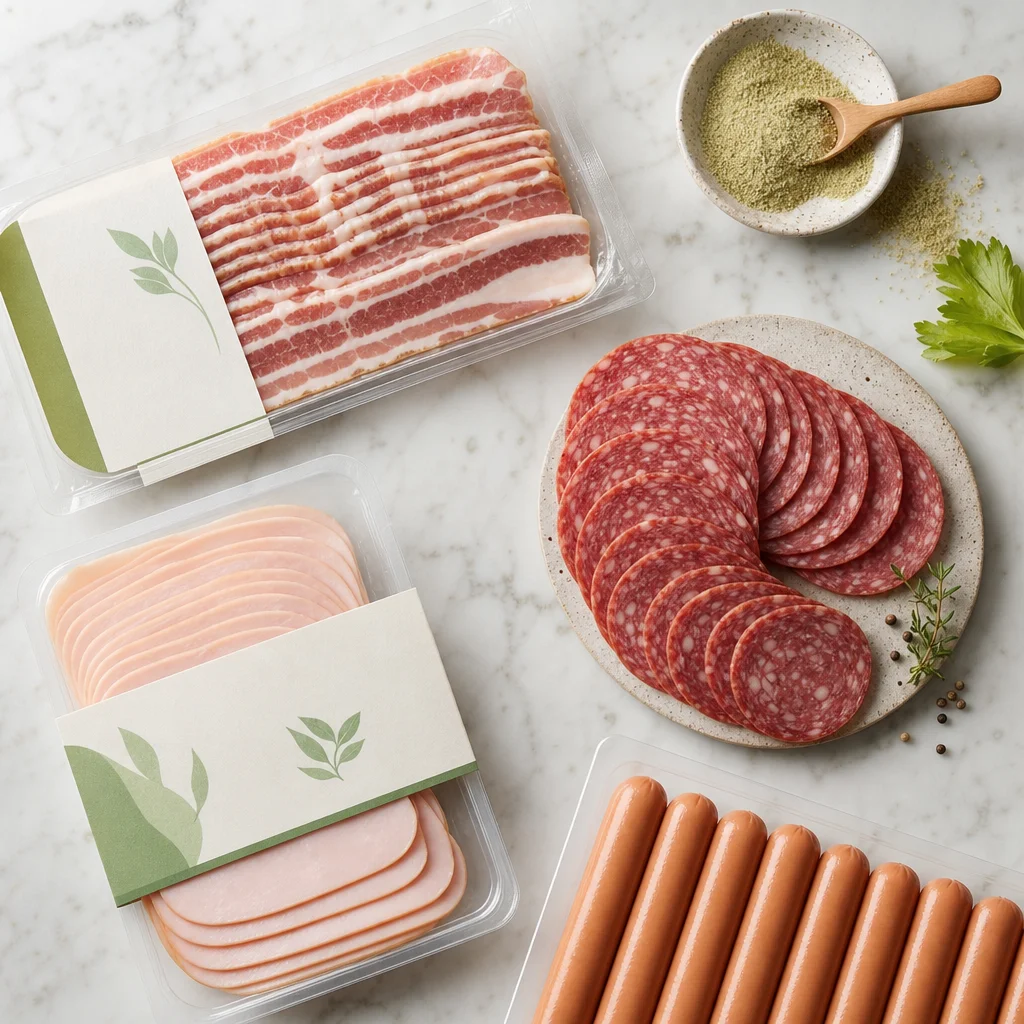
Celery is a top food allergen in Europe and must appear in bold on EU labels, but the US does not classify it as a major allergen. The biggest hidden risk: celery powder is used as a natural curing agent in bacon, salami, and hot dogs labeled 'uncured.'

Jun 5, 2026|11 min read
By Sanket Patel|Updated 2026-06-05|7 sources|Editorial standards
Celery Allergy Dietary Guide: How Uncured Meats Hide Celery Powder

Celery allergy is one of the most common food allergies in several European countries. In Switzerland, celery sensitization has been reported in up to 40% of food-allergic patients, and in France it ranks among the top food allergens alongside egg, peanut, and milk. In Germany, prevalence studies place celery allergy as a significant concern, particularly in adults.

The United States is a different picture. Celery allergy is not tracked as a major allergen, is not subject to any special labeling requirement under FALCPA, and is likely significantly underdiagnosed. The most common pathway to celery allergy in Northern and Central Europe — birch pollen sensitization — exists in the US, but the clinical recognition gap means many Americans with mild celery-related oral symptoms may not have connected them to celery at all.

For those with a diagnosed celery allergy, the biggest risk is not the stalk sitting in the produce drawer. It is celery powder — a concentrated, dehydrated form of the entire plant, present in a growing number of processed meat and packaged food products, often without any visual cue or obvious name on the label.

The Birch Pollen Connection

The majority of celery allergies in adults, particularly in Northern and Central Europe, develop through a pathway called pollen-food allergy syndrome, also known as oral allergy syndrome. The mechanism involves the immune system producing IgE antibodies against Bet v 1, the major allergen in birch pollen. Because Api g 1, the major celery allergen found in the stalk and root, shares a highly similar molecular structure to Bet v 1, the immune system can react to celery as if it were birch pollen.

The resulting reaction is typically mild: itching, tingling, and mild swelling of the mouth and throat, occurring within minutes of eating raw celery. The Api g 1 protein is heat-labile — it breaks down at cooking temperatures. For some patients whose allergy is exclusively driven by Api g 1, cooked celery may be tolerated.

The Heat-Resistant Allergen That Changes the Risk Profile

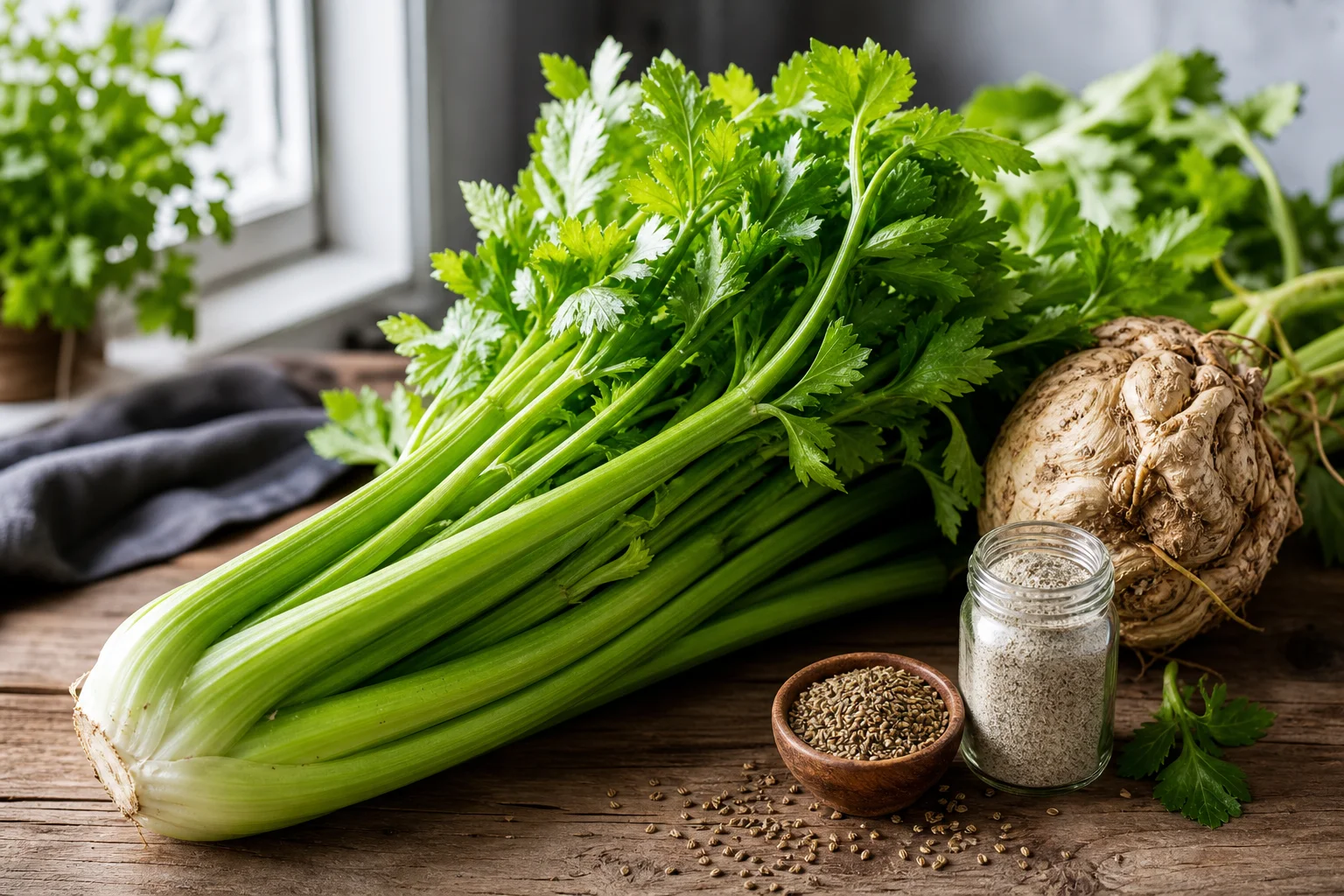
There is a second, clinically more significant celery allergen: Api g 2, a lipid transfer protein that is highly heat-stable and survives boiling, baking, and industrial processing. This is the protein present in celery spice, celery powder, celery seed, and celeriac. Individuals sensitized to Api g 2 are at risk of systemic reactions rather than localized oral symptoms. These reactions can be severe. The form of celery that presents the greatest risk — powdered, processed, concentrated — is the form in which Api g 2 is most concentrated.

The practical distinction: fresh celery stalk, eaten raw, produces oral symptoms in the birch-sensitized patient. Celery powder in a cured sausage, consumed unknowingly, presents a completely different risk profile.

The Uncured Meat Trap

This is the most important section of this guide for any celery-allergic consumer buying packaged meat in the United States.

Traditional cured meats — bacon, salami, pepperoni, hot dogs, corned beef, and many deli meats — are preserved with sodium nitrite, a synthetic curing agent. In response to consumer demand for "natural" and "clean label" products, manufacturers developed an alternative: celery powder. As with many food labeling issues covered in our master guide to food additives, the "natural" language can be misleading.

Celery is naturally high in nitrate. When celery powder is fermented or treated with a starter culture, the nitrate converts to nitrite, which performs the same curing function as synthetic sodium nitrite. The result is a product that can legally be labeled "uncured" or "no nitrates or nitrites added" — a designation that, per USDA regulations, must be accompanied by the qualifying statement "except those naturally occurring in celery powder" or similar language.

The entire "uncured" and "natural" processed meat category is built on celery powder. The brands in this category include Applegate, Oscar Mayer Natural, Hormel Natural Choice, Boar's Head natural line, and many supermarket private-label natural meat lines. The celery powder is a processed ingredient — dried, concentrated celery — and it contains celery allergens, including heat-stable Api g 2.

For a celery-allergic consumer, the regulatory situation is perverse. A product labeled "uncured" or "no nitrates added" — language that reads as cleaner and safer to the general public — presents a concentrated celery risk that a traditional cured product does not. A celery-allergic individual who shops for "natural" meat is steering directly toward the celery-containing products.

The same celery powder mechanism is used in some "naturally cured" or "naturally preserved" vegetable juice products, jerkies, and dried meat snacks. The ingredient must appear on the label — "celery powder," "cultured celery powder," or "celery juice powder" — but the connection between these terms and celery allergy is not one that most consumers make without education.

Traditional Cured Meats Are Not Automatically Safe

Synthetic sodium nitrite curing does not involve celery, so traditional cured meats do not carry the celery risk from the curing process. But celery seed, celery powder, and celery salt are used as spice components in sausages, bologna, liverwurst, and some salami varieties independent of the curing agent. On a USDA-regulated product, celery used as a spice can legally be grouped under "spices" or "natural flavors" without being individually named. Manufacture contact is the only way to rule celery out for USDA-labelled products whose ingredient list includes these collective terms.
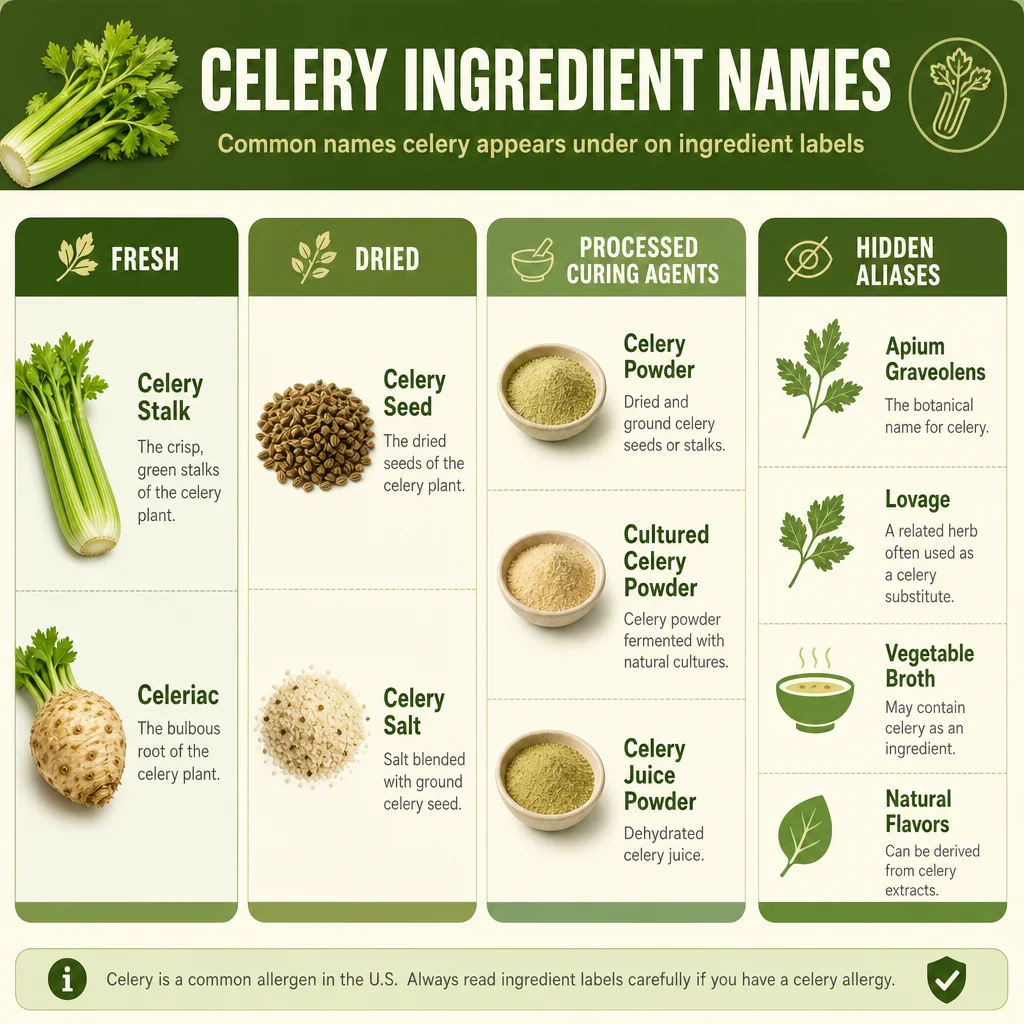
Every Name for Celery on a Food Label

Every Name for Celery on a Food Label

Direct celery forms:

Label NameWhat It Is
CeleryThe fresh vegetable (stalk, Apium graveolens var. dulce)
Celeriac / celery rootThe enlarged hypocotyl; common in European cooking; concentrated allergen source
Celery seedWhole or ground; used as a spice; concentrated Api g 2
Celery saltCelery seed ground with salt; ubiquitous in spice blends, Bloody Marys, and deli seasoning
Celery powderDehydrated ground celery
Cultured celery powderCelery powder treated with starter culture (nitrate-to-nitrite conversion); the curing agent described above
Celery juice / celery juice powderDehydrated celery juice; used in natural curing and as a vegetable-based flavor
Celery extractConcentrated flavor or functional extract
Celery oleoresinSolvent-extracted celery concentrate; used as a flavoring agent
Celery leaf / celery flakesDried celery leaves; used as seasoning
Apium graveolensThe botanical name for celery; used on ingredients lists, especially on imported and supplement products
Lovage (Levisticum officinale)A closely related plant in the Apiaceae family; not identical to celery but contains cross-reactive allergens. If allergic to celery, discuss lovage with your allergist — it is used in soups, stocks, and some European herb blends.

Ingredients that implicitly contain celery:

Label NameCelery Context
Vegetable broth / vegetable stockCelery is a standard component in most commercial vegetable broth formulations
Mirepoix / soffrittoThe French/Italian aromatic base of onion, carrot, and celery. Products listing "mirepoix" or "soffritto" as an ingredient contain celery
Bouquet garniThe classic French herb bundle; celery leaf is a traditional component (parsley, thyme, bay leaf are the other three)
Spices (USDA products)Celery seed and celery powder can legally be included under this collective term on USDA-regulated meat products
Natural flavorsCelery-derived flavoring agents may be listed as "natural flavors" without identifying the celery origin
Vegetable powderCan include celery powder; requires manufacturer clarification

Where Celery Appears in Food Products

Where Celery Appears in Food Products

Soups, Stocks, and Bouillon

Celery is part of the aromatic base — mirepoix (onion, carrot, celery) in French cooking, soffritto in Italian — that underlies virtually all Western soup and stock production. Canned soups, bouillon cubes, soup bases, ramen seasoning packets, and gravy mixes nearly always contain celery in some form.

The ingredient may be listed as celery, celery powder, celery seed, celery extract, or simply "vegetables" (on USDA products where the component vegetables are not individually named). Bouillon cubes and soup bases are a high-priority category for label scanning.

Bloody Marys and Cocktails

Celery salt is the defining seasoning of the Bloody Mary. The drink itself, the rim salt, and the garnishes are all potential celery exposure points. Celery salt and celery seed are also used in some craft cocktail syrups and savory cocktail preparations.

Spice Blends and Seasonings

  • Old Bay Seasoning — celery salt is a primary ingredient.
  • Poultry seasoning — celery seed or celery salt is a conventional component.
  • Pickling spice — celery seed is standard in many formulations.
  • Everything bagel seasoning — some formulations include celery seed; most do not but must be verified brand by brand.
  • Dry soup mixes, dip mixes, and ranch seasoning — celery powder is present in many formulations.

Frozen and Prepared Meals

Celery in its diced vegetable form appears in frozen pot pies, frozen casseroles, canned stews, canned chili, and frozen vegetable medleys. These products generally list celery by name as a vegetable component. The more significant risk is celery powder or celery extract in the sauce or broth base of the same product, which may appear lower in the ingredient list and can be missed in a quick scan.

Vegetable Juices

Celery juice is a popular wellness product in its own right, and celery appears as a component ingredient in many mixed vegetable juice blends (V8 and similar products). Green juice products that list "green vegetables" or "vegetable juice blend" on the label almost always include celery unless specifically formulated without it.

Cross-Reactivity: The Celery-Carrot-Mugwort-Spice Syndrome

The most clinically important cross-reactivity relationship for celery allergy is with the broader Apiaceae (Umbelliferae) family. Celery shares allergen proteins — particularly profiling and lipid transfer proteins — with:

  • Carrot (Daucus carota) — the closest cross-reactive food. Carrot-celery co-allergy is so common in Central Europe that the combination has its own clinical designation.
  • Birch pollen and mugwort pollen — celery-carrot-mugwort-spice syndrome is a well-described pattern where sensitization to mugwort pollen (Artemisia vulgaris) drives cross-reactivity to celery, carrot, and spices from the Apiaceae family. This pattern is more common in Southern Europe, while birch-celery is the Northern European pattern.
  • Spices from the Apiaceae family: dill, fennel, coriander (cilantro seed), cumin, anise, caraway, and parsley. Cross-reactivity varies by individual. Positive skin or blood tests to multiple Apiaceae spices are common in celery-allergic patients, but clinical reactivity — actually reacting when eating the spice — is less common than the tests suggest. Individual assessment through an allergist is required.
  • Parsnip — cross-reactive; clinical relevance is high.
  • Lovage — contains cross-reactive allergens; often used in European soups and stocks.

The general clinical guidance: a celery-allergic individual should discuss each Apiaceae food with their allergist individually rather than assuming blanket cross-reactivity across the entire botanical family.

EU Labeling

Under EU Regulation 1169/2011, "celery and products thereof" is one of the 14 mandatory food allergens. Any packaged food containing celery must emphasize it typographically within the ingredient list — bold face, contrasting color, or italics — and it must be disclosed for unpackaged food sold in restaurants and cafeterias upon customer request.

European celery-allergic consumers benefit from a labeling system that makes celery immediately visible on every packaged product. The contrast with the US regulatory environment, where celery is not a major allergen and can appear as "spices" or "natural flavors" on USDA products, could hardly be starker.

A Practical Label-Reading Strategy

Celery is not one of the nine FALCPA major allergens in the United States. It receives no "Contains" statement, no bold text, and no allergen flag. On USDA-regulated meat and poultry products, celery can legally be grouped under "spices," "natural flavors," or "vegetables" without being individually named. The most significant hidden celery risk in US food is celery powder used as a natural curing agent in "uncured" processed meats.

When scanning for celery:

  1. Scan the ingredient list for every known celery name: celery, celeriac/celery root, celery seed, celery salt, celery powder, cultured celery powder, celery juice/celery juice powder, celery extract, celery oleoresin, celery leaf/celery flakes, Apium graveolens (botanical name), and lovage (a cross-reactive relative). Vegetable broth, mirepoix, and bouquet garni implicitly contain celery.
  2. On processed meats, "uncured" or "no nitrates or nitrites added" products should be treated as high-priority. These products use celery powder to convert naturally occurring nitrates to nitrites for curing. Read for "celery powder," "cultured celery powder," "celery juice powder," or the qualifying statement "except those naturally occurring in celery powder." Traditional cured meats using sodium nitrite do not carry this celery curing risk but may contain celery as a spice.
  3. On USDA-regulated products, "spices," "natural flavors," and "vegetables" as collective terms should prompt manufacturer contact.
  4. On European imports, celery will appear in bold or other typographic emphasis within the ingredient list. Sellerie (German), céleri (French), apio (Spanish), or sedano (Italian) in bold text is the EU allergen flag.
  5. For soups, stocks, and gravy mixes, celery is present in the overwhelming majority of commercial formulations. Bouillon cubes and soup bases should be assumed to contain celery until confirmed otherwise.

Using IngrediCheck, you can scan any packaged food and identify celery in every form.

Next Label Check

Follow the scanner, hub, and ingredient paths connected to this guide

Get the app for clearer label decisions.

Scan labels, see what fits your food notes, and read the why in plain English.

IngrediCheck app