Dietary Guides

Mustard Allergy Dietary Guide: Why Spices Can Mean Mustard in the US

Mustard is a top-four food allergen in France and a mandatory labeled allergen in the EU and Canada, but the US does not classify it as a major allergen. It can legally be hidden under 'spices' or 'natural flavors' on American food labels.

Jun 8, 2026|11 min read
By Sanket Patel|Updated 2026-06-08|7 sources|Editorial standards
Mustard Allergy Dietary Guide: Why Spices Can Mean Mustard in the US

Mustard allergy is the fourth most common food allergy in France, where it accounts for 1-7% of all food allergies and is a well-known clinical concern among allergists. It is most commonly diagnosed in children before age three, and it persists for years in a substantial subset of patients.

The United States has a labeling gap that makes mustard uniquely dangerous for consumers on this side of the Atlantic. In the European Union and Canada, mustard is one of the government-mandated priority allergens — it must appear on labels with visual emphasis, and it cannot be hidden under generic category terms. In the United States, mustard is not one of the nine FALCPA major allergens. It must appear in the ingredient list of FDA-regulated products under its common name, but it receives no allergen flag, no bold text, no "Contains" box. And in products regulated by the USDA, it can legally be listed under the collective term "spices" or "natural flavors" without any specific identification.

The practical result: an American consumer with mustard allergy must do more detective work than a consumer with any of the nine FALCPA allergens. The label does not help in the way it helps with peanuts, eggs, or milk. You are reading every line yourself, and in some product categories, the line may not even name mustard directly.
The US Labeling Gap

Under FALCPA, the nine major allergens are milk, eggs, fish, crustacean shellfish, tree nuts, peanuts, wheat, soybeans, and sesame. Mustard is not on this list. A bill to add it has been introduced in Congress multiple times — most recently as part of the FASTER Act discussions that ultimately added only sesame — but as of 2026, mustard remains without major allergen status.

The gap manifests in three ways, similar to the labeling gaps covered in our guide to how food labels work:

  1. No "Contains" statement. A product containing mustard seed, mustard flour, or mustard oil does not need a "Contains: Mustard" declaration. The ingredient appears in the ingredient list under its name, but without the standardized allergen flag that consumers are trained to look for.
  1. The "spices" loophole on USDA products. USDA-regulated products — most meat, poultry, and processed egg items — are not covered by FALCPA. Under USDA labeling rules, "spices" can be listed as a collective term without naming the component spices individually. Mustard seed, mustard flour, and mustard powder in a sausage, deli meat, or marinated poultry product may legally appear under the single word "spices."
  1. "Natural flavors." Mustard-derived flavorings may be listed as "natural flavors" on both FDA and USDA products. Because mustard is not a major allergen, there is no requirement to identify the source of a mustard-derived natural flavoring. A consumer reading "natural flavors" on a packaged food label has no way of knowing whether that natural flavoring is derived from mustard.

This is in sharp contrast to the situation in Europe, where Regulation 1169/2011 lists "mustard and products thereof" as one of 14 mandatory allergens. In EU products, mustard must appear in the ingredient list with typographic emphasis — bold text, contrasting color, or italic — and it must be identified by name. The Canadian Food Inspection Agency also classifies mustard as a priority allergen requiring clear label declaration.

For a US consumer, the EU and Canadian labels offer a level of readability that American labels do not.

Every Name for Mustard on a Food Label

Every Name for Mustard on a Food Label

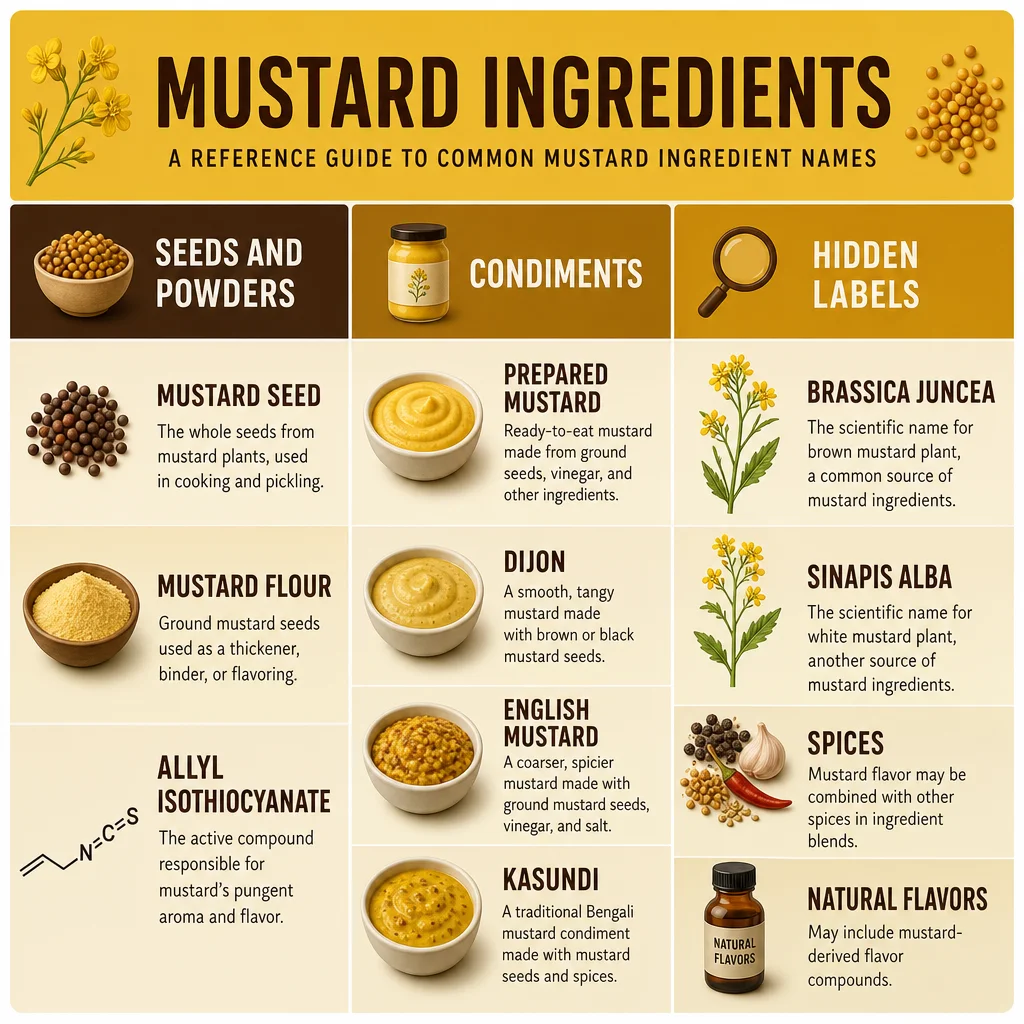
Mustard appears under several forms, only some of which contain the word "mustard":

Direct mustard ingredients:

Label NameWhat It Is
Mustard seedWhole seeds; yellow (white), brown, or black
Mustard powder / ground mustardDried, ground mustard seed
Mustard flourFinely ground mustard seed; higher protein content than powder
Prepared mustardThe condiment; varies by variety (yellow, Dijon, whole grain, English)
Mustard oilPressed from mustard seeds; discussed separately below
Mustard oleoresinSolvent-extracted flavor concentrate
Mustard greens / mustard leafThe leafy vegetable (Brassica juncea); may trigger reactions in mustard-allergic individuals
Mustard branOuter seed coat fraction; used as a fiber ingredient
Mustard sproutsYoung germinated plants

Hidden and scientific names:

Label NameWhat It Is
Sinapis alba / Brassica albaWhite/yellow mustard botanical name
Brassica junceaBrown/Indian mustard botanical name
Brassica nigraBlack mustard botanical name
Allyl isothiocyanateThe pungent volatile compound in mustard; may appear on flavor or preservative labels
SinalbinThe glucosinolate compound specific to white mustard
SinigrinThe glucosinolate in brown/black mustard
4-Hydroxybenzyl isothiocyanateThe hydrolysis product of sinalbin; responsible for white mustard pungency

Label names specific to Indian and South Asian ingredients:

Label NameContext
Rai / rai kuriaIndian term for brown mustard seed (split or whole); appears on spice blend labels
Sarson / sarson ka telIndian term for mustard greens / mustard oil
Panch phoron / panch puranBengali five-spice blend; mustard seed is one of the five essential components
KasundiBengali mustard sauce/condiment
Achar / pickle masalaIndian pickle spices; mustard seed is a core component of most achar recipes

Where Mustard Hides Most Often

Where Mustard Hides Most Often

Condiments, Sauces, and Dressings — the Highest-Risk Category

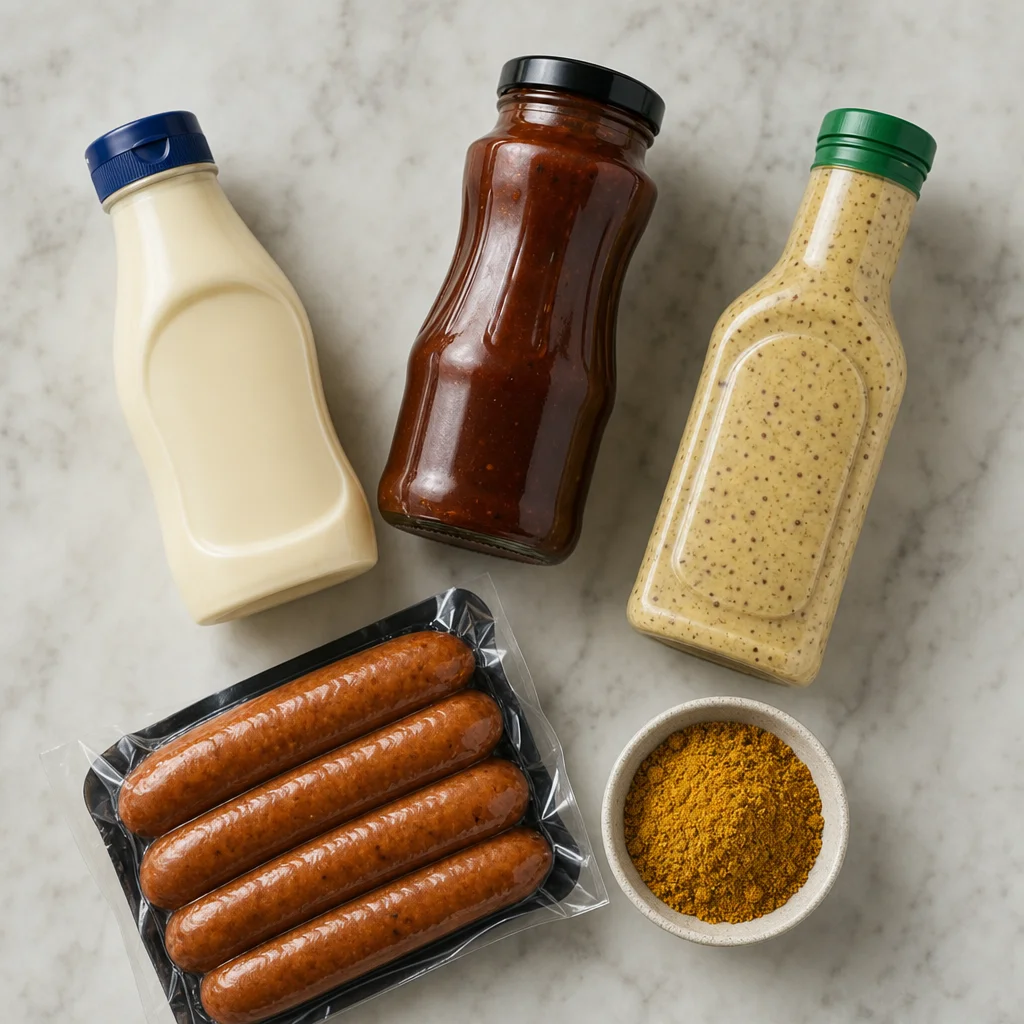
Mustard appears as a background ingredient in a vast range of condiments that consumers do not associate with mustard by taste or name:

  • Mayonnaise — many commercial mayonnaises, including Hellmann's and Duke's, contain mustard flour as an emulsifier or flavor enhancer. Dijon-style mayonnaise is obviously mustard-containing, but standard mayonnaise often includes it without fanfare.
  • Barbecue sauce — mustard is a base ingredient in Carolina-style (South Carolina gold) and many Kansas City-style sauces. Even tomato-based barbecue sauces may include ground mustard as a background note.
  • Salad dressings — vinaigrettes, creamy dressings, and bottled coleslaw dressing frequently contain ground mustard or prepared mustard. This is ubiquitous enough that packaged salad dressing should be assumed to contain mustard until confirmed otherwise.
  • Steak sauce, Worcestershire sauce, and hot sauces — diverse condiment category that frequently uses ground mustard as a background flavor component.
  • Ketchup — some brands use mustard flour; most commercial formulations do not, but imported or specialty varieties sometimes include it.

Processed Meats

This is the most dangerous category for US consumers because of the USDA "spices" loophole. Sausages, hot dogs, bologna, salami, pepperoni, liverwurst, and many deli meat products use mustard seed or mustard flour as a spice component. USDA-regulated meat products can list mustard under "spices" or "natural flavors" without naming it individually. A consumer reading "spices" on a sausage label has no way to rule out mustard.

Indian and South Asian Cuisine

Mustard seeds are fundamental to tempering (tadka / chaunk / baghar) across Indian regional cooking. Brown mustard seeds are popped in hot oil at the beginning of cooking and then form the aromatic base of the dish. This technique is used in dals, curries, sabzis, chutneys, and rice dishes across virtually every Indian state. The seeds remain visible after cooking but are not always described in the dish name or on a menu.

Specific high-risk items:

  • Sarson ka saag — the signature Punjabi dish built around mustard greens
  • Panch phoron — the Bengali five-spice blend (mustard, cumin, fennel, nigella, fenugreek)
  • South Indian tadka — mustard seeds are nearly always present in the tempering for sambar, rasam, upma, and most South Indian curries
  • Pickles (achar) — mustard seeds and mustard oil are central to Indian preserved pickles
  • Kasundi — Bengali mustard sauce served as a condiment

Spice Blends and Dry Rubs

The following spice blends almost always contain mustard:

  • Curry powder (Western-style) — both Madras and standard curry powder formulations typically include ground mustard
  • Garam masala — many (not all) garam masala blends include mustard seed; must be verified brand by brand
  • Panch phoron — mustard is one of the five required components
  • Pickling spice — mustard seed is a standard component in American and European pickling spice blends
  • Dry rubs and barbecue rubs — ground mustard is a very common component
  • Herbes de Provence — most formulations do NOT contain mustard; this is the exception people worry about unnecessarily
  • Za'atar — does NOT contain mustard; confusion arises because both are small brown seeds used in Middle Eastern cooking (za'atar is thyme/sumac/sesame)

European Prepared Foods

  • Dijon mustard is the most concentrated form. This appears in French cooking extensively: vinaigrettes, sauces (béchamel with mustard is a common variation), coq au vin, rabbit preparations, and as a crust on roasted meats and fish.
  • English mustard is hotter and present in British condiments, Scotch eggs, pork pies, and Ploughman's lunch components.
  • German mustard (Senf) is standard accompaniment to sausages (Bratwurst, Weisswurst), pretzels, and many German deli items. German potato salad, unlike its American counterpart, is made with a mustard dressing.

Mustard Oil: Why It Is Banned From US Food Use

Mustard oil is a vegetable oil pressed from mustard seeds (Brassica juncea). It is a staple cooking oil in North India, Bangladesh, Nepal, and parts of Pakistan, where it is valued for its pungent, wasabi-like flavor and high smoke point.

Mustard oil is not permitted for food use in the United States, Canada, or the European Union. The FDA bans it because mustard oil contains high levels of erucic acid (up to 46%), which has been associated with myocardial lipidosis in animal studies. Imported mustard oil sold in the US is typically labeled "For External Use Only" — it is marketed as a massage oil.

Despite the explicit ban, mustard oil remains widely available in South Asian grocery stores in the US. It is imported and sold with the external-use label designation, but a substantial share of consumers purchase it for cooking anyway, consistent with its cultural role. This creates a dual problem for mustard-allergic consumers: the oil is present in kitchens where it should not be legally present in food, and it is highly allergenic — cold-pressed mustard oil retains mustard protein and contains allyl isothiocyanate, the compound responsible for mustard's pungency.

Refined mustard oil that meets EU erucic acid limits (below 2%) is sold as a food-grade product in India and the UK, but it is still mustard oil. It contains mustard protein and is never safe for mustard-allergic individuals.

Cross-Reactivity Within the Brassica Family

Mustard belongs to the Brassicaceae (Cruciferae) family, which also includes broccoli, cabbage, cauliflower, Brussels sprouts, kale, turnips, radishes, and rapeseed (the source of canola oil).

The clinical question is whether mustard allergy predicts allergy to other members of the brassica family. The answer is nuanced.

Rapeseed / canola protein shows the highest cross-reactivity with mustard. Shared 2S albumin storage proteins are present in both seeds, and sensitization to one predicts IgE binding to the other. However, the clinical significance for canola oil is different from the lab data. Highly refined canola oil is protein-free and is tolerated by mustard-allergic individuals. Cold-pressed or unrefined rapeseed oil, which retains 2S albumins, should be avoided.

Broccoli, cabbage, cauliflower, kale, and other brassica vegetables — IgE sensitization is common, but clinical reactivity is rare. Most mustard-allergic individuals tolerate cooked brassica vegetables without issue. The AAAAI notes that reactions to these vegetables in mustard-allergic patients are uncommon but have been documented, particularly with raw preparations.

Mustard greens (the leafy vegetable, Brassica juncea) are more directly relevant. They contain the same allergenic proteins as mustard seeds and can trigger reactions in mustard-allergic individuals. The leaves are used extensively in Southern US, Chinese, and Indian cooking.

Tree nuts and peach — elevated co-sensitization rates have been documented, likely representing shared 2S albumin and nonspecific lipid transfer protein sensitization in atopic individuals rather than direct cross-reactivity. Clinical management proceeds on an individual basis through an allergist.

A Practical Label-Reading Strategy

Mustard is not one of the nine FALCPA major allergens in the United States. This means mustard receives no "Contains" statement, no bold text, and no allergen flag on US food labels. On USDA-regulated meat and poultry products, mustard can legally be listed under the collective term "spices" or "natural flavors" without being individually named. This is the key difference from allergens like peanut or milk.

When scanning for mustard:

  1. Scan the full ingredient list for every known mustard name: mustard seed, mustard flour, mustard powder, prepared mustard (yellow, Dijon, whole grain, English), mustard oil, mustard oleoresin, mustard greens, mustard bran. Botanical names: Sinapis alba/Brassica alba (white mustard), Brassica juncea (brown/Indian mustard), Brassica nigra (black mustard). Chemical names: allyl isothiocyanate, sinalbin, sinigrin. Indian/South Asian names: rai, sarson, panch phoron (mustard is one of five components), kasundi, achar/pickle masala.
  2. On USDA-regulated meats (sausages, hot dogs, deli meat, bologna), "spices" and "natural flavors" are red-flag terms. Neither is required to identify mustard individually. Contact the manufacturer to confirm.
  3. On imported products, check for language-specific terms: moutarde (French), senf (German), mostarda (Italian), rai or sarson (South Asian). European imports bearing mustard as a mandatory allergen will have it in bold in the ingredient list.
  4. Condiments require the most scrutiny. Mayonnaise, barbecue sauce, salad dressing, and steak sauce are the categories where mustard is present in the largest number of unexpected products.
  5. In restaurant settings, Indian cuisine presents the highest risk due to tadka tempering (mustard seeds popped in oil). French cuisine carries risk through Dijon mustard in sauces and dressings. A chef card is recommended for both.

Using IngrediCheck, you can scan any packaged food and flag every mustard-derived ingredient across all 30+ names and aliases.

Next Label Check

Follow the scanner, hub, and ingredient paths connected to this guide

Get the app for clearer label decisions.

Scan labels, see what fits your food notes, and read the why in plain English.

IngrediCheck app