Dietary Guides

Fish Allergy Dietary Guide: Worcestershire Sauce, Caesar Dressing, and Other Surprises

Fish allergy is one of the most persistent food allergies and often develops in adulthood. The species must be named on the label — but fish hides in Worcestershire sauce, Caesar dressing, beer, and a dozen other products where shoppers don't expect it.

Jun 5, 2026|10 min read
By Sanket Patel|Updated 2026-06-05|8 sources|Editorial standards
Fish Allergy Dietary Guide: Worcestershire Sauce, Caesar Dressing, and Other Surprises

Fish allergy stands apart from most other major food allergies in one important way: it frequently develops in adulthood. While peanut, tree nut, and egg allergies are predominantly diagnosed in childhood, fish allergy is one of the most common adult-onset food allergies, and unlike most childhood food allergies, it is almost never outgrown. An estimated 0.5% of US adults and 0.2% of US children have fish allergy, with approximately 40% of cases first diagnosed after the age of 18.

The persistence of fish allergy in adults and the wide variety of forms fish takes in the food supply — sauces, clarifying agents, supplements, even fining agents in beer — makes it one of the more complex food allergies to manage through label reading alone.
Which Fish Species Are Covered Under US Law

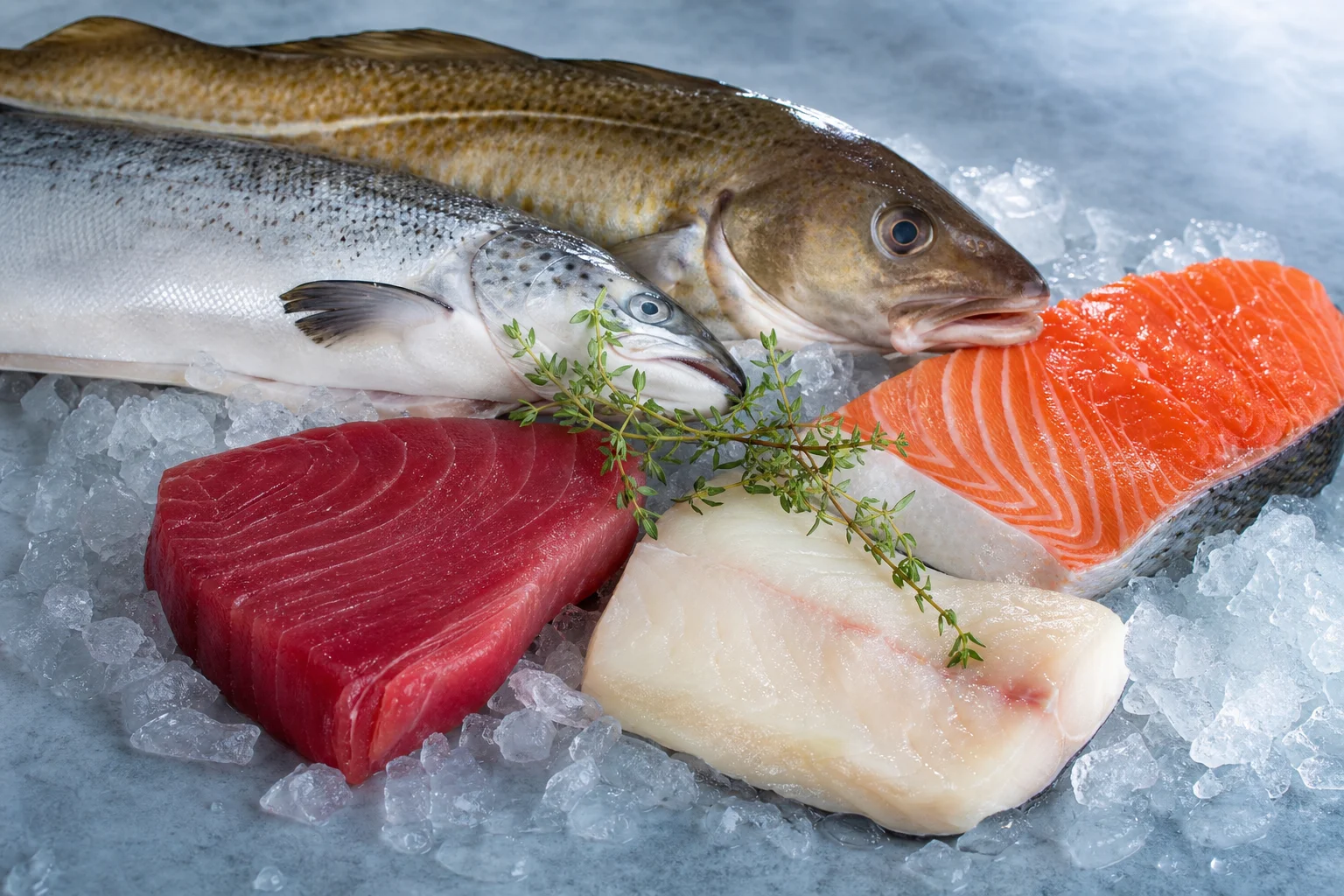
Under FALCPA, "fish" is one of the nine major food allergens. The law requires that any fish-derived ingredient must identify the specific type of fish in the ingredient list or "Contains" statement. A label cannot simply say "Contains: Fish" — it must name the species, for example "Contains: Fish (Tuna)" or "Contains: Fish (Cod, Salmon)."

The FDA's allergen guidance lists the following as examples of fish covered under FALCPA:

  • Anchovy
  • Bass
  • Catfish
  • Cod
  • Flounder
  • Grouper
  • Haddock
  • Hake
  • Halibut
  • Herring
  • Mahi mahi
  • Perch
  • Pike
  • Pollock
  • Salmon
  • Snapper
  • Sole
  • Swordfish
  • Tilapia
  • Trout
  • Tuna

This species-specific labeling requirement is meaningful for individuals who react to some fish but not others. It allows someone who tolerates salmon but not cod to make informed decisions — if the label identifies the specific fish.

Cross-Reactivity: Can You Eat Some Fish If Allergic to Others?

The primary allergen in most fish is parvalbumin, a calcium-binding muscle protein. Because parvalbumin is present across nearly all finfish species and shares significant structural similarity between species, cross-reactivity in fish allergy is the rule rather than the exception.

Studies using skin prick testing and oral food challenges consistently show that the majority of fish-allergic individuals react to multiple species. The practical implication: if you have a confirmed allergy to one finfish, most allergists advise avoiding all finfish until specific cross-reactivity has been assessed through supervised oral food challenges.

That said, parvalbumin content and structure do vary across species, and not all cross-reactivities are clinically equivalent:

  • Tuna and swordfish contain relatively lower levels of parvalbumin compared to cod, pollock, and salmon, which is why some individuals with moderate fish allergy tolerate them while reacting to others. However, this is not a reliable guide without individual challenge.
  • Cod, pollock, haddock, and hake (all members of the Gadidae family) are among the most cross-reactive species.
  • Salmon and trout (Salmonidae family) are closely related and typically cross-reactive.
  • Shellfish — shrimp, crab, lobster, clams, oysters, scallops — use a completely different allergen protein (tropomyosin) and are classified as a separate major allergen under FALCPA, as detailed in our guide to undeclared allergens in food recalls. Fish allergy does not predict shellfish allergy. Most fish-allergic individuals tolerate shellfish without issue, and vice versa, though individual variation and co-sensitization exist.

Hidden Fish Ingredient Names on Labels

Hidden Fish Ingredient Names on Labels

Fish appears in a wider variety of manufactured products than most consumers expect. The following ingredient names indicate fish-derived content:

Label NameNotes
Fish sauceConcentrated fermented fish liquid; fundamental seasoning in Southeast Asian cooking
Nam plaThai fish sauce
Nước mắmVietnamese fish sauce
Pla ra / padaekFermented fish paste (Thai/Lao)
Anchovy pasteConcentrated anchovy product used in dressings, sauces
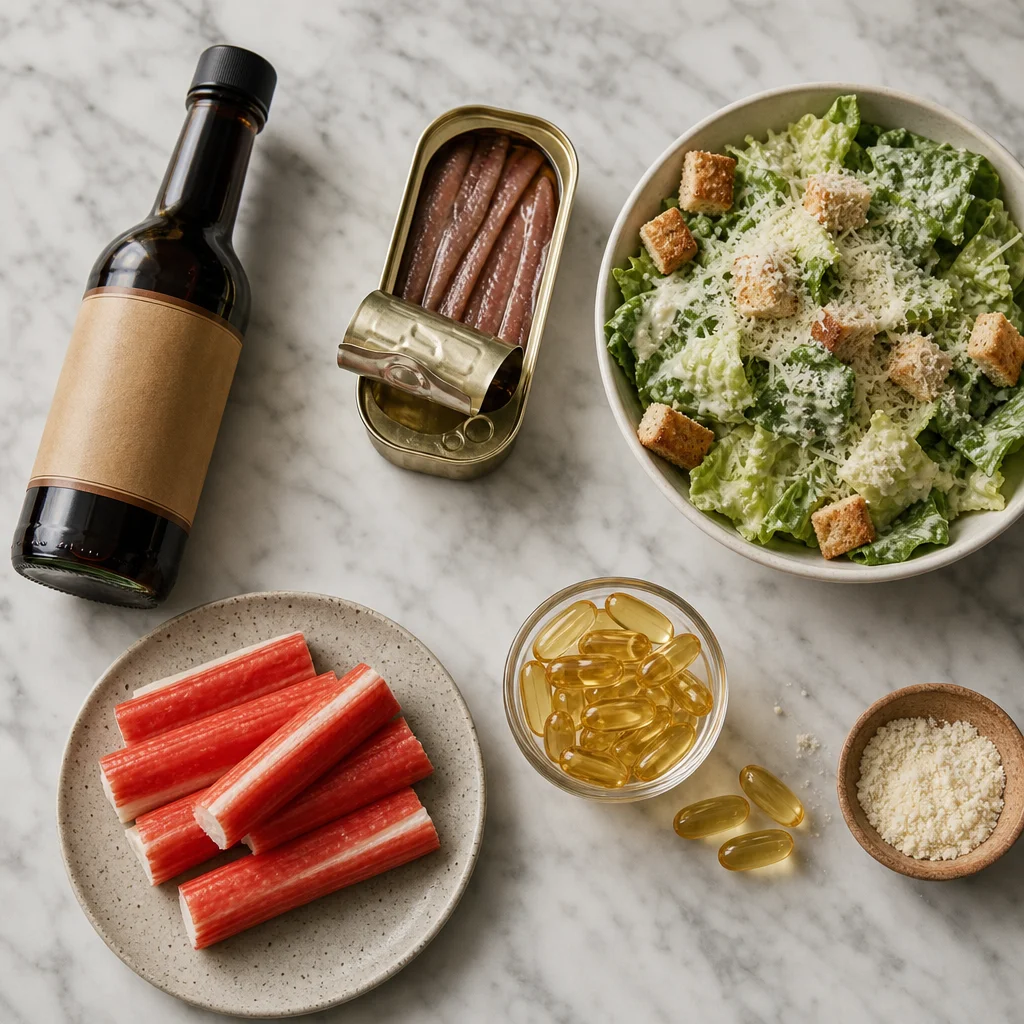
Worcestershire sauceTraditional Lea & Perrins formula contains anchovies
Caesar salad dressingTraditional recipe and many commercial versions contain anchovies
SurimiImitation crab, imitation lobster, crab sticks — made from minced pollock or other white fish
Imitation crab / imitation lobster / seafood sticksAll typically surimi (pollock-based)
IsinglassClarifying agent made from dried fish swim bladders; used in some beer and wine production
Fish gelatinGelatin derived from fish skins/bones; used as halal/kosher alternative to pork gelatin
Fish broth / fish stockUsed in soups, risottos, paella
Fish oilUsed in omega-3 supplements, some fortified foods
Omega-3 (from fish)Supplement and food fortification; many fish-oil-based products are now common
Glucosamine (marine-derived)Some glucosamine supplements are derived from fish cartilage; others are from shellfish
BouillabaisseFrench seafood stew; always contains fish
CaponataSome versions include anchovies
TapenadeTraditionally made with anchovies
Pasta puttanescaClassic recipe includes anchovies
Tonnato sauceItalian tuna-based sauce for vitello tonnato

The Worcestershire Sauce and Caesar Dressing Blind Spots

These two are responsible for a disproportionate share of accidental fish exposures in fish-allergic individuals who consider themselves careful label readers.

Worcestershire sauce — the original Lea & Perrins formulation and most commercial Worcestershire sauces contain anchovies as a key flavor component. The anchovies must be declared under FALCPA on US labels. But Worcestershire sauce appears as a minor ingredient in hundreds of steak sauces, burger seasonings, Bloody Mary mixes, barbecue sauces, meat marinades, and savory dips. Consumers checking the label of the finished product should see the fish declaration; those ordering the finished product at a restaurant or accepting it from a buffet have no way to know without asking.

Caesar salad dressing — traditional Caesar dressing is made with anchovy fillets or anchovy paste as a foundational ingredient. Many commercial Caesar dressings also contain anchovies. The ingredient will be declared on packaged dressing labels, but Caesar salads in restaurants are almost never labeled, and servers may not know that the dressing contains fish.

Surimi: The Imitation Seafood Trap

Surimi-based products — imitation crab, imitation lobster, crab sticks, and seafood sticks — are made from minced white fish, most commonly pollock. They are flavored and shaped to resemble shellfish.

This creates a particular risk for individuals who are allergic to fish but not shellfish (or who have never considered a crab stick to be a fish product). The "imitation" name implies the product is not real seafood, which is accurate in that it contains no crab — but it contains pollock, a covered finfish allergen under FALCPA.

Surimi-based products must declare fish (and the specific species) on their labels. But the mismatch between the product name ("imitation crab") and its actual content (pollock) means the allergen risk is not self-evident from the product category.

Isinglass in Beer and Wine

Isinglass in Beer and Wine

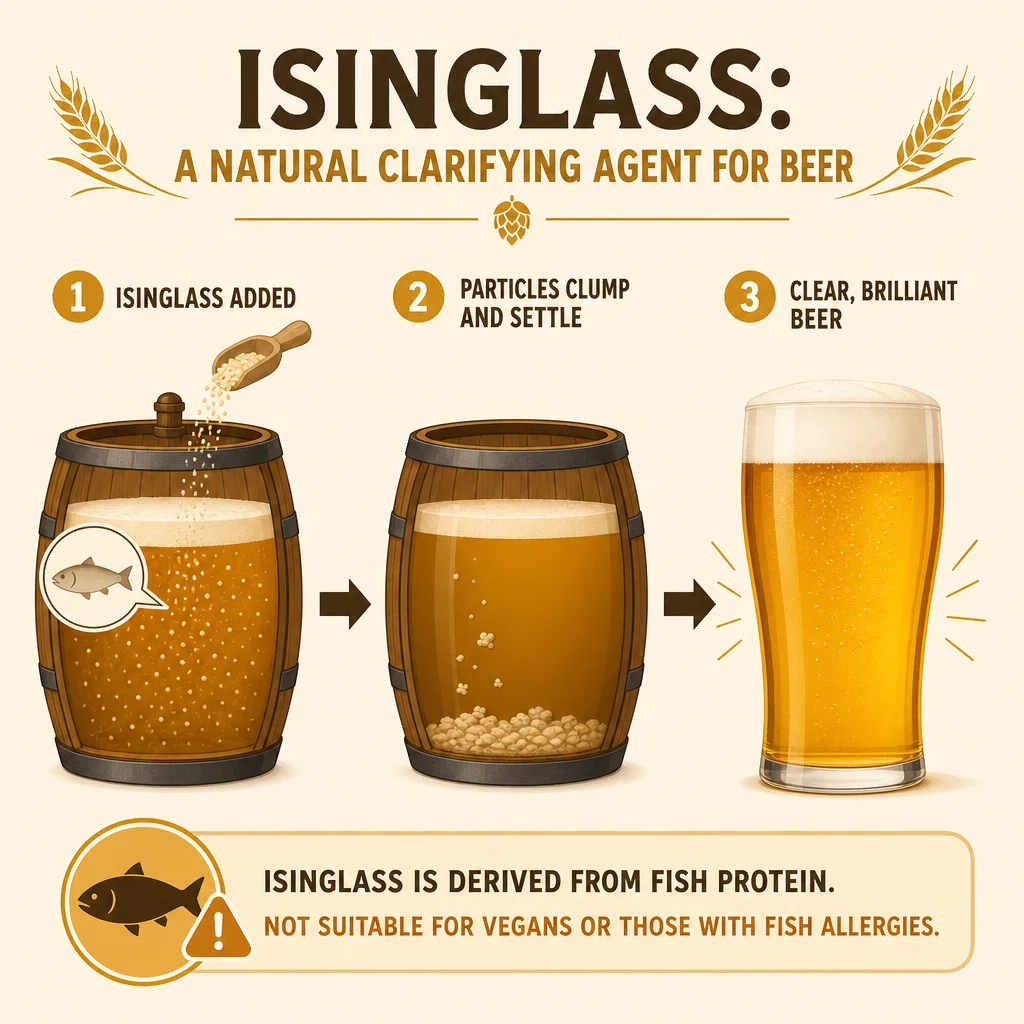
Isinglass is a clarifying agent made from the dried swim bladders of fish, typically sturgeon or tropical fish. It is used in the production of some beers and wines to remove yeast and particulate matter, producing a clearer final product.

Most fish-allergic individuals do not react to products clarified with isinglass because the fining agent is separated out before packaging and residual protein levels are typically very low. However, some studies have detected trace fish protein in isinglass-fined beverages, and highly sensitive individuals should be aware of the risk.

Fish-allergic individuals who observe strict avoidance should look for beers and wines labeled as vegan (which by definition use no animal-derived fining agents, including isinglass) or that specifically state "isinglass-free" fining. The TTB 2024 allergen rule now requires alcoholic beverages to declare fish when used as a processing aid if residual protein is detectable.

Omega-3 Supplements and Fish Oil

The global omega-3 supplement market relies predominantly on fish oil — typically from small fatty fish like anchovies, sardines, mackerel, and herring. Fish-allergic individuals should avoid fish oil-based omega-3 supplements.

Alternatives exist: algal omega-3 supplements (derived from marine algae, the original source of DHA and EPA that fish accumulate) contain no fish protein and are safe for fish-allergic individuals.

Glucosamine supplements present a more complex picture. Glucosamine is derived from either shellfish chitin or, in some products, from fish cartilage. Products should specify the source; "marine-derived glucosamine" may indicate fish origin.

Fish Gelatin

Standard gelatin in Western food manufacturing is almost entirely pork- or beef-derived. However, fish gelatin is produced as a halal and kosher alternative for use in products served to observant Muslim and Jewish consumers. It appears in some marshmallows, gummy candies, dessert gels, and capsule coatings marketed for these communities.

Fish-allergic individuals in communities where fish gelatin is more common should check whether gelatin in a specific product is fish-derived. The specific source is not always declared beyond "gelatin," though FALCPA requires the fish to be named if fish-derived gelatin is used.

Restaurants: Where Fish Allergy Is Most Dangerous

Fish allergy in restaurant settings presents risks beyond the obvious fish entrée. The hidden vectors are:

  • Shared fryers and cooking surfaces — fish and non-fish items cooked in the same oil or on the same grill carry genuine cross-contact risk. Many kitchens with deep fryers cook fish products in the same oil as fries and other items.
  • Caesar salad — already discussed; staff may not know the dressing contains anchovy.
  • Asian restaurants — fish sauce is used across Thai, Vietnamese, and some Chinese cooking as a background seasoning, in ways that neither the menu description nor the server's knowledge will typically disclose.
  • French cuisine — anchovies appear in pissaladière (Provençal tart), tapenade, vitello tonnato (Italian but frequently available at French-influenced restaurants), bagna cauda, and various butter sauces.
  • Pizza — anchovy is a standard optional topping; cross-contact from shared pizza pans used for anchovy and non-anchovy pies is a realistic risk in high-volume pizza settings.

Fish vs. Shellfish: Two Separate Allergens

Fish (finfish) and shellfish (crustaceans: shrimp, crab, lobster; and molluscs: clams, oysters, scallops, squid) are classified as separate major allergens under FALCPA. Their allergenic proteins are unrelated: finfish allergy centers on parvalbumin; shellfish allergy centers primarily on tropomyosin.

Having a fish allergy does not predict having a shellfish allergy. The majority of people allergic to finfish tolerate shellfish, and vice versa. This is a common misconception that leads some individuals to unnecessarily restrict their diet. Allergy testing and supervised oral food challenges with specific species are the appropriate tools for determining which animals an individual can safely eat.

A Practical Label-Reading Strategy

Fish is one of the nine major food allergens under FALCPA. Under US law, any fish-derived ingredient must identify the specific type of fish — a label cannot simply say "Contains: Fish"; it must name the species such as "Contains: Fish (Tuna)" or "Contains: Fish (Cod, Salmon)."

When scanning for fish:

  1. Check the "Contains" statement for any fish species. The species must be named per FALCPA.
  2. Scan the ingredient list for every known fish-derived ingredient: fish sauce, nam pla (Thai), nước mắm (Vietnamese), anchovy, anchovy paste, Worcestershire sauce (traditional formula contains anchovies), surimi, imitation crab, imitation lobster, seafood sticks, isinglass (a clarifying agent from fish swim bladders used in beer and wine), fish gelatin, fish broth, fish stock, fish oil, and omega-3 from fish. Caesar salad dressing (traditional and most commercial) contains anchovies. Bouillabaisse, tapenade, and pasta puttanesca all contain fish ingredients.
  3. For supplements, check whether omega-3 or glucosamine products specify a fish or algal source. Marine-derived glucosamine may come from fish cartilage.
  4. In restaurant settings, ask specifically about anchovy in dressings and sauces, fish sauce used in cooking, shared fryers, and whether surimi is used in any seafood preparations. Worcestershire sauce is a background ingredient in many steak sauces and marinades.

Using IngrediCheck, you can scan packaged products and identify every declared fish-derived ingredient by species.

Next Label Check

Follow the scanner, hub, and ingredient paths connected to this guide

Get the app for clearer label decisions.

Scan labels, see what fits your food notes, and read the why in plain English.

IngrediCheck app