Dietary Guides

Tree Nut Allergy Dietary Guide: Which Nuts the FDA Regulates and How to Spot Them on Labels

Tree nut allergy affects around 1% of Americans and is lifelong in over 90% of cases. The 12 FDA-regulated tree nuts each hide under multiple names — and a January 2025 regulatory update removed several nuts from the mandatory disclosure list entirely.

Jun 8, 2026|13 min read
By Sanket Patel|Updated 2026-06-08|14 sources|Editorial standards
Tree Nut Allergy Dietary Guide: Which Nuts the FDA Regulates and How to Spot Them on Labels

Tree nut allergy affects roughly 1% of Americans and around 2% of children. Unlike peanut allergy, which improves in a meaningful minority of children, tree nut allergy resolves in fewer than 10% of cases. For most people diagnosed in childhood or adulthood, it is a permanent condition.

The complexity of navigating tree nut allergy comes from two directions. First, the term "tree nut" covers 12 distinct regulated species under US law, each with its own set of label names. Second, tree nuts appear in a surprising range of foods where shoppers do not expect them — inside pastry creams, cocktail syrups, liqueurs, spice blends, and Indian curry sauces that are not marketed as nut products at all.

This guide covers every species, every alias, the January 2025 regulatory change that removed several nuts from mandatory label disclosure, and the full landscape of hidden sources to watch.

The January 2025 FDA Update You May Not Know About

On January 6, 2025, the FDA published its fifth edition of guidance on food allergen labeling. The most significant change for tree nut-allergic consumers: the FDA substantially narrowed its list of tree nuts that require mandatory allergen labeling under FALCPA.

Before this update, the FDA recognized 23 items as tree nuts for labeling purposes. The revised guidance reduced that to 12 specific species. Eleven nuts — including coconut, shea nut, chestnut, hickory nut, ginkgo nut, beech nut, butternut, chinquapin, cola/kola nut, palm nut, and pili nut — were removed from the mandatory disclosure list.

The FDA's stated reason was that removed items lacked a "robust body of evidence" to qualify as major food allergens. In practical terms: products containing these ingredients are no longer required to include them in a "Contains" allergen statement. Coconut and shea nut must still be declared in the ingredient list (as any ingredient must), but they no longer require the allergen flag.

What this means for consumers: If you have a confirmed allergy to coconut or any of the other removed nuts, you now bear greater responsibility for scanning the full ingredient list rather than relying on the "Contains" statement. The ingredient will still appear in the list — but without the bold warning.

FARE's analysis of the 2025 FDA changes recommends that anyone with a known allergy to a removed nut contact their allergist for updated guidance.

The 12 FDA-Required Tree Nuts (2025)

The 12 FDA-Required Tree Nuts (2025)

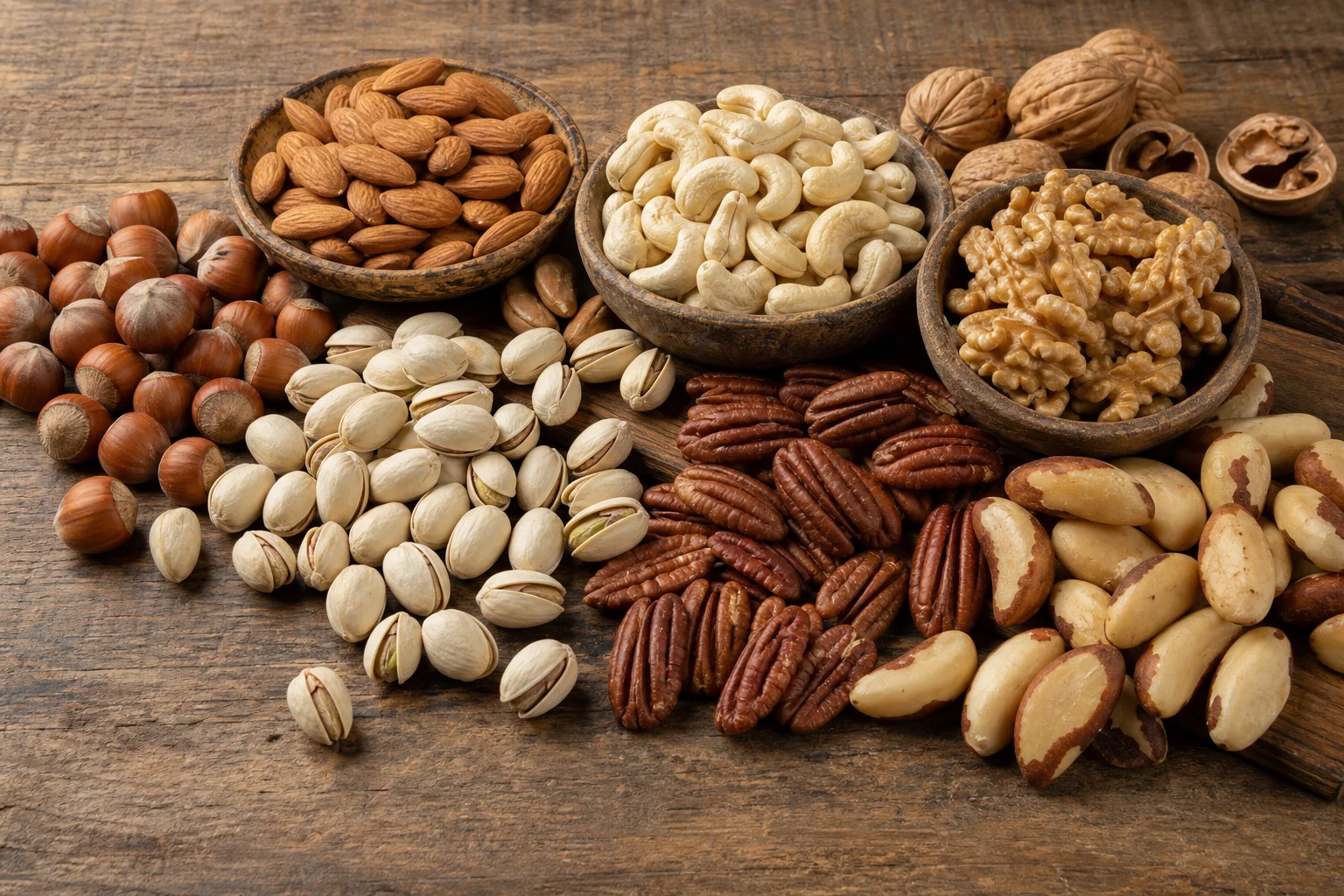
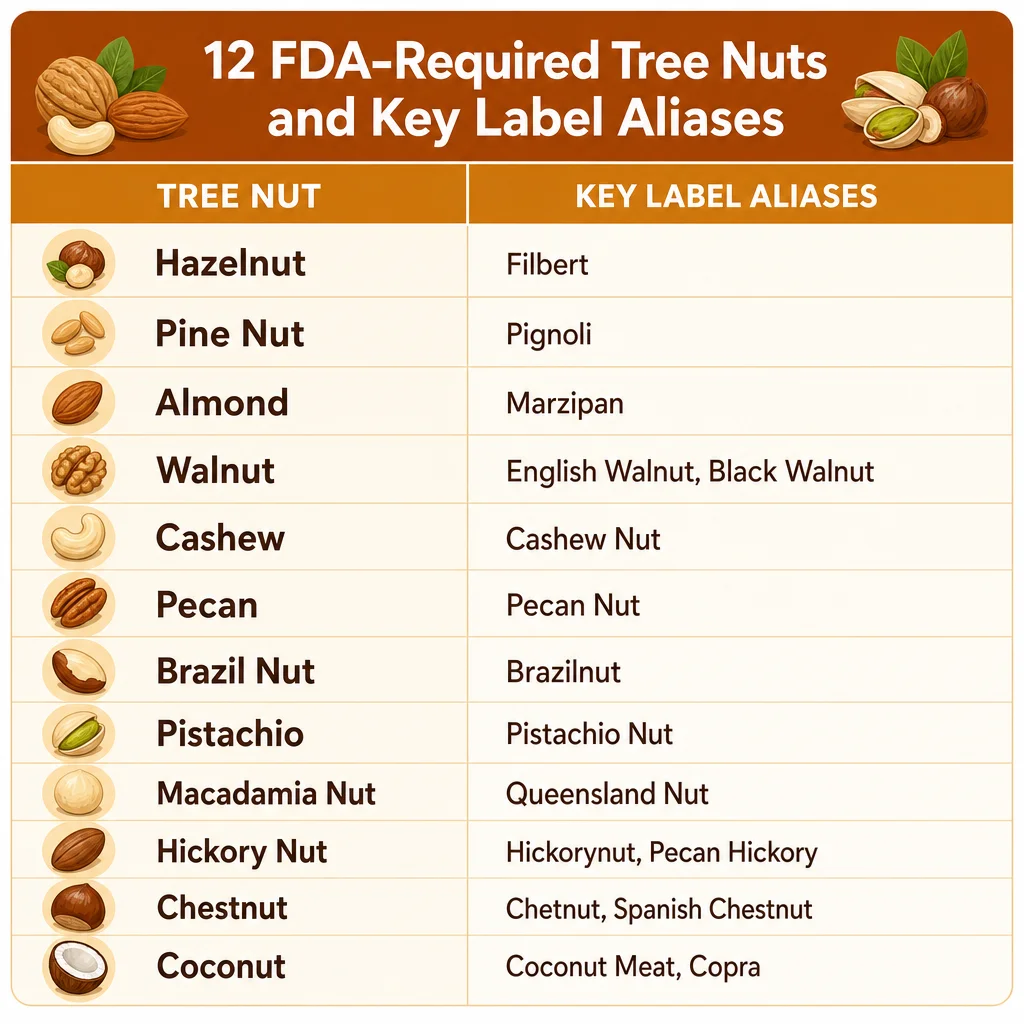
The following 12 tree nuts currently require mandatory allergen declaration under US law. A product containing any of these must either name the specific nut in the ingredient list or include it in a "Contains" statement.

Tree NutFDA-Recognized Alternate Names
AlmondAlmond meal, almond flour, almond paste, almond oil, marzipan, frangipane, orgeat, amaretto, natural almond extract
Black walnutBlack walnut hull, Juglans nigra
Brazil nutPara nut, cream nut, Amazon nut, Bolivian nut, Bertholletia
California walnutCalifornia English walnut
CashewCashew butter, cashew milk, cashew cream, anacardium
Filbert / HazelnutHazel, cobnut, hazelnut oil, hazelnut paste, praline, gianduja, filbert
Heartnut / Japanese walnutJuglans ailanthifolia
Macadamia nut / Bush nutQueensland nut, maroochi nut, bauple nut, Hawaii nut
PecanPecan oil, praline (Southern US variety)
Pine nut / Pinon nutPignoli, pignolia, piñon, pinyon, pignon, Indian nut, cedar nut
PistachioPistachio paste, pistachio butter, pistachio cream, pistachio oil
English / Persian walnutWalnut oil, walnut extract, Juglans regia

Several additional names to watch across tree nut products generally: mandelonas (peanuts flavored to taste like almonds), mixed nuts, nut butters, nut meal, nut pieces, nut paste, nougat, gianduja, and mortadella (the Italian cold cut containing pistachios).

Species-by-Species: The Aliases That Matter Most

A few entries in the table above deserve particular attention.

Hazelnuts / Filberts

"Filbert" is the legally equivalent alternate name for hazelnut, widely used on US food labels. A product that lists "filbert" in its ingredients requires the same "Contains: Tree Nut (Filbert/Hazelnut)" declaration. The same nut also appears as cobnut (a cultivated variety), hazel, and in European contexts, the trade name Cor a (a component designation from allergy testing, occasionally misused on product information sheets).

Gianduja is a chocolate-hazelnut mixture originating in Piedmont, Italy. It appears as an ingredient in premium chocolates, chocolate bars, gelato, and spreads (including Nutella, in which hazelnuts are the second ingredient by weight). When a label says "gianduja" without further explanation, hazelnut is always present.

Praline paste in European and Belgian chocolate contexts is a ground hazelnut-almond caramel mixture, not the pecan-sugar confection common in the US South.

Pine Nuts

Pine nuts are technically seeds — the edible kernels of pine tree cones — but the FDA classifies them as tree nuts for allergen labeling purposes. Their most common alias is pignoli (Italian), which appears in Italian-American baking and specialty food packaging. The Siberian variety is sold as cedar nuts in imported products. Not every pesto contains pine nuts; some brands substitute walnuts, almonds, or cashews.

Brazil Nuts

Brazil nuts are rarely listed by anything other than their standard name in English, but imported products from South America or Europe may use Para nut, Amazon nut, or the Portuguese castanha (which is also sometimes used for chestnut — different nut, same word in Portuguese; always check the full ingredient context).

Almonds

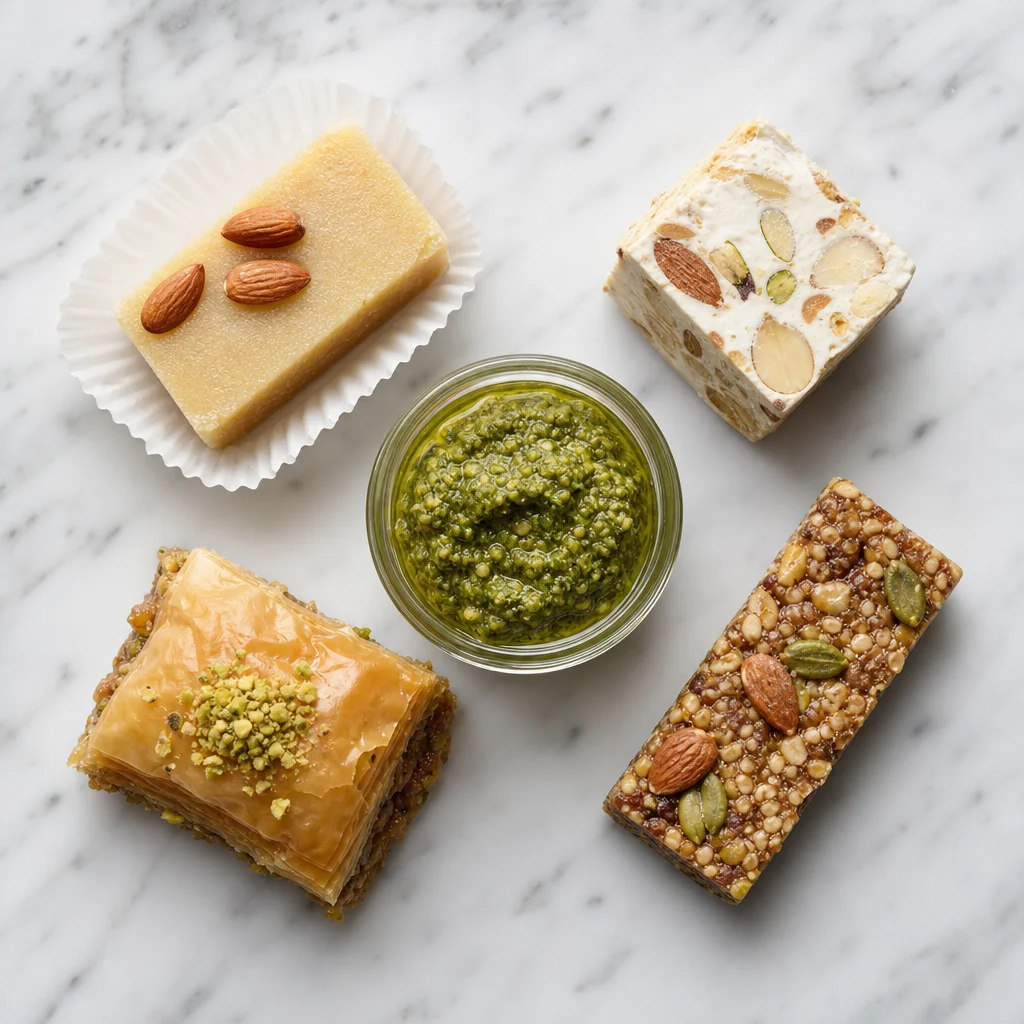
Almond's most consequential alias in food is marzipan and almond paste. Both are almond-based confections that appear as filling, decoration, or coating in pastries, cakes, and candy without always being described that way verbally. Frangipane (almond cream) is a foundational ingredient in French and Italian pastry — croissants aux amandes, galette des rois, Bakewell tart — and is composed primarily of ground almonds.

Orgeat syrup is an almond-based cocktail syrup used in Mai Tais and other tiki drinks. It contains almond protein. Amaretto is an almond-flavored Italian liqueur. Neither falls under FALCPA because alcoholic beverages regulated by the TTB are not covered by the food allergen labeling law.
Cross-Reactivity: The Two Pairs That Matter Most

Cross-Reactivity: The Two Pairs That Matter Most

Approximately 50% of people with one tree nut allergy are also allergic to at least one other tree nut. Longitudinal data suggest that figure rises to around 86% by age 14 in children diagnosed with a single tree nut allergy. Understanding which nuts are most likely to cross-react helps in having informed conversations with an allergist.

The research is clearest on two pairs.

Cashew and Pistachio

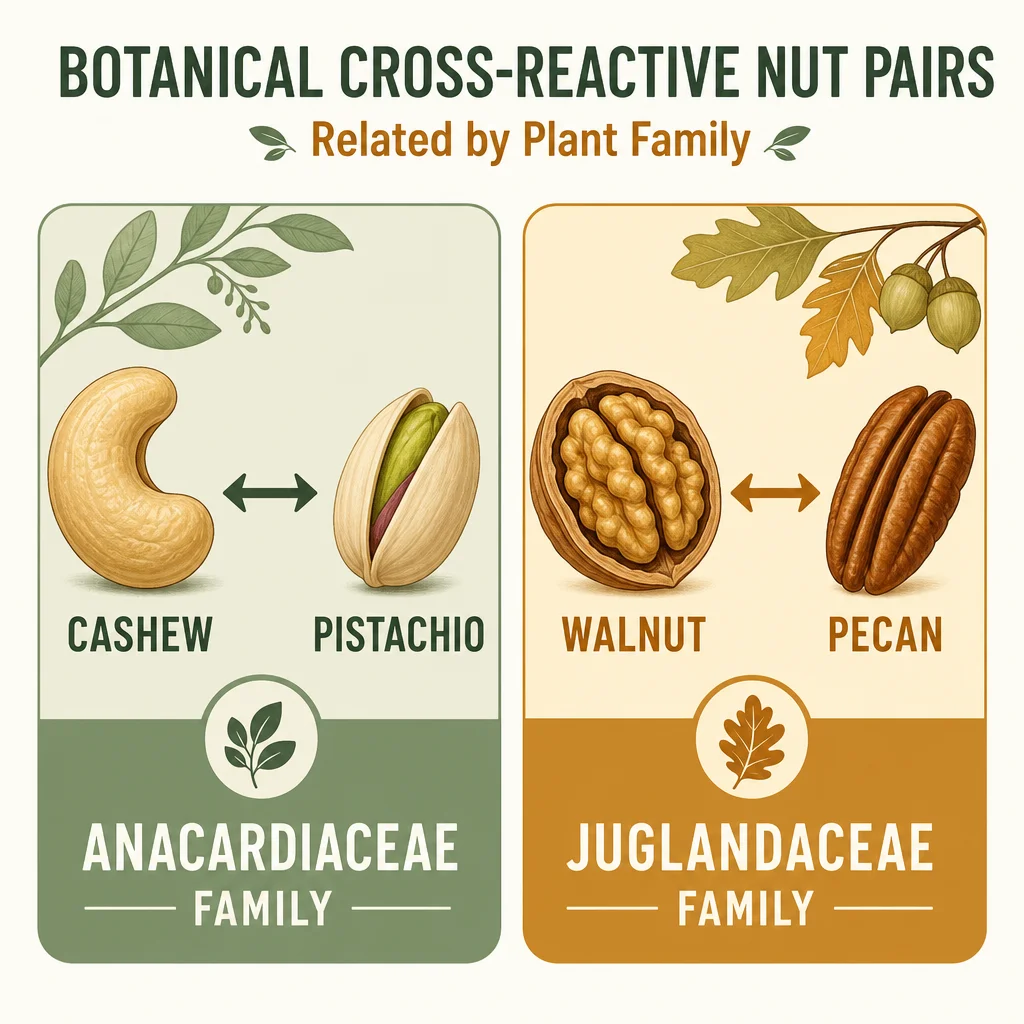
Cashews and pistachios belong to the same botanical family (Anacardiaceae) and share closely related allergenic proteins, particularly 2S albumins. The cross-reactivity is so consistent that clinical guidance from multiple allergy organizations treats them as effectively equivalent for most patients. A 2018 systematic review in Clinical & Experimental Allergy (Smeekens et al.) found that approximately 83% of patients who completed cashew oral immunotherapy passed a subsequent oral food challenge to pistachio. "Very few cashew-allergic persons tolerate pistachio, and vice versa," per Kids With Food Allergies.

Walnut and Pecan

Walnuts and pecans are both members of the family Juglandaceae and share highly similar allergen structures. The same cross-reactivity review found that 100% of patients who completed walnut oral immunotherapy passed a subsequent pecan food challenge. FARE notes that approximately two-thirds of walnut-allergic patients react to pecan when challenged. Hazelnuts show more distant but real cross-reactivity with walnuts — walnut OIT desensitized approximately 50% of patients to hazelnut as a secondary effect.

Tree Nuts and Peanuts

Peanut is a legume, botanically unrelated to any tree nut. That said, between 25% and 40% of peanut-allergic individuals also react to at least one tree nut. The ACAAI places this figure at 25–40%. The relationship is primarily co-sensitization — both conditions co-occur in people with atopic predisposition — rather than true immunological cross-reactivity. For a full breakdown of peanut-specific hidden names and label rules, see our peanut allergy dietary guide. Most clinicians no longer recommend blanket avoidance of all tree nuts for peanut-allergic individuals; oral food challenges with specific nuts are the preferred approach.

Where Tree Nuts Appear Unexpectedly

Where Tree Nuts Appear Unexpectedly

The more significant challenge for most people with tree nut allergy is not recognizing the word "cashew" on a label. It is encountering tree nut-derived ingredients in products where the nut is not named or not obvious. These are the categories most responsible for reactions in people who believe they are being careful.

French and European Pastry

French patisserie is the highest-concentration tree nut environment in Western food culture. Almonds and hazelnuts are structural ingredients — not garnishes — across dozens of traditional preparations:

  • Macaron shells are made primarily from almond flour. These are not the coconut macaroons common in North America; they always contain almond.
  • Financiers and dacquoise use almond or hazelnut flour as a primary ingredient and are sold in formats (bite-sized, in coffee shops) where ingredient labels are rarely available.
  • Paris-Brest is filled with a praline mousseline — a cream based on hazelnut-almond praline paste.
  • Torrone and nougat (the Italian and French versions both) are made with almonds and/or hazelnuts as core components, not as optional additions.

Bakeries and patisseries processing frangipane, praline paste, and marzipan across multiple product lines carry significant cross-contact risk for all products made on the premises.

Indian Cuisine

Cashew paste is used as a foundational thickener in Mughlai-style Indian cooking. It is not a garnish; it is cooked into the sauce in the same way that a roux is used in French cooking. Dishes where it appears without appearing in the name include:

  • Korma and shahi paneer: cashew paste is the primary cream component in many restaurant versions
  • Mughlai biryani: fried whole cashews mixed into the rice
  • Barfi and Indian sweets: kaju katli is approximately 50% cashew by weight; mixed nut barfi contains cashews, pistachios, and almonds

Kitchen staff may not be aware that cashew paste is a pre-made sauce ingredient rather than a visible nut, making verbal confirmation unreliable without speaking directly to the chef.

Middle Eastern Cuisine

  • Baklava contains walnuts, pistachios, or almonds (varying by country and bakery). The nut type varies; all versions contain tree nuts.
  • Muhammara is a Syrian red pepper and walnut dip frequently served alongside hummus without the walnut being prominently named.
  • Ma'amoul are walnut- or pistachio-filled shortbread cookies served at religious celebrations. They look like plain butter cookies from the outside.
  • Dukkah is an Egyptian spice-nut blend (hazelnuts and almonds ground with spices) served as a dip for bread and oil.

Cocktails and Liqueurs

Three beverages are commonly encountered at bars and restaurants that contain significant tree nut content:

  • Orgeat syrup: An almond syrup required in Mai Tais and other tiki cocktails. Bartenders may not flag it as a nut product because it is a modifier syrup rather than an obvious nut ingredient.
  • Amaretto: An almond liqueur (Disaronno and similar brands) used in sours, coffees, and tiramisu.
  • Frangelico: A hazelnut liqueur used in espresso drinks and dessert cocktails.

None of these require FALCPA allergen labeling. Alcoholic beverages are regulated by the Alcohol, Tobacco Tax and Trade Bureau (TTB), not the FDA, and TTB does not impose equivalent allergen labeling requirements.

Energy Bars, Granola, and Cereal

Almonds, cashews, walnuts, macadamia nuts, and pecans appear in a large share of energy bars, granola bars, trail mixes, and breakfast cereals. Products that do not contain tree nuts as ingredients are very frequently manufactured in facilities that also process tree nuts, making "may contain" labeling ubiquitous in this category. This is one of the few food categories where the absence of a precautionary label should be treated with some skepticism.

The Refined Tree Nut Oil Exemption

The same FALCPA provision that exempts highly refined peanut oil from mandatory allergen labeling also applies to highly refined tree nut oils. Cold-pressed (expeller-pressed, virgin) almond oil, walnut oil, hazelnut oil, and macadamia oil retain significant protein content and must be declared. But commercially refined versions — processed with solvents, bleached, and deodorized — may legally appear on a label without triggering the "Contains" statement.

In practice, refined tree nut oils appear less commonly in packaged foods than refined peanut or soybean oil. The more significant exposure route is topical. Almond oil and walnut shell powder are widely used in moisturizers, body oils, and facial scrubs. FALCPA does not cover cosmetics or personal care products — no allergen labeling is required regardless of refining status. Some allergists specifically advise against using nut oil-containing skincare products on children with eczema, where compromised skin may allow allergen uptake.

EU and UK Labeling

Under EU Regulation 1169/2011, tree nuts are one of 14 mandatory allergen categories (Annex II). The EU specifies eight tree nut species: almonds, hazelnuts, walnuts, cashews, pecan nuts, Brazil nuts, pistachio nuts, and macadamia or Queensland nuts. All must be visually emphasized (typically bold typeface) within the ingredient list.

The EU list does not include pine nuts by name, though pine nut as an ingredient must still be declared under the ingredient list. The EU never required allergen labeling for coconut or shea nut — so the US's January 2025 removal of those items brings US rules closer to the longstanding EU approach.

The UK retained the same 14-allergen EU framework post-Brexit, supplemented by Natasha's Law (October 2021), which requires prepacked-for-direct-sale foods — such as sandwiches made and sold on the same premises — to carry full ingredient lists with allergens emphasized.

A Practical Label-Reading Strategy

Tree nuts are one of the nine major food allergens under FALCPA. The FDA currently requires mandatory allergen labeling for 12 specific tree nut species: almond, black walnut, Brazil nut, California walnut, cashew, filbert/hazelnut, heartnut/Japanese walnut, macadamia nut/bush nut, pecan, pine nut/pinon nut, pistachio, and English/Persian walnut. If a product contains any of these, it must be declared in a "Contains" statement or by the specific nut name in the ingredient list.

When scanning for tree nuts:

  1. Check the "Contains" statement for any tree nut species, including "Tree Nut" as a category or a specific nut name.
  2. Scan the ingredient list for every species name and alias. Key aliases to watch: filbert (hazelnut), pignoli (pine nut), gianduja (chocolate-hazelnut mixture), praline paste (hazelnut-almond), frangipane (almond cream), marzipan (almond paste), orgeat syrup (almond), amaretto (almond liqueur), and botanical names like Juglans (walnut) and Bertholletia (Brazil nut).
  3. Check for tree nut-derived oils. Almond oil, hazelnut oil, and walnut oil may appear without specifying refining status. If the label does not say "highly refined," assume protein is present.
  4. Assess cross-contact risk. The precautionary boxes "may contain tree nuts" or "made in a facility that processes tree nuts" warrant avoidance for highly reactive individuals.
  5. On imported products, look for bold or contrasting allergen text in the ingredient list. European products may present the allergen in botanical form.

Using IngrediCheck, you can scan any packaged product and immediately flag every known tree nut ingredient across all 12 species and their label aliases.

Next Label Check

Follow the scanner, hub, and ingredient paths connected to this guide

Get the app for clearer label decisions.

Scan labels, see what fits your food notes, and read the why in plain English.

IngrediCheck app