Dietary Guides

PEG Allergy Dietary Guide: Macrogol, E1521, and the Hidden Excipient

Polyethylene glycol is not one of the regulated food allergens, so it never triggers a 'Contains' warning. It hides in supplement coatings, tabletop sweeteners, laxatives, and medications under names like macrogol, E1521, and PEG 3350.

Jun 13, 2026|11 min read
By Sanket Patel|Updated 2026-06-13|5 sources|Editorial standards
PEG Allergy Dietary Guide: Macrogol, E1521, and the Hidden Excipient

Polyethylene glycol allergy is rare. Anaphylaxis UK estimates it affects fewer than 1 in 10,000 people. But it is one of the most under-recognized allergies in medicine, and it is uniquely difficult to manage through label reading. The reason is simple: polyethylene glycol, usually written as PEG, is not one of the major regulated food allergens anywhere in the world. It never earns a bold "Contains" warning. It sits quietly in ordinary ingredient lists and in the "inactive ingredients" panels of medications, under at least half a dozen different names.

For most people, PEG is harmless and passes through the body largely unabsorbed, which is exactly why it is used in laxatives. For the small number of people who react to it, PEG is a genuine anaphylaxis risk that spans three worlds most allergy guides never connect: packaged food, dietary supplements, and medicine. This guide covers where PEG is allowed in food, every name it travels under, the polysorbate cross-reactivity question, and how to scan for it when no label is obligated to help you.

What PEG (Polyethylene Glycol) Actually Is

Polyethylene glycol is not a food in any traditional sense. It is a synthetic polymer, a chain of repeating ethylene oxide units derived from petroleum. The same base chemistry, at different chain lengths, produces everything from a thin liquid used as a solvent to a waxy solid used to coat tablets.

That chain length matters more than almost anything else in PEG allergy, and it is encoded directly in the name. The number after "PEG" usually refers to the polymer's average molecular weight. PEG 400 is a light liquid of roughly 400 grams per mole. PEG 3350, PEG 4000, PEG 6000, and PEG 8000 are progressively larger, waxier solids. In cosmetics, a different convention counts the repeating units instead, which is why you see forms like PEG-8 or PEG-75 on personal care products.

The clinical significance is that higher molecular weight PEGs appear to be more allergenic. Laboratory work suggests antibody binding to PEG increases with the size of the polymer, and many patients have an individual threshold: they may react to PEG 3350 in a laxative while tolerating the smaller PEG 300 found in some medicines. This is why laxatives and bowel-preparation solutions, which deliver large PEG molecules in large doses, are the classic trigger.

One point of frequent confusion is worth settling early. Polyethylene glycol is not propylene glycol. Propylene glycol is a small, chemically unrelated molecule best known for causing contact dermatitis. According to the AAAAI, there is no established cross-reactivity between the two. A propylene glycol sensitivity does not mean a PEG allergy, and vice versa.

PEG as a Food Additive: E1521 and Where It Is Allowed

In food, PEG carries the European E-number E1521. It is not a general-purpose additive. Under the European Commission food additives database, E1521 is authorized in only a narrow set of products: table-top sweeteners in powder form, table-top sweeteners in tablet form, and solid food supplements such as coated tablets and capsules. Its jobs there are as a glazing agent, a carrier, and an anti-foaming aid.

European food safety regulators consider it safe at the levels people actually consume. The EFSA panel that reassessed E1521 in 2018 concluded that estimated dietary exposure fell within existing acceptable intake values. That is a toxicology judgment about general safety, not an allergy assessment. Being "safe" in the toxicological sense does nothing to help the rare individual whose immune system reacts to the molecule.

In the United States, the FDA lists polyethylene glycol (molecular weight 200 to 9,500) as a substance added to food, with technical uses that include coatings, formulation aid, lubricant and release agent, surface-active agent, and defoaming agent. It appears across several regulations covering direct food use, food coatings, anti-foaming, and food-contact materials.

In practice, this means PEG in the food aisle is concentrated in a few predictable places: the coating on vitamin and supplement tablets, tabletop sweetener tablets and powders, and as a processing aid such as an anti-foaming agent. If you take coated supplements, the "other ingredients" line is the single most likely place PEG will appear in your diet.

Every Hidden Name for PEG on a Label

Every Hidden Name for PEG on a Label

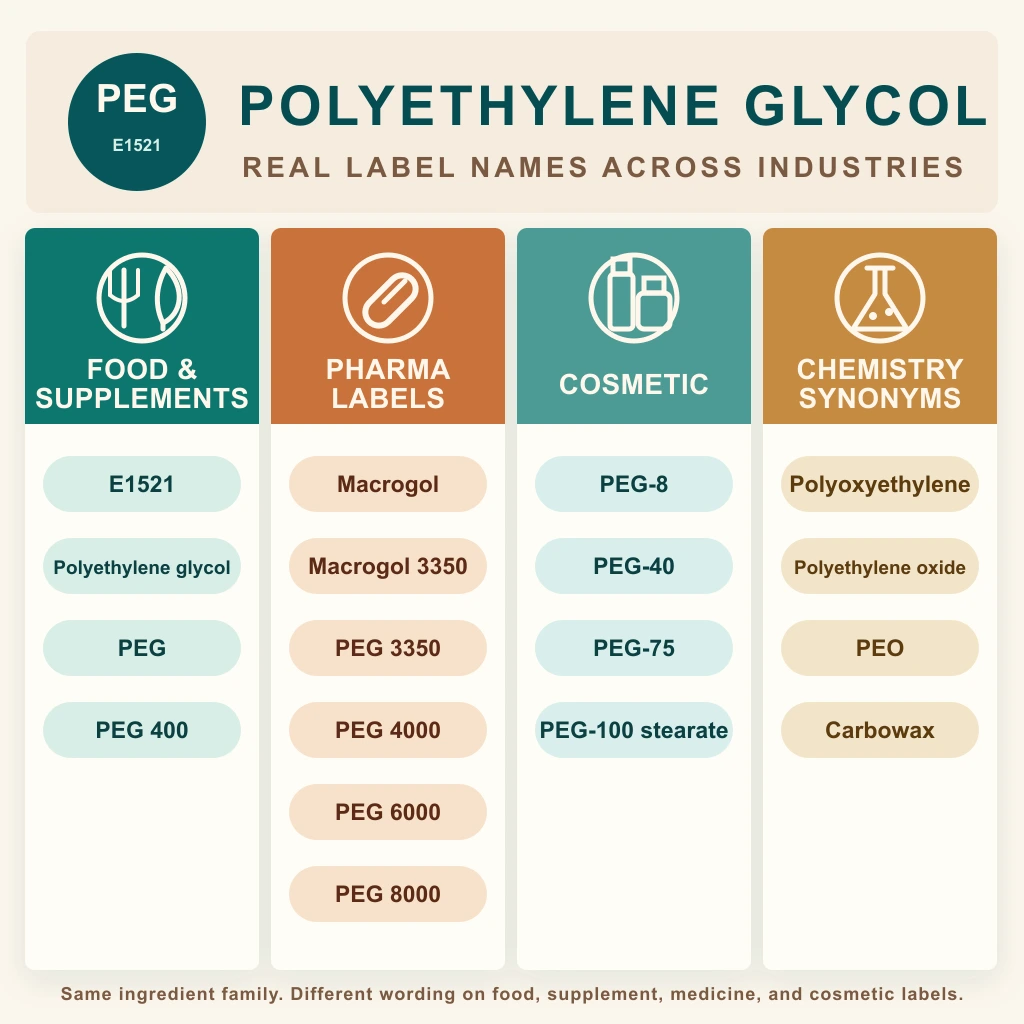
PEG is a shape-shifter on ingredient lists because the food world, the drug world, and the cosmetics world each label it differently. All of the following indicate the presence of polyethylene glycol.

Label NameWhere You See It
Polyethylene glycolThe full chemical name; food ingredient lists and supplements
PEG followed by a number (PEG 3350, PEG 4000, PEG 6000, PEG 8000)Pharmaceutical convention; the number is the molecular weight
PEG-8, PEG-40, PEG-75, and similarCosmetic convention; the number counts repeating units
Macrogol (macrogol 3350, macrogol 4000)The pharmaceutical name used in the UK, EU, and most drug labeling
E1521The European food additive number
Polyoxyethylene (POE)An alternate chemical name
Polyethylene oxide (PEO)Used for higher molecular weight versions
CarbowaxA common trade name for industrial and pharmaceutical PEG

The trap here is the word macrogol. A shopper who has learned to scan food labels for "polyethylene glycol" may never connect that word to "macrogol" on a medicine box, even though they are the same substance. Anyone managing PEG allergy has to hold both vocabularies at once.

The Polysorbate Cross-Reactivity Question

PEG rarely travels alone. It belongs to a broader family of ingredients built around ethylene oxide chains, and the most important relatives for an allergic person are the polysorbates. Polysorbate 80 (E433), polysorbate 20 (E432), and polysorbate 60 (E435) are emulsifiers built partly from the same polyethylene chemistry, and they appear widely in ice cream, sauces, baked goods, supplements, and vaccines.

There is real evidence that PEG and polysorbates can be immunologically cross-reactive. The influential 2019 case series by Stone and colleagues documented patients who reacted to both, and skin testing has shown some PEG-allergic patients also test positive to polysorbate 80.

The honest caveat is that the clinical importance of this is still uncertain. Polysorbate 80 is one of the most widely used emulsifiers in the world and is tolerated by the overwhelming majority of people, including many who are PEG-sensitive. So cross-reactivity is a documented possibility rather than a rule. It is a reason to discuss polysorbates with an allergist, not a reason to assume every PEG-allergic person must avoid every polysorbate. Poloxamers and PEGylated castor oils such as Cremophor sit in the same structural family and warrant the same cautious, individualized attention.

Where PEG Hides Beyond the Grocery Aisle

Where PEG Hides Beyond the Grocery Aisle

For most allergens, the food label is the whole battle. PEG is different, because a PEG-allergic person's largest and most dangerous exposures usually come from outside the pantry.

Laxatives are the single most common high-dose exposure. PEG 3350 is the active ingredient in osmotic laxatives sold as MiraLAX, ClearLax, and GlycoLax in the United States, and as Movicol, Laxido, and generic macrogol in the UK and Europe. A standard dose delivers around 17 grams of PEG, far more than any food would.

Bowel-preparation solutions for colonoscopy concentrate PEG even further. Products such as GoLYTELY, MoviPrep, and TriLyte are among the most documented triggers of PEG anaphylaxis, precisely because they deliver an enormous PEG load in a single sitting.

Medications and their coatings are a constant background exposure. PEG is one of the most common pharmaceutical excipients, used in tablet coatings, capsule fillers, ointment bases, and some injectable drugs including certain depot steroid preparations.

The COVID-19 mRNA vaccines brought PEG to wider attention. Both the Pfizer/BioNTech and Moderna vaccines use a PEG-2000 lipid to stabilize their nanoparticles, and PEG is the component most implicated in the rare anaphylaxis cases those vaccines caused. The CDC treats a known severe allergy to a vaccine component, PEG included, as a contraindication, and notes that PEG and polysorbate are structurally related enough that cross-reactive reactions may occur.

Personal care products such as toothpaste, mouthwash, shampoo, and lotions frequently contain lower molecular weight PEGs. These tend to cause milder skin reactions rather than anaphylaxis, but they are worth checking if symptoms appear.

Why the Label Never Warns You: The Regulatory Gap

This is the heart of the problem. Food allergen labeling laws protect against a fixed list of allergens, and PEG is on none of them.

In the United States, FALCPA and the FASTER Act define exactly nine major food allergens: milk, eggs, fish, crustacean shellfish, tree nuts, peanuts, wheat, soybeans, and sesame. Only those nine require a plain-language "Contains" statement. PEG is not among them, so it is never flagged as an allergen. It appears only in the regular ingredient list, spelled out chemically or, for supplements, sometimes as E1521.

The European Union is no different in this respect. The 14 allergens that must be emphasized under Regulation 1169/2011 are cereals containing gluten, crustaceans, eggs, fish, peanuts, soybeans, milk, tree nuts, celery, mustard, sesame, sulphur dioxide and sulphites, lupin, and molluscs. PEG and E1521 are not on the list, so they receive no bold type and no special emphasis.

In medicine the gap is wider still. PEG is classified as an inactive ingredient, buried in the excipient panel rather than highlighted anywhere. This is why a PEG-allergic person can react repeatedly to unrelated products, a laxative one month and a coated tablet the next, without any label ever connecting the dots.

The Clinical Picture: Rare, Severe, and Often Missed

PEG allergy is uncommon, but when it occurs it can be serious. Reactions can be immediate and IgE-mediated, and the most frequently reported presentation in the medical literature is anaphylaxis rather than a mild rash.

Because PEG is a hidden ingredient shared across so many products, PEG allergy is frequently misdiagnosed. A person who reacts to several structurally unrelated medications may be labeled with "idiopathic anaphylaxis" or "multiple drug allergy" when the real common thread is the PEG they all contain. A history of a severe reaction after a laxative or a colonoscopy prep is a recognized red flag that should raise the question.

Diagnosis is genuinely difficult and belongs with a specialist. Skin testing results depend on which PEG molecular weight is used, false negatives are possible, and the testing itself can provoke a severe reaction, so it is carried out only in allergy centers equipped to manage anaphylaxis. Anyone with unexplained anaphylaxis, or reactions to multiple unrelated products, is a candidate for referral to an allergist rather than self-diagnosis. For a closer look at how these reactions present and why the ingredient is so easy to miss, see our companion piece on why PEG is harder to avoid than you think.

A Practical Label-Reading Strategy

Polyethylene glycol (PEG) is not one of the major regulated food allergens. In the United States, FALCPA and the FASTER Act require a "Contains" statement only for nine allergens (milk, eggs, fish, crustacean shellfish, tree nuts, peanuts, wheat, soybeans, sesame), and in the European Union Regulation 1169/2011 emphasizes only 14 allergens. PEG is on neither list, so it will never appear in an allergen warning box. It shows up only in the ordinary ingredient list, in a supplement's "other ingredients" line, or, in medications, in the "inactive ingredients" panel. You have to find it yourself.

Scan every ingredient list, supplement panel, and drug excipient panel for all of these names, which all mean polyethylene glycol:

  1. Polyethylene glycol in full.
  2. PEG followed by a number: PEG 3350, PEG 4000, PEG 6000, PEG 8000 (pharmaceutical, the number is molecular weight), and PEG-8, PEG-40, PEG-75 (cosmetic, the number counts units).
  3. Macrogol, including macrogol 3350 and macrogol 4000. This is the standard name on UK and EU medicines and is the same substance as PEG.
  4. E1521, the European food additive number, most often on tabletop sweeteners and coated supplements.
  5. Polyoxyethylene (POE), polyethylene oxide (PEO), and the trade name Carbowax.

Also watch for the related emulsifiers that may be cross-reactive in some PEG-allergic individuals, though tolerance is common and this should be assessed individually: polysorbate 80 (E433), polysorbate 20 (E432), polysorbate 60 (E435), poloxamers, and PEGylated castor oil (Cremophor).

In food, PEG is most likely to appear in coated vitamin and dietary supplement tablets and capsules, and in tabletop sweetener tablets and powders. Outside of food, the highest-dose exposures are osmotic laxatives (MiraLAX, ClearLax, Movicol, Laxido, generic macrogol) and colonoscopy bowel-preparation solutions (GoLYTELY, MoviPrep, TriLyte), followed by coated tablets, some injectable medications, and the PEG-2000 in mRNA vaccines. Read the inactive-ingredient panel on every medication, and ask a pharmacist to screen prescriptions and suggest PEG-free alternatives where they exist.

Using IngrediCheck, you can scan any packaged food, supplement, or product label and immediately flag polyethylene glycol across all of its names, including PEG, macrogol, E1521, and the polysorbate emulsifiers, so an ingredient that no allergen warning is required to highlight does not slip past you.
Next Label Check

Follow the scanner, hub, and ingredient paths connected to this guide

Get the app for clearer label decisions.

Scan labels, see what fits your food notes, and read the why in plain English.

IngrediCheck app