Dietary Guides

Low FODMAP Dietary Guide: Oligosaccharides, Polyols, and the Monash Method

An encyclopedic guide to FODMAP intolerance covering carbohydrate chemistry, detailed food content values, the Monash University low-FODMAP diet protocol, clinical trial evidence, microbiome effects, and practical label-reading strategies.

Jun 9, 2026|12 min read
By Sanket Patel|Updated 2026-06-09|10 sources|Editorial standards
Low FODMAP Dietary Guide: Oligosaccharides, Polyols, and the Monash Method

FODMAP intolerance is not a single condition but a descriptive term for the symptom pattern that occurs when the small intestine cannot properly absorb certain short-chain carbohydrates. These carbohydrates, collectively known as FODMAPs, are then fermented by bacteria in the colon, producing gas, drawing water into the intestinal lumen, and causing the bloating, pain, and altered bowel habits that characterize irritable bowel syndrome. The low-FODMAP diet, developed by researchers at Monash University in Australia, has become the most evidence-based dietary intervention for managing these symptoms. This guide provides an encyclopedic reference to the chemistry, physiology, clinical evidence, food content, and practical implementation of the low-FODMAP approach.
The Chemistry of FODMAPs

The Chemistry of FODMAPs

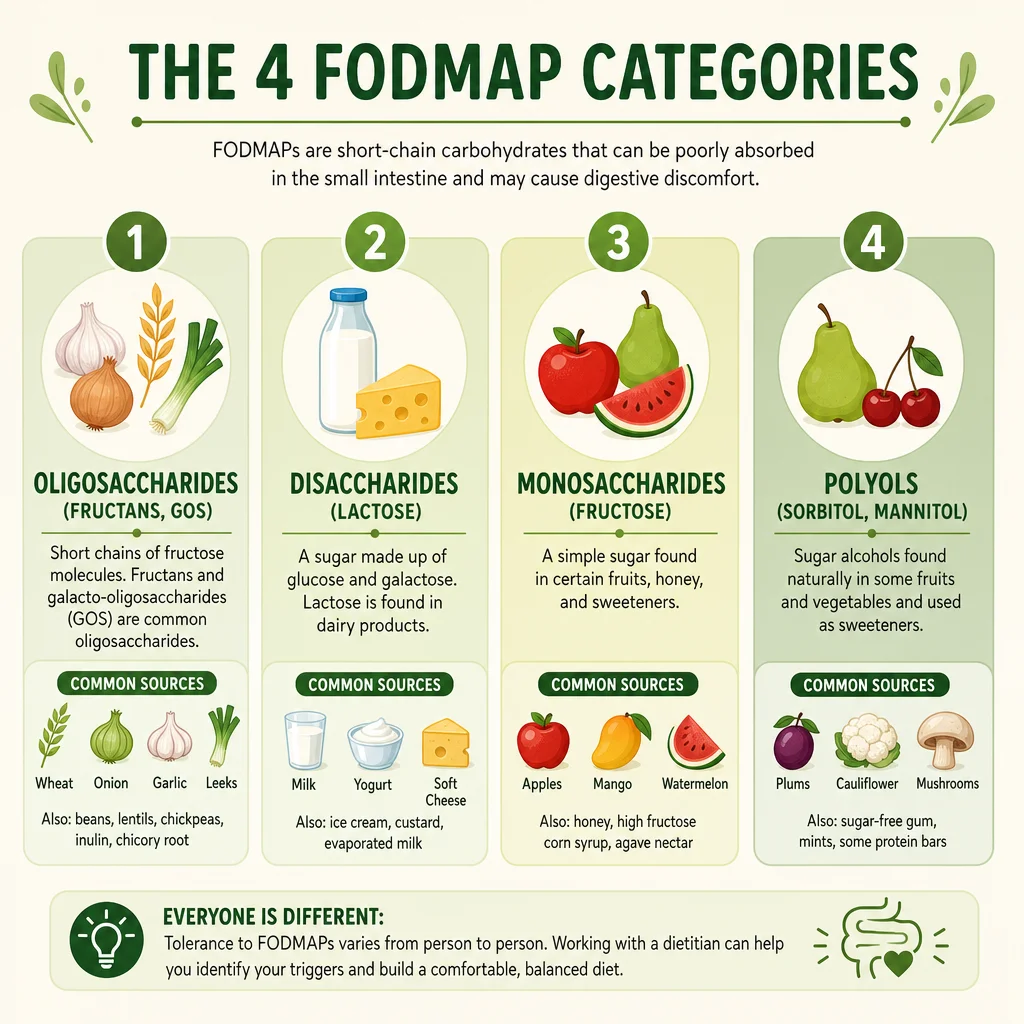
FODMAP is an acronym coined by researchers at Monash University: Fermentable Oligosaccharides, Disaccharides, Monosaccharides, and Polyols. Each category represents a group of small carbohydrates with shared chemical properties.

Oligosaccharides are short-chain carbohydrates made of 3 to 10 sugar units. The two types relevant to FODMAPs are fructans and galacto-oligosaccharides (GOS). Fructans are chains of fructose units linked by beta-2,1-glycosidic bonds, with a terminal glucose unit. They are found in wheat, rye, onions, garlic, and some legumes. GOS consists of galactose units linked to a terminal glucose and is found in lentils, chickpeas, and beans. Humans lack the enzymes needed to break down either type, so they always reach the colon.

Disaccharides in this context refers specifically to lactose, the sugar in milk and dairy products. Lactose is a disaccharide of glucose and galactose linked by a beta-1,4-glycosidic bond. It requires the enzyme lactase to be hydrolyzed and absorbed. People with lactose intolerance do not produce enough lactase, so lactose becomes a FODMAP for them.

Monosaccharides refers to excess fructose, which is found in some fruits, honey, and high-fructose corn syrup. Fructose is absorbed through the GLUT5 and GLUT2 transporters in the small intestine. When fructose is present in excess relative to glucose, it overwhelms the absorptive capacity and passes into the colon.

Polyols are sugar alcohols, a class of carbohydrates that are neither sugars nor alcohols in the conventional sense. They are poorly absorbed across the intestinal mucosa because they are too large for simple diffusion and lack specific active transporters. Common polyols include sorbitol, mannitol, xylitol, maltitol, and isomalt. They occur naturally in some fruits and vegetables and are widely used as low-calorie sweeteners in sugar-free products.

The Physiology of FODMAP Malabsorption

When FODMAPs are consumed, they are either absorbed in the small intestine or they pass through to the colon. The ones that are not absorbed have two major physiological effects.

First, they are osmotically active. This means they draw water into the intestinal lumen by osmosis, increasing the volume of fluid in the gut. This can cause diarrhea or loose stools, particularly in the small intestine before fermentation begins.

Second, they are rapidly fermented by bacteria in the colon. This fermentation produces hydrogen, carbon dioxide, methane, and short-chain fatty acids. The gas production distends the bowel, causing bloating, pain, and flatulence. The combination of increased fluid volume and gas production is what generates the characteristic symptoms of FODMAP intolerance.

The threshold for symptom generation varies widely between individuals. Some people can tolerate small amounts of FODMAPs without symptoms, while others are highly sensitive. The Monash University research has demonstrated that tolerance is often dose-dependent, meaning that a small serving of a high-FODMAP food may be tolerated while a large serving is not.

The Monash University Low-FODMAP Diet: Origin and Protocol

The Monash University Low-FODMAP Diet: Origin and Protocol

The low-FODMAP diet was developed by Professor Peter Gibson, Dr. Jane Muir, and their team at Monash University in Melbourne, Australia. The first research paper was published on April 1, 2005. Since then, the team has published over 100 papers on the topic, created a smartphone app, established a food certification program, and trained thousands of dietitians worldwide.

According to Monash University, the diet has helped millions of people globally, and the Monash FODMAP app has been downloaded 1.75 million times since its 2012 launch. The app is now listed in the American College of Gastroenterology Clinical Practice Guidelines for the treatment of IBS.

The diet is implemented in three distinct phases.

Phase 1: Restriction (2-6 weeks)

All high-FODMAP foods are eliminated from the diet. This is the most restrictive phase and is designed to reduce symptoms and establish a baseline. The goal is not to stay on this phase indefinitely, but to use it as a diagnostic and therapeutic tool.

Phase 2: Rechallenge (6-8 weeks)

Individual FODMAP groups are systematically reintroduced, one at a time, in increasing amounts. For example, fructans might be tested first, then lactose, then polyols, then excess fructose. Each challenge is followed by a washout period to allow symptoms to return to baseline before the next challenge. This phase identifies which specific FODMAPs trigger symptoms and at what threshold.

Phase 3: Personalization (ongoing)

Based on the results of the rechallenge phase, the diet is expanded to include as many foods as possible while keeping symptoms under control. Most people can tolerate some high-FODMAP foods in small amounts or when combined with low-FODMAP foods. The personalization phase is a long-term eating plan that balances symptom control with dietary variety and nutritional adequacy.

FODMAP Content: Detailed Food Values

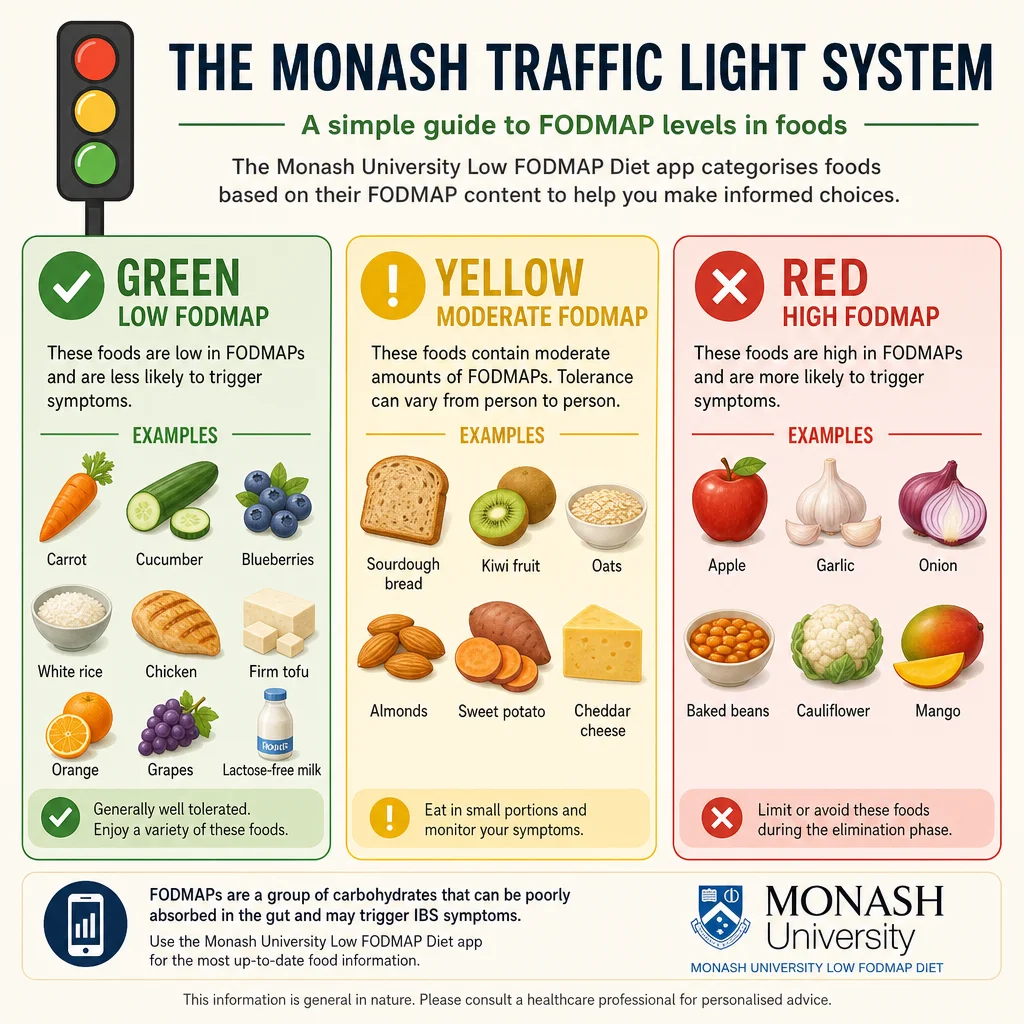
The Monash University team has tested hundreds of foods and assigns them a traffic-light rating based on typical serving sizes. Green is low FODMAP (generally safe). Yellow is moderate FODMAP (may be tolerated in small amounts). Red is high FODMAP (avoid during restriction).

Fructan content of common foods:

FoodFructan Content (g/100g)
Garlic17.4
Onion1.1-10.1
Jerusalem artichoke16.0-20.0
Wheat flour1.0-4.0
Wheat bread (white)0.7-2.8
Wheat pasta1.0-4.0
Rye grain4.6-6.6
Rye bran7.0
Barley kernels22.0
Asparagus1.4-4.1
Globe artichoke2.0-6.8

According to Wikipedia, fructans are important storage polysaccharides in grasses and confer freezing tolerance. They are used in the food industry as prebiotic dietary fiber. The degree of polymerization (the length of the fructose chain) varies between foods and affects how they are tolerated.

Lactose content in dairy:

FoodLactose (g/100g)
Milk4.8-5.0
Yogurt4.0
Ice cream3.6-6.0
Soft cheese2.6-3.5
Hard cheese<0.1
Butter0.1
Lactose-free milk0.0

Excess fructose in fruits:

FoodFructose (g/100g)Glucose (g/100g)Excess Fructose
Apples5.92.43.5
Pears6.22.83.4
Watermelon3.31.61.7
Mango2.91.41.5
Cherries5.44.01.4
Bananas2.62.30.3
Blueberries2.42.40.0
Oranges2.22.00.2
Strawberries2.42.20.2
Grapes4.84.80.0

Polyols in foods:

FoodPolyol Type
Stone fruits (peaches, plums, nectarines)Sorbitol
Apples, pearsSorbitol
CauliflowerMannitol
MushroomsMannitol
WatermelonMannitol
Sugar-free gum and candySorbitol, xylitol, maltitol, isomalt

Clinical Evidence for the Low-FODMAP Diet

The efficacy of the low-FODMAP diet has been evaluated in multiple randomized controlled trials, systematic reviews, and meta-analyses. A review in PMC summarized the evidence as follows.

A meta-analysis by Marsh et al. analyzed six randomized controlled trials and 16 non-randomized controlled trials. They found a significant decrease in the Irritable Bowel Syndrome Symptom Severity Scale (IBS-SSS) and improvements in abdominal pain, bloating, and quality of life. Another meta-analysis by Schumann et al. included nine RCTs with 596 patients and found that a low-FODMAP diet was effective and safe in the short term compared to habitual diet, high-FODMAP diet, sham diet, and usual dietary recommendations.

According to Johns Hopkins Medicine, the low-FODMAP diet reduces symptoms in up to 86% of people with IBS. However, the diet is not a panacea. Response rates vary, and the diet requires expert delivery by a trained dietitian to ensure proper implementation and nutritional adequacy.

A recent randomized controlled trial published in 2025, reported by News Medical, found that a 28-day low-FODMAP diet improved gastrointestinal symptoms in women with endometriosis. Sixty percent of participants on the low-FODMAP diet reported clinically meaningful reductions in symptoms, compared to 26% on a control diet. The low-FODMAP group had a 40% lower overall gastrointestinal symptom severity score.

Hidden FODMAPs in Processed Foods

Hidden FODMAPs in Processed Foods

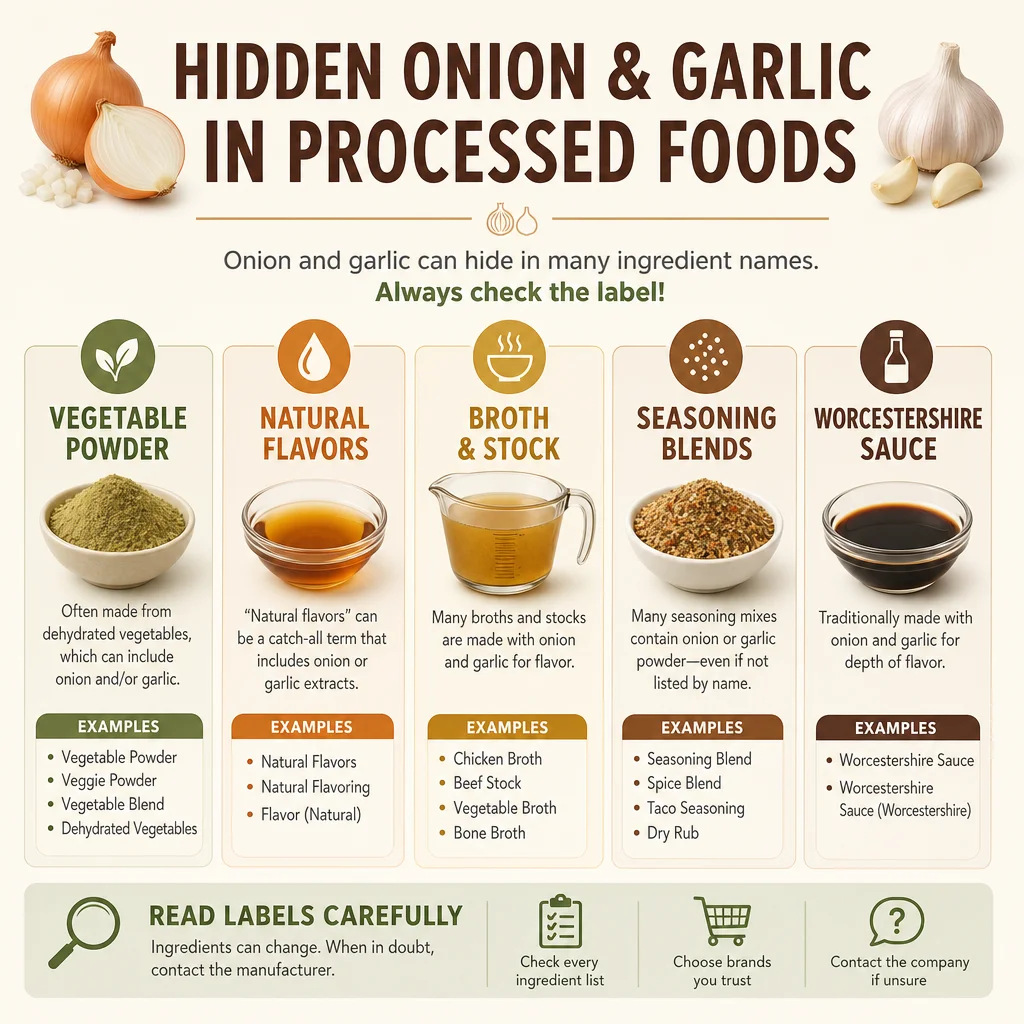
FODMAPs are particularly difficult to avoid because they are hidden in many processed foods. The most common hidden sources are onion and garlic, which appear in flavor bases, broths, stocks, sauces, and seasoning blends, often under generic names like "natural flavors" or "vegetable powder." Worcestershire sauce, many curry pastes, and pre-made marinades frequently contain both.

Inulin and chicory root fiber are often added to processed foods as a prebiotic fiber or fat replacer. Inulin is a fructan and is high in FODMAPs. It appears in some protein bars, yogurts, and baked goods marketed as high-fiber or gut-healthy.

High-fructose corn syrup and fruit juice concentrate are common sweeteners in beverages, snacks, and condiments. These provide excess fructose, which is a monosaccharide FODMAP.

Sugar alcohols including sorbitol, mannitol, xylitol, and maltitol are frequently used in sugar-free and low-calorie products. They are polyols and can cause symptoms even in people who do not otherwise have FODMAP intolerance.

Wheat-derived ingredients such as wheat starch, maltodextrin, and modified food starch are common in processed foods and contribute fructans to the diet. Even products that are not obviously bread or pasta may contain wheat-derived fillers.

Regulatory and Labeling Context

There is no standardized FODMAP labeling system on food packages anywhere in the world. The Monash University certification program is the closest thing to a regulated label. Products that are Monash Low FODMAP Certified have been tested and verified to meet low-FODMAP standards at specified serving sizes. This certification is voluntary and growing, but it is not yet universal.

In the absence of certified labels, the only reliable approach is to read ingredient lists carefully. The ingredient list reveals onion, garlic, inulin, wheat, HFCS, and sugar alcohols, but it does not quantify them. This means that a product with onion powder near the end of the ingredient list may be tolerable for some people, while the same product might trigger symptoms in others. Personal tolerance thresholds are a central concept in the low-FODMAP diet.

The Microbiome Impact and Long-Term Considerations

A concern with the low-FODMAP diet is its potential impact on the gut microbiome. Because the diet restricts prebiotic fibers such as fructans and GOS, it may reduce the abundance of beneficial bacteria, particularly Bifidobacteria. A review in PMC noted that while the diet is effective in the short term, long-term restriction could have negative effects on microbiome diversity.

This is why the reintroduction and personalization phases are essential. The goal is not to stay on a strict low-FODMAP diet indefinitely, but to identify individual tolerance thresholds and reintroduce as many FODMAP-containing foods as possible. Some studies suggest that targeted probiotic supplementation during the low-FODMAP diet may help maintain microbiome diversity, though more research is needed.

FODMAP Intolerance vs IBS vs SIBO

FODMAP intolerance is not a formal medical diagnosis. It is a descriptive term for the symptom pattern that occurs when someone eats high-FODMAP foods. The most common underlying condition is irritable bowel syndrome (IBS), a functional gastrointestinal disorder characterized by recurrent abdominal pain and changes in bowel habits, without detectable structural abnormalities.

Small intestinal bacterial overgrowth (SIBO) is another condition that can cause FODMAP intolerance symptoms. In SIBO, bacteria that normally reside in the colon have migrated into the small intestine, where they ferment FODMAPs prematurely, causing symptoms before the carbohydrates ever reach the colon. The low-FODMAP diet can help manage SIBO symptoms, but it does not treat the underlying bacterial overgrowth, which may require antibiotics or other interventions.

The low-FODMAP diet is now recommended by the American College of Gastroenterology as a first-line dietary therapy for IBS. According to Shepherd Works, restriction of FODMAPs reduces functional gut symptoms, an effect that is durable and can be reversed by reintroduction. This means the diet is not a placebo effect. The symptoms are real, and the response is reproducible.

A Practical Label-Reading Strategy

This section is designed to be a standalone, actionable checklist for reading food labels when you have FODMAP intolerance. Follow these steps every time you shop, and use this list as a reference when scanning ingredients with an ingredient checker or app.

Step 1: Identify wheat and rye sources

Look for the following ingredients, which indicate the presence of fructan-containing grains:

  • Wheat, wheat flour, wheat starch, wheat bran, wheat germ
  • Rye, rye flour, pumpernickel
  • Barley (contains fructans in addition to gluten)
  • Inulin, chicory root fiber, chicory root extract
  • Oligofructose, fructo-oligosaccharides, FOS

Step 2: Check for onion and garlic

These are the most common hidden FODMAPs in savory foods. Look for:

  • Onion, onion powder, onion salt, onion extract, onion juice
  • Garlic, garlic powder, garlic salt, garlic extract, garlic juice
  • Vegetable powder, natural flavors, flavorings (when savory)
  • Spices, spice blends, seasoning mixes, broth, stock, bouillon
  • Worcestershire sauce, many Asian sauces, curry pastes, and pre-made marinades

Step 3: Identify lactose-containing dairy

  • Milk, milk powder, milk solids, milk protein
  • Soft cheeses: cottage cheese, ricotta, cream cheese, mozzarella
  • Yogurt, ice cream, sour cream, buttermilk
  • Whey, whey protein concentrate (unless labeled lactose-free)

Hard cheeses such as cheddar, parmesan, and Swiss are naturally low in lactose and generally safe. Butter and cream are also low in lactose.

Step 4: Check for excess fructose

  • High-fructose corn syrup, glucose-fructose syrup, isoglucose
  • Agave nectar, agave syrup, honey
  • Fruit juice concentrate, apple juice concentrate, pear juice concentrate
  • Fructose, crystalline fructose
  • Dried fruit, fruit puree, fruit paste

Step 5: Identify polyols and sugar alcohols

  • Sorbitol, mannitol, xylitol, maltitol, isomalt, erythritol
  • Stone fruits: peaches, plums, nectarines, apricots, cherries
  • Cauliflower, mushrooms, and some sugar-free products

Note that erythritol is generally better tolerated than other polyols because it is absorbed before reaching the colon, but individual tolerance varies.

Step 6: Look for Monash Low FODMAP certification

If a product carries the Monash Low FODMAP Certified logo, it has been tested and verified to meet low-FODMAP standards at a specified serving size. This is the most reliable indicator on a package. If the product is not certified, proceed with ingredient-based assessment.

Step 7: Build a safe shopping list

Focus on the following naturally low-FODMAP categories:

  • Plain grains: rice, quinoa, oats, buckwheat, millet, polenta, corn
  • Fresh vegetables: carrots, cucumber, lettuce, bell peppers, potatoes, zucchini, green beans, spinach, tomatoes, eggplant
  • Fresh fruits: bananas, blueberries, strawberries, oranges, kiwi, grapes, cantaloupe, pineapple
  • Proteins: eggs, chicken, beef, pork, fish, firm tofu, tempeh in small amounts
  • Dairy alternatives: lactose-free milk, almond milk, oat milk
  • Hard cheeses and butter
  • Nuts and seeds in small portions: walnuts, peanuts, macadamias, pumpkin seeds, chia seeds

Using IngrediCheck, you can scan any product label and instantly identify FODMAP-containing ingredients, including hidden onion and garlic, inulin, wheat-derived additives, high-fructose sweeteners, and sugar alcohols. This takes the guesswork out of grocery shopping and helps you build a diet that supports your digestive health.

For more information on fructose-related ingredients, see our Fructose Intolerance Dietary Guide.

Next Label Check

Follow the scanner, hub, and ingredient paths connected to this guide

Get the app for clearer label decisions.

Scan labels, see what fits your food notes, and read the why in plain English.

IngrediCheck app