Fructose intolerance is one of the most underdiagnosed digestive conditions, yet it affects a substantial portion of the population. The condition exists in two distinct forms: a rare genetic disorder called hereditary fructose intolerance, and a common acquired form known as fructose malabsorption. Both involve the inability to properly process fructose, but their mechanisms, severity, and management differ dramatically. This guide provides an encyclopedic reference to the biochemistry, genetics, epidemiology, clinical presentation, dietary management, and labeling challenges of fructose intolerance.
Dietary Guides
Fructose Intolerance Dietary Guide: HFCS, Hidden Fructose, and Fruit That Fools Your Gut
An encyclopedic guide to fructose intolerance and malabsorption covering molecular biology, genetic forms, GLUT5 transporter, detailed food content tables, regulatory context, and practical label-reading strategies.
Jun 9, 2026|12 min read
Start from the cluster

Try it yourself
Does this conflict with Fructose?
The Biochemistry of Fructose Absorption
Fructose is a monosaccharide, or simple sugar, that occurs naturally in fruits, honey, and some vegetables. It is also a component of sucrose (table sugar), which is a disaccharide of glucose and fructose linked by an alpha-1,2-glycosidic bond. In the modern diet, fructose is frequently consumed in the form of high-fructose corn syrup (HFCS), a processed sweetener derived from corn starch.
Fructose is absorbed in the small intestine through two primary transport proteins. The first is GLUT5 (SLC2A5), a fructose-specific transporter located on the apical membrane of enterocytes. The second is GLUT2, which is recruited to the brush border membrane when fructose concentrations are high. Once inside the enterocyte, fructose is transported across the basolateral membrane into the bloodstream, also via GLUT2.
Unlike glucose, which is actively transported by SGLT1 and co-absorbed with sodium, fructose absorption is entirely passive and concentration-dependent. This means the capacity to absorb fructose is limited. When intake exceeds the absorptive capacity of GLUT5 and GLUT2, unabsorbed fructose passes into the colon, where it is fermented by bacteria, producing hydrogen, carbon dioxide, methane, and short-chain fatty acids. This fermentation causes the osmotic draw of water into the intestinal lumen and the production of gas, leading to the characteristic symptoms of bloating, pain, and diarrhea.
A study published in Nature identified that GLUT5 expression is regulated by the liver X receptor (LXR), a nuclear receptor that responds to dietary factors. This finding suggests that fructose absorption capacity may be modulated by metabolic state, though the clinical implications are still being explored.
Hereditary Fructose Intolerance: The Genetic Form
Hereditary fructose intolerance (HFI) is a rare autosomal recessive disorder caused by mutations in the ALDOB gene on chromosome 9q22.3. This gene encodes the enzyme aldolase B, which is responsible for cleaving fructose-1-phosphate into glyceraldehyde and dihydroxyacetone phosphate in the liver, kidney, and small intestine.
When aldolase B is deficient, ingested fructose is rapidly phosphorylated to fructose-1-phosphate by fructokinase, but it cannot be further metabolized. This leads to accumulation of fructose-1-phosphate, which sequesters inorganic phosphate and inhibits glycogenolysis and gluconeogenesis. The result is postprandial hypoglycemia, lactic acidosis, and hyperuricemia. Over time, repeated exposure to fructose causes hepatic and renal damage, including steatohepatitis, cirrhosis, and proximal tubular dysfunction.
According to GeneReviews, the estimated prevalence of HFI is 1 in 18,000 to 1 in 31,000 in European populations, though precise estimates vary by region. Orphanet reports an estimated prevalence of 1 in 20,000 in Europe, with a carrier frequency of approximately 1 in 70.
Clinical features of HFI:
- Onset typically occurs in infancy when fructose is introduced into the diet
- Symptoms include vomiting, hypoglycemia, poor feeding, failure to thrive, and jaundice
- Affected children often develop a strong aversion to sweets and fruits, which can be a diagnostic clue
- Long-term complications include hepatic failure, renal tubular acidosis, and growth retardation
- Dental caries are notably absent in many affected adults due to avoidance of sugary foods
Diagnosis is confirmed by genetic testing for ALDOB mutations. The measurement of aldolase B activity in liver biopsy was historically used but is now largely replaced by molecular testing. The cornerstone of management is the strict avoidance of fructose, sucrose, and sorbitol, which is converted to fructose in the body.
Fructose Malabsorption: The Acquired Form
Fructose malabsorption is the common form of fructose intolerance. It is estimated to affect approximately 40% of individuals in Western populations, according to MedlinePlus. The condition is characterized by the incomplete absorption of fructose in the small intestine, leading to it reaching the colon undigested.
The pathophysiology of fructose malabsorption is multifactorial. It may result from exceeding the absorptive capacity of GLUT5, insufficient upregulation of GLUT5 in response to dietary fructose, or underlying gastrointestinal conditions that affect the intestinal mucosa. According to a review in the British Journal of Nutrition, the condition may develop from acute gastroenteritis, inflammatory bowel disease, or simply from a diet high in fructose over a prolonged period.
Symptoms of fructose malabsorption typically include bloating, abdominal cramps, flatulence, diarrhea, and nausea. Some individuals also experience fatigue, brain fog, or sugar cravings. The severity depends on the amount of fructose consumed, the fructose-to-glucose ratio of the food, individual gut microbiome composition, and overall gut health.
The condition is closely linked to irritable bowel syndrome (IBS), which affects approximately 11% of the global population. The low-FODMAP diet, which restricts fructose among other fermentable carbohydrates, is now a first-line dietary treatment for IBS and has been shown to reduce symptoms in 50-70% of patients.
The Fructose-to-Glucose Ratio: Why It Matters
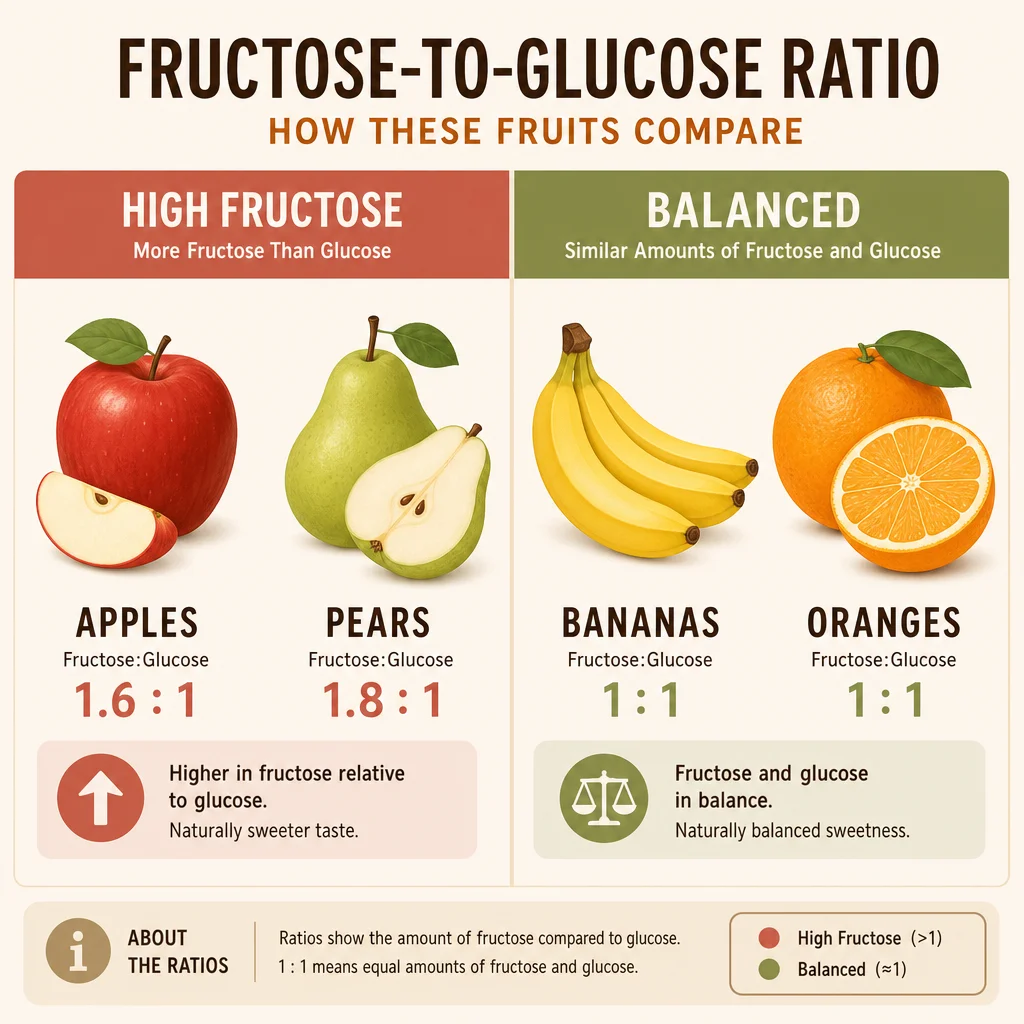
The ratio of fructose to glucose in a food is a critical determinant of how well it is absorbed. Glucose enhances fructose absorption through the GLUT2 transporter, which co-transports both sugars. When fructose and glucose are present in roughly equal amounts, absorption is generally efficient. When fructose exceeds glucose, the excess fructose is more likely to escape absorption.
Fructose-to-glucose ratio of common foods:
| Food | Fructose (g/100g) | Glucose (g/100g) | Ratio |
|---|---|---|---|
| Apples | 5.9 | 2.4 | 2.5:1 |
| Pears | 6.2 | 2.8 | 2.2:1 |
| Watermelon | 3.3 | 1.6 | 2.1:1 |
| Mango | 2.9 | 1.4 | 2.1:1 |
| Cherries | 5.4 | 4.0 | 1.4:1 |
| Grapes | 4.8 | 4.8 | 1.0:1 |
| Bananas | 2.6 | 2.3 | 1.1:1 |
| Oranges | 2.2 | 2.0 | 1.1:1 |
| Blueberries | 2.4 | 2.4 | 1.0:1 |
| Strawberries | 2.4 | 2.2 | 1.1:1 |
| Honey | 40.9 | 35.7 | 1.1:1 |
| High-fructose corn syrup (HFCS-55) | 55% | 42% | 1.3:1 |
High-fructose corn syrup is particularly problematic because it is designed to be sweet and cheap, not balanced. HFCS-55, the most common type used in soft drinks, contains 55% fructose and 45% glucose. This skewed ratio makes it harder to absorb and more likely to reach the colon undigested. Table sugar (sucrose), which contains 50% fructose and 50% glucose, is generally better tolerated in moderate amounts because the glucose facilitates fructose absorption.
Where Fructose Hides in Processed Foods
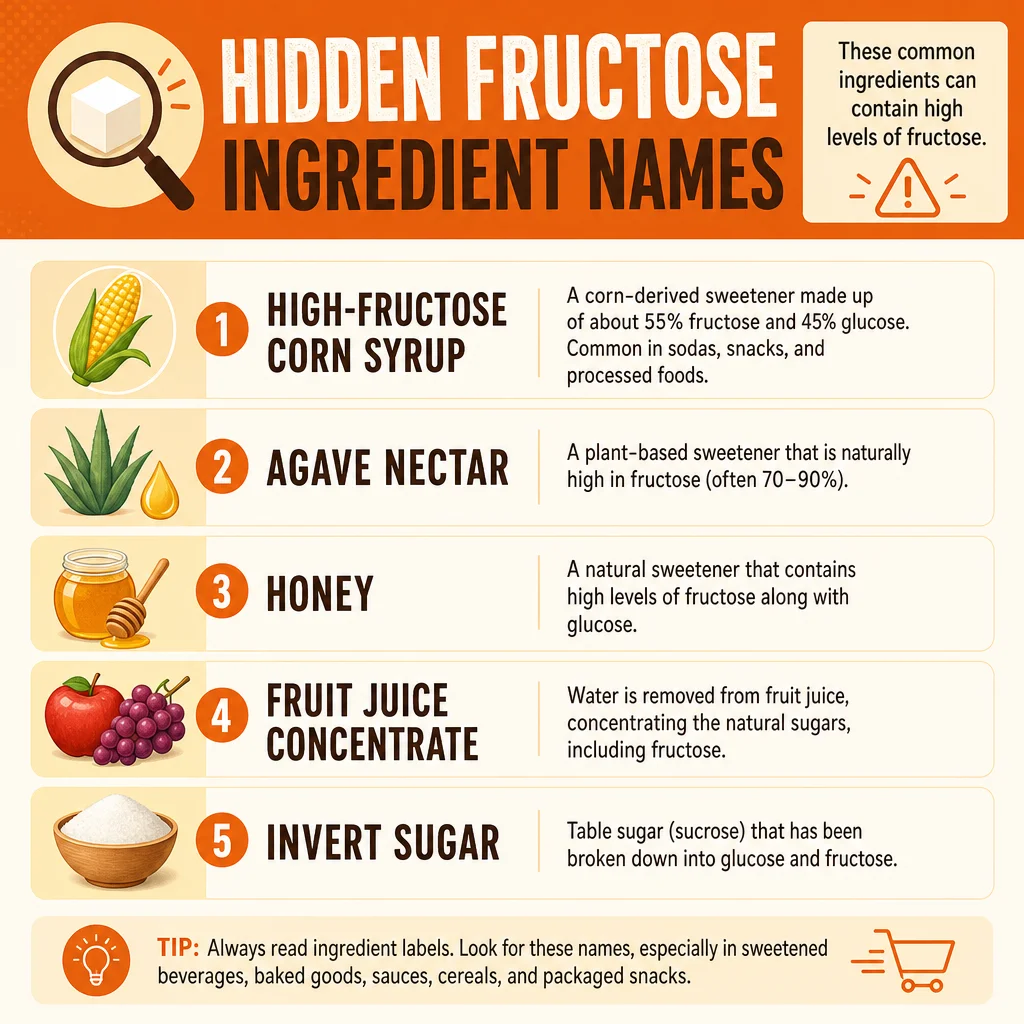
Fructose is added to a vast range of processed foods under many names. The most common source is high-fructose corn syrup, which according to the Corn Refiners Association is used in soft drinks, baked goods, breakfast cereals, jellies, jams, and condiments.
Common hidden fructose sources:
- High-fructose corn syrup (HFCS), glucose-fructose syrup, isoglucose, fructose-glucose syrup
- Agave nectar and agave syrup (often 70-90% fructose, marketed as healthy)
- Honey (contains more fructose than glucose)
- Fruit juice concentrate, apple juice concentrate, pear juice concentrate, white grape juice concentrate
- Fructose, crystalline fructose, fructose syrup
- Invert sugar, invert syrup, inverted sugar syrup
- Molasses, caramel, treacle, golden syrup
- Sorbitol, mannitol, xylitol, and other sugar alcohols (poorly absorbed and can worsen symptoms)
- Dried fruit, fruit puree, fruit paste, fruit leather
- Fruit-flavored products containing actual fruit juice or concentrate
Foods where fructose hides unexpectedly:
Bread and baked goods often contain HFCS or fruit juice concentrate as sweeteners. Even savory bread may have added sugar for browning and yeast activation.
Salad dressings and condiments are major sources. Ketchup, barbecue sauce, sweet relishes, and many salad dressings contain HFCS or sugar.
Flavored yogurt can contain fruit juice concentrate, high-fructose corn syrup, or added fructose beyond the natural lactose content.
Protein bars and granola are frequently sweetened with honey, agave, or dried fruit.
Soft drinks and sweetened beverages are the most obvious sources, but flavored waters, sports drinks, and iced teas can contain significant fructose.
Cough syrups and liquid medications often use HFCS or sorbitol as sweeteners and carriers.
According to Naturally Savvy, unexpected sources include bread, salad dressing, and even some brands of whole-grain crackers.
High-Fructose and Low-Fructose Foods
Fruits to approach with caution:
- Apples, pears, mango, watermelon, cherries, grapes, dried fruit, fruit juice
- These have high fructose content or a high fructose-to-glucose ratio
Fruits that are usually safer:
- Bananas, blueberries, strawberries, oranges, kiwi, cantaloupe, raspberries, papaya, pineapple
- These have lower fructose content or a balanced fructose-to-glucose ratio
Vegetables to be mindful of:
- Asparagus, artichokes, sugar snap peas, and some mushrooms contain moderate fructose
- Most non-starchy vegetables are low in fructose and generally safe
Sweeteners to avoid:
- High-fructose corn syrup, agave nectar, honey, crystalline fructose, fruit juice concentrate
- Invert sugar, molasses, and most syrups
Sweeteners that are generally safer:
- Glucose, dextrose, and plain sucrose (table sugar) in small amounts
- Rice malt syrup, which is glucose-based rather than fructose-based
- Pure maple syrup in small amounts (contains some fructose but less than agave)
Regulatory and Labeling Context
In the United States, the FDA requires total sugars to be listed on the Nutrition Facts panel, but it does not require manufacturers to specify how much of that sugar is fructose. Added sugars must be declared separately, but there is no breakdown of fructose content. This means a product could contain a high-fructose ingredient like agave or HFCS, and the label would only show "added sugars" without distinguishing the type.
In the European Union, high-fructose corn syrup is less common because of sugar beet subsidies, but glucose-fructose syrup is widely used. The EU does not require specific fructose labeling either. The term "natural sweeteners" is often used to market agave, honey, and fruit juice concentrate as healthier alternatives. For someone with fructose malabsorption, these natural sweeteners can be just as problematic as HFCS, if not more so. Agave nectar can contain up to 90% fructose, making it one of the most concentrated sources available.
Diagnosis and Testing
The hydrogen breath test is the most common diagnostic tool for fructose malabsorption. The patient consumes a standardized fructose solution, and breath hydrogen levels are measured at intervals. An increase of more than 20 ppm above baseline indicates malabsorption. Some laboratories also measure methane, which is produced by certain gut bacteria and may be associated with constipation-predominant symptoms.
The fructose elimination diet is another diagnostic approach. The patient avoids high-fructose foods for 2-4 weeks, then reintroduces them systematically to observe symptoms. This is often used in conjunction with the broader low-FODMAP diet.
Genetic testing for hereditary fructose intolerance is available through specialized laboratories and can identify mutations in the ALDOB gene. Carrier testing is also available for at-risk populations.
The Gut Microbiome Connection
A narrative review published in MDPI found that high-fructose diets promote an increase in inflammatory bacterial groups such as Desulfovibrio and Deferribacteraceae while reducing beneficial Bacteroidetes. These microbial alterations may impair intestinal barrier function, modify short-chain fatty acid profiles, and contribute to systemic inflammation. This suggests that fructose malabsorption is not just a matter of osmotic and fermentative symptoms, but may also contribute to broader metabolic and inflammatory consequences.
A Practical Label-Reading Strategy
This section is designed to be a standalone, actionable checklist for reading food labels when you have fructose intolerance. Follow these steps every time you shop, and use this list as a reference when scanning ingredients with an ingredient checker or app.
Step 1: Identify the type of sugar
Look at the ingredient list for specific sugar sources, not just the total sugar content. The following ingredients indicate significant fructose content:
- High-fructose corn syrup, HFCS, glucose-fructose syrup, isoglucose, fructose-glucose syrup
- Agave nectar, agave syrup, agave extract
- Honey, raw honey, manuka honey
- Fruit juice concentrate, apple juice concentrate, pear juice concentrate, white grape juice concentrate
- Fructose, crystalline fructose, fructose syrup
- Invert sugar, invert syrup, inverted sugar syrup
- Molasses, treacle, caramel, golden syrup
- Dried fruit, fruit puree, fruit paste, fruit leather
- Sorbitol, mannitol, xylitol, maltitol, isomalt (these are polyols that can worsen malabsorption symptoms)
Step 2: Check the ingredient order
Ingredients are listed by weight, from most to least. If a high-fructose ingredient appears in the first three ingredients, the product is likely to trigger symptoms. If it appears near the end, the amount may be small enough to tolerate, depending on your individual sensitivity.
Step 3: Understand "fruit" and "natural" claims
Products labeled as "made with real fruit" or "naturally sweetened" may contain fruit juice concentrate, which is a concentrated source of fructose. Do not assume these products are safer. Always check the ingredient list for specific fruit-derived sweeteners.
Step 4: Watch for sugar alcohols
Sorbitol, mannitol, xylitol, and other polyols are often added to sugar-free products. While they are not fructose, they are poorly absorbed and can cause similar bloating and diarrhea. For people with fructose malabsorption, these sugar alcohols can compound the problem.
Step 5: Consider glucose-to-fructose balance
When choosing sweetened products, prefer those sweetened with glucose or dextrose over those sweetened with fructose-dominant ingredients. Plain table sugar, which is 50% glucose and 50% fructose, is generally better tolerated than HFCS or agave in small amounts.
Step 6: Use a structured approach when shopping
Start with whole, unprocessed foods. Fresh vegetables, plain meats, rice, oats, and quinoa are naturally low in fructose. When buying packaged foods, scan for the fructose-containing ingredients listed above. If the product contains any of them, set it aside and look for an alternative with a simpler ingredient list and no concentrated fructose sources.
Using IngrediCheck, you can scan any product label and instantly identify fructose-containing ingredients, high-fructose corn syrup, agave, and sugar alcohols that may trigger your symptoms. This takes the guesswork out of grocery shopping and helps you build a diet that supports your digestive health.
For more information on other fermentable carbohydrates, see our FODMAP Intolerance Dietary Guide.
Related Guides
- Low-FODMAP Diet Label Reading Guide for IBS Sufferers
- Lactose Intolerance Dietary Guide: Hidden Dairy Names, Lactose-Free Labels, and the EU-US Divide
- Gluten Intolerance Dietary Guide: Wheat Starch, Maltodextrin, and the FALCPA Loophole
- How to Spot Corn Syrup: Every Name It Hides Under
- FODMAP Intolerance Dietary Guide: Oligosaccharides, Polyols, and the Monash Method
- Sugar-Free Scanner App
On this page
Sources
Source lists are maintained with our editorial policy.
- Medical News Today - Fructose Intolerance
- GeneReviews - Hereditary Fructose Intolerance
- MedlinePlus - Hereditary Fructose Intolerance
- Orphanet - Hereditary Fructose Intolerance
- Nature - GLUT5 as a Novel Target of Nuclear Receptor LXR
- MDPI - Fructose Malabsorption, Gut Microbiota and Clinical Consequences
- Cambridge - Fructose Malabsorption: Causes, Diagnosis and Treatment
- Corn Refiners Association - HFCS FAQ
- Wikipedia - High-Fructose Corn Syrup
- Naturally Savvy - Hidden HFCS
Next Label Check
Follow the scanner, hub, and ingredient paths connected to this guide
Scanner workflows
Low FODMAP scannerScanner workflow
Low FODMAP Ingredient Checker
Scan labels for low FODMAP grocery clues, IBS trigger ingredients, sweeteners, fibers, and related digestive-health guides.
Gluten-free scannerScanner workflow
Gluten-Free Barcode Scanner
Scan barcodes and labels for gluten clues, hidden wheat, barley, rye, malt, and celiac-relevant ingredient risks with IngrediCheck's gluten-free workflow.
Topic hubs
Topic hub
Ingredient Safety
Explore IngrediCheck's ingredient safety hub for additives, contaminants, preservatives, and evidence-based label guidance.
Topic hub
Gluten-Free Label Reading
Find IngrediCheck's gluten-free topic hub covering hidden gluten, celiac-safe label reading, and ingredient-level guidance.
Topic hub
Low FODMAP Label Reading
Use IngrediCheck's low FODMAP hub to spot ingredient triggers, interpret labels faster, and shop with more confidence for IBS.
Related articles
Dietary GuidesArticle
Histamine Intolerance Dietary Guide: DAO Deficiency, Fermented Foods, and the Migraine Connection
An encyclopedic guide to histamine intolerance covering DAO and HNMT enzyme biochemistry, AOC1 gene polymorphisms, histamine content tables, mast cell activation, diagnostic criteria, and practical label-reading strategies.
Dietary GuidesArticle
Lactose Intolerance Dietary Guide: Hidden Dairy Names, Lactose-Free Labels, and the EU-US Divide
An encyclopedic guide to lactose intolerance covering genetics, molecular biology, global prevalence, diagnostic methods, hidden dairy ingredients, regulatory differences, and actionable label-reading strategies.
Dietary GuidesArticle
Low FODMAP Guide: Inulin, Polyols & Hidden Ingredients
Low FODMAP guide to inulin, polyols, and hidden ingredients on packaged-food labels, including onion, garlic, chicory root, lactose, and fructose.
Get the app for clearer label decisions.
Scan labels, see what fits your food notes, and read the why in plain English.