Ingredient Deep Dives

Foods With BHA, BHT, and TBHQ: A Label Guide for Shoppers

Learn which pantry categories commonly deserve a BHA, BHT, or TBHQ check, recognize their label names, and compare preservative rules without alarmism.

Jun 29, 2026|8 min read
By Sanket Patel|Updated 2026-07-29|8 sources|Editorial standards
Foods With BHA, BHT, and TBHQ: A Label Guide for Shoppers

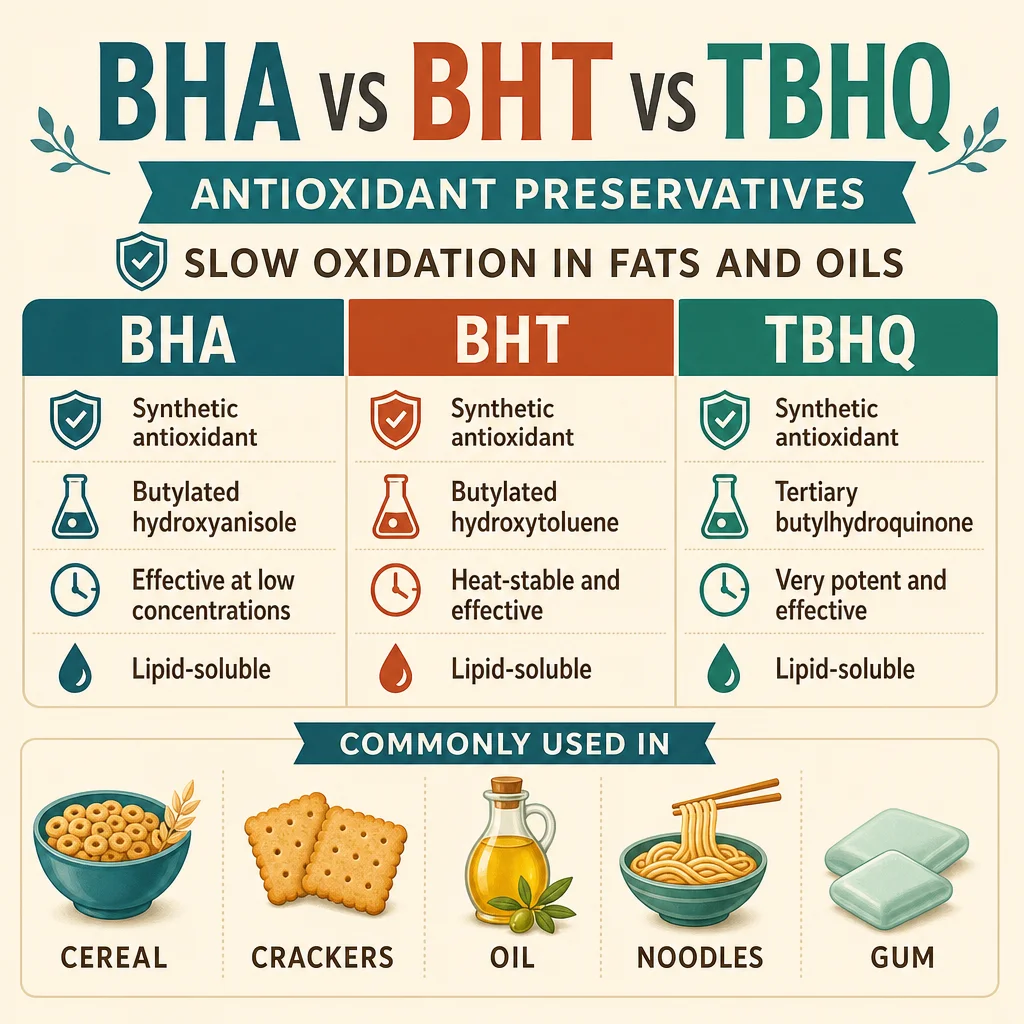
BHA, BHT, and TBHQ often appear in the same pantry conversation because they solve a similar manufacturing problem. They slow oxidation in fats and oils, helping foods resist rancid flavors and quality loss during storage.

They are not the same chemical, and they do not appear in every processed food. The useful shopping question is not Which foods always contain them? It is Which aisles deserve a quick label check, and what names should I look for?

This guide was checked against current U.S. rules and FDA review pages on July 29, 2026. Product recipes can change. Examples below identify high-yield categories, not guaranteed ingredients or safe-product lists.
Quick Pantry List

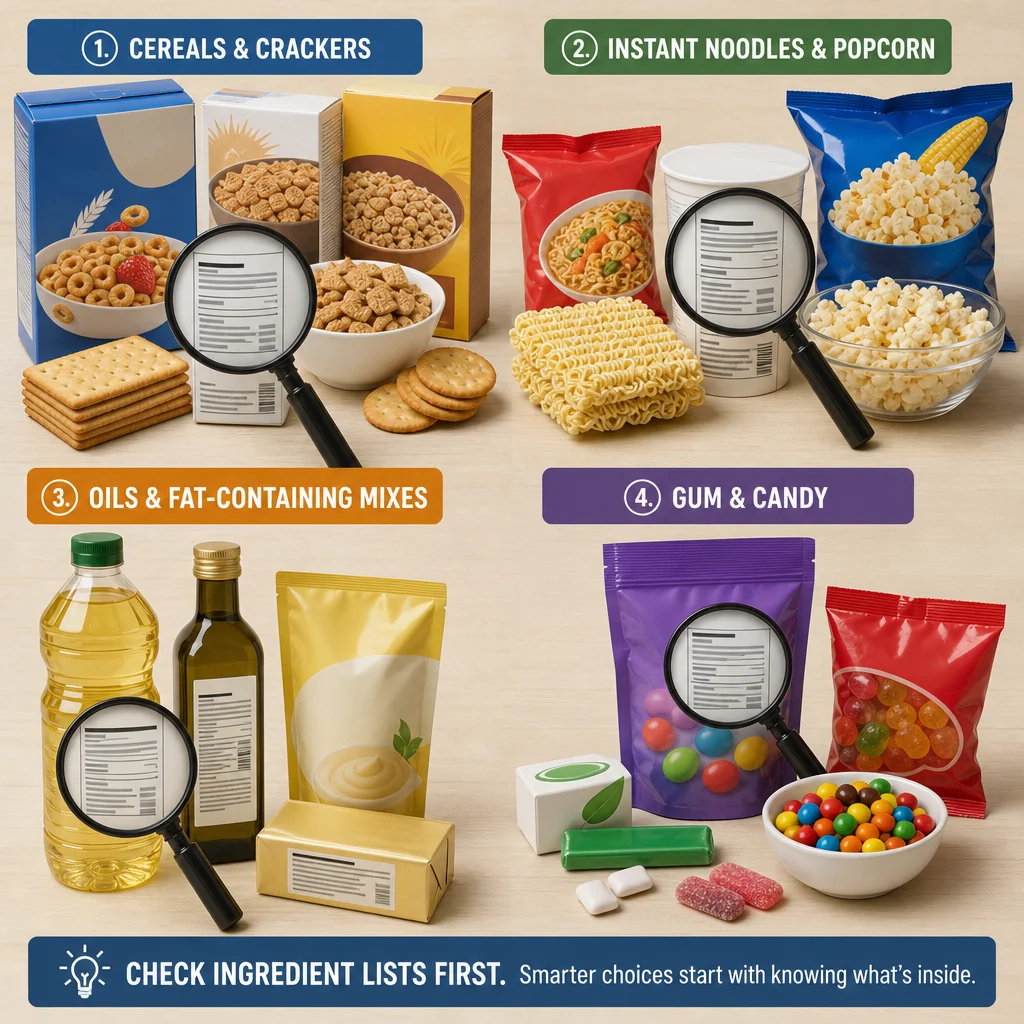
Check these categories first:

  • dry breakfast cereals;
  • crackers and seasoning-coated snacks;
  • potato flakes, granules, and other shelf-stable potato products;
  • instant noodles and seasoning packets;
  • microwave popcorn;
  • packaged baked goods;
  • chewing gum;
  • cooking oils and fat-containing mixes;
  • frozen or shelf-stable foods with added fats;
  • candy and snack products designed for long storage.

The current ingredient panel decides whether a specific product contains BHA, BHT, or TBHQ. Many brands use other antioxidant systems, reformulate, or sell different recipes by market.

The Three Label Names

Short nameFull nameEU additive numberMain label-reading role
BHAButylated hydroxyanisoleE320Antioxidant for fats, oils, and selected foods
BHTButylated hydroxytolueneE321Antioxidant for fats, oils, cereals, and selected foods
TBHQTertiary butylhydroquinoneE319Antioxidant often used in fat-containing shelf-stable foods

On a U.S. package, the ingredient list may show the short name or full name. On an imported package, the additive may be declared by function plus name or E-number, such as antioxidant: E319.

EFSA explains that EU food labels identify an additive's function and the specific substance by name or E-number. This makes E319, E320, and E321 useful additions to a saved label rule.

What These Preservatives Do

What These Preservatives Do

Fats react with oxygen. Over time, that reaction can create stale odors, off-flavors, color changes, and shorter shelf life.

BHA, BHT, and TBHQ interrupt parts of that oxidation process. Food rules classify them as antioxidant preservatives. Their commercial value is most obvious in foods that contain fat and need to stay stable during shipping or pantry storage.

This technical function does not tell you whether a whole food is nutritious. A cereal can be high in fiber and use an antioxidant. A cracker can avoid these three and still be high in sodium. Ingredient screening and nutrition assessment answer different questions.

Foods Where BHA May Appear

Current FDA regulations list BHA uses in selected categories including:

  • dry breakfast cereals;
  • dehydrated potato shreds;
  • potato flakes and granules;
  • sweet potato flakes;
  • active dry yeast;
  • dry beverage or dessert mixes;
  • emulsion stabilizers for shortenings;
  • dry diced glazed fruit.

FDA's 2026 BHA reassessment announcement also describes use in foods such as frozen meals, breakfast cereals, cookies, candy, ice cream, and meat products. It notes that packaged-food label data indicate use has declined while BHA remains present in products, including some marketed to children.

That does not mean every item in those categories contains BHA. It means those are sensible places to check.

The clearest label terms are:

  • BHA;
  • butylated hydroxyanisole;
  • E320;
  • a parenthetical note such as added to preserve freshness.

For the evidence and current reassessment, use the BHA ingredient profile and BHA FDA review guide.

Foods Where BHT May Appear

FDA's direct-additive rule lists BHT for selected uses that include:

  • dry breakfast cereals;
  • dehydrated potato shreds;
  • potato flakes and granules;
  • sweet potato flakes;
  • emulsion stabilizers for shortenings.

The 2026 Federal Register request for information asks manufacturers for current BHT use levels and food categories as FDA conducts a post-market assessment. The notice explains that BHT is used to retard deterioration, rancidity, or discoloration caused by oxidation.

For pantry shopping, also check labels on crackers, chewing gum, baking mixes, packaged snacks, and other fat-containing products. These are screening categories, not claims that every product uses BHT.

Look for:

  • BHT;
  • butylated hydroxytoluene;
  • E321;
  • wording that says the antioxidant preserves freshness.

The BHT ingredient profile and BHT preservative guide provide the current evidence trail.

Foods Where TBHQ May Appear

TBHQ is especially worth checking in long-shelf-life foods built around oils or fat-containing seasonings.

High-yield categories include:

  • crackers;
  • instant noodles;
  • microwave popcorn;
  • fried snack foods;
  • packaged baked goods;
  • seasoning-coated chips;
  • frozen potato products;
  • cooking oils and fat blends;
  • cereal and convenience foods.

Under 21 CFR 172.185, TBHQ may be used as an antioxidant alone or with BHA and BHT. The total antioxidant content cannot exceed 0.02 percent of the food's oil or fat content, including essential volatile oil.

Look for:

  • TBHQ;
  • tertiary butylhydroquinone;
  • tert-butylhydroquinone;
  • E319.

Use the existing TBHQ preservative guide for the ingredient-specific regulatory discussion.

Why They Sometimes Appear Together

Food formulators can use antioxidant systems rather than one ingredient in isolation. U.S. rules explicitly discuss BHA and BHT combinations in selected foods and allow TBHQ alone or with BHA and BHT under prescribed conditions.

That is why a shopper should not stop after finding one acronym. If the household rule is to review synthetic antioxidant preservatives, check the complete group:

  • BHA and E320;
  • BHT and E321;
  • TBHQ and E319;
  • propyl gallate;
  • preservative notes attached to oils, flavorings, or cereal packaging.

These ingredients have related functions, but they do not share one evidence record. Avoid turning a group check into a claim that all three have identical health effects.

A Pantry-by-Pantry Check

A Pantry-by-Pantry Check

Cereal and granola

Check the main ingredient list and any parenthetical note connected to the packaging or cereal base. BHA and BHT have specific regulatory history in dry breakfast cereal.

Crackers, chips, and popcorn

Read the oil, seasoning, and flavor sub-ingredients. TBHQ or another antioxidant may be declared inside parentheses rather than as a standalone final ingredient.

Instant noodles

Check the noodle block and seasoning packet. The oil used to fry or stabilize the noodles may carry an antioxidant declaration.

Potato products

Dry potato shreds, flakes, and granules appear explicitly in BHA and BHT rules. Frozen potato products can also be worth checking for TBHQ or other oil-stability ingredients.

Gum and candy

Read gum-base, flavor, and oil-related declarations. Do not assume a product is free from these preservatives because the main ingredient list looks short.

Oils, shortenings, and baking mixes

Antioxidants may protect the fat ingredient before it reaches the finished mix. Check sub-ingredients and phrases such as to preserve freshness.

What U.S. Review Status Means in 2026

BHA and BHT remain permitted under applicable U.S. conditions while FDA conducts post-market assessments.

FDA launched a comprehensive reassessment of BHA in February 2026. In May 2026, FDA requested current use, exposure, and safety information for BHT. A review is not the same as a ban or a completed safety conclusion.

TBHQ has its own authorization and evidence record. Do not treat the BHA and BHT review announcements as proof that FDA launched the same 2026 process for TBHQ.

This distinction keeps the guide current without predicting what regulators will decide.

Are These Ingredients Banned in Europe?

Simple ban lists can be misleading. The EU additive system uses authorizations, food categories, conditions of use, and maximum levels. BHA, BHT, and TBHQ are known as E320, E321, and E319 in that system.

The shopper task is to check the current market's label and the exact additive's permitted conditions. Allowed somewhere does not mean allowed in every food, and restricted does not mean every use is prohibited.

Use the Preservatives hub and E-Number Glossary when an imported label uses a number instead of the chemical name.

How to Compare Two Products

Use a five-step comparison:

  1. Match the category. Compare two crackers with similar uses, not a cracker with plain oats.
  2. Read the complete ingredient list. Expand every parenthetical oil, flavor, and seasoning component.
  3. Search all six names. Check BHA/E320, BHT/E321, and TBHQ/E319.
  4. Review the rest of the label. Sodium, added sugars, allergens, and serving size still matter.
  5. Recheck repeat purchases. Formulations change.

Choosing the product without one of these preservatives can be a valid clean-label preference. It should not be described as a guarantee that the whole product is healthier or safer for everyone.

A Saved-Rule Checklist

If you want a scanner to flag the group consistently, save:

  • BHA;
  • butylated hydroxyanisole;
  • E320;
  • BHT;
  • butylated hydroxytoluene;
  • E321;
  • TBHQ;
  • tertiary butylhydroquinone;
  • tert-butylhydroquinone;
  • E319.

Also review propyl gallate if your goal is to compare the broader antioxidant-preservative family.

IngrediCheck can scan a barcode or ingredient-label photo for BHA, BHT, TBHQ, their full chemical names, and saved E-number rules. It then shows which term matched so you can compare pantry products without treating one preservative as the whole food decision.

Frequently Asked Questions

What foods commonly use BHA, BHT, or TBHQ?

Check dry cereals, crackers, potato products, instant noodles, microwave popcorn, packaged baked goods, chewing gum, seasoning-coated snacks, oils, and fat-containing mixes. Formulas vary, so the current ingredient list is the deciding evidence.

What are the E-numbers for BHA, BHT, and TBHQ?

TBHQ is E319, BHA is E320, and BHT is E321. Imported labels may use the E-number, the full chemical name, or both.

Are BHA, BHT, and TBHQ the same preservative?

No. They are different antioxidant preservatives. All three can slow oxidation in fats and oils, but their chemistry, permitted uses, evidence records, and regulatory reviews are not identical.

Does every cereal or cracker contain these preservatives?

No. Similar products can use different antioxidant systems or none of these three. Recipes change, so compare the current ingredient lists instead of relying on a category assumption.

Next Label Check

Follow the scanner, hub, and ingredient paths connected to this guide

Get the app for clearer label decisions.

Scan labels, see what fits your food notes, and read the why in plain English.

IngrediCheck app