BHA: The Preservative the FDA Is Finally Reviewing

BHA has been flagged as a probable carcinogen since 1991. Now the FDA is finally reviewing it. Here's what it is, where it hides, and what regulators around the world say.

Mar 9, 2026|10 min read
BHA: The Preservative the FDA Is Finally Reviewing

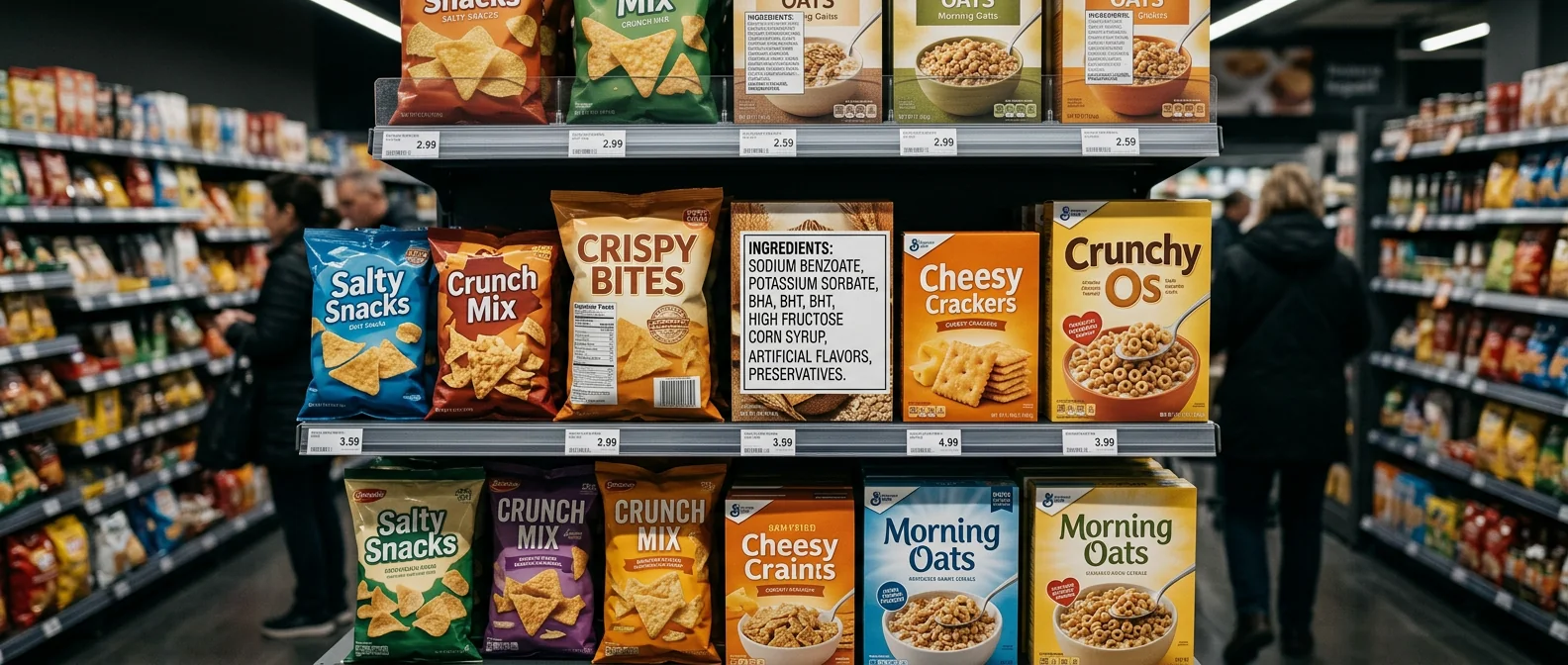
Open a bag of chips. Read the ingredient list. Somewhere near the bottom, often in parentheses after the oil, you may see four letters: BHA.

BHA — butylated hydroxyanisole — is a synthetic antioxidant preservative that has been in the American food supply since the 1940s. It appears in potato chips, breakfast cereals, chewing gum, vegetable oils, instant noodles, processed meats, butter, and hundreds of other products. Its job is to prevent fats and oils from oxidizing and going rancid, extending shelf life.

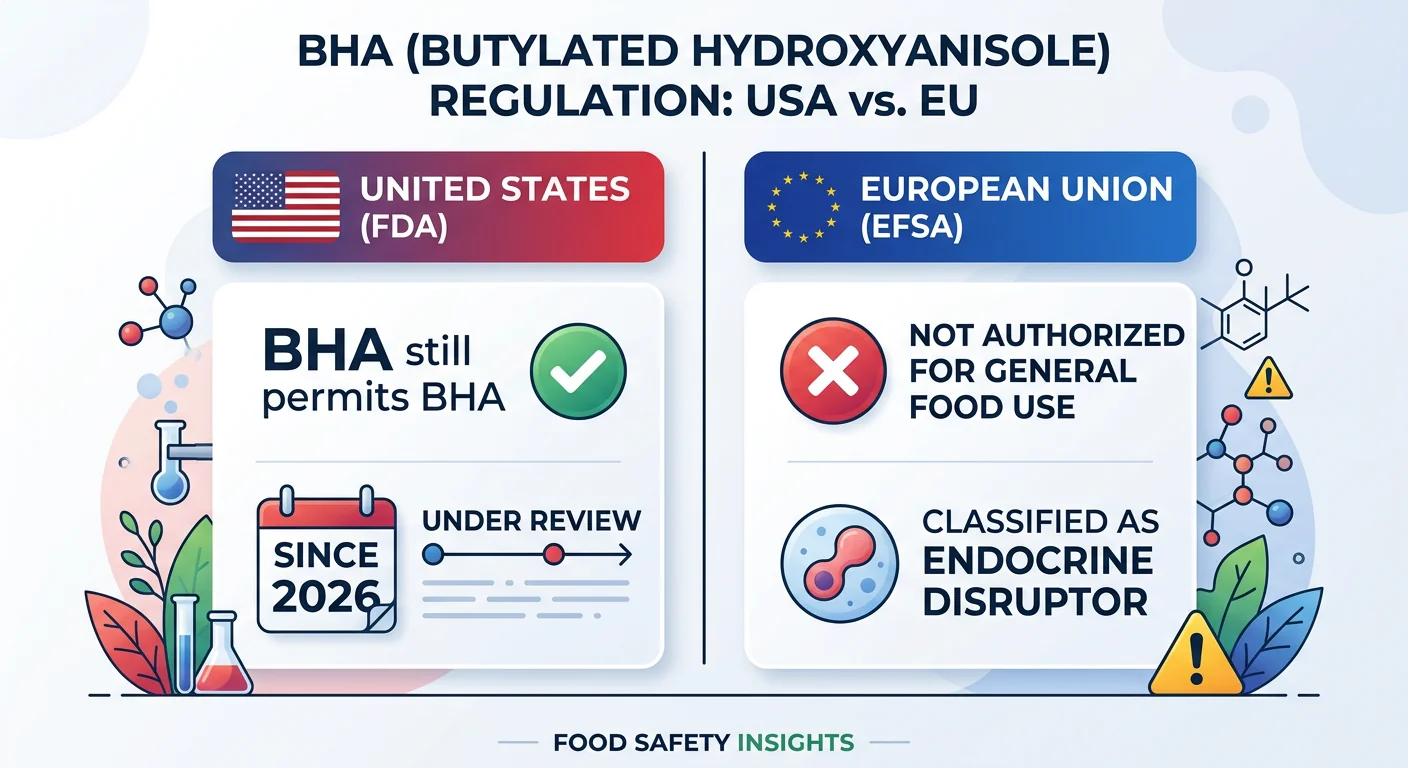
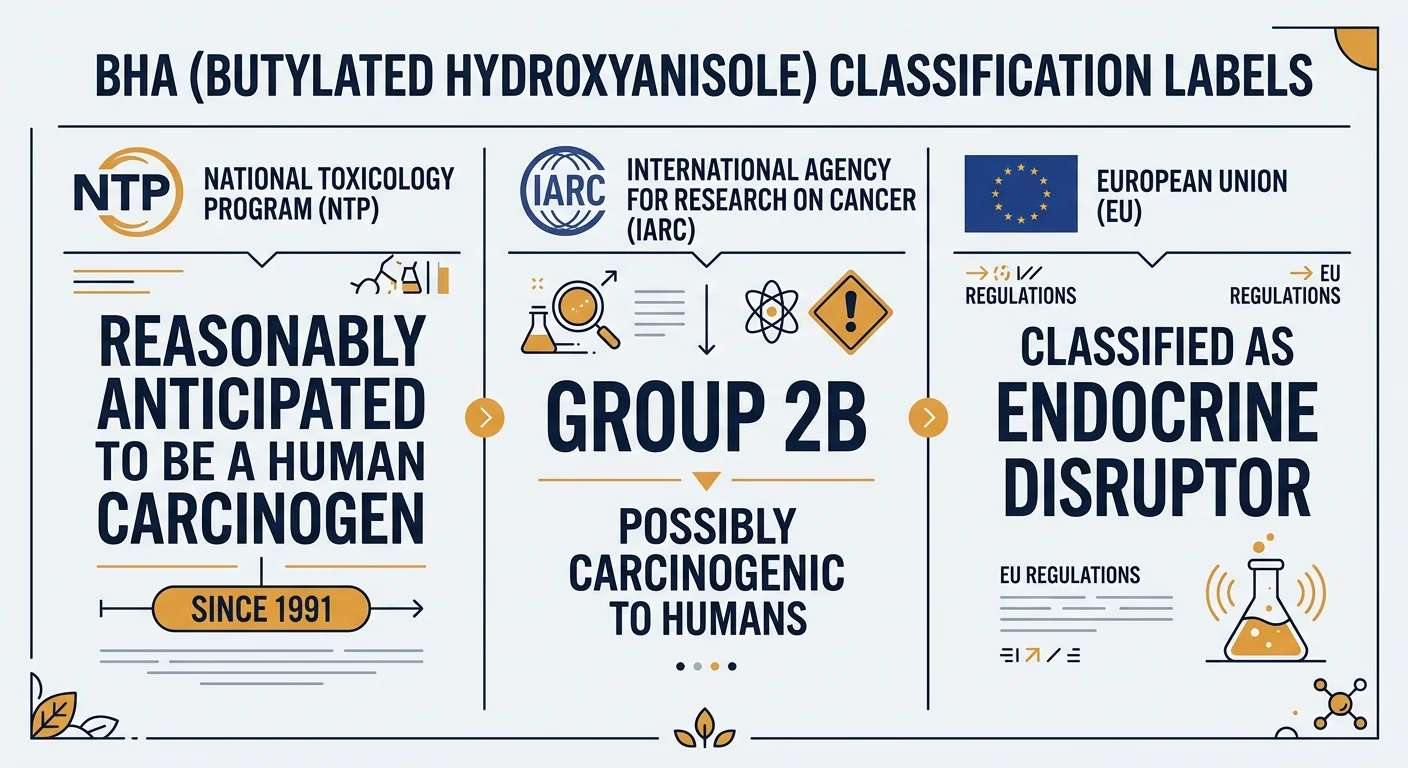
The US National Toxicology Program has listed BHA as "reasonably anticipated to be a human carcinogen" since 1991 — 35 years ago. The International Agency for Research on Cancer classified it as "possibly carcinogenic to humans" in 1986. The European Union does not permit BHA in general food use and classifies it as an endocrine disruptor.

The FDA has permitted it throughout. Until now.

In February 2026, the FDA formally announced that BHA is among the food additives under active reassessment in its post-market chemical review program. It is one of the first chemicals to receive this designation. What happens next will depend on what that review finds — and how the agency weighs findings that have been in the scientific record for decades.
What BHA Does and Where It Hides

BHA is a phenolic compound — specifically, a mixture of two isomers of butylated hydroxyanisole. Like its close relative BHT (butylated hydroxytoluene), it functions as a fat-soluble antioxidant. When added to oils and fat-containing foods, it interrupts the chain reaction of oxidation that causes fats to become rancid, turns them sour-smelling, and eventually makes them unsafe to eat.

This is a technically useful function. Fats and oils are chemically unstable — they react with oxygen over time, producing off-flavors, off-odors, and in some cases, harmful byproducts. Before synthetic preservatives like BHA, fat-containing processed foods had very short shelf lives.

BHA is found in concentrations up to 0.02% of the fat content in a given product — a small absolute amount, but one that appears across a wide range of everyday foods:

  • Snack foods: Potato chips, crackers, pretzels, popcorn
  • Cereals: Many ready-to-eat breakfast cereals
  • Baked goods: Packaged cookies, pastries, pie crusts
  • Processed meats: Sausages, cured meats, lard
  • Chewing gum: Used directly as a preservative in the gum base
  • Vegetable oils and shortening: Often included in the oil before it is used in cooking
  • Instant noodles and soup packets: Particularly in flavor packets containing oils
  • Packaging materials: BHA can migrate from food packaging into food; it is also used directly in some packaging

BHA is listed under a range of names on ingredient labels. Most commonly: BHA, butylated hydroxyanisole, or E320 (the European additive number used on imported products). Because it is fat-soluble, it is typically declared alongside the fat or oil it is preserving: "soybean oil (BHA added to preserve freshness)" or simply listed at the end of the ingredient list.

The Science: 35 Years of Concern

The Science: 35 Years of Concern

The scientific concern about BHA is not new. The evidence that triggered regulatory attention dates back to the 1980s.

In animal studies, BHA has been shown to cause forestomach tumors in rats, mice, and hamsters when administered at high doses. The forestomach is a stomach compartment not present in humans — a critical caveat that the FDA has historically used to argue the findings are not directly applicable to human risk assessment. But regulatory science bodies that apply a precautionary standard have not found that caveat sufficient to dismiss concern.

IARC (1986): The International Agency for Research on Cancer classified BHA as Group 2B — possibly carcinogenic to humans based on the animal data, while acknowledging limited human data existed. The classification has remained in place.

NTP (1991, reaffirmed through 2021): The National Toxicology Program placed BHA on its Report on Carcinogens as "reasonably anticipated to be a human carcinogen" — the second-highest classification in the NTP framework. The 15th Report on Carcinogens, published in 2021, retained this listing. The reasoning: the forestomach findings in multiple rodent species are consistent enough to warrant precautionary classification, even given anatomical differences.

Endocrine disruption: More recently, BHA has come under scrutiny for potential endocrine-disrupting properties. Studies have shown that BHA can weakly mimic estrogen at the cellular level and may interfere with androgen signaling. The European Chemicals Agency (ECHA) has classified BHA as an endocrine disruptor under its REACH regulation, which has directly influenced the EU's decision not to authorize it for general food use.

The dose-response question is central to the debate. Consumer advocates argue that even low-level chronic exposure to a probable carcinogen warrants regulatory action. Industry representatives argue that exposure levels from food are far below those used in rodent studies that produced tumors, and that BHA may actually exhibit antioxidant, anti-cancer properties at low doses — a concept sometimes invoked by manufacturers to argue the chemical is protective rather than harmful.

This dose ambiguity — where the same compound may be harmful at high doses and potentially protective at low doses — makes BHA scientifically complex and politically contentious.

The Regulatory Divergence: US vs. EU

The Regulatory Divergence: US vs. EU

The gap between how the United States and the European Union approach BHA illustrates a fundamental difference in food safety philosophy.

United States: BHA is listed as Generally Recognized as Safe (GRAS) by the FDA under 21 CFR 182.3169. This original GRAS determination was made decades ago. Under the GRAS framework, the burden of proof lies on regulators to demonstrate harm before restricting a substance — not on manufacturers to demonstrate safety before using it. BHA has never been formally reassessed under modern toxicological standards. It has remained in the food supply on the basis of its original 1950s-era designation.

European Union: BHA (E320) is not authorized for general food use in the EU. Its permitted uses are limited to highly specific applications — certain fats used in the manufacture of food-grade paper, dry foods for pets, and a small number of other narrow categories. In general food products, it is not permitted. The EU's approach is precautionary: given the carcinogen and endocrine disruptor classifications, the regulatory default is restriction unless safety is demonstrated for each specific use.

"The EU operates on the precautionary principle — if there is scientific uncertainty about whether something is safe, restrict it until you know. The US operates on the opposite default: allow it unless harm is proven."

This regulatory asymmetry means the same snack food product may contain BHA when sold in the United States but use a reformulated recipe — typically with natural antioxidants like rosemary extract or mixed tocopherols — when sold in Europe.

The FDA's 2026 Review

In February 2026, the FDA announced that BHA is among the first food additives to enter its newly formalized post-market chemical review program. This program, launched as part of the FDA's Human Foods Program 2026 priority deliverables, is designed to systematically reassess food additives that have been on the market for decades under GRAS designations that were never updated.

The review is significant because it represents the FDA formally acknowledging that its existing safety determinations for some food chemicals may be outdated. Whether BHA's review will result in restriction, labeling requirements, or no change remains to be seen. The process is expected to take two or more years.

The announcement comes alongside broader political pressure on the FDA to address food chemical safety. HHS Secretary Robert F. Kennedy Jr. has repeatedly cited BHA as an example of an ingredient the FDA has failed to adequately review, and it featured prominently in the "Make America Healthy Again" regulatory agenda. The FDA's 2026 deliverables explicitly name BHA alongside Red No. 3 and several other additives.

States Are Moving Ahead

While the federal review proceeds, states have already begun acting on BHA directly — particularly in the context of school food.

Texas SB 314 (2025): Texas enacted legislation restricting a set of food additives from foods served in school nutrition programs, with BHA among the named substances. The law requires that school meal vendors certify that food items do not contain the listed additives.

Louisiana SB 14 (2025): Louisiana enacted similar legislation targeting harmful food additives in school cafeterias, including BHA, as part of a broader school nutrition reform effort.

These state-level school nutrition laws follow the model established in West Virginia and California for synthetic food dyes — using the school food channel as a first step toward broader restriction. Because national food manufacturers often produce a single product line for institutional buyers, school bans can trigger reformulation that flows into the general consumer market.

Natural Alternatives: What Replaces BHA?

BHA's core function — preventing fat oxidation — is not irreplaceable. Several natural alternatives are already in widespread commercial use:

Rosemary extract (E392): Derived from rosemary leaves, this natural antioxidant is effective at preventing fat oxidation in oils, nuts, and meat products. It is GRAS in the US and has full authorization in the EU. Many food manufacturers that have reformulated away from BHA in European markets use rosemary extract as the replacement.

Mixed tocopherols (Vitamin E): Tocopherols are naturally occurring forms of Vitamin E and effective antioxidants in fats and oils. They are widely used as BHA alternatives and appear on labels as "mixed tocopherols" or simply "vitamin E."

Ascorbic acid (Vitamin C): Water-soluble antioxidant used in meat products and some beverages, though less effective in high-fat applications.

The trade-off is cost. Synthetic BHA is inexpensive — pennies per kilogram of oil protected. Rosemary extract costs more. For manufacturers operating at the scale of tens of millions of pounds of product annually, even a small per-unit cost increase is significant. This is the core reason BHA has persisted in the food supply despite the availability of alternatives: it works, and it is cheap.

How to Identify BHA on a Label

Federal labeling law requires that BHA be declared on ingredient labels. Look for:

  • BHA — most common listing
  • Butylated hydroxyanisole — full chemical name, used by some manufacturers
  • E320 — the European number, which may appear on imported products

BHA is typically listed at the end of the ingredient list, often immediately after the oil it is preserving, in parentheses: (soybean oil, BHA added to preserve freshness).

Products that have removed BHA often signal this with "no artificial preservatives" claims and list rosemary extract, mixed tocopherols, or vitamin E as the antioxidant.

The FDA review underway in 2026 may eventually result in BHA being restricted or removed from the GRAS list — but that process will take years. In the meantime, BHA remains legal, widely used, and present in many common packaged foods.

Using IngrediCheck, you can scan any packaged food and instantly see whether it contains BHA — along with its regulatory classifications, health concerns, and whether natural alternatives are used instead — so you can make informed decisions about what you and your family are eating while the federal review proceeds.

Start making confident food choices today !

Scan food and understand what's right for you and your family, with AI.

IngrediCheck app