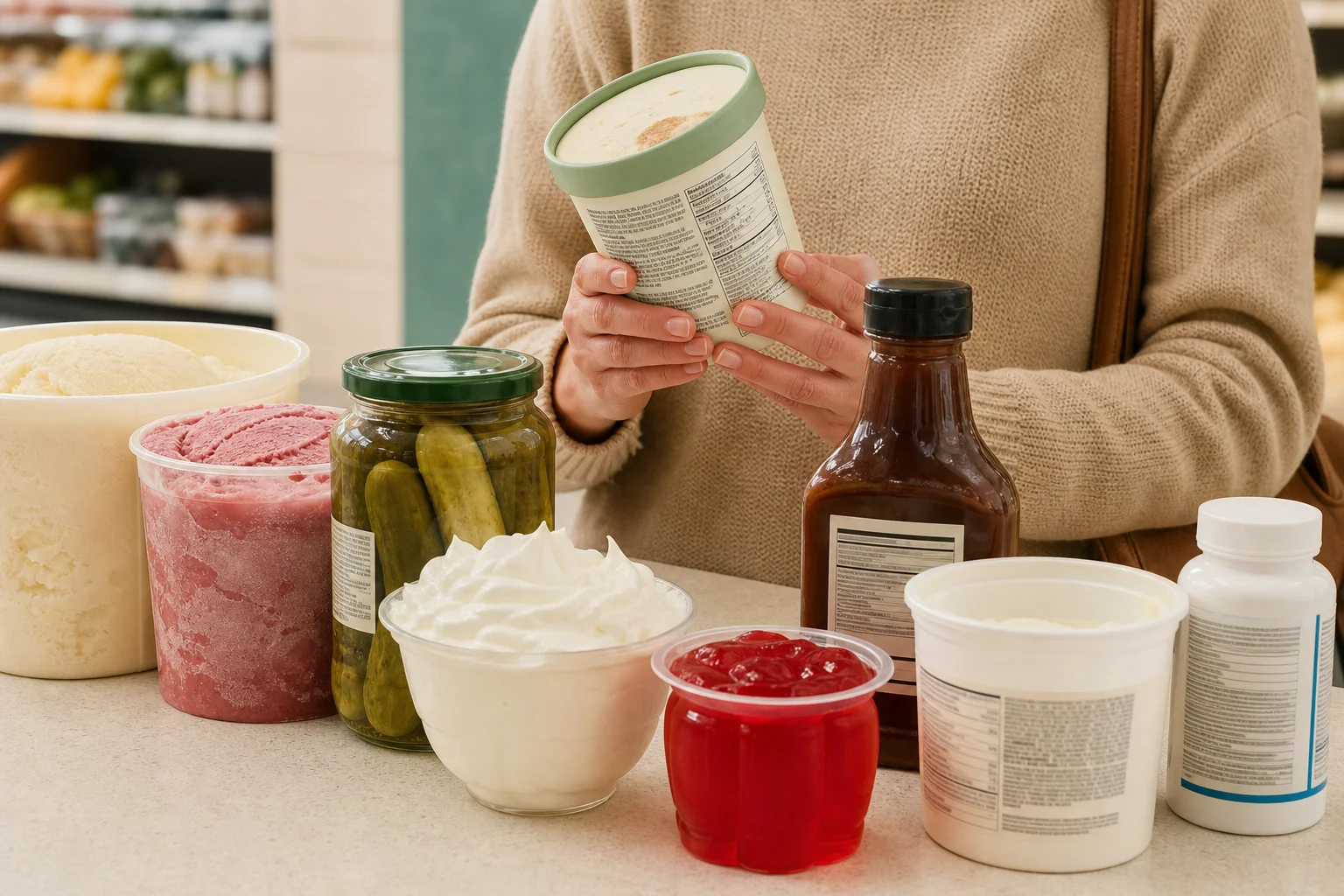
Polysorbate 80 can appear in foods that need oil and water to stay mixed, flavors to disperse evenly, or a stable texture during storage. The fastest places to check are frozen desserts, whipped toppings, gelatin desserts, pickles, barbecue sauce, shortenings, edible oils, and selected vitamin or mineral preparations.
That list is a screening map, not proof that every product contains the additive. Two ice creams on the same shelf may use completely different emulsifier systems. One flavor from a brand may contain polysorbate 80 while another does not.
This guide focuses on where polysorbate 80 may appear and how to find it on a current label. For the microbiome, intestinal-barrier, and safety evidence, use the separate Polysorbate 80 gut-health explainer.
Names to Look For on the Label
| Label term | Where you may see it | What it means |
|---|
| Polysorbate 80 | U.S. ingredient lists | The common food-additive name |
| E433 | EU and other international labels | The E-number for polysorbate 80 |
| INS 433 | Some international labels | The Codex-style numbering format |
| Emulsifier (E433) | Imported foods | Function followed by the additive code |
| Tween 80 | Technical documents and some specialty products | A widely used trade or technical alias |
| Polyoxyethylene (20) sorbitan monooleate | Regulations and specifications | The formal chemical description |
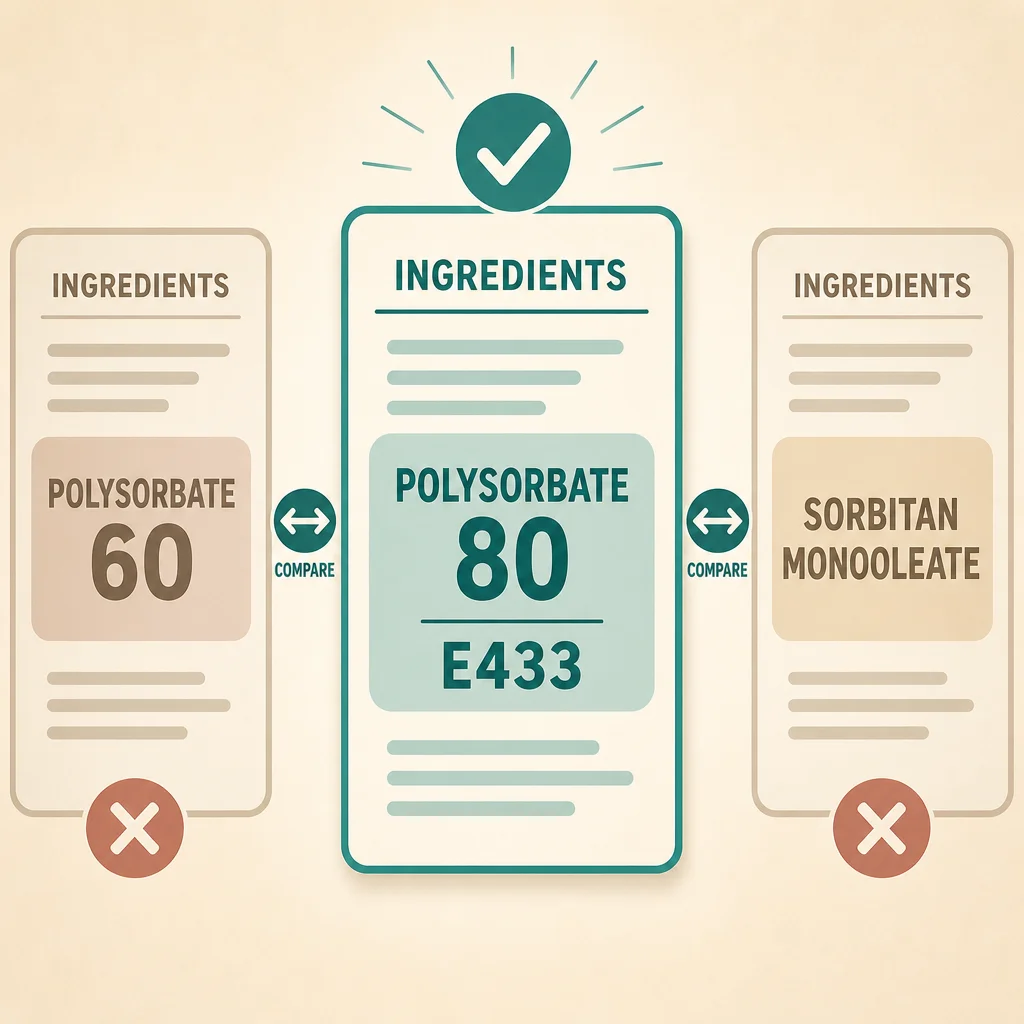
On a U.S. packaged food, start by searching for polysorbate 80. Under 21 CFR 101.4, ingredients generally must be listed by their common or usual names. On an imported label, search for both the name and E433.
Do not shorten your rule to the word polysorbate if you need to distinguish members of the family. Polysorbate 20, 40, 60, 65, and 80 are related but not interchangeable names for one ingredient.
Why It Appears in These Foods
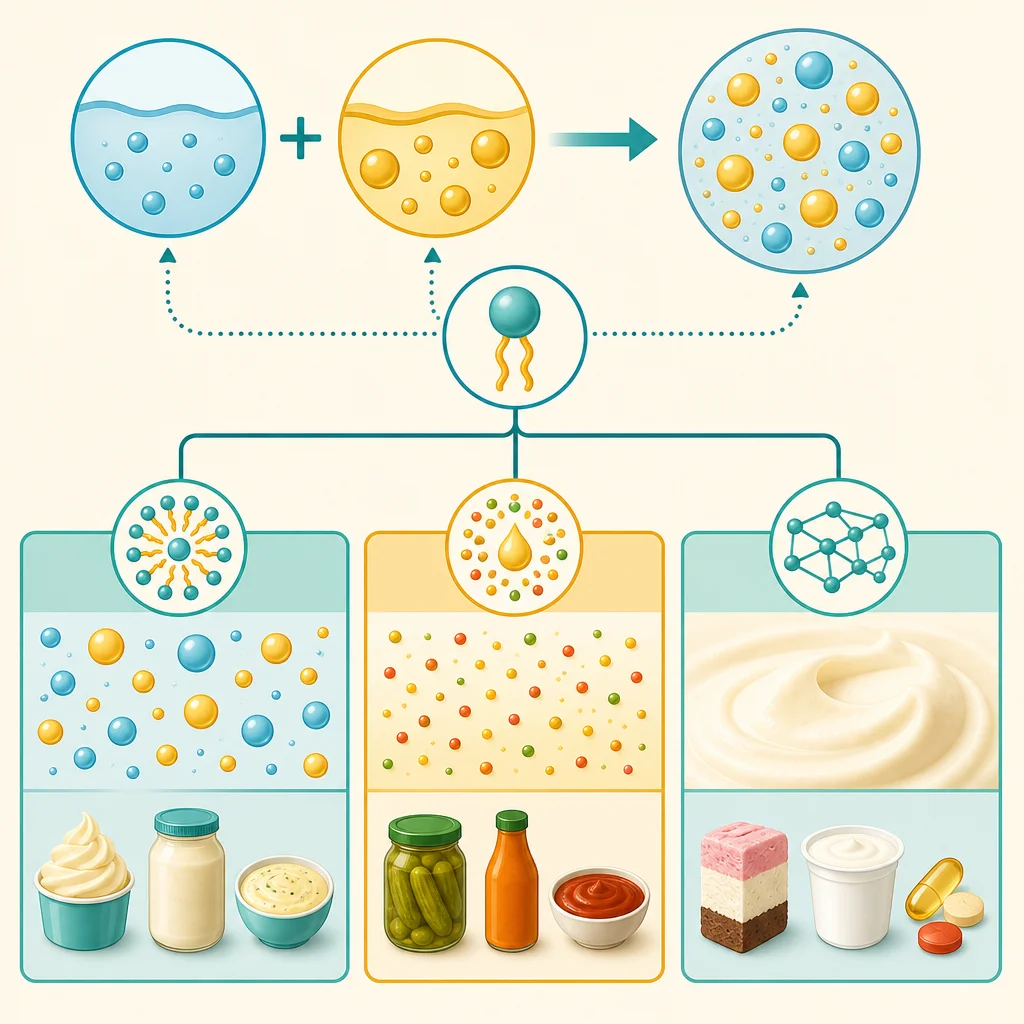
Polysorbate 80 is a surfactant and emulsifier. In plain language, part of the molecule interacts well with water and another part interacts well with oils. That property helps manufacturers keep a mixture uniform or distribute a small amount of an oily substance through a water-based food.
Its job changes with the product:
- in frozen desserts, it helps manage the fat-water mixture and finished texture;
- in pickles, it can help oils and flavor components disperse;
- in gelatin mixes, it acts as a dispersing agent;
- in whipped toppings, it supports the emulsified structure;
- in vitamin preparations, it can help disperse fat-soluble components;
- in barbecue sauce, it can help wet and disperse colors.
The ingredient's function does not tell you how nutritious the whole product is. A frozen dessert can contain polysorbate 80 and have a very different nutrition profile from a vitamin preparation that uses it for a technical reason.
Frozen Desserts
Frozen desserts are the most recognizable category. The current U.S. rule for polysorbate 80 specifically covers ice cream, frozen custard, ice milk, fruit sherbet, and nonstandardized frozen desserts.
Under 21 CFR 172.840, polysorbate 80 may be used alone or with polysorbate 65 in those products, with a combined maximum of 0.1 percent of the finished frozen dessert. The same regulation lists different conditions for other uses.
When comparing frozen desserts:
- Read the exact flavor's ingredient list. Flavor-specific inclusions can change the formula.
- Check parenthetical sub-ingredients in swirls, cookie pieces, and toppings.
- Compare another flavor or brand instead of assuming the entire freezer case is the same.
- Recheck after a package redesign because a new label can accompany a reformulation.
Do not use front-of-package phrases such as premium, natural, or simple as substitutes for the ingredient list. Those words do not answer whether polysorbate 80 is present.
Whipped Toppings, Oils, and Shortenings
The federal rule also lists whipped edible-oil topping and certain shortenings or edible oils. In these products, polysorbate 80 can help keep an oil-and-water system stable.
Check:
- refrigerated and frozen whipped toppings;
- shelf-stable dessert toppings;
- specialty shortenings;
- emulsified oil products;
- baking, dessert, or beverage mixes that include a prepared fat system.
Compound ingredients matter here. A cake mix may not show polysorbate 80 as a top-level ingredient, but a topping, flavor preparation, or oil-based sub-ingredient could list it inside parentheses. Read the full declaration before deciding.
Pickles, Sauces, and Gelatin Desserts
Polysorbate 80 can also be used as a solubilizing or dispersing agent in pickles and pickle products. The rule permits it in canned spiced green beans for dispersing dill oil and in barbecue sauce for wetting and dispersing natural or artificial colors.
For these products, check the ingredient panel when you see:
- flavored or seasoned pickles;
- pickle relishes and specialty pickle products;
- sauces with suspended oil-soluble flavors or colors;
- gelatin desserts and dry gelatin mixes;
- canned vegetables with added spice oils.
Again, permission is not the same as universal use. Plain pickles may use a short list of cucumbers, water, vinegar, salt, and spices. A flavored version may have a more complex dispersing system. Compare actual labels.
Vitamins and Specialty Dietary Products
The same U.S. regulation describes limited uses in vitamin and vitamin-mineral preparations, including products with fat-soluble vitamins or calcium caseinate. It also permits polysorbate 80 as an emulsifier for edible fats and oils in special dietary foods under specified daily-use directions.
For a supplement, look below the Supplement Facts panel in the Other ingredients list. Search for:
- polysorbate 80;
- E433 on imported products;
- other emulsifiers if your personal rule covers the whole category.
A supplement's active ingredients and inactive ingredients answer different questions. Finding polysorbate 80 does not change the labeled amount of a vitamin, but it may matter to someone following a clinician-directed excipient restriction or a personal emulsifier-avoidance preference.
What About Packaged Bread, Coffee Creamer, and Salad Dressing?
Online lists often name many more categories than the direct U.S. rule does. Some may reflect products sold in other countries, historical formulations, ingredients carried through from a component, or confusion with polysorbate 60.
That is why this guide does not claim that every coffee creamer, salad dressing, bread, or sauce contains polysorbate 80. They may still deserve a check, especially when the product needs an emulsifier, but the current label decides.
Use a three-level confidence system:
- Confirmed: the current ingredient list names polysorbate 80 or E433.
- Worth checking: the food category commonly uses emulsifiers, but you have not verified this product.
- Not established: a search result or old database names the product without a current package or manufacturer ingredient list.
This keeps a useful category clue from becoming a false product claim.
What the Safety Evidence Can and Cannot Tell You
Regulators have evaluated polysorbates as food additives, while researchers continue to study how emulsifiers may interact with the gut. Laboratory, animal, and controlled-feeding studies answer important questions, but they do not prove that a single packaged food causes a specific symptom in a specific person.
The gut-focused evidence includes animal research and human experimental work. Study design, dose, exposure pattern, and the rest of the diet all matter. The practical response is to keep the claims proportional, follow medical advice for symptoms, and avoid using a product category as a diagnosis.
For a fuller explanation of those studies and the regulatory context, read what Polysorbate 80 may do to the gut. This page deliberately stays focused on the different question: where should you look, and how do you verify the label?