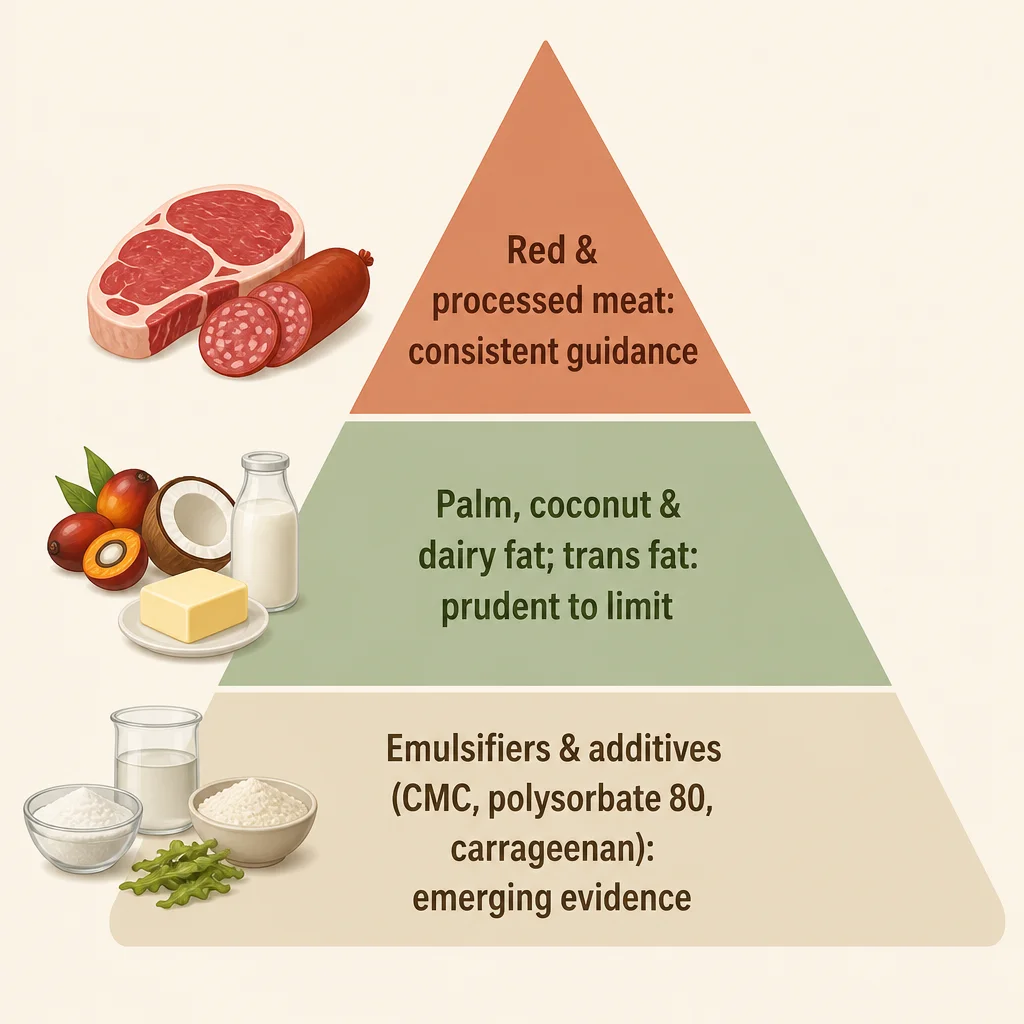
Putting the three documents together gives you a list with three tiers of confidence.
Tier 1: Red and processed meat
This is the one recommendation all three bodies share. The strongest human data come from a prospective cohort study published in Gut in 2004, which followed people with UC in remission for a year. Those who ate the most meat, especially red and processed meat, and those who drank the most alcohol were more likely to relapse. The authors suspected sulfur compounds in these foods, which gut bacteria convert into hydrogen sulfide, a gas toxic to the cells lining the colon.
Processed meat is worth singling out because it often adds more than meat. Bacon, ham, salami, hot dogs, and deli meats are usually cured with sodium nitrite (E250) or potassium nitrate (E252). In the UK and EU, sausages and burger meat may also contain sulphites (E220 to E228).
Tier 2: Saturated and trans fats
IOIBD singles out myristic acid, found in:
- Coconut oil and coconut cream
- Palm kernel oil (palm oil itself contains only small amounts, but the two are often blended)
- Butter, cream, ghee, and full-fat dairy fat
- Fat from grain-fed meat
Trans fats are mostly gone from US foods since the FDA ruled that partially hydrogenated oils are no longer "generally recognized as safe," and the EU caps industrial trans fat at 2 grams per 100 grams of fat. They still turn up in some imported products and older formulations, labeled as partially hydrogenated oil.
Note what is not on this list: dairy as a whole. Neither IOIBD nor ECCO recommends cutting out milk, yogurt, or cheese for UC. If dairy bothers you, lactose intolerance is a more likely cause than the colitis itself, and lactose-free products are the simpler fix. Our lactose intolerance guide covers how to tell the two apart on a label.
Tier 3: Emulsifiers and other additives (emerging evidence)
This is where most of the online lists come from, and where the evidence is thinnest. The Crohn's & Colitis Foundation groups these under "emerging evidence suggests [they] may play a role in inflammation (although more research is needed)":
- Carboxymethylcellulose (cellulose gum, E466)
- Polysorbate-80 (E433)
- Carrageenan (E407, E407a)
- Maltodextrin
- Titanium dioxide (E171)
- Sulfites (E220 to E228)
- Guar gum (E412)
- Sucralose (E955) and saccharin (E954)
The best human evidence so far is for carboxymethylcellulose. A randomized controlled-feeding study in Gastroenterology gave healthy adults an additive-free diet with or without CMC for 11 days. CMC reduced bacterial diversity, lowered beneficial short-chain fatty acids, and in a few participants allowed bacteria to press into the protective mucus layer of the colon. That is a mechanism worth taking seriously, but it was a short study in people without IBD.
Titanium dioxide shows how regulators can disagree on the same data. The EU banned E171 as a food additive in 2022 after EFSA could not rule out genotoxicity. In the US, the FDA still allows it as a color additive at up to 1% of a food's weight, most often in candy coatings, frosting, and white-colored gum.
We cover several of these additives in depth: cellulose gum, polysorbate 80, carrageenan, maltodextrin, and titanium dioxide.