Dietary Guides

SCD Dietary Guide: Disaccharides, Starch, Additives, and Hidden Complex Carbohydrates on Labels

An encyclopedic guide to the Specific Carbohydrate Diet covering the science behind removing disaccharides and complex carbs, illegal SCD additives (starch, carrageenan, xanthan gum), hidden sucrose in processed foods, label reading for IBD and Crohn's patients, and the 24-hour fermented yogurt requirement.

Jun 11, 2026|12 min read
By Sanket Patel|Updated 2026-06-11|6 sources|Editorial standards
SCD Dietary Guide: Disaccharides, Starch, Additives, and Hidden Complex Carbohydrates on Labels

What Is the Specific Carbohydrate Diet?

The Specific Carbohydrate Diet was developed by biochemist Elaine Gottschall, who built on earlier work by pediatric gastroenterologist Sidney Haas. Haas had observed in the 1920s that certain children with severe intestinal conditions recovered when complex carbohydrates were removed from their diets. Gottschall systematized and popularized this approach in her 1994 book, and the SCD has since gathered a substantial following among people with inflammatory bowel disease (IBD), including Crohn's disease and ulcerative colitis, as well as irritable bowel syndrome (IBS) and celiac disease.

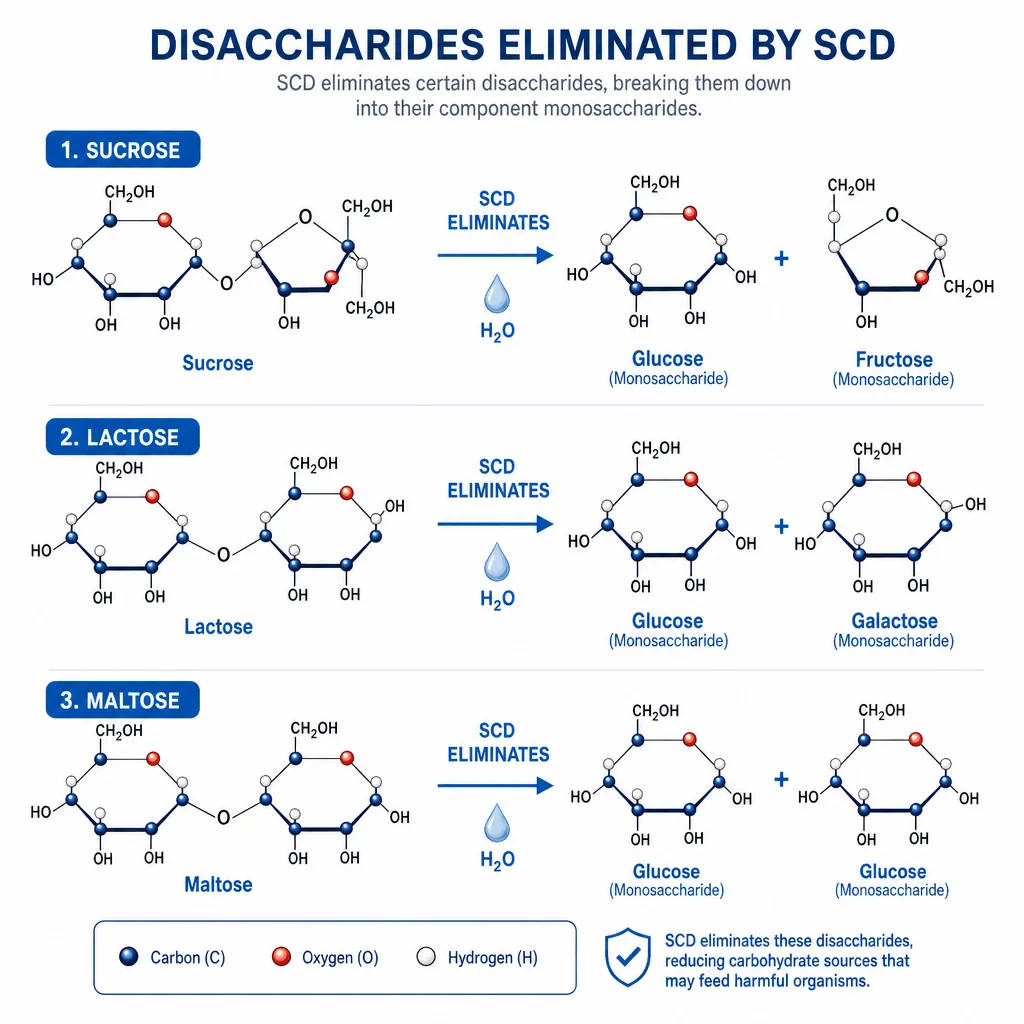
The core scientific premise of SCD is the "gut flora hypothesis." According to this framework, certain carbohydrates, specifically disaccharides (two-sugar molecules) and polysaccharides (complex chains of sugars), cannot be fully digested and absorbed by a compromised intestinal lining. When these carbohydrates pass undigested into the colon, they feed harmful bacteria and yeast. The resulting microbial overgrowth produces acids and gases that damage the intestinal lining further, impairing the production of disaccharidase enzymes (such as sucrase and lactase), which are needed to digest those very carbohydrates. This creates a self-reinforcing cycle of intestinal injury.

By restricting the diet to monosaccharides (single-sugar molecules like glucose, fructose, and galactose), the theory holds that the substrate for harmful fermentation is removed. The gut microbiome can then rebalance, intestinal inflammation subsides, and the mucosa has the opportunity to heal. Research published in journals including Gastroenterology and Inflammatory Bowel Diseases has shown promising clinical remission rates in pediatric and adult Crohn's patients, though larger randomized controlled trials are still ongoing.

The Crohn's and Colitis Foundation recognizes SCD as a structured dietary therapy worthy of investigation and has been involved in funding research such as the PRODUCE trial, which compared SCD against the Mediterranean-style diet in children with Crohn's disease.
What the Specific Carbohydrate Diet Actually Bans

SCD uses the terminology "legal" and "illegal" to describe foods. Understanding these categories at the ingredient level is what separates successful adherence from accidental violations.

All grains and grain-derived ingredients are illegal. This includes wheat, rye, barley, oats, corn, rice, millet, buckwheat, amaranth, quinoa, and teff. It also includes every processed form of these grains: flour of any kind (wheat flour, rice flour, corn flour, oat flour), bran, germ, semolina, bulgur, farro, and spelt. Pseudograins like quinoa and buckwheat, which are often considered safe on other diets, are not permitted on SCD.

All starchy vegetables are removed. Potatoes (white and sweet), yams, parsnips, chickpeas, soybeans, and bean sprouts from starchy legumes are all illegal. Most commercial-grade starchy tubers cause problems even when processed, because their starch content survives cooking and digestion in a form that fuels bacterial overgrowth.

Canned vegetables with additives present a particular challenge. Plain canned tomatoes with no additives listed may be legal, but most commercial canned vegetables contain starch, calcium chloride (generally acceptable), citric acid (legal), or modified starch (illegal). Any canned product that lists starch, modified food starch, cornstarch, or similar ingredients as a thickener or stabilizer is off-limits.

Sugar and most sweeteners are illegal with specific, narrow exceptions. Sucrose (table sugar) is a disaccharide and is strictly prohibited. Maltose, a disaccharide formed from two glucose units, is prohibited. Lactose, the milk sugar, is prohibited. Isomaltose, used as a sweetener in some confectionery and protein bars, is prohibited. High-fructose corn syrup is prohibited. The only legal sweeteners on SCD are honey (which contains primarily monosaccharides glucose and fructose), saccharin, and very limited quantities of dry cider with no added sugar.

Most dairy products are restricted because lactose is a disaccharide. Fresh milk, condensed milk, evaporated milk, cream cheese that contains starches, and yogurt fermented for fewer than 24 hours are all illegal. The 24-hour fermentation requirement for yogurt is one of SCD's most distinctive and specific rules: when yogurt is fermented for a full 24 hours, the bacteria consume virtually all the lactose, converting it to lactic acid. Commercial yogurt, including most probiotic yogurts sold at health food stores, is fermented for only 4 to 8 hours and retains substantial residual lactose.

Certain legumes are restricted. Chickpeas, soybeans, bean sprouts, and fava beans are illegal. However, navy beans, lentils, split peas, lima beans, and several other legumes are considered legal after proper soaking and cooking, with initial dietary introduction deferred until the gut has stabilized.

Processed meats and deli meats are typically illegal because commercial preparations almost universally include starch fillers, dextrose as a curing agent (dextrose itself is a legal monosaccharide, so pure dextrose additions are technically acceptable), or modified food starch as a binder.

All commercially prepared condiments, sauces, and dressings are presumed illegal unless verified. Ketchup contains sucrose. Barbecue sauce contains both sucrose and starch thickeners. Soy sauce contains wheat. Most commercial salad dressings contain xanthan gum, modified starch, or sugar.

Alcohol is restricted to dry wine and dry cider with no added sugar. Beer, spirits aged in grain barrels, and liqueurs are all illegal.

The Hidden Ingredient Problem

The Hidden Ingredient Problem

This is where SCD adherence becomes genuinely difficult. The problem is not only knowing which categories of food to avoid but recognizing the specific names these banned substances carry on ingredient lists.

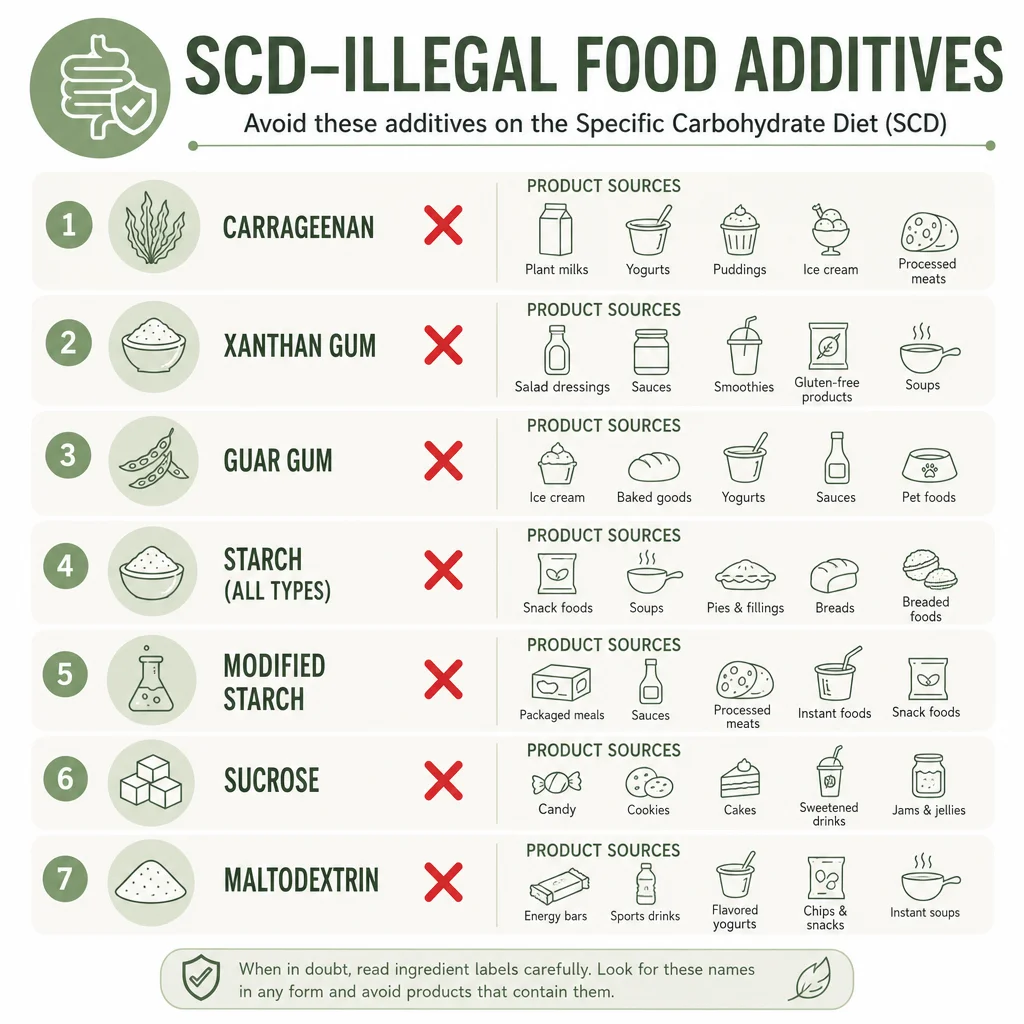
Starch and its many names is the single most pervasive hidden ingredient for SCD followers. Cornstarch appears as a thickener in gravies, cream sauces, pie fillings, and many canned soups. Modified food starch and modified corn starch appear in nearly every processed food product as a texture stabilizer. Potato starch is common in gluten-free products, which may look safe to SCD followers shopping in the free-from aisle but are frequently non-compliant. Tapioca starch (also labeled tapioca flour or cassava starch) appears in paleo crackers, grain-free tortillas, and dairy-free cheese alternatives. Arrowroot powder is used as a thickener in "natural" and organic product lines. Wheat starch, rice starch, and pea starch round out the list. Any ingredient containing the word "starch" or ending in "-starch" is illegal on SCD, without exception.

Carrageenan is extracted from red seaweed and used as a thickener and emulsifier. It appears in commercial dairy products including cottage cheese, sour cream, heavy cream, and plant-based milks. It is also common in deli turkey and chicken slices as a moisture-retaining binder, in chocolate milk, in infant formula, and in many yogurts. Carrageenan is strictly illegal on SCD.

Xanthan gum is produced by bacterial fermentation of carbohydrates. It is the most common thickener and stabilizer in gluten-free and grain-free product lines. Xanthan gum appears in gluten-free bread, grain-free pizza crusts, many nut-milk products, salad dressings, sauces, ice cream, and low-calorie or zero-sugar products. Because xanthan gum is such a standard ingredient in foods marketed to people avoiding gluten or grains, SCD followers who use the gluten-free aisle as a shortcut will regularly encounter it.

Guar gum is derived from guar beans and serves a similar stabilizing role to xanthan gum. It appears in ice cream, canned legumes, sauces, gluten-free baked goods, and fiber supplements. Carob bean gum (also called locust bean gum) is used in hard cheeses, ice cream, and meat products. Both are illegal on SCD.

Sucrose in disguise is another major issue. Sucrose appears not only as "sugar" but as "cane sugar," "evaporated cane juice," "organic cane sugar," "raw cane sugar," "beet sugar," "turbinado sugar," "demerara sugar," "coconut sugar," and "palm sugar." All of these are sucrose or contain sucrose as the primary component and are therefore illegal. "Natural sweeteners" on a label should trigger scrutiny: this phrase legally covers a wide range of substances including sucrose-containing syrups. Date syrup and maple syrup, while often promoted as natural alternatives, contain sucrose and are not permitted.

Dextrose vs. sucrose is one of the more nuanced distinctions for label readers. Dextrose is simply another name for glucose, a monosaccharide. Dextrose added to processed meats as a curing agent is technically legal in the context of SCD rules, because it is a monosaccharide. However, the same product may contain both dextrose and modified food starch or carrageenan, making it illegal on other grounds. Never assume that a product is legal simply because the sweetener used is dextrose.

Lactose in non-dairy products catches many followers off guard. Lactose is used as a filler in pharmaceutical tablets, protein powders, and some vitamin supplements. Whey powder added to baked goods or protein bars contains lactose unless it is whey protein isolate (which has minimal residual lactose). Non-dairy creamers often contain caseinate and other dairy fractions alongside vegetable oils and starch thickeners.

Yeast extract and autolyzed yeast appear in Worcestershire sauce, bouillon cubes, stock powders, canned soups, flavored snack chips, and savory crackers as umami flavor enhancers. Commercial Worcestershire sauce also typically contains malt vinegar (from barley) and tamarind concentrate with added sugar. Almost no commercial Worcestershire sauce is SCD-legal.

Soy in its many forms presents a problem because soybeans are illegal on SCD. Soy lecithin, soybean oil, soy protein isolate, hydrolyzed soy protein, and textured soy protein (TVP) all appear across categories including chocolate, protein bars, cooking sprays, and margarines.

US vs EU Labeling: What's Different

US vs EU Labeling: What's Different

For SCD followers purchasing food on both sides of the Atlantic, label-reading rules differ in ways that matter practically.

In the United States, the FDA requires all ingredients to be listed by their common or usual name in descending order of predominance by weight. "Modified food starch" may appear without specification of the source grain, meaning a US label cannot distinguish cornstarch-derived modified starch from wheat-derived modified starch. Consumers with both SCD and celiac concerns cannot assume a modified food starch is gluten-free from the label alone. The FDA does not require declaration of carrageenan, xanthan gum, or guar gum as allergens; they appear simply within the ingredient list.

In the European Union, food labeling is governed by Regulation (EU) No 1169/2011. The EU requires that the source of starch be declared when it is derived from one of the 14 major allergens (including wheat). This means a product in the EU will list "modified wheat starch" rather than simply "modified starch" if wheat is the source. This is more useful for SCD followers who are also managing gluten sensitivity, but it does not affect identification of non-wheat starches, which may still appear generically as "maize starch," "rice starch," or "potato starch."

The EU also uses E-numbers for approved food additives. Carrageenan is E407. Xanthan gum is E415. Guar gum is E412. Locust bean gum is E410. These E-numbers appear in place of common names on many EU products. An SCD follower who does not know that E407 is carrageenan or that E415 is xanthan gum may inadvertently consume these additives.

The EU additionally restricts the use of carrageenan in infant formula, where it is not permitted, while the US FDA had previously reviewed but not banned its use in infant formula. Regulatory divergence around carrageenan is ongoing, and SCD followers should not assume that a product approved for use in one market is necessarily free of this additive.

In both markets, "natural flavors" (US) and "natural flavourings" (EU) can legally contain a wide range of substances without specific disclosure. For SCD followers, the risk is relatively low with natural flavors used in small quantities, but products that list it prominently or early in the ingredient list warrant closer inspection.

A Practical Label-Reading Strategy

A Practical Label-Reading Strategy

Strictly Avoid

Any of the following terms in an ingredient list makes a product non-compliant, regardless of any other claims on the packaging:

  • Any form of starch: cornstarch, modified food starch, modified corn starch, modified starch, potato starch, tapioca starch, tapioca flour, arrowroot, rice starch, wheat starch, pea starch, cassava starch, or simply "starch"
  • Carrageenan (E407) or Irish moss
  • Xanthan gum (E415)
  • Guar gum (E412)
  • Locust bean gum / carob bean gum (E410)
  • Sucrose, cane sugar, evaporated cane juice, organic cane sugar, beet sugar, turbinado, demerara, coconut sugar, palm sugar, maple syrup, date syrup, molasses
  • Maltose, lactose, isomaltose, high-fructose corn syrup
  • Soy flour, soy protein, textured soy protein, soybean, soy lecithin (from illegal soybean source)
  • Any grain flour: wheat flour, rice flour, oat flour, corn flour, millet flour, rye flour, spelt flour
  • Malt, malt extract, malt vinegar, barley malt
  • Canned vegetables (in brine or sauce)
  • Commercial yogurt
  • Nut milks (commercial)
  • Spice blends and seasoning mixes

Generally Safe

These ingredients, when appearing without accompanying illegal additives, are typically compliant with SCD rules:

  • Honey (as sweetener in small amounts)
  • Pure fruit juice with no added sugar (fructose content is a monosaccharide)
  • Olive oil, coconut oil, avocado oil, ghee, butter without additives
  • Citric acid (a natural preservative, not a carbohydrate)
  • Lactic acid and acetic acid (fermentation acids, not carbohydrates)
  • Gelatin (from pork or beef, no additives)
  • Apple cider vinegar and white wine vinegar
  • Pure cocoa powder without sugar or starch (check labels carefully)
  • Sea salt, mineral salt
  • Pure spices (single-ingredient, not blended with starch)
  • Natural flavors / natural flavourings
  • Dextrose
  • Whey protein isolate

Ignore on Labels

Some terms on labels create confusion for SCD followers but do not actually affect compliance:

  • "Gluten-free" (does not mean SCD-compliant; most gluten-free products use starch and gum substitutes)
  • "Grain-free" (does not preclude tapioca starch, arrowroot, or xanthan gum)
  • "Natural" (no regulatory definition that maps to SCD rules)
  • "No added sugar" (the product may still contain lactose or maltose naturally)
  • "Organic" (certification addresses farming practices, not carbohydrate structure)
  • Fiber content declarations (dietary fiber on nutrition panels does not indicate whether soluble fiber-based additives are present)
  • "Probiotic" on yogurt labels (does not indicate 24-hour fermentation)

Managing SCD compliance across hundreds of packaged food categories is a task that genuinely benefits from automated ingredient analysis. IngrediCheck scans food labels and cross-references ingredient lists against diet-specific rules, flagging illegal additives by their common names, E-numbers, and alternate synonyms in real time. For those who are simultaneously managing celiac disease alongside SCD, where grains and starch both independently pose threats, the overlap in restricted ingredients makes manual label reading doubly time-consuming. IngrediCheck handles that cross-referencing automatically, making it a practical tool for anyone maintaining a medically motivated diet in a food environment that was not designed with those restrictions in mind.

Next Label Check

Follow the scanner, hub, and ingredient paths connected to this guide

Get the app for clearer label decisions.

Scan labels, see what fits your food notes, and read the why in plain English.

IngrediCheck app