Seed Oils: Separating Science from the MAHA Panic

Are seed oils actually toxic? We break down the MAHA claims against the clinical evidence from Harvard, Johns Hopkins, and 30+ RCTs. What's real, what's not.

Mar 17, 2026|11 min read
Seed Oils: Separating Science from the MAHA Panic

If you've spent any time on social media recently — or consumed any health content at all — you've encountered some version of the claim: seed oils are poison. They cause inflammation. They drive obesity. They are a pillar of a failing food system, and you should throw out your canola oil immediately and replace it with beef tallow.

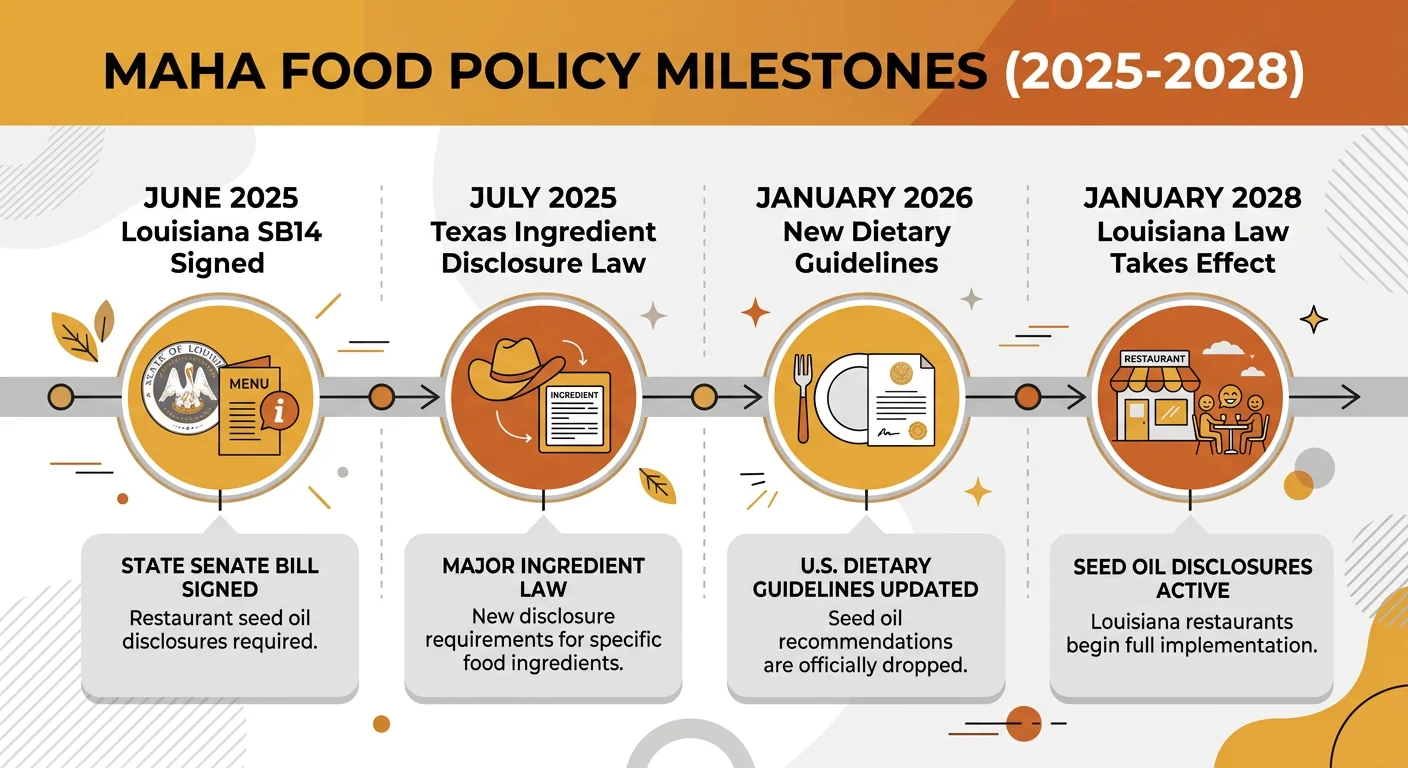
This argument has moved from wellness influencer circles into federal health policy. RFK Jr., now serving as HHS Secretary, has called seed oils a driver of the chronic disease epidemic. The 2025–2030 Dietary Guidelines, released in January 2026, quietly dropped explicit recommendations for seed oils for the first time in decades. Louisiana passed a law in 2025 requiring restaurant menus to disclose when seed oils are used in cooking.

So: are seed oils actually toxic? Or is this a case of a legitimate nutritional nuance — blown into a sweeping health panic by a combination of social media, political momentum, and genuine frustration with a food system that has failed a lot of people?

The answer matters, because the evidence has real implications for what you eat, what you avoid, and what you should actually be worried about.

This article is for informational purposes only and should not be considered medical advice. Consult a healthcare professional for personalized guidance.
The "Hateful Eight" and How We Got Here

The anti-seed-oil movement didn't start with RFK Jr. The framework was largely built by Dr. Cate Shanahan, a physician and author of Dark Calories, who coined the term "Hateful Eight" to describe the oils she believes are at the root of modern metabolic disease: canola, corn, cottonseed, soybean, sunflower, safflower, grapeseed, and rice bran oil.

Shanahan's critique dates to 2002. The core of her argument is that these are industrial oils — extracted using high heat, pressure, and in some cases the solvent hexane — that are high in omega-6 polyunsaturated fatty acids (PUFAs), particularly linoleic acid. The MAHA movement adopted this framing wholesale.

The hexane argument is the easiest to dispatch. A federal toxicology report published in April 2025 reviewed hexane residues in finished seed oil products and concluded the amounts present were "toxicologically insignificant." Processing methods matter, but what reaches your bottle doesn't carry meaningful hexane risk.

The linoleic acid argument takes more unpacking — and that's where the bulk of the scientific debate lives.

The Inflammation Claim: What the Trials Actually Show

The most frequently cited mechanism behind seed oil harm is this: linoleic acid (omega-6) converts in the body to arachidonic acid, which produces pro-inflammatory signaling compounds called eicosanoids. Therefore, eating a lot of omega-6 drives chronic inflammation, which drives chronic disease.

It's a plausible-sounding pathway. The problem is that when researchers have tested it in humans, it doesn't hold up.

A systematic review of 15 randomized controlled trials published in the Journal of the Academy of Nutrition and Dietetics found that increasing dietary linoleic acid did not significantly raise concentrations of any major inflammatory markers — not CRP, not fibrinogen, not TNF-α, not cytokines. The review's conclusion was unambiguous: "Virtually no evidence is available from randomized, controlled intervention studies to show that addition of linoleic acid to the diet increases the concentration of inflammatory markers."

A separate meta-analysis of 30 RCTs involving 1,377 subjects confirmed this finding: "Increasing dietary LA intake does not have a significant effect on the blood concentrations of inflammatory markers."

Then, in June 2025, a study analyzing blood markers from nearly 1,900 people flipped the script entirely. Researchers found that higher linoleic acid levels were associated with lower inflammation and better cardiometabolic outcomes — not higher.

The reason the theoretical pathway doesn't manifest is partly mechanistic: dietary linoleic acid does not meaningfully raise arachidonic acid tissue levels in practice. The body tightly regulates this conversion. Eating more omega-6 does not translate linearly into more pro-inflammatory signaling.

The inflammation claim is the loudest charge against seed oils. The clinical evidence doesn't support it.

The Cardiovascular Evidence: Decades of Data

The Cardiovascular Evidence: Decades of Data

On cardiovascular outcomes, the picture for seed oils is consistently positive when they replace saturated fats in the diet.

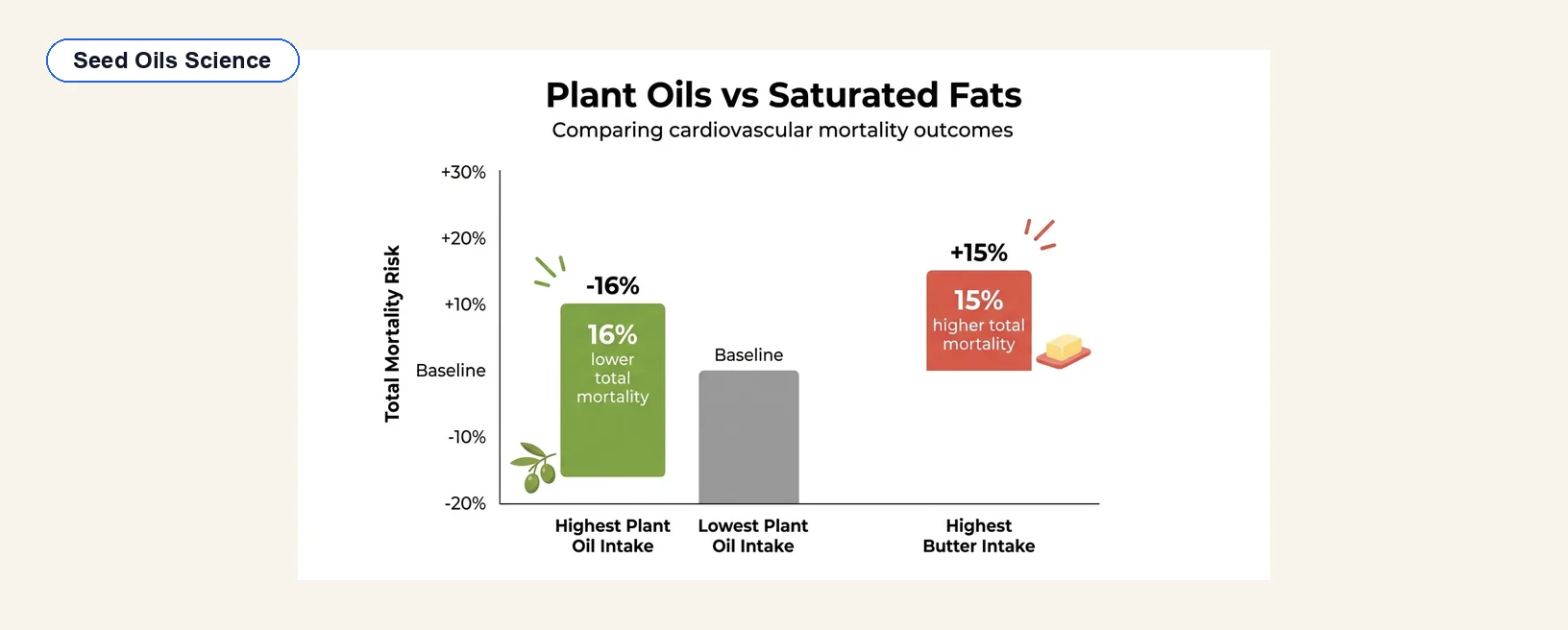
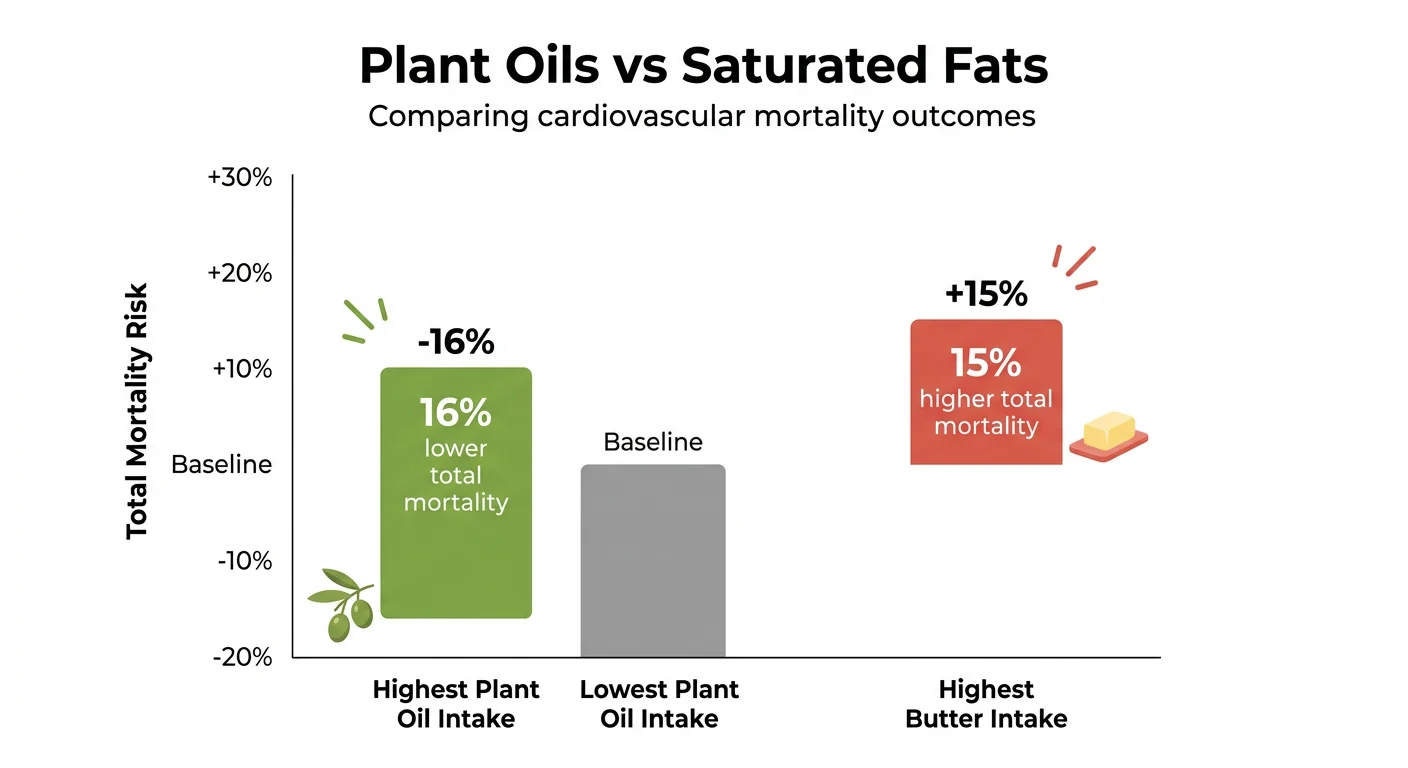
A Harvard meta-analysis of 38 studies covering more than 810,000 people found that those with the highest linoleic acid intake had 13% lower all-cause mortality and 13% lower cardiovascular mortality compared to those with the lowest intake. A large 2025 cohort study found that those with the highest total plant oil consumption had a 16% lower total mortality vs. those with the lowest — while those with the highest butter intake had a 15% higher total mortality.

Johns Hopkins Bloomberg School of Public Health summarized the consensus in 2025: "The fatty acids typical in seed oils — like linoleic acid — are associated with lower risk of chronic diseases like cardiovascular disease, heart attack, strokes and diabetes."

The American Heart Association, reviewing the full body of evidence in August 2024, put it plainly: "There's no reason to avoid seed oils and plenty of reasons to eat them."

None of this means seed oils are a health food in their own right. But the claim that they drive disease is not supported by the population-level and controlled trial data.

Where Critics Have a Real Point: Oxidation and Heat

Not every concern raised by seed oil critics is baseless. There's one area where the science does support caution: high-heat and repeated-use cooking.

Polyunsaturated fatty acids are chemically less stable than saturated or monounsaturated fats. When oils high in PUFAs are subjected to prolonged high heat — as in commercial deep fryers where oil is reused over many hours or days — they can oxidize and produce aldehydes and lipid peroxides, compounds that are genuinely harmful.

The Cleveland Clinic acknowledges this concern directly, but adds important context: this risk is primarily associated with commercial and industrial settings, not typical home cooking. At home, oil is rarely heated repeatedly or to the extreme temperatures of industrial fryers.

If you're concerned about oxidation:

  • Use oils high in monounsaturated fat (olive oil, avocado oil, high-oleic sunflower oil) for high-heat cooking
  • Don't reuse cooking oil repeatedly
  • Avoid fried foods from restaurants that reuse fry oil heavily

This is a legitimate, evidence-based refinement to how you use seed oils. It is not evidence that seed oils are toxic.

The Ultra-Processed Food Conflation

Here's the most important analytical error in the seed oil debate: confusing correlation with causation in the context of ultra-processed foods.

Seed oils are present in virtually every ultra-processed food — chips, crackers, cookies, fast food, frozen meals, salad dressings. Ultra-processed foods (UPFs) are strongly and consistently associated with poor health outcomes. A review of 45 UPF studies found greater UPF consumption linked to higher risks of cardiovascular disease, metabolic disorders, cancer, and mental health conditions.

But UPFs don't just contain seed oils. They contain refined starches, added sugar, excess sodium, emulsifiers, artificial flavors, and almost no fiber. They're calorie-dense and nutrient-poor. When researchers see that people who eat more UPFs are sicker, the question is: which component is actually driving the harm?

The answer, according to Johns Hopkins researchers in their October 2025 briefing, is that seed oils are not unhealthy on their own. The damage comes from the full package — the food matrix — not from the oil extracted and studied in isolation.

This distinction matters practically. If you stop buying canola oil and start cooking with tallow, but you're still eating chips, frozen meals, and fast food daily, you have not addressed the actual problem. The seed oil in your kitchen is not the issue.

Olive Oil vs. Seed Oils: Not a Competition

Much of the MAHA framing presents a false binary: seed oils bad, butter or tallow good. But the more scientifically accurate comparison is: both olive oil and seed oils outperform saturated animal fats on cardiovascular outcomes in clinical evidence. They are on the same side of the fence.

That said, extra-virgin olive oil does have a more compelling health profile than most seed oils — and it's worth understanding why. EVOO is rich in monounsaturated oleic acid and, uniquely, in a dense array of polyphenols including hydroxytyrosol and oleocanthal, which have anti-inflammatory and antioxidant properties independent of its fat content. The landmark PREDIMED trial showed EVOO specifically reduced heart attacks, strokes, and cardiovascular deaths in high-risk individuals.

The sensible takeaway is not "avoid seed oils." It's "use EVOO when you can, use seed oils when you can't, and avoid saturated fats where possible." These are complementary choices, not competing ones.

The Policy Landscape Is Shifting — Driven by Politics, Not New Data

The Policy Landscape Is Shifting — Driven by Politics, Not New Data

Understanding the regulatory moment matters for consumers trying to make sense of the noise.

Louisiana SB 14, signed June 27, 2025, requires food service establishments that cook with seed oils to display a menu disclaimer: "Some menu items may contain or be prepared using seed oils." The law — which also requires disclosure of food dyes, sweeteners, and 40+ other ingredients — takes effect January 1, 2028. Texas passed similar ingredient disclosure legislation the same month.

The 2025–2030 Dietary Guidelines for Americans, released in January 2026, removed explicit recommendations for seed oils — canola, corn, soybean, and sunflower had previously been named as healthy substitutes for saturated fat. The new guidelines are broadly seen as reflecting the political influence of the MAHA movement on the guidelines process, not a change in the underlying nutritional evidence.

The science did not shift. The policy environment did. Those are different things, and it's important not to mistake one for the other.

What to Actually Do

The seed oil debate has generated enormous heat and relatively little practical light. Here is a summary of what the evidence supports:

Not supported by evidence:

  • Throwing out seed oils and replacing them with butter or tallow
  • Avoiding all foods that contain any seed oil
  • Treating canola, soybean, or sunflower oil as categorically "toxic"

Supported by evidence:

  • Reducing consumption of ultra-processed foods — this is where the real harm lies, regardless of what oil they contain
  • Preferring extra-virgin olive oil for cold applications and moderate-heat cooking, where its polyphenol content can provide added benefit
  • Using high-oleic versions of sunflower or safflower oil for high-heat cooking if you want better heat stability
  • Increasing omega-3 intake (fatty fish, walnuts, flaxseed) — not because omega-6s are bad, but because omega-3s have proven anti-inflammatory benefit and most Western diets are genuinely low in them
  • Not reusing cooking oil repeatedly at high temperatures

The simplest framing: the oil in your kitchen is not the problem. The packaged food in your pantry may be.

How IngrediCheck Helps

While the seed oil debate often focuses on cooking oils themselves, the more relevant concern for most consumers is the seed oils hidden inside ultra-processed foods — the ingredient lists of crackers, frozen meals, sauces, and snacks that list soybean oil, canola oil, or corn oil alongside refined starches, added sugars, and preservatives. IngrediCheck lets you scan any packaged food and immediately see exactly what oils and other ingredients it contains, so you can make an informed decision about whether a product fits your dietary goals — without needing to decode a dense ingredient list by hand.

Start making confident food choices today!

Scan food and understand what's right for you and your family, with AI.

IngrediCheck app