Nitrates in Processed Meat: Are They Causing Cancer?

Processed meat is in IARC's Group 1 carcinogen list alongside tobacco. Here's what that actually means for your risk, and why vegetables are different.

Apr 1, 2026|9 min read
Nitrates in Processed Meat: Are They Causing Cancer?

In 2015, the World Health Organization made headlines by classifying processed meat as a Group 1 carcinogen. The same category as tobacco. The same category as asbestos. Predictably, panic followed.

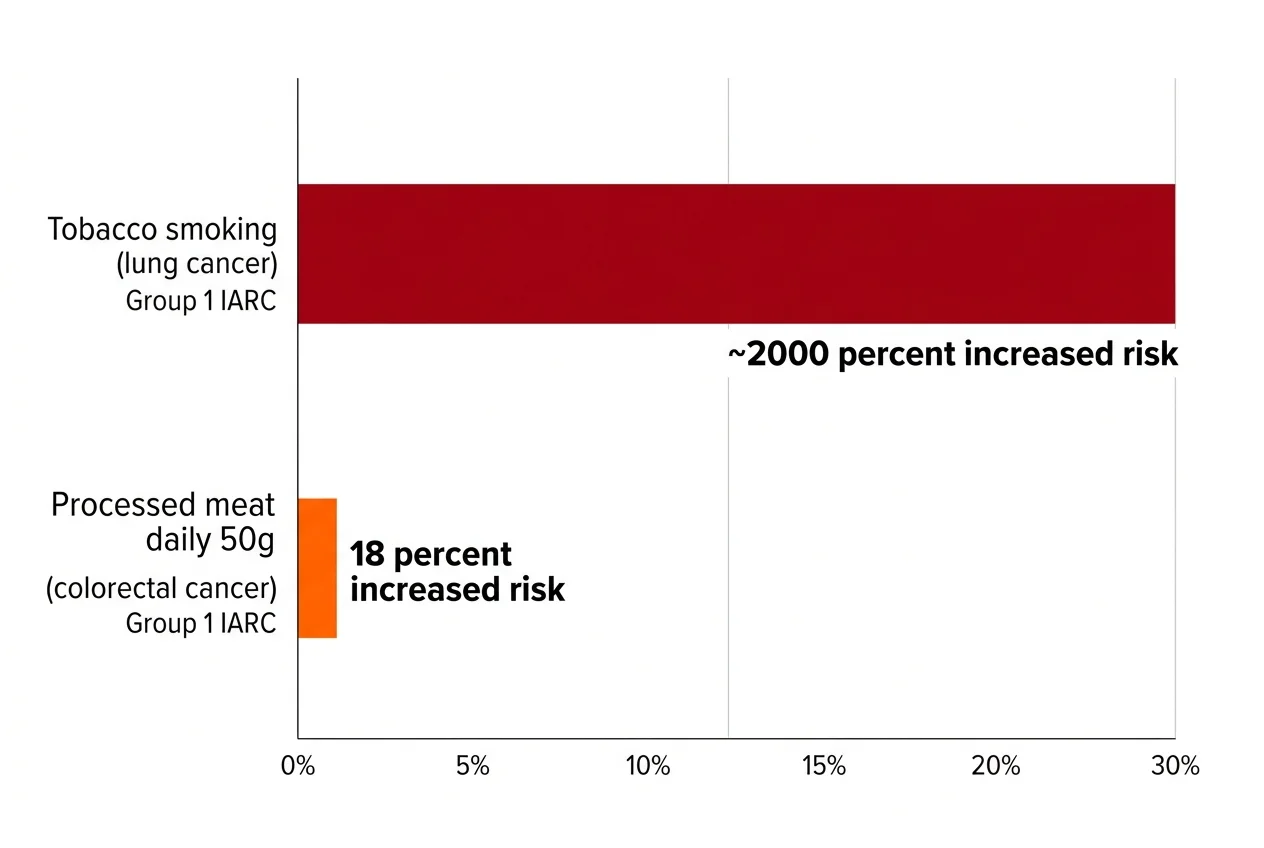
But here's what most of the coverage missed: the Group 1 classification describes the strength of the evidence that something causes cancer, not how dangerous it is relative to other things in the same category. Smoking a pack a day raises your lung cancer risk by around 2,000%. Eating 50 grams of processed meat daily raises your colorectal cancer risk by 18%. Both are in Group 1. They are not the same thing.

The nitrate question is real and worth understanding. But it requires more nuance than a headline can carry.

Why Nitrates and Nitrites Are in Your Processed Meat

Sodium nitrite and sodium nitrate have been used to cure meat for over a century. They do three things: they prevent the growth of Clostridium botulinum, the bacteria that causes botulism; they give cured meats their characteristic pink color; and they extend shelf life by slowing fat oxidation.

Without nitrite curing, the risk of botulism in products like bacon, hot dogs, and cured sausages would be substantially higher. Nitrites, in this context, are a genuine food safety tool. The question isn't whether they should exist in processed meat — it's what happens to them once they're there.

The FDA sets strict limits on residual nitrite levels by product type: 200 ppm for ham and whole-muscle products, 156 ppm for sausage, and 120 ppm for bacon. These limits are enforced by USDA inspection.

How Nitrites Become a Cancer Risk

How Nitrites Become a Cancer Risk

The concern isn't the nitrite molecule itself. The concern is what nitrites can become inside the body.

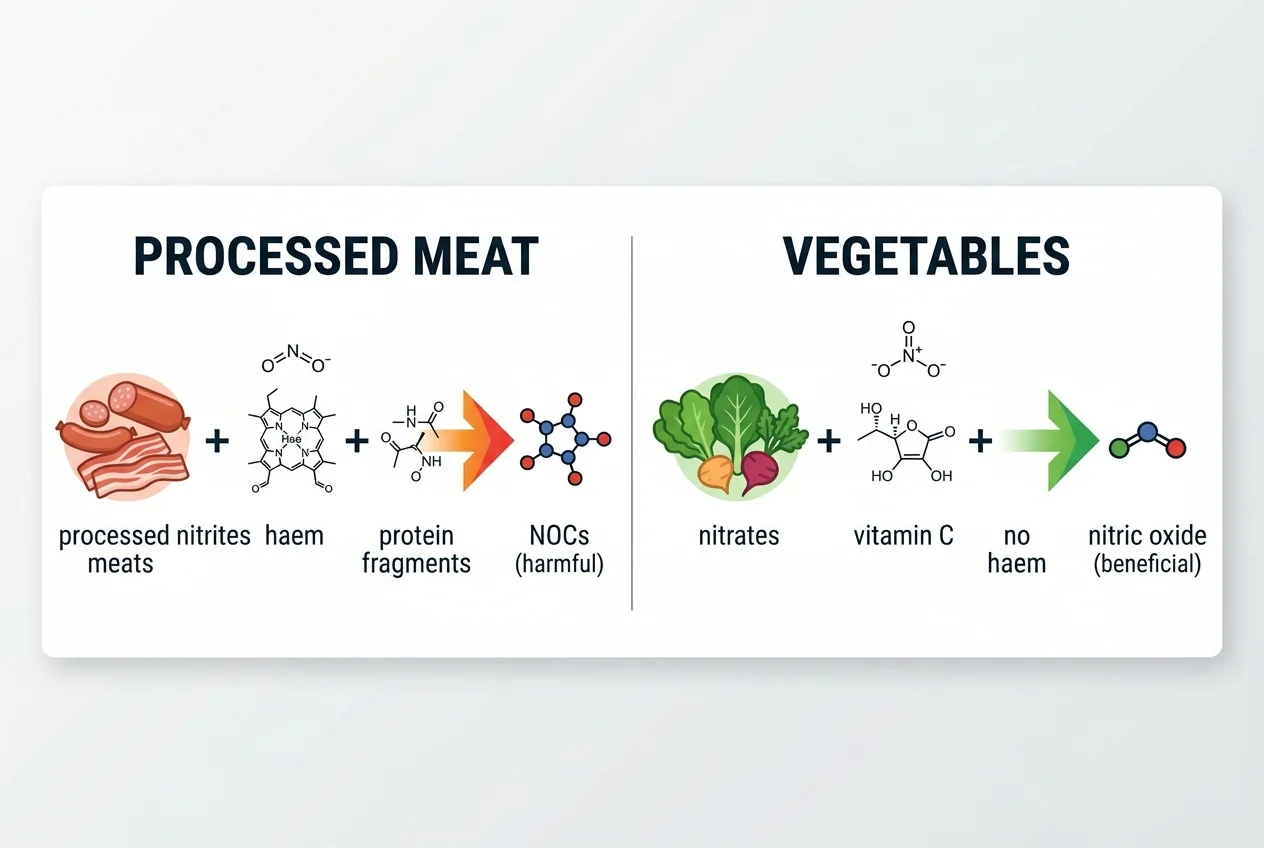
When nitrites encounter the protein fragments produced during digestion of meat, they can react to form compounds called N-nitroso compounds (NOCs), which include nitrosamines. Many NOCs are classified as probable or confirmed carcinogens. High-heat cooking — particularly frying or grilling — accelerates this process, as the heat promotes nitrosamine formation directly in the meat before it's eaten.

The cancer most consistently linked to this pathway is colorectal cancer. Research published in PMC found that among studies examining nitrite-treated processed meats specifically, 65% showed evidence of a link with colorectal cancer. That's a meaningful signal, even accounting for the complexity of dietary research.

There's a second mechanism worth knowing about. Meat is rich in haem, the iron-containing compound that gives it its red color. Haem reacts with nitrites to form nitrosyl-haem, which then reacts with protein fragments to produce NOCs. This haem-mediated pathway is separate from nitrosamine formation and is one reason why the overall processed meat risk extends beyond just the added nitrites.

Why Vegetables Are a Different Story

Here's where the story gets counterintuitive. Vegetables are responsible for roughly 80% of the nitrate in the average person's diet. Spinach, rocket, beetroot, and celery all have high natural nitrate concentrations. Yet eating vegetables is consistently associated with lower cancer risk, not higher.

The difference comes down to two factors.

First, vegetables don't contain haem. Without haem, the nitrate-to-NOC conversion pathway is largely blocked. The chemical precondition for NOC formation from nitrites simply isn't present in plant-based foods.

Second, vegetables contain compounds that actively suppress NOC formation in the gut: vitamin C, vitamin E, and polyphenols. These antioxidants intercept the chemical reaction before NOCs can form. Processed meats don't just lack these protective compounds — the high-protein, high-fat environment of meat digestion actually promotes the reaction instead.

The upshot: the same nitrate molecule behaves very differently depending on what it's traveling alongside. Nitrates in spinach are not nitrates in bacon.

What 18% Actually Means

The WHO's quantified finding is that each additional 50 grams of processed meat consumed daily is associated with an 18% increase in colorectal cancer risk. To put this in concrete terms: colorectal cancer affects about 4-5% of people in Western populations over a lifetime. An 18% relative increase on a 4% baseline risk moves that number to roughly 4.7% — an absolute increase of less than one percentage point.

That doesn't make the risk zero. It means the magnitude is meaningful but modest, and it's dose-dependent. Eating processed meat occasionally is not the same as eating it at every meal.

Fifty grams is roughly two strips of bacon or one hot dog. It's a realistic daily quantity for many people, which is why the IARC findings matter for population-level cancer prevention. For an individual making occasional choices, the math looks different.

This article is for informational purposes only and should not be considered medical advice. Consult a healthcare professional for personalized guidance.

Not All Processed Meats Are Equal

Not All Processed Meats Are Equal

The IARC classification covers processed meat broadly — bacon, hot dogs, sausages, salami, ham, corned beef, canned meat, and meat-based sauces. But the research doesn't treat all of these as identical.

The key variables are nitrite content, cooking temperature, and protein composition. Bacon fried until crispy at high heat generates significantly more nitrosamines than deli turkey eaten cold. Products with lower added nitrite levels and cooked at lower temperatures carry meaningfully lower risk.

A 2022 study in Scientific Reports measuring residual nitrite across US processed meat products found wide variation — including some products well below FDA limits, and some that raised questions about accurate labeling. The category is not monolithic.

The "No Nitrates Added" Label Is Misleading

Walk through any deli section and you'll see packages labeled "uncured," "no nitrates added," or "no added nitrites." These sound like safer options. They are usually not.

Products carrying these labels typically use celery powder or celery juice concentrate as a curing agent instead of sodium nitrite. Celery is naturally very high in nitrates. When celery juice is treated with a bacterial starter culture, those nitrates convert to nitrites — the same nitrite molecule as the synthetic version. Your body can't tell the difference.

As NPR reported in an investigation of these labels, products using celery-derived nitrites must legally be labeled "uncured" and "no nitrates added" — even though the nitrate content is often comparable to or higher than conventionally cured products. Look for the asterisk: it usually points to fine print that says "except those naturally occurring in celery powder."

Consumer Reports and the Center for Science in the Public Interest petitioned the USDA to require clearer labeling in 2019. The petition was unsuccessful.

What This Means for Your Actual Choices

The evidence supports moderation rather than elimination. Here's what that looks like in practice.

Limit frequency, not variety. The IARC risk figure is built around daily consumption. Eating processed meat a few times a week at ordinary serving sizes sits at a very different risk level than 50 grams every day.

Watch cooking temperature. Nitrosamine formation accelerates significantly at high heat. Bacon fried in a hot pan or meat grilled at high temperatures generates more carcinogenic byproducts than the same product heated gently or eaten cold. If you eat bacon, lower heat and shorter cooking time reduces exposure.

Pair with vitamin C. Vitamin C directly inhibits nitrosamine formation. Eating a tomato alongside deli meat isn't just culturally traditional — it's biochemically relevant. Orange juice, bell peppers, and leafy greens alongside processed meat meaningfully change the chemistry.

Skip the "uncured" premium. Unless a product is made with genuinely lower nitrite levels (check the label for actual nitrate/nitrite content, not just marketing language), paying more for "no nitrates added" provides no meaningful health benefit.

Increase vegetables, not just reduce meat. The evidence on dietary nitrates is essentially: more vegetables, better outcomes; more processed meat, worse outcomes. The absolute risk from occasional processed meat consumption is modest. The protective effect of vegetables is robust.

When you're reading labels in the deli aisle, IngrediCheck makes it easy to spot which ingredients are in any packaged meat product — including sodium nitrite, sodium nitrate, and celery powder used as a nitrite source. Scanning a product before it goes in your cart gives you a clearer picture of what's actually inside, so you can make choices based on facts rather than front-of-package claims.

Start making confident food choices today!

Scan food and understand what's right for you and your family, with AI.

IngrediCheck app