44 Food Additives Banned Abroad: Texas's Warning Label List

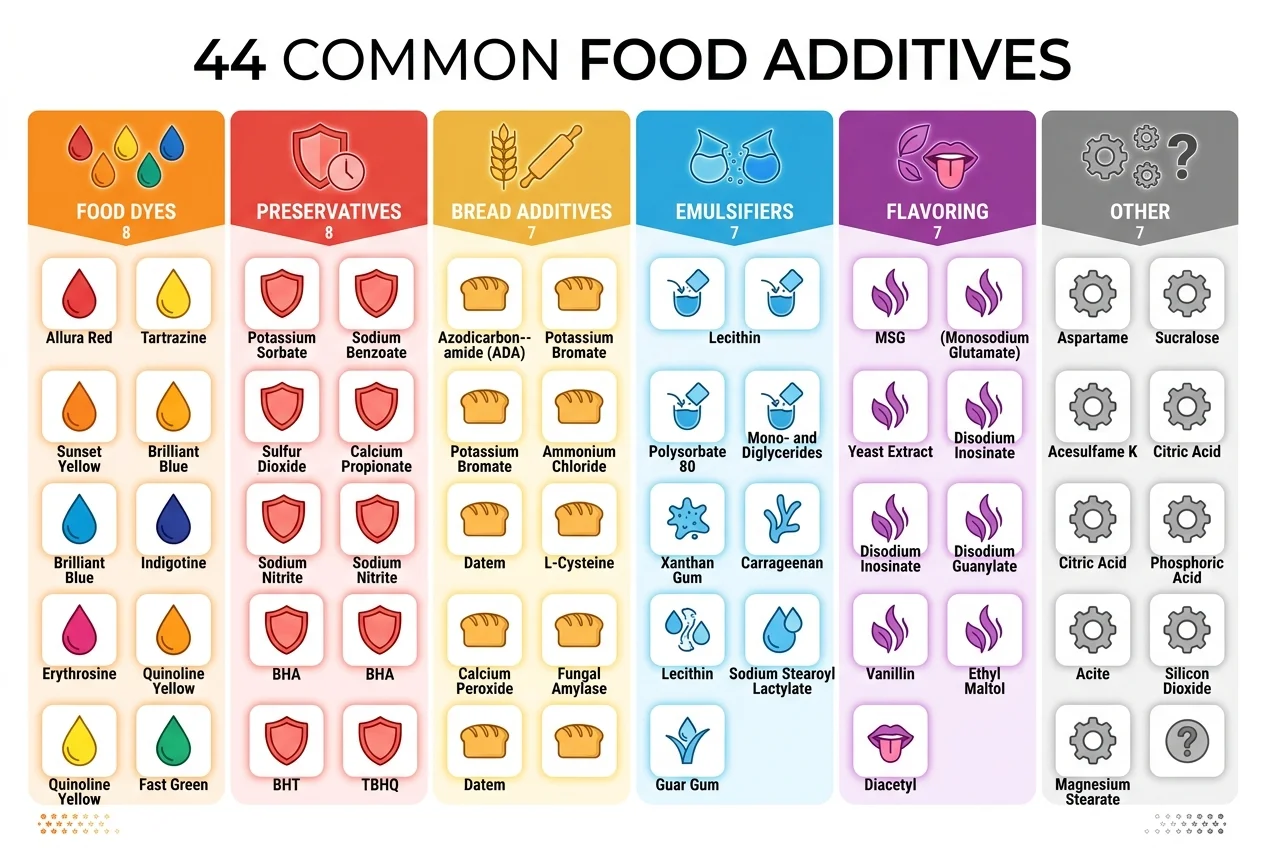
Texas SB 25 requires warning labels on 44 food additives banned abroad. Here's the full list by category, what each does, and why global regulators flagged them.

Mar 23, 2026|10 min read
44 Food Additives Banned Abroad: Texas's Warning Label List

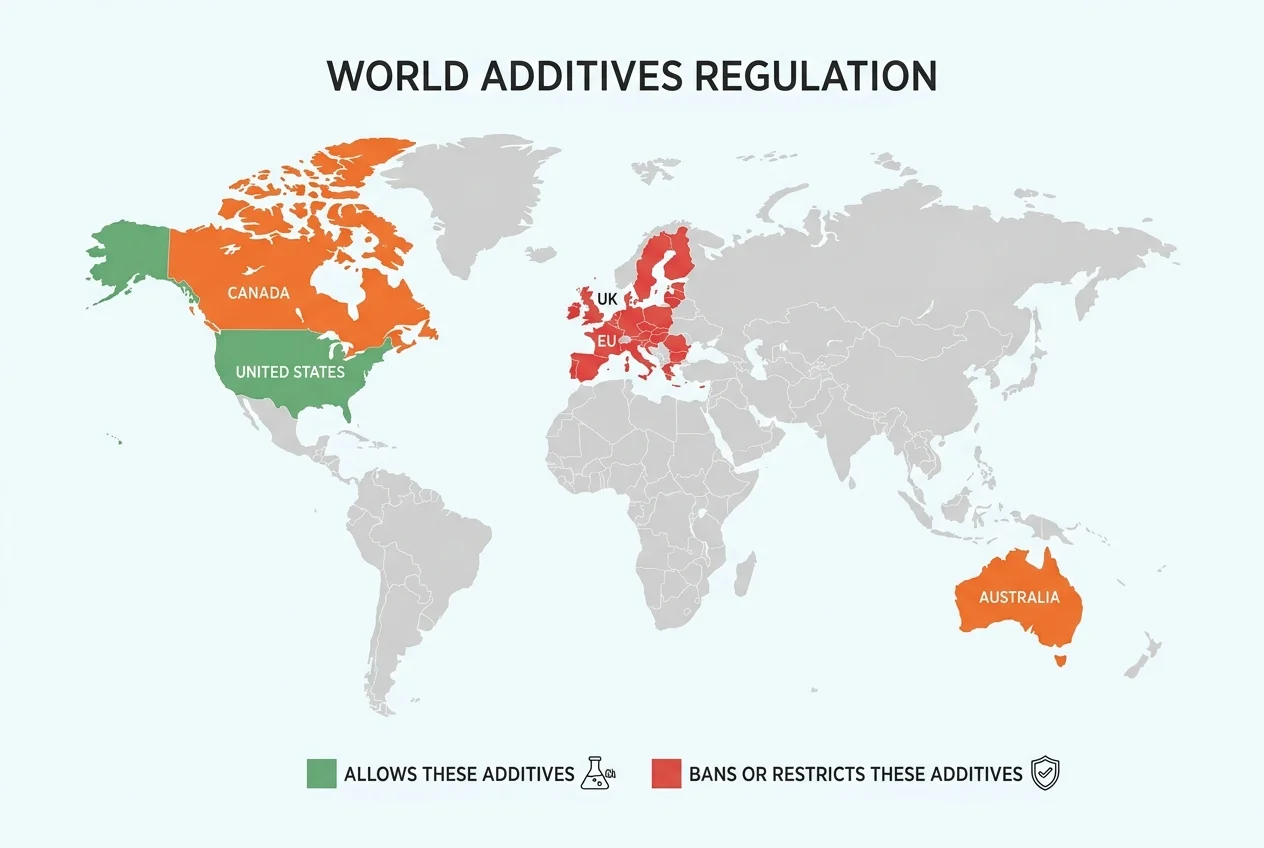
Most food labels tell you what is in a product but not what regulators in other countries think about those ingredients. You might scan an ingredient list and see "Yellow 6," "BHT," or "potassium bromate" and have no idea that these substances are banned or heavily restricted in the European Union, Australia, Canada, or the United Kingdom — while remaining perfectly legal in American food.

Texas decided to change that. In June 2025, Governor Greg Abbott signed Senate Bill 25 into law, requiring that any packaged food sold in Texas and containing one or more of 44 specified ingredients must carry this warning on the label:

"WARNING: This product contains an artificial color, chemical, or food additive that is banned in Australia, Canada, the European Union, or the United Kingdom."

It was the first law of its kind in the United States. It was also promptly blocked by a federal court — but the list of 44 ingredients it produced is one of the most useful consumer references to emerge from the American food safety debate in years.
The Logic: Using Other Countries' Standards as a Benchmark

The Logic: Using Other Countries' Standards as a Benchmark

Texas SB 25 did not commission new toxicology research or ask the FDA to revisit its approvals. Instead, it took a simpler approach: if a regulatory body in Australia, Canada, the EU, or the UK has concluded that an ingredient is unsafe enough to ban or not authorize for use in food, Texas consumers deserve to know they are eating it.

The law was closely associated with the Make America Healthy Again movement, which has drawn widespread attention to the gap between US food regulations and those in peer countries. The US permits hundreds of food additives that European regulators have never approved or have actively removed from use.

The 44-ingredient list covers a wide range — from food dyes and preservatives to bread conditioners, flavoring agents, and fat substitutes. Not every ingredient on it carries the same level of concern. Some have been extensively studied and are considered safe at normal consumption levels by most toxicologists. Others have clear evidence of harm and were banned abroad specifically because of that evidence. Understanding the distinctions matters.

The Dyes: Eight Colors on the List

Eight synthetic food dyes made the Texas list, all petroleum-derived, all either banned or unauthorized in the EU:

Blue 1 (Brilliant Blue FCF) and Blue 2 (Indigo Carmine) are widely used in candy, beverages, and baked goods in the US. Neither is approved for most food applications in the EU. Studies in the 1980s raised concerns about carcinogenicity in animals for Blue 2, and while the evidence in humans remains inconclusive, European regulators declined to authorize it broadly.

Green 3 (Fast Green FCF) is one of the rarest dyes in the American food supply but still legal. It is not permitted in the EU. Animal studies have suggested potential carcinogenic effects at high doses.

Red 3 (Erythrosine) was finally banned by the FDA in January 2025 — decades after the agency's own scientists flagged its link to thyroid tumors in rats. Red 4 was banned even earlier, in 1976. Both appear on the Texas list as a reminder that products with old labels may still list them.

Red 40 (Allura Red), Yellow 5 (Tartrazine), and Yellow 6 (Sunset Yellow) are the three most ubiquitous artificial dyes in the US food supply — found in cereals, sports drinks, candy, chips, and thousands of other products. In the EU, foods containing these three dyes must carry a mandatory warning: "may have an adverse effect on activity and attention in children." Many manufacturers reformulate for the European market using natural colorants, selling an identically branded product in the US with synthetic dyes. The FDA announced in April 2025 that it would work with industry to voluntarily phase all six remaining synthetic dyes out of the US food supply by end of 2026 — though that timeline depends on manufacturer compliance.

The Preservatives: BHA, BHT, Propyl Paraben

BHA (butylated hydroxyanisole) is the subject of a dedicated IngrediCheck post — it is classified as a possible human carcinogen by IARC, banned from food in Japan and restricted in the EU, and currently under formal FDA post-market review.

BHT (butylated hydroxytoluene) is BHA's close chemical cousin and equally common in packaged snacks, cereals, and chewing gum. The European Commission's scientific committee has flagged it for potential endocrine-disrupting properties, reproductive and developmental toxicity in animals, and thyroid effects. It is not authorized as a general food preservative across most EU food categories, and the FDA added it to its 2026 post-market chemical assessment alongside BHA.

Propyl paraben is a preservative found in baked goods, tortillas, and processed snacks. In 2006, the European Union removed it from the list of authorized food additives after EFSA concluded that the previously established safe intake level was no longer valid — because studies showed it affected sex hormones and male reproductive organs in young rats. It acts as a weak synthetic estrogen and has been characterized as an endocrine-disrupting chemical. Despite this, the FDA still permits propyl paraben in food, and it has been found in nearly 50 US snack products according to EWG analysis.

The Bread Additives: A Familiar Group

The Texas list includes several flour and dough treatment agents that IngrediCheck has covered in dedicated posts:

Potassium bromate — banned in over 40 countries and now under FDA post-market review — strengthens dough but leaves behind a potentially carcinogenic residue if bread is underbaked. Full coverage here.

Azodicarbonamide (ADA) — the "yoga mat chemical" banned in the EU, UK, and Australia — bleaches flour and conditions dough but breaks down into semicarbazide, which has raised carcinogenicity concerns in animal studies. Full coverage here.

Potassium iodate is less well known but follows a similar pattern. Like potassium bromate, it is used as a flour treatment agent to strengthen dough. The WHO concluded that its use as a flour additive was unacceptable because it could result in excessive iodine intake, and it has been banned in the EU, Australia, New Zealand, Canada, and dozens of other countries. People with thyroid conditions are particularly vulnerable to excess iodine. The Center for Science in the Public Interest notes it may also be a weak carcinogen based on Japanese animal studies.

Bleached flour uses chemical agents (chlorine, benzoyl peroxide, or other oxidizers) to speed up the natural whitening process. The EU prohibits the use of chemical bleaching agents in flour, requiring that flour be aged naturally or unbleached.

Diacetyl: The "Popcorn Lung" Flavoring

Diacetyl is the butter-flavored compound responsible for the characteristic taste of microwave popcorn, some margarines, and certain snack products. Its story is a cautionary tale about the gap between food safety regulation and occupational health.

In 2000, NIOSH investigated a Missouri popcorn manufacturing plant where workers were developing a rare and severe lung disease — bronchiolitis obliterans, now widely known as "popcorn lung." The culprit was diacetyl vapor inhaled over years of working with the flavoring. At least 200 workers have been identified with the disease; several died. OSHA has issued specific warnings about diacetyl exposure for workers in the flavor and food manufacturing industries.

The critical distinction: the risk appears to come primarily from inhaling diacetyl vapor in occupational concentrations, not from eating food containing it. Eating a bag of microwave popcorn is very different from spending eight hours a day in a factory where the chemical is heated and aerosolized. But because diacetyl has been associated with serious lung disease in occupational settings, and because the EU has banned it from e-cigarettes while scrutinizing its food applications, it ended up on the Texas list. Most major microwave popcorn brands voluntarily reformulated without diacetyl after the popcorn lung controversy became public.

Olestra: The Fat Substitute With a Warning Label History

Olestra was the FDA's celebrated fat substitute of the late 1990s — a calorie-free molecule that passed through the digestive system without being absorbed. It was approved for snack foods in 1996 and appeared in products including WOW! chips (Frito-Lay's reduced-fat line). The FDA required a warning label from the start: the compound could cause gastrointestinal distress and inhibited the absorption of fat-soluble vitamins and carotenoids. The EU and Canada declined to authorize it on safety grounds. The FDA removed the warning requirement in 2003, but the product had already largely disappeared from the market as consumers abandoned it due to its side effects. It remains technically legal in the US, which is why it appears on the Texas list.

The Less Familiar Entries

The Less Familiar Entries

Several ingredients on the Texas list are obscure enough that most consumers will never encounter them by name, but are worth knowing:

  • Dimethylamylamine (DMAA) — a stimulant the FDA has repeatedly warned against in dietary supplements due to serious cardiovascular risks. Its presence on a food additive warning list reflects the breadth of Texas's approach.
  • Morpholine — used as a wax coating on fruits and vegetables (apples, citrus) to extend shelf life. Not authorized in the EU.
  • Dioctyl sodium sulfosuccinate (DSS) — used in some fruit juices and prune juice as a processing aid. Listed as a laxative drug in other contexts.
  • Propylene oxide — a chemical fumigant used to treat spices and tree nuts to reduce pathogens. Not authorized in the EU as a food treatment agent.
  • Sodium lauryl sulfate (SLS) — primarily known as the foaming agent in toothpaste and shampoo, but also used in some dried egg products and marshmallows. Some EU food applications are restricted.

Why the Court Blocked It

On February 11, 2026, a federal district court granted a preliminary injunction blocking enforcement of the warning label requirement. The court found the law likely violates the First Amendment because it compels food manufacturers to display a government-scripted message on their packaging — a form of compelled commercial speech — without sufficient justification under the applicable constitutional standard.

The injunction currently protects members of the four trade associations that challenged the law: the American Beverage Association, the Consumer Brands Association, the National Confectioners Association, and FMI the Food Industry Association. It is a preliminary ruling, not a final judgment. The underlying case is ongoing.

The First Amendment issue is genuinely complex. Courts have allowed mandatory disclosure requirements on food labels before — the original Nutrition Facts panel, allergen warnings, calorie counts. But the legal analysis differs when the required message conveys a value judgment ("banned in other countries") rather than a neutral factual disclosure. The outcome of the case may ultimately shape what kinds of ingredient disclosures governments can mandate on packaging.

What This Means for You Today

The Texas law is on hold. But the 44-ingredient list it generated is fully public and entirely useful — regardless of what happens in court. These are ingredients that regulatory bodies in peer countries concluded were unsafe enough to ban from their food supplies, and they remain in products sold on American shelves today.

Some are being phased out voluntarily or under new regulatory pressure: the FDA is reviewing BHA and BHT, phasing out synthetic dyes, and planning to overhaul its GRAS framework. Others — like propyl paraben, potassium iodate, and bleached flour — face no imminent action in the US.

Reading labels is the most direct action available to consumers right now. That means knowing not just whether an ingredient is present, but understanding what it is, what it does, and how other countries have evaluated its risk.

IngrediCheck lets you scan the barcode of any packaged food and instantly see its full ingredient list — so you can check for any of the 44 ingredients on this list without having to memorize every chemical name. If you're trying to align your grocery choices with global food safety standards, that means knowing in seconds whether what you're about to buy is something the EU, UK, Australia, or Canada has already decided doesn't belong in food.

This article is for informational purposes only and should not be considered medical advice. Consult a healthcare professional for personalized guidance.

Start making confident food choices today!

Scan food and understand what's right for you and your family, with AI.

IngrediCheck app