Food Policy Watch

FSSAI Banned Ashwagandha Leaves in Food: What to Know

FSSAI's April 2026 advisory tells food businesses to stop using ashwagandha leaves in any form. Here's the science behind the decision and what it means for shoppers.

Apr 14, 2026|10 min read
FSSAI Banned Ashwagandha Leaves in Food: What to Know

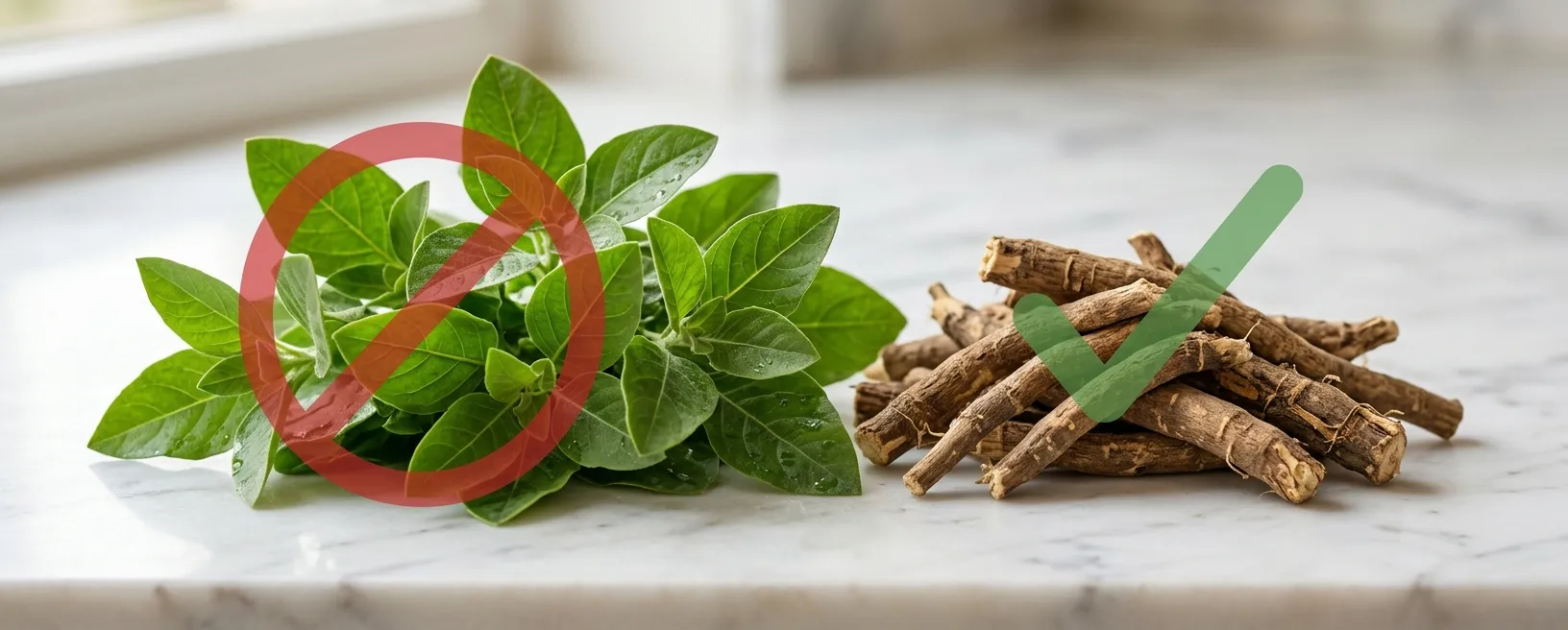
On April 16, 2026, India's food regulator quietly closed a loophole that had let parts of a booming wellness market run ahead of the rulebook. The Food Safety and Standards Authority of India (FSSAI) advisory told food business operators to stop using ashwagandha leaves in any form, crude, extract, or powder, in food products sold in India. Only the root and its extract are allowed, and only under the strict conditions already spelled out in Schedule IV of the 2016 Nutraceutical Regulations.

This matters far beyond India. Ashwagandha has become one of the most widely sold adaptogens on the planet, showing up in protein powders, stress-relief gummies, sleep drinks, and "functional" coffees. If you have ever picked up a bottle that simply says "Ashwagandha Extract" on the front, this advisory is a good reason to read the back more carefully.
What the FSSAI advisory actually says

The advisory does three things.

First, it reaffirms that under Schedule IV of the Food Safety and Standards (Health Supplements, Nutraceuticals, Food for Special Dietary Use, Food for Special Medical Purpose, Functional Food and Novel Food) Regulations, 2016, only the roots and root extracts of Withania somnifera (ashwagandha) are listed as permitted plant parts for use in health supplements, nutraceuticals, foods for special dietary use, and foods for special medical purposes. Leaves were never on that list.

Second, it flags that some manufacturers had started using ashwagandha leaves anyway, often packaged under broader "whole plant" or "full spectrum" labels. That practice is not allowed.

Third, it directs state food safety commissioners and regional directors to actively check products on the market and take enforcement action under the Food Safety and Standards Act, 2006. In practice, that means testing, seizures, and penalties for non-compliant products.

The advisory is short, but its scope is wide. It applies to every food product category that FSSAI oversees, which is effectively anything edible sold in India that is not a licensed drug.

Why leaves and roots are not the same plant (from a chemistry standpoint)

Why leaves and roots are not the same plant (from a chemistry standpoint)

Ashwagandha has been used in Ayurveda for centuries, and most of that traditional use is of the root. The leaves were treated very differently, often as a poultice for wounds or swelling, not as a daily tonic to be swallowed. Modern chemistry helps explain why.

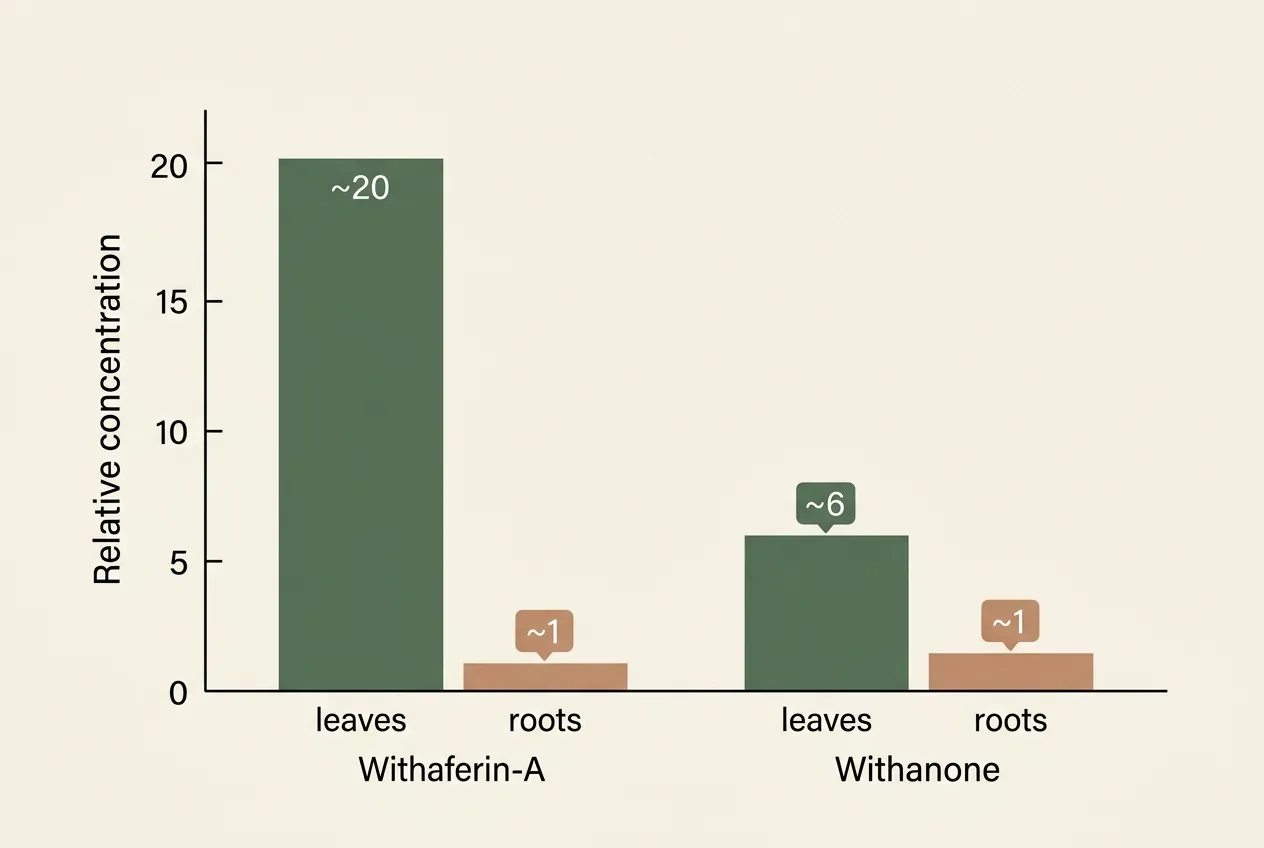
The plant produces a family of compounds called withanolides. Two of them matter most in the safety conversation: withaferin A and withanone. Both are biologically active. Both are also concentrated very differently in the leaves versus the roots.

A 2025 AI-driven meta-analysis published in Frontiers in Nutrition summarized the evidence. Withaferin A is reported to be more than twenty times higher in the leaves than in the roots. Withanone is roughly six times higher. The leaves also contain alkaloids, such as tropin-like compounds, that the root does not carry in meaningful amounts.

Withaferin A is the compound that excites cancer researchers. It has potent anti-tumor activity in laboratory models. That same potency is why toxicologists treat it carefully. Withanone, the other concentrated leaf compound, has been studied for a different reason. Research published in ScienceDirect shows that withanone can form adducts with DNA. Under normal conditions, the body neutralizes it with glutathione. When glutathione runs low, for example during illness, heavy alcohol use, or when someone is on multiple medications, the DNA damage is not cleared, which may contribute to liver injury.

None of this makes ashwagandha leaves poisonous in every dose. It does make them a much higher-variance ingredient than the root. A consumer buying a daily supplement is a very different user than a traditional healer applying a leaf paste.

The liver injury signal regulators keep seeing

The regulatory move did not come out of nowhere. For the past three years, hospitals across several countries have been reporting a pattern of cholestatic liver injury in people taking commercial ashwagandha supplements.

In a case series published in Hepatology Communications, Indian physicians documented 8 patients with liver injury linked to single-ingredient ashwagandha formulations, out of 23 total herbal injury cases. Five patients had underlying chronic liver disease. Three of those progressed to acute-on-chronic liver failure and died on follow-up.

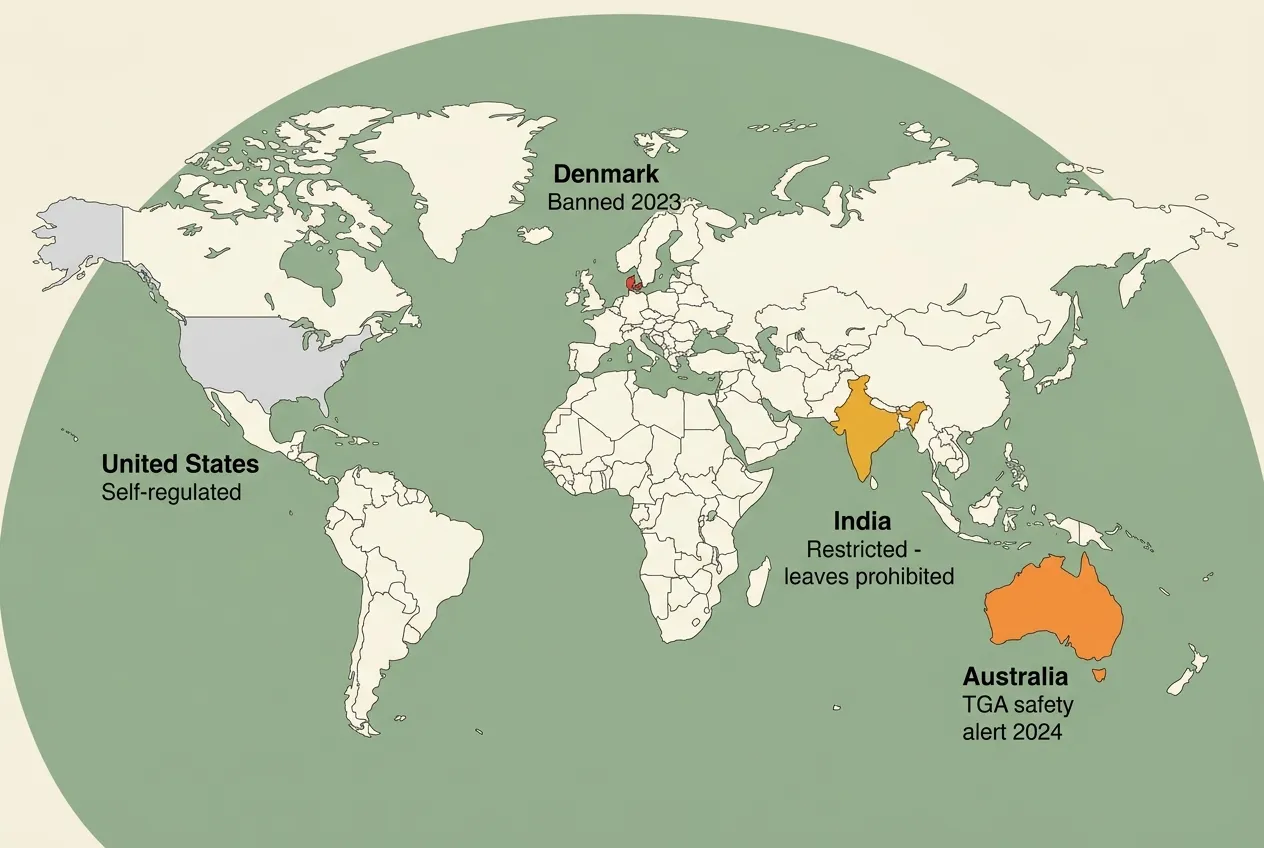
The Australian regulator acted first among major agencies. In February 2024, the Therapeutic Goods Administration (TGA) issued a safety alert after receiving 12 reports of liver problems in Australians taking ashwagandha products. Seven of those reports had enough clinical detail to reasonably suggest the herb was the cause. Four patients were hospitalized. Most recovered after they stopped taking the product.

The US National Institutes of Health's LiverTox database now classifies clinically apparent liver injury from commercial ashwagandha products as a documented adverse event, typically appearing 2 to 12 weeks after the user starts the supplement. The pattern is usually cholestatic, meaning bile flow is disrupted, which shows up as jaundice and intense itching before classic hepatitis markers rise.

Researchers have not proven that every reported case was caused by leaf material. Many commercial products do not specify which plant parts they use, which is part of why regulators have been frustrated. But the concentration difference and the mechanism of withanone DNA binding give regulators a plausible story for why leaf-containing products could be more likely to cause harm, even at the same dose on the label.

What counts as a "safe" ashwagandha product

What counts as a "safe" ashwagandha product

If you scan the packaging of well-established ashwagandha supplements, you will notice many are specifically "standardized root extract." Two widely used commercial extracts, KSM-66 and Sensoril, are both root-based and have been studied in controlled trials at defined doses. A 2024 risk assessment from the Dutch RIVM concluded that daily doses up to around 300 mg of root extract standardized to 1.5 percent withanolides are within a reasonable safety window for healthy adults.

That is a narrow window. Issues start when:

  • The label says "whole plant" or "full spectrum," meaning leaves are almost certainly included.
  • The dose is far above 600 mg per day, which several case reports associate with higher injury risk.
  • The product is taken for long periods without breaks.
  • The user has existing liver conditions, heavy alcohol use, or is on multiple other supplements, especially kava, green tea extract, or other adaptogens.

Pregnant and breastfeeding people are a special case. Ayurvedic tradition has long warned against ashwagandha during pregnancy, and modern preclinical data on withaferin A suggest a genuine reproductive toxicity concern. Both FSSAI and the TGA advise against use during pregnancy.

How other regulators have handled ashwagandha

How other regulators have handled ashwagandha

FSSAI's position is firm but narrow. It targets the plant part, not the plant. Other countries have been less patient.

Denmark went further in 2023. The Danish Veterinary and Food Administration banned the marketing of ashwagandha in food supplements entirely, citing insufficient safety data for key groups including pregnant people, children, and those with thyroid conditions. Industry bodies pushed back hard, calling the move "unjustified." Danish authorities have not reversed it.

Sweden, Finland, and a few other European states have signaled similar concerns, though without going as far as Denmark. The Netherlands' RIVM published its formal risk assessment in 2024 and suggested defined caps on daily intake rather than an outright ban.

In the United States, ashwagandha sits inside the usual Dietary Supplement Health and Education Act framework. The FDA does not pre-approve dietary supplements for safety. Manufacturers are responsible for their own products, and the FDA can only act after adverse events are reported. That is how 5 percent of US adults in a recent survey could be using a supplement that Denmark considers unsafe, all while the label says nothing about which plant part is inside.

Why this advisory will actually change what is on Indian shelves

Ashwagandha is big business. Market research firms estimate the global ashwagandha market at roughly 0.9 billion USD in 2026 and growing at double-digit rates per year. India is both the largest grower and one of the largest consumer markets. A cost-conscious manufacturer using whole-plant material gets more biomass and more "actives" per kilogram than one that uses only carefully cleaned roots. That is the economic pressure that pushed some operators into leaf-containing formulations in the first place.

The FSSAI advisory removes that shortcut. It also gives state enforcement teams a simple legal line to enforce: if a product contains ashwagandha leaves in any form, it is non-compliant, period. That is much easier to prosecute than a slow, evidence-heavy toxicity case.

For shoppers, the practical effect in India should be visible within a quarter or two. Products reformulated as "root extract" or "root powder only" should begin to replace broader "whole-plant" versions. Companies that rely on leaf material will either reformulate, lose market access, or move those products into channels regulated as traditional Ayurvedic medicines, where a different set of rules applies.

What to look for on a label right now

If you take ashwagandha, whether in India or anywhere else, the label language actually matters.

  • Preferred: "Ashwagandha root extract" or "Withania somnifera root extract," ideally with a defined withanolide percentage (for example, 5 percent withanolides) and a clear daily dose in milligrams.
  • Watch out for: "Ashwagandha (whole plant)," "Withania somnifera leaf extract," "full spectrum ashwagandha," or products that mention leaves as an ingredient but do not quantify how much.
  • Be cautious with: High-dose products above 600 mg per day, combination stress formulas that stack multiple liver-active herbs (ashwagandha plus kava, plus green tea extract, plus turmeric in high doses), and products imported through unregulated cross-border channels.

Any liver symptoms during use, yellowing of the eyes or skin, dark urine, persistent nausea, intense itching, deserve an immediate stop and a call to a physician. Most reported cases improved after discontinuation, but a minority did not, and early action clearly helps.

The bigger pattern: plant part matters, not just plant name

FSSAI's advisory is narrow on paper but it points to a bigger problem with how herbal ingredients are labeled globally. A plant is not an ingredient. Different parts of the same plant can contain very different compounds at very different concentrations. Elderberry berries are safe when cooked; the leaves, stems, and unripe fruit contain cyanogenic glycosides. Rhubarb stalks are a dessert staple; the leaves are toxic. Cassava roots are a dietary staple for millions when processed correctly; improperly processed, they release hydrogen cyanide.

Ashwagandha belongs on that list. The root and the leaves have different withanolide profiles, different alkaloid contents, and, as a growing case-report literature shows, different clinical risk profiles. Labels that treat them as interchangeable are not helpful to consumers.

Using IngrediCheck, you can scan the label of a supplement or packaged food and instantly see whether it lists ashwagandha, which plant part is declared, and any related ingredients you might want to avoid. For people with liver conditions, pregnant and breastfeeding users, and anyone stacking several adaptogens at once, that visibility turns a vague "natural" claim into something you can actually act on.

Get the app for clearer label decisions.

Scan labels, see what fits your food notes, and read the why in plain English.

IngrediCheck app