Food Policy Watch

FSANZ Caffeine Rules 2026: Australia & NZ Label Changes

FSANZ approved Proposal P1056 to tighten caffeine and guarana rules across Australia and New Zealand. Here is what is changing, what stays the same, and how new labels will work.

Apr 15, 2026|10 min read
FSANZ Caffeine Rules 2026: Australia & NZ Label Changes

Caffeine is not an allergen, but it is one of the most consequential ingredients on a label for many people. A single concentrated product can deliver more stimulant than several cups of coffee, and vulnerable groups react differently than healthy adults. That is why regulators keep revisiting how caffeine may be sold, added to foods, and declared on packaging.

In March 2026, the Food Standards Australia New Zealand (FSANZ) Board approved Proposal P1056, a long-running review of caffeine permissions in the Australia New Zealand Food Standards Code. The decision does not ban coffee shops or everyday energy drinks in their current regulated form. It does redraw the boundaries for pure caffeine, added caffeine in general foods, guarana concentrates, high-dose coffee beverages, and formulated supplementary sports foods.

If you shop in Australia or New Zealand, or you buy imported products formulated for those markets, the next few years will change what appears on shelves and what you can infer from an ingredient list without guesswork.

Why FSANZ Took On a Full "Caffeine Review"

Caffeine has centuries of use in tea, coffee, and cacao. For most healthy adults, moderate intake from conventional beverages is well tolerated. Problems show up when dose, concentration, and consumer expectations stop lining up: powdered additives, novel delivery formats, and "functional" snacks can push intake higher than people realize, especially when labels are unclear.

FSANZ opened P1056 in 2023 and ran multiple rounds of public consultation, including a final consultation window closing in December 2025. The agency's published rationale ties the final amendments to public health goals: reduce pathways for unsafe highly concentrated products, clarify when caffeine may be added to retail foods, and improve transparency where caffeine levels are high enough to warrant explicit warnings.

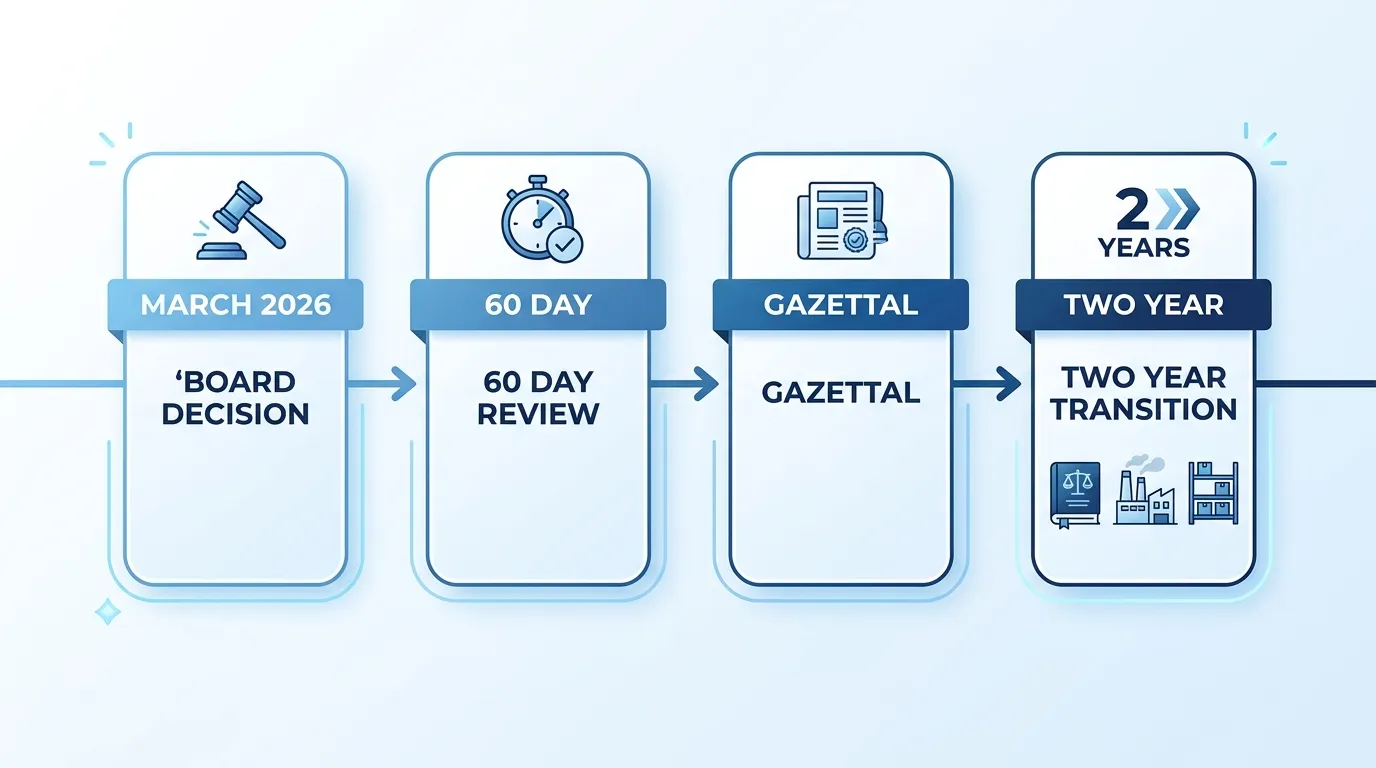
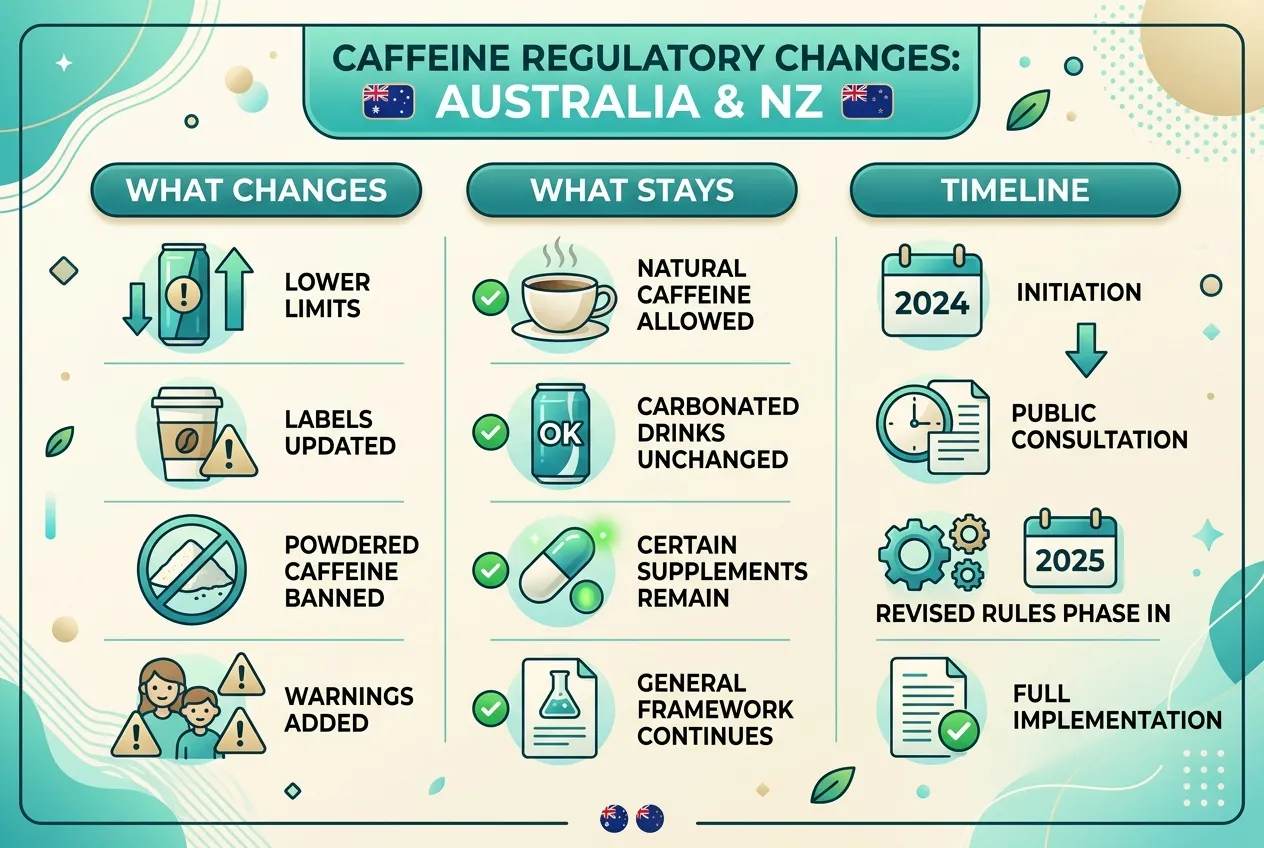
The Board approved the proposal on 10 March 2026. Australian food ministers then entered a statutory review period (FSANZ states 60 days for ministers to consider whether to request a review). If no review is requested, the variation will be gazetted. After gazettal, industry receives a two-year transition to comply. The exact calendar dates depend on ministerial decisions and publication timing, but businesses and shoppers should treat this as a phased reform, not an overnight switch.

What Will Change Under P1056

What Will Change Under P1056

The official P1056 summary groups the amendments into several concrete buckets.

Retail sale of caffeine as a food

The Code will prohibit the retail sale of caffeine as a food. That targets situations where caffeine itself is sold in a form meant for consumers to add to drinks or foods, rather than consuming caffeine only as part of an already regulated product category. The goal is to narrow the channel for dangerously concentrated "raw" caffeine in the general food supply.

Adding caffeine to foods for retail sale

FSANZ frames a broad rule: caffeine from all sources will not be permitted as an added ingredient in foods for retail sale unless the Code explicitly allows it elsewhere. In practice, that means companies cannot freely fortify random snacks or novelty foods with caffeine powder or extracts unless a specific standard permits that use. Permission pathways that remain include categories the Code already regulates in detail (discussed below).

Guarana extract

Guarana contains natural caffeine, but extracts can be produced at concentrations that behave like a concentrated additive in the marketplace. P1056 restricts retail sale of guarana extract with high caffeine concentrations, aiming to stop highly concentrated sources from being sold as ordinary food ingredients without appropriate controls.

Packaged coffee beverages with very high caffeine

For packaged coffee beverages that exceed defined "high caffeine" thresholds, new requirements will apply: declare caffeine content per serve in the nutrition information panel, and carry an advisory statement that the product is not suitable for children under 15, or for pregnant or breastfeeding women, reflecting the populations regulators worry about most when doses climb.

This matters because ready-to-drink coffee products have expanded in strength and marketing reach. A shopper comparing two bottles may soon get a standardized quantitative cue rather than relying on brand names alone.

Formulated supplementary sports foods (FSSF)

Sports nutrition categories receive a structured permission rather than a free-for-all. FSANZ will allow caffeine in formulated supplementary sports foods within defined limits, including a maximum one-day quantity of 200 mg from caffeine (counting caffeine from any source in that product context). Industry reporting also highlights new advisory and warning labelling for these products, including an alternative warning wording that explicitly mentions breastfeeding alongside pregnancy, and an advisory that the product contains caffeine. Multipacks will face additional packaging requirements in some configurations.

What stays the same

FSANZ is explicit about continuity. Existing permissions for caffeine in energy drinks and cola-type beverages remain unchanged, subject to their current standards. Ingredients that naturally contain caffeine, such as coffee or tea used as recognizable ingredients, can still be added to foods unless they qualify as an unapproved novel food under the Code, which triggers a separate pre-market safety pathway.

That distinction matters for reading labels: a mocha bar flavored with coffee is a different regulatory story from a bar with isolated caffeine anhydrous added for effect.
How P1056 Relates to the Older Emergency Rule (P1054)

Years before P1056 was finalized, FSANZ used an urgent pathway to respond to acute safety concerns around pure and highly concentrated caffeine. Urgent Proposal P1054 introduced a prohibition on retail sale of foods where total caffeine concentration meets or exceeds 5% in solid or semi-solid foods, or 1% in liquid foods, measured in line with the standard's definitions.

That emergency rule took effect on 12 December 2019 and remains in force until P1056 fully completes the broader modernization. P1056 should be read as the comprehensive update; P1054 was the interim guardrail against the most extreme concentration hazards.

What This Means for Everyday Label Reading

What This Means for Everyday Label Reading

You will not "see" FSANZ's legal mechanics on a package. You will see outcomes: fewer categories of foods silently spiked with caffeine, clearer warnings on sports products, and numeric caffeine declarations on the strongest ready-to-drink coffees. If you are pregnant, breastfeeding, or purchasing for young teenagers, those warnings are the most actionable lines on the panel.

For energy drinks and colas, the lesson is different: your checklist may not shift immediately, because those permissions were left stable. That does not mean those beverages are appropriate for every person or every age. It means the reform targeted other growth areas FSANZ considered less controlled under the older Code.

If you follow low-caffeine or caffeine-free eating patterns for sleep, anxiety, or cardiovascular reasons, the ingredient list still matters. Caffeine hides behind words like guarana, green tea extract, yerba mate, and kola nut, not only behind "caffeine" itself. P1056 tightens the regulatory envelope around some of those inputs, but it does not remove the need to read closely.

International Context in One Paragraph

Other regions already treat caffeine differently. The European Food Safety Authority has published intake guidance used by risk managers; Health Canada and the U.S. FDA maintain their own labeling and maximum approaches for various product classes. FSANZ's update is not a global harmonization event. It is a Australia–New Zealand Code change designed for those markets' enforcement structures and product mix. Travelers should still assume rules differ by country.

While the Rules Phase In: a Practical Checklist

While the Rules Phase In: a Practical Checklist

Retail shelves do not flip overnight. Even after gazettal, FSANZ allows two years for businesses to align formulations and artwork. During that window you may see old and new label styles side by side. The following habits stay useful no matter what the calendar says:

  1. Scan the nutrition panel for caffeine milligrams when a product markets itself as an energy shot, a strong coffee drink, or a sports supplement. If milligrams are missing today, compare brands and favor those that already disclose dose clearly.
  2. Read the full ingredient list for stimulant aliases. Guarana, yerba mate, guayusa, and some tea extracts contribute caffeine even when the word "caffeine" never appears as a stand-alone ingredient.
  3. Treat multipacks and single serves as separate decisions. A sports nutrition multipack can carry warnings that apply differently depending on how many units someone consumes in a day. The 200 mg per day framing in FSANZ's sports-food permission is about total contribution from those products in scope, not a personal medical limit for every individual.
  4. Keep pediatric and pregnancy guidance front of mind. FSANZ's new advisory language for high-caffeine packaged coffees mirrors a broader consensus that vulnerable groups deserve explicit signposting. When in doubt, ask a clinician rather than trusting marketing copy on the front of a bottle.

The Bottom Line

FSANZ used P1056 to answer a simple question in complex legal language: when caffeine moves from everyday beverages into concentrated formats, novel foods, and "functional" snacks, how should the Code keep pace? The Board's March 2026 approval points toward tighter retail controls, clearer sports-nutrition warnings, and more transparent labeling for the strongest packaged coffees, with a two-year implementation runway after gazettal.

IngrediCheck helps you scan products and see caffeine-related ingredients and additives in context, including guarana and other natural stimulants that can sit alongside declared caffeine. As FSANZ's changes roll into real-world labels, having a consistent way to decode ingredient lists makes it easier to align what you buy with how you want to feel.

Get the app for clearer label decisions.

Scan labels, see what fits your food notes, and read the why in plain English.

IngrediCheck app