Azodicarbonamide: The Yoga Mat Chemical in Your Bread

ADA is banned in the EU, UK, and Australia but still legal in US bread. Learn what the science says about this controversial dough conditioner.

Mar 10, 2026|10 min read
Azodicarbonamide: The Yoga Mat Chemical in Your Bread

There is a good chance you have eaten azodicarbonamide this week. It was probably in your sandwich bread, your hamburger bun, or the wraps you grabbed at the grocery store. The ingredient is listed on the label — but most people skim past it, assuming that if the FDA allows it, it must be safe.

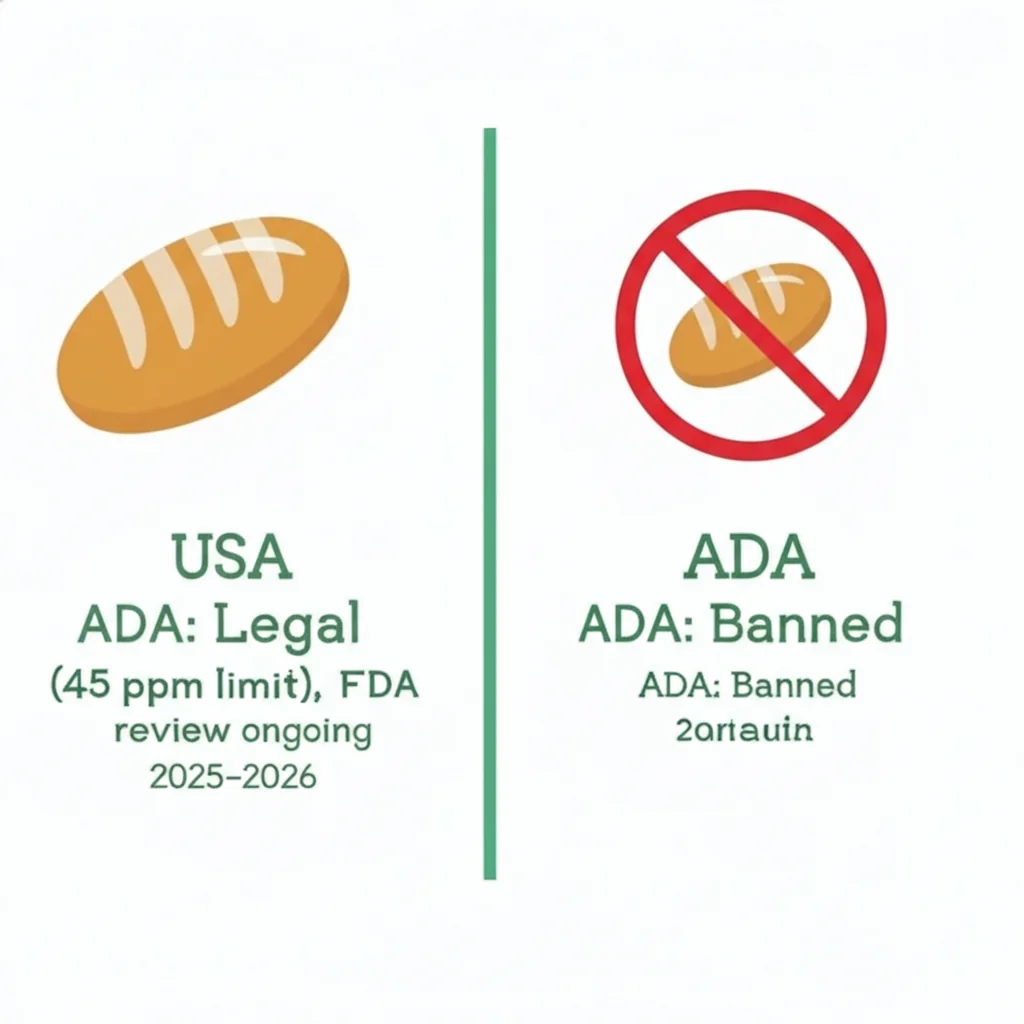
The story of azodicarbonamide, commonly abbreviated ADA, is more complicated than that. It is a synthetic chemical that has been banned for use in food across the European Union, the United Kingdom, Australia, and Singapore. Yet in the United States, it remains perfectly legal — approved as a dough conditioner and flour-bleaching agent in bread products at up to 45 parts per million. Understanding why requires looking at both the chemistry and the regulatory history behind one of food safety's most contested additives.

What Azodicarbonamide Actually Does

ADA is not an ingredient in the traditional sense — it does not add flavor, nutrition, or color to your bread. It is a processing agent, used to make industrial bread production faster and more consistent.

When ADA is added to flour, it does two things. First, it acts as a bleaching agent, oxidizing pigments in the flour to produce a whiter, more uniform crumb. Second, it strengthens the gluten network in dough, making it more elastic and allowing it to trap gas bubbles more efficiently during fermentation. The result is bread that rises more predictably, has better volume, and holds its shape well on industrial production lines.

For large-scale commercial baking, these are valuable properties. Processing times can be shortened, and the bread comes out looking consistent across millions of loaves. ADA became a staple of industrial baking in the United States beginning in the 1960s.

The FDA approved it under 21 CFR 172.806, setting the maximum allowable concentration at 45 ppm — a limit based on what was considered technologically necessary to achieve the desired effect.

The Chemistry Problem: What ADA Becomes in Your Bread

The core concern with azodicarbonamide is not ADA itself — it is what ADA breaks down into when it reacts with the proteins and moisture in bread dough.

When ADA is added to wet flour and subjected to the heat of baking, it decomposes rapidly. The primary breakdown products are biurea (considered largely inert) and semicarbazide. This last compound is where the controversy begins.

Semicarbazide has been classified by the International Agency for Research on Cancer (IARC) as a Group 3 substance — meaning the evidence in humans is inadequate to classify it as carcinogenic, but animal studies have raised concerns. In particular, studies conducted in mice found that semicarbazide at high doses produced an increased incidence of lung tumors. The doses used in these studies were far higher than what humans would encounter from eating bread with trace residues of semicarbazide, and extrapolating animal findings to humans is always uncertain — but regulators in Europe and elsewhere decided the evidence was sufficient to remove ADA from approved food additives rather than wait for human data.

A second breakdown product that appears in some baked goods is urethane (ethyl carbamate), a known carcinogen classified in IARC Group 2A (probably carcinogenic to humans). Urethane forms when semicarbazide reacts with ethanol during fermentation in products like bread made with yeast. European regulators cited urethane formation as a key reason to ban ADA from food use, since urethane is an established carcinogen with no safe threshold of exposure.

"Yoga Mat Chemical": How a Nickname Changed the Conversation

In 2014, a food blogger known as Food Babe published a widely circulated post pointing out that azodicarbonamide is also used as a blowing agent in the manufacture of foamed plastics — including yoga mats, shoe soles, and synthetic leather. The chemical properties that make it useful for conditioning bread dough (its ability to release nitrogen gas) are the same properties that make it useful for creating tiny air bubbles in plastic foam.

The "yoga mat chemical" label went viral almost immediately. Within days, a petition demanding that Subway remove ADA from its bread had collected over 92,000 signatures. Subway announced the reformulation within weeks, removing ADA from all of its bread products in the United States.

The nickname was arguably more rhetorical than scientifically meaningful — many industrial chemicals serve dual purposes in food and manufacturing, and the fact that something is used in yoga mats does not by itself say anything about its safety at low doses in food. But the episode highlighted a real gap: the United States had not reassessed ADA's safety since its initial approval decades earlier, while other food regulatory bodies around the world had reviewed the same evidence and reached different conclusions.

Following the Subway reformulation, McDonald's, Wendy's, and Chick-fil-A also announced plans to remove ADA from their bread products — driven by consumer pressure rather than any regulatory requirement.

The Regulatory Divide

The contrast between how different countries regulate ADA is striking.

In the European Union, azodicarbonamide is not permitted as a food additive under Regulation (EC) No 1333/2008. The EU's regulatory framework for food additives operates on a positive list: only substances that have been evaluated and approved may be used. ADA was never added to that list, and EFSA (the European Food Safety Authority) has not recommended its approval.

In Australia and New Zealand, ADA was removed from the permitted food additives list following a review that concluded the safety data was insufficient to justify its continued use.

In Singapore, its use in food is prohibited, with violations subject to significant penalties.

In the United States, ADA remains on the Generally Recognized as Safe (GRAS) framework for flour treatment agents, and commercial bakers can still add it to bread up to the 45 ppm limit. That said, this may be changing. In August 2025, the FDA added azodicarbonamide to its post-market review list — a formal signal that the agency intends to re-examine whether ADA's approval is still warranted given the current body of evidence. This review is part of a broader FDA initiative to reassess dozens of food additives that were approved before modern toxicological standards were established.

The Occupational Asthma Connection

The Occupational Asthma Connection

Beyond the cancer-related debate, there is a more firmly established concern about ADA: occupational asthma.

Studies dating back to 1980, published in the journal Thorax, documented cases of asthma and allergic sensitization among workers in commercial bakeries that used ADA-containing flour. Inhaling ADA dust can trigger sensitization, and in workers who become sensitized, even small exposures can provoke serious asthmatic responses. One study found that in bakeries using ADA, approximately 18.5% of workers showed signs of respiratory sensitization.

This occupational hazard is well-established enough that the World Health Organization's Food Additives Series has explicitly noted respiratory concerns for workers handling ADA. In the United States, OSHA considers azodicarbonamide a respiratory hazard in occupational settings — a notable tension given that the same substance is permitted in food consumed by the general public.

Where ADA Still Hides in American Bread

In 2014, the Environmental Working Group (EWG) surveyed the American food supply and found azodicarbonamide listed as an ingredient in nearly 500 bread products sold in the United States. That number has declined significantly in the decade since, driven by reformulations from major chains and growing consumer awareness.

However, ADA has not disappeared from the American food supply. It remains present in many:

  • Commercial sandwich breads and rolls from national brands
  • Burger and hotdog buns
  • English muffins
  • Pre-made pizza crusts
  • Some wraps and flatbreads

The American Bakers Association has noted that many of its member companies have committed to phasing out ADA, with an industry-wide target of completing most reformulations by end of 2026. But until the FDA completes its post-market review and takes regulatory action, individual manufacturers are under no legal obligation to remove it.

The practical challenge for consumers is label scanning. ADA is required to be listed on ingredient labels in the United States, so it is technically possible to check for it — but it requires reading every label carefully, which few people do when selecting bread at the grocery store.

Alternatives That Work Just as Well

The commercial baking industry's gradual movement away from ADA has not caused bread quality to collapse. Several alternatives achieve similar dough-conditioning and flour-treatment effects without the regulatory concerns:

  • Ascorbic acid (vitamin C) — widely used as a dough conditioner in Europe; strengthens gluten networks effectively
  • Enzyme blends — combinations of fungal alpha-amylase and xylanase improve dough extensibility and gas retention
  • Datem (diacetyl tartaric acid esters of mono- and diglycerides) — an emulsifier that improves dough strength
  • Calcium peroxide — a flour bleaching agent

These alternatives are generally more expensive or technically complex to use than ADA, which is one reason ADA remained common in high-volume commercial baking for so long. But as more manufacturers have reformulated, the industry has demonstrated that it is entirely feasible to produce consistent, commercially viable bread without azodicarbonamide.

What the FDA Review Means for Consumers

What the FDA Review Means for Consumers

The FDA's August 2025 decision to place ADA on its post-market review list is meaningful, but it does not represent an immediate ban. Post-market reviews can take years, and the outcome may be a reaffirmation of safety, a tighter usage limit, or a full prohibition depending on what the review concludes.

What the review does signal is that the regulatory landscape may be changing. Manufacturers that have not yet reformulated may find themselves needing to do so within the next several years. For consumers who want to avoid ADA now, the only option is to read ingredient labels and choose products that do not list it.

How to Identify ADA on Labels

Azodicarbonamide will appear on US ingredient lists as:

  • Azodicarbonamide
  • Sometimes abbreviated as ADA in informal product descriptions (though not on labels)

It will typically appear near the end of the ingredients list, grouped with other dough conditioners and flour treatment agents. Look for it in the ingredient lists of sandwich breads, burger buns, English muffins, wraps, and packaged flatbreads.

If you see it, it means the product was made using a formulation that is banned in Europe, the UK, and Australia — and that is currently under FDA review for potential removal from the US approved additives list.

Using IngrediCheck, you can instantly scan any packaged bread product and see if azodicarbonamide (or any other flagged additive) is present in the ingredient list. Whether you are managing food sensitivities, following a clean-label diet, or simply trying to avoid additives that are banned elsewhere in the world, IngrediCheck helps you make that call in seconds — so you can put the loaf back on the shelf or toss it in the cart with confidence.

Start making confident food choices today !

Scan food and understand what's right for you and your family, with AI.

IngrediCheck app