Food Policy Watch

ALDI Restricted Ingredients List: All 57 Ingredients

ALDI says its private-label food, vitamin, and supplement products will exclude 57 restricted ingredients by the end of 2027. Here is the full list, grouped and normalized for shoppers.

Apr 27, 2026|11 min read
ALDI Restricted Ingredients List: All 57 Ingredients

If you are looking for the complete ALDI restricted ingredients list, this is the reference page. ALDI says its exclusive food, vitamin, and supplement products will exclude 57 ingredients in total: 13 it already removed and 44 additional ingredients it plans to eliminate by December 2027.

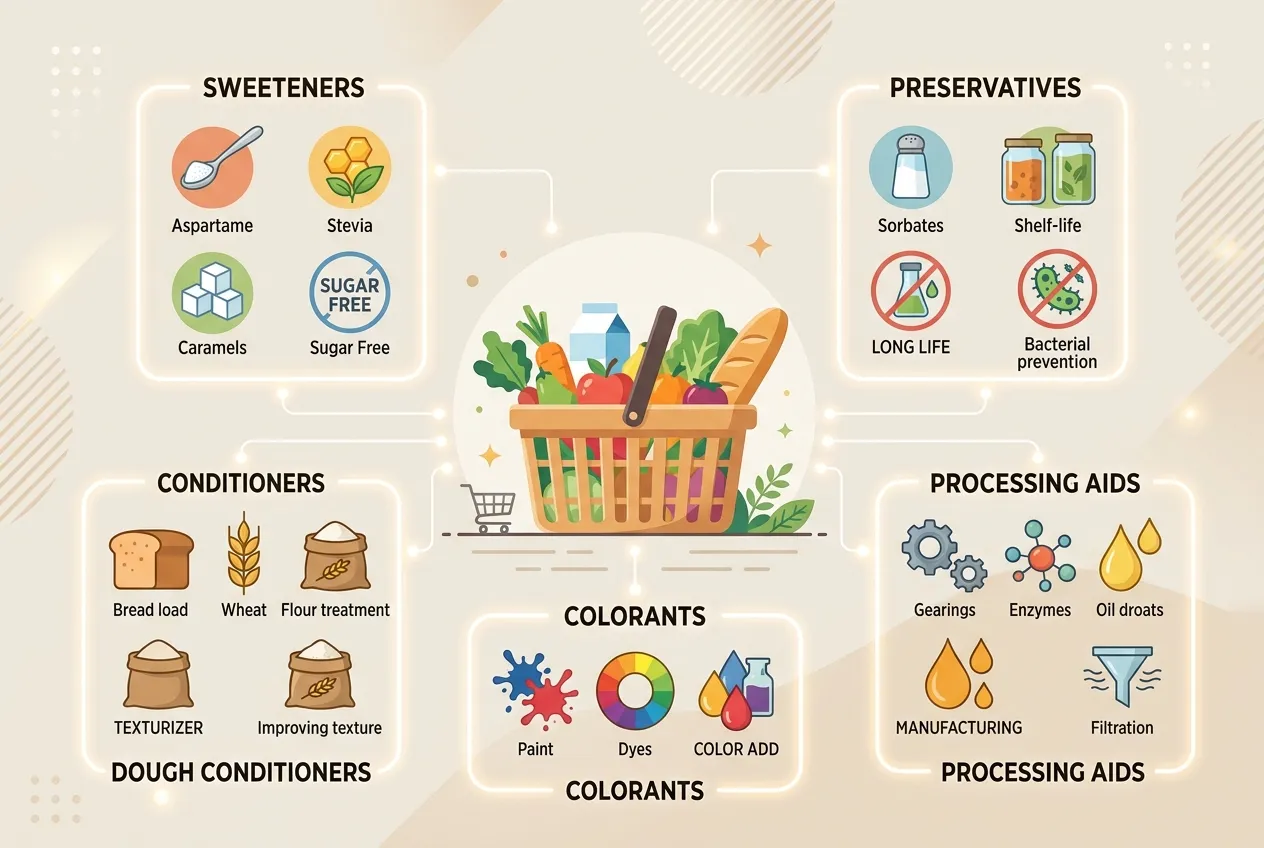
There are two boundaries worth stating up front. First, this policy applies to ALDI-exclusive products, not every national brand sold inside an ALDI store. Second, this is a retailer standard, not a government hazard ranking. The list mixes synthetic dyes, preservatives, sweeteners, dough conditioners, processing aids, and a few broader ingredient families that do not all carry the same regulatory history or evidence base.

If you want the shorter news version of the announcement, start with Aldi Removes 44 More Ingredients From Store Brands. If you want the overlapping policy context, compare this page with 44 Food Additives Banned Abroad: Texas's Warning Label List, Red 40, Yellow 5, and the Dyes the FDA Is Finally Phasing Out, and The GRAS Loophole: How Food Chemicals Skip FDA Review.

What This List Is, and What It Is Not

This page preserves ALDI's published ingredient wording in the first column, then normalizes names in the second column so shoppers can connect the announcement to ingredient profiles and broader regulation. Where ALDI's public list uses two names for one future ingredient family, both entries stay on the page. That is why potassium nitrate and potassium nitrite each appear separately here, even though both point to the shared nitrates topic.

That same rule applies to lye and sodium hydroxide, which are closely related label concepts, and to sulfite-style entries such as potassium bisulfite/bisulfate and potassium metabisulphite. The point of this page is not to flatten Aldi's wording. It is to make the list usable.

The other important distinction is policy framing. Some names on Aldi's list overlap with ingredients already facing direct pressure from U.S. regulators or state lawmakers, including Red Dye 3, potassium bromate, propylparaben, and titanium dioxide. Others are better understood as retailer clean-label choices. That is why this page lives separately from the "banned abroad" cluster.

The 13 Ingredients ALDI Already Removed

ALDI's older restricted list dates back to 2015, when the chain said it had already removed 13 ingredients from its exclusive products. Most of those legacy removals were synthetic colors, but the older list also covered trans-fat ingredients, MSG, and brominated vegetable oil.

Dyes and colorants

Aldi wordingCanonical ingredient nameOne-line shopper contextProfile
FD&C Blue No. 1 – Brilliant Blue FCFBlue 1 / Brilliant Blue FCFBright blue synthetic dye used in drinks, candy, frostings, and novelty snacks.Profile
FD&C Blue No. 2 – IndigotineBlue 2 / IndigotineSynthetic blue color used in candies, cereals, and iced baked goods.Profile
FD&C Green No. 3 – Fast Green FCFGreen 3 / Fast Green FCFLess common certified dye still seen in some mint candies, desserts, and drink mixes.Profile
FD&C Red No. 2 – Amaranth, Citrus redAmaranth / Citrus Red No. 2Legacy red color entry in Aldi's older restricted list, preserved here exactly as Aldi published it.
FD&C Red No. 3 – ErythrosineRed 3 / ErythrosineSynthetic red dye that the FDA has now also moved to revoke from food.Profile
FD&C Red No. 40 – Allura red ACRed 40 / Allura Red ACThe most common red synthetic dye in U.S. packaged food.Profile
FD&C Yellow No. 5 – TartrazineYellow 5 / TartrazineWidely used yellow dye that carries child-behavior warnings in Europe.Profile
FD&C Yellow No. 6 – Sunset yellow FCFYellow 6 / Sunset Yellow FCFCommon orange-yellow dye used in chips, candy, drinks, and bakery fillings.Profile
Orange Borange synthetic dye BRare synthetic color once used in sausage and casing applications.

Emulsifiers, flavor enhancers, and trans-fat ingredients

Aldi wordingCanonical ingredient nameOne-line shopper contextProfile
Brominated Vegetable OilBrominated vegetable oilBeverage emulsifier once used to keep citrus flavor oils suspended in soft drinks.Profile
Monosodium glutamateMSG / monosodium glutamateFlavor enhancer common in savory seasonings, snack coatings, and instant foods.Profile
Partially hydrogenated oils (PHOs)Partially hydrogenated oilsIndustrial trans-fat source historically used for shelf life and texture.
Synthetic Trans Fatty AcidSynthetic trans fatsBroad label concept for artificial trans-fat ingredients created through hydrogenation.

The 44 Ingredients ALDI Says It Will Remove by December 2027

The 44 Ingredients ALDI Says It Will Remove by December 2027

The newer 44-item expansion is broader than the 2015 list. It reaches into sweeteners, preservatives, baking chemistry, processing aids, fumigants, coatings, and appearance agents. Grouping them this way makes the announcement easier to read, but the categories should not be mistaken for equal risk tiers.

Sweeteners and fat replacers

Aldi wordingCanonical ingredient nameOne-line shopper contextProfile
Acesulfame KAcesulfame potassiumHigh-intensity sweetener common in zero-sugar drinks, gum, and protein products.Profile
Advantameadvantame sweetenerUltra-intense sweetener used in very small amounts in reduced-sugar formulations.
Cyclamatescyclamate sweetenersOlder artificial sweetener family still relevant in global formulations and policy debates.Profile
Neotameneotame sweetenerPotent aspartame-related sweetener used in tiny doses in processed foods.Profile
Olestraolestra fat substituteNon-absorbed fat substitute once marketed heavily in reduced-fat snack chips.Profile
Simplesse (brand name)SimplesseMicroparticulated protein-based fat substitute sold under a brand name.

Preservatives and curing salts

Aldi wordingCanonical ingredient nameOne-line shopper contextProfile
BHA (butylated hydroxyanisole)BHA / butylated hydroxyanisoleAntioxidant preservative used to keep oils and flavorings from going rancid.Profile
BHT (butylated hydroxytoluene)BHT / butylated hydroxytolueneCommon antioxidant preservative often paired with BHA in cereals and snacks.Profile
ButylparabenButyl parabenParaben preservative used in some processed foods and surface treatments.
Calcium propionatePropionate mold inhibitor (calcium salt)Mold inhibitor common in bread, tortillas, buns, and other baked goods.Profile
Calcium sorbateSorbate preservative (calcium salt)Preservative salt used to slow mold and yeast growth.
MethylparabenMethyl parabenParaben preservative used for shelf stability in processed products.Profile
Potassium benzoateBenzoate preservative saltBenzoate preservative used in acidic drinks, sauces, and syrups.
Potassium bisulfite/bisulfatePotassium bisulfite / potassium bisulfateSulfite-style salts linked to shelf life, processing, and sensitivity concerns.
Potassium metabisulphitePotassium metabisulfiteSulfite preservative used to protect color and extend shelf life.
Potassium nitrateNitrate curing salt (KNO3)Curing nitrate used in preserved meats and some shelf-stable products.Profile
Potassium nitriteNitrite curing salt (KNO2)Curing nitrite used in processed meats for preservation and pink color.Profile
PropylparabenPropyl parabenParaben preservative already restricted in Europe and watched closely by U.S. shoppers.Profile
Sodium propionatePropionate mold inhibitor (sodium salt)Mold inhibitor used in bread, rolls, tortillas, and other baked goods.

Bromates, leavening agents, and dough-texture additives

Aldi wordingCanonical ingredient nameOne-line shopper contextProfile
Aluminum sodium sulfate / Sodium aluminum sulfateAluminum sodium sulfate / sodium aluminum sulfateAluminum-based leavening acid used in baking powders and self-rising mixes.
Azodicarbonamide (ADA)AzodicarbonamideDough conditioner and flour treatment agent best known from the "yoga mat chemical" debate.Profile
Bromated FlourBromated flourFlour treated with bromate compounds to strengthen dough performance.
Calcium BromateCalcium bromateBromate dough treatment agent related to potassium bromate.
Lactylated esters of mono and diglyceridesLactylated esters of mono- and diglyceridesEmulsifier system used to improve softness and structure in baked goods.
Potassium aluminum sulfateAlum firming or leavening saltAlum salt used in certain leavening and firming applications.
Potassium BromatePotassium bromateBread additive used to strengthen dough and speed bakery performance.Profile
Sodium aluminium phosphate acidic / Aluminum sodium phosphateSodium acid aluminum phosphate / aluminum sodium phosphateAluminum-based leavening acid used in biscuits, pancakes, and packaged mixes.
Sodium stearyl fumarateStearyl fumarate conditionerDough conditioner and anti-caking aid used in dry mixes and bakery systems.
Stearyl tartratefatty-acid tartrate emulsifierEmulsifier-texturizer used in some baked and confectionery products.
SucroglyceridesSucrose-fatty acid emulsifiersEmulsifier made from sucrose and fatty acids to stabilize texture.

Processing aids and treatment chemicals

Aldi wordingCanonical ingredient nameOne-line shopper contextProfile
Anisoleanisole aromatic compoundAromatic compound tied to flavor, fragrance, and processing chemistry uses.
Diacetyl (Synthetic)Synthetic diacetylButter-flavor compound best known from the popcorn-lung manufacturing controversy.
Dioctyl Sodium Sulfocsuccinate (DSS)Dioctyl sodium sulfosuccinateWetting agent and processing aid more familiar to many consumers as a laxative drug ingredient.
Ficinficin enzymeFig-derived enzyme used as a tenderizer or specialty processing aid.
Lyecaustic soda / lyeStrong alkali used for pretzels, olives, and certain traditional processing steps.
Morpholinemorpholine coating agentProduce-coating chemical used to help waxes spread on fruit.Profile
Propylene OxidePropylene oxideFumigant used to reduce microbes in spices, nuts, powders, and cocoa ingredients.Profile
Sodium ferrocyanide (Yellow Prussiate of Soda)Sodium ferrocyanideAnti-caking salt additive used to keep powders and crystals free-flowing.
Sodium hydroxideNaOH / caustic sodaAlkali processing agent used in olives, cocoa, noodles, and pretzel treatments.
Talctalc anti-caking agentAnti-caking or polishing agent that appears in some food-processing contexts.
Toluenetoluene-related solvent chemistrySolvent-related chemical with little clean-label appeal for food contact or processing.

Colorants and appearance agents

Aldi wordingCanonical ingredient nameOne-line shopper contextProfile
Canthaxanthincanthaxanthin colorantOrange-red color additive used to deepen hue in select processed foods.
Titanium DioxideTitanium dioxideWhitening colorant used in candy, gum, icing, and bright white coatings.Profile

Other

Aldi wordingCanonical ingredient nameOne-line shopper contextProfile
PhthalatesPhthalate plasticizersPlasticizer family more often discussed as packaging or indirect food-contact contamination concerns.

How To Read This List Without Overreading It

The cleanest way to interpret Aldi's list is to separate three different stories that have been compressed into one retailer announcement.

The first story is regulation catching up to ingredients that were already controversial. That bucket includes Red Dye 3, potassium bromate, propylparaben, BHA, titanium dioxide, and azodicarbonamide. These are not random clean-label picks. They sit inside longer fights over cancer risk, endocrine disruption, dough improvers, or foreign regulatory divergence.

The second story is retailer simplification. Ingredients such as acesulfame potassium, calcium propionate, potassium benzoate, morpholine, sodium ferrocyanide, and talc are not all facing the same kind of imminent legal action. They are on the list because modern shoppers increasingly treat unfamiliar additive decks as a trust problem. That is the same consumer logic behind recent retailer moves from Walmart, Sam's Club, Save A Lot, and Hy-Vee.

The third story is label usability. The average shopper is not going to memorize 57 names, especially when some of them are broad families and some are alternate label forms for overlapping chemistry. That is why it helps to pair this page with the Ingredient Safety hub, the Food Additives hub, and ingredient profiles such as nitrates, Red 40, and Yellow 5.

Why This Page Exists Separately From The News Story

The announcement itself is a fast-moving retailer story. It answers what changed, why Aldi is doing it now, and how the chain fits into the broader clean-label competition. The evergreen question is different: what exactly is on Aldi's restricted list, and how should a shopper interpret each name?

That is why this page lives alongside, not inside, the original Aldi article. The news page remains the cleanest entry point for timing and retailer context. This page is the stable reference for the actual ingredient list. It now has live profile coverage for the full Wave 1 set, including bht, acesulfame-k, morpholine, olestra, propylene-oxide, and the missing synthetic dyes, so the page is already functioning as a stronger hub rather than a stale announcement recap.

If you use IngrediCheck to scan labels in the aisle, this page gives you the vocabulary behind the app alerts. If a product still contains one of these ingredients during Aldi's phase-in period, you will know whether it is a synthetic dye issue, a curing salt, a dough conditioner, or a processing aid before you decide what matters for your household.

Get the app for clearer label decisions.

Scan labels, see what fits your food notes, and read the why in plain English.

IngrediCheck app