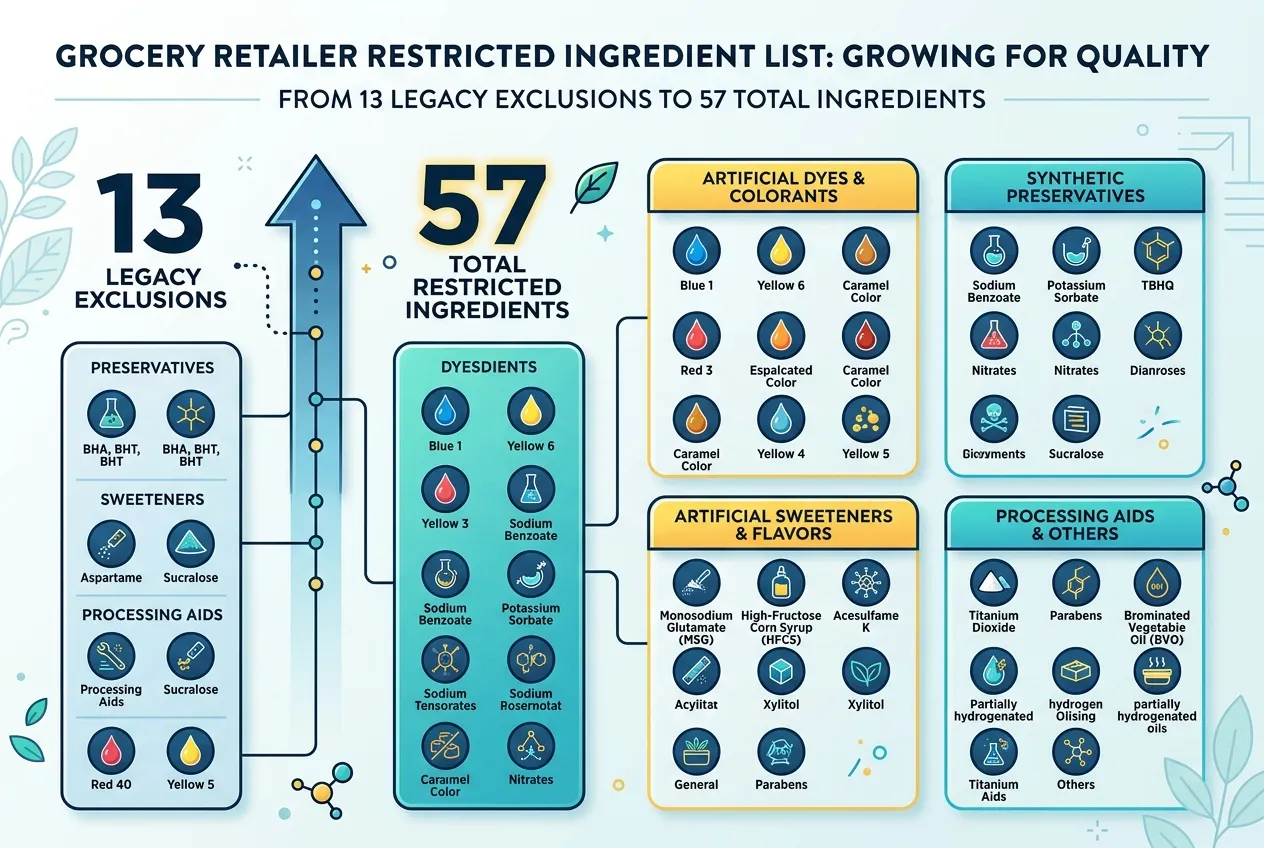
The most interesting part of ALDI's announcement is not the number 44 by itself. It is the mix of ingredients behind it.
High-profile additives already under pressure
Several of the newly targeted ingredients are already familiar to anyone following the U.S. additive fight:
- Potassium bromate and bromated flour
- Propylparaben
- BHA and BHT
- Titanium dioxide
- Azodicarbonamide
- Potassium nitrate and potassium nitrite
Some of these have already triggered government action elsewhere. California's Food Safety Act, which takes effect in 2027, bars brominated vegetable oil, potassium bromate, propylparaben, and Red 3 from foods sold in the state. The FDA has already revoked Red No. 3 in food and ingested drugs, and federal officials have separately announced a broader phaseout of petroleum-based synthetic dyes.
That means ALDI is not operating in a vacuum. Part of its new list overlaps with ingredients already under state pressure, federal scrutiny, or longstanding European restrictions.
Sweeteners and preservatives that remain legal in the U.S.
Other additions are notable precisely because they are still permitted in American packaged food and are not on the verge of a federal ban. ALDI's new exclusions include acesulfame potassium, advantame, neotame, cyclamates, calcium propionate, potassium benzoate, calcium sorbate, methylparaben, and several sulfite and nitrate compounds.
This is where the announcement needs nuance. ALDI's restricted list is not a government danger list. It is a retailer standard, and it mixes ingredients with very different evidence bases and policy histories. Some names on the list have been the subject of intense regulatory fights for years. Others are better understood as ingredients ALDI thinks shoppers increasingly do not want in a modern private-label lineup.
That distinction matters because it keeps the story honest. Removing an additive from a store-brand spec does not automatically mean the ingredient is newly proven unsafe. Sometimes it means the retailer sees more commercial upside in simpler formulas than in defending older ones.
Processing aids and dough conditioners most shoppers never notice
The list also reaches into a less visible part of the food system: the ingredients consumers rarely recognize but repeatedly encounter in baked goods, coated produce, and shelf-stable snacks.
Examples include morpholine, propylene oxide, sodium hydroxide, lye, sodium ferrocyanide, talc, and lactylated esters of mono and diglycerides. These are the kinds of names that rarely make front-page headlines but often fuel consumer distrust because they sound industrial, unfamiliar, and hard to evaluate in the aisle.
For ALDI, that may be the point. A cleaner shelf today is not defined only by removing the most controversial dye. It is also defined by reducing the long tail of unfamiliar additives that make labels feel opaque and overengineered.