Dietary Guides

Heart Health Dietary Guide: Trans Fats, Saturated Fat Labels, and the Omega-3 Claims Problem

An encyclopedic guide to heart-healthy eating covering FDA's PHO ban and the 0g trans fat loophole, saturated fat label claim thresholds, the difference between LDL-raising and neutral saturated fats, plant sterol health claims, omega-3 label gaps, and what the PREDIMED trial actually showed.

Jun 9, 2026|14 min read
By Sanket Patel|Updated 2026-06-09|9 sources|Editorial standards
Heart Health Dietary Guide: Trans Fats, Saturated Fat Labels, and the Omega-3 Claims Problem

Cardiovascular disease causes more than 919,000 deaths in the United States annually, the leading cause of death for both men and women. Diet is a primary modifiable risk factor, yet the labeling of fats on food products contains some of the most consequential gaps in US food regulation. A product can legally display "0g trans fat" while containing enough partially hydrogenated oil to meaningfully raise LDL cholesterol. A food can be certified "heart-healthy" with 480 mg of sodium per serving. And the omega-3 claims filling supplement aisles often describe forms of the nutrient that lack clinical cardiovascular evidence.

This guide covers what the science actually shows and how to read labels accurately.

The Four Fat Types and Their Cardiovascular Effects

Saturated fats raise LDL ("bad") cholesterol and, in most studies, also raise HDL ("good") cholesterol. The net effect on cardiovascular risk depends on the specific saturated fatty acid, a distinction that most food labels cannot capture:

  • Lauric acid (C12), myristic acid (C14), palmitic acid (C16): These are the LDL-raising saturated fats found primarily in coconut oil, palm oil, butter, and red meat. The 2016 meta-analysis by Mensink et al. in the Journal of Lipid Research confirmed these raise LDL-to-HDL ratios, which is associated with increased cardiovascular risk.
  • Stearic acid (C18): Found in cocoa butter and beef tallow. Rapidly converted to oleic acid in the body; neutral to LDL levels. This is why dark chocolate and beef have a more complex cardiovascular profile than a simple "saturated fat" count suggests.

Trans fats from partially hydrogenated oils (PHOs) raise LDL and simultaneously lower HDL, the worst combination for cardiovascular risk. They also increase systemic inflammation. Trans fats from ruminant animals (found in trace amounts in dairy and beef) do not appear to have the same adverse effect and may be neutral or mildly beneficial.

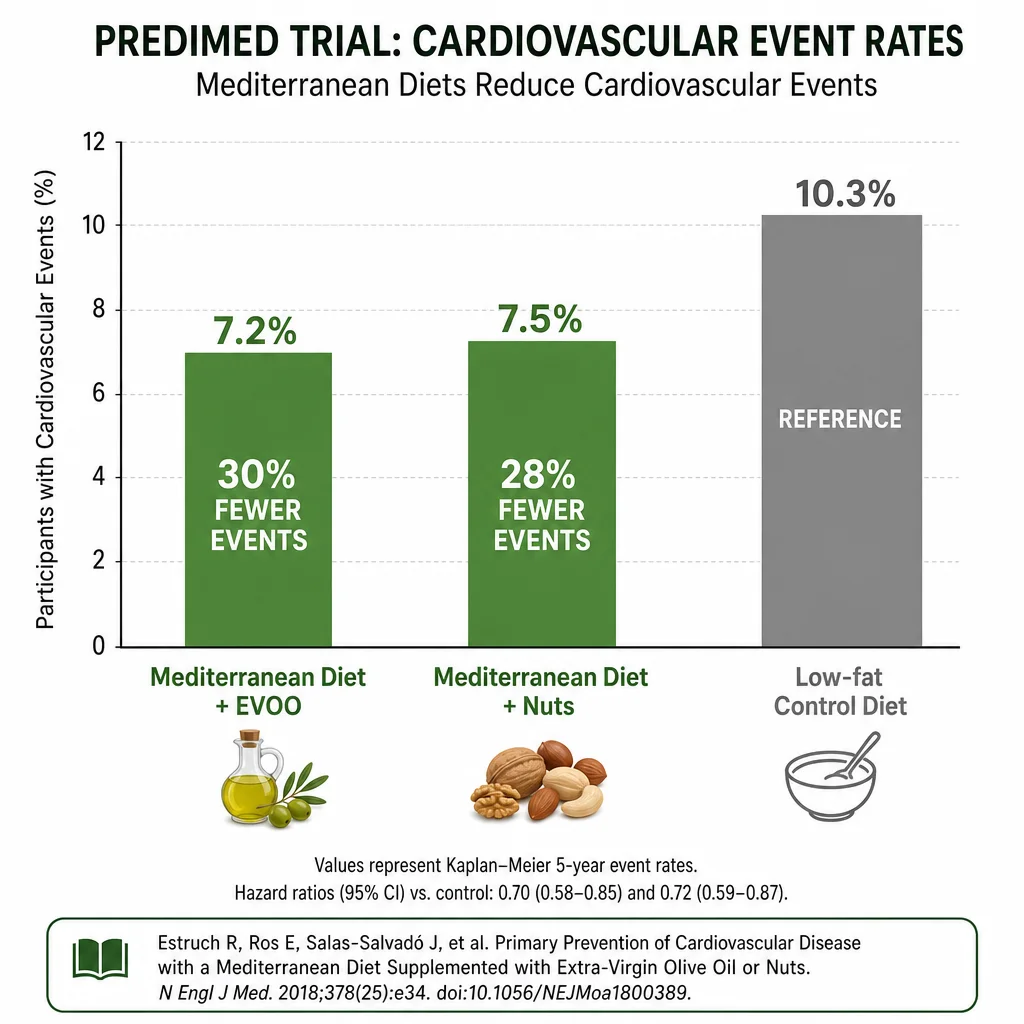
Monounsaturated fats (MUFAs): Oleic acid, the primary fat in olive oil and avocados. Lowers LDL while preserving or raising HDL. The PREDIMED trial (the largest randomized trial of a Mediterranean diet) showed a 30 percent reduction in cardiovascular events in high-risk participants who followed a Mediterranean diet supplemented with extra-virgin olive oil or nuts.

Polyunsaturated fats (PUFAs): Includes omega-6 (linoleic acid; found in corn, soybean, sunflower oils) and omega-3 (alpha-linolenic acid from plants; EPA and DHA from marine sources). Omega-6 fats lower LDL when substituted for saturated fats. Omega-3 EPA and DHA from fish reduce triglycerides and inflammatory markers; the clinical evidence for reducing hard cardiovascular events (heart attack, death) is strongest for high-dose prescription fish oil (Vascepa) and less robust for standard supplement doses.

FDA's Trans Fat Ban and the "0g" Loophole

FDA's Trans Fat Ban and the "0g" Loophole

In 2015, FDA determined that partially hydrogenated oils (PHOs), the primary industrial source of artificial trans fats, are not generally recognized as safe (GRAS). The ban took full effect on June 18, 2018: manufacturers could no longer add PHOs to foods without a specific petition and authorization.

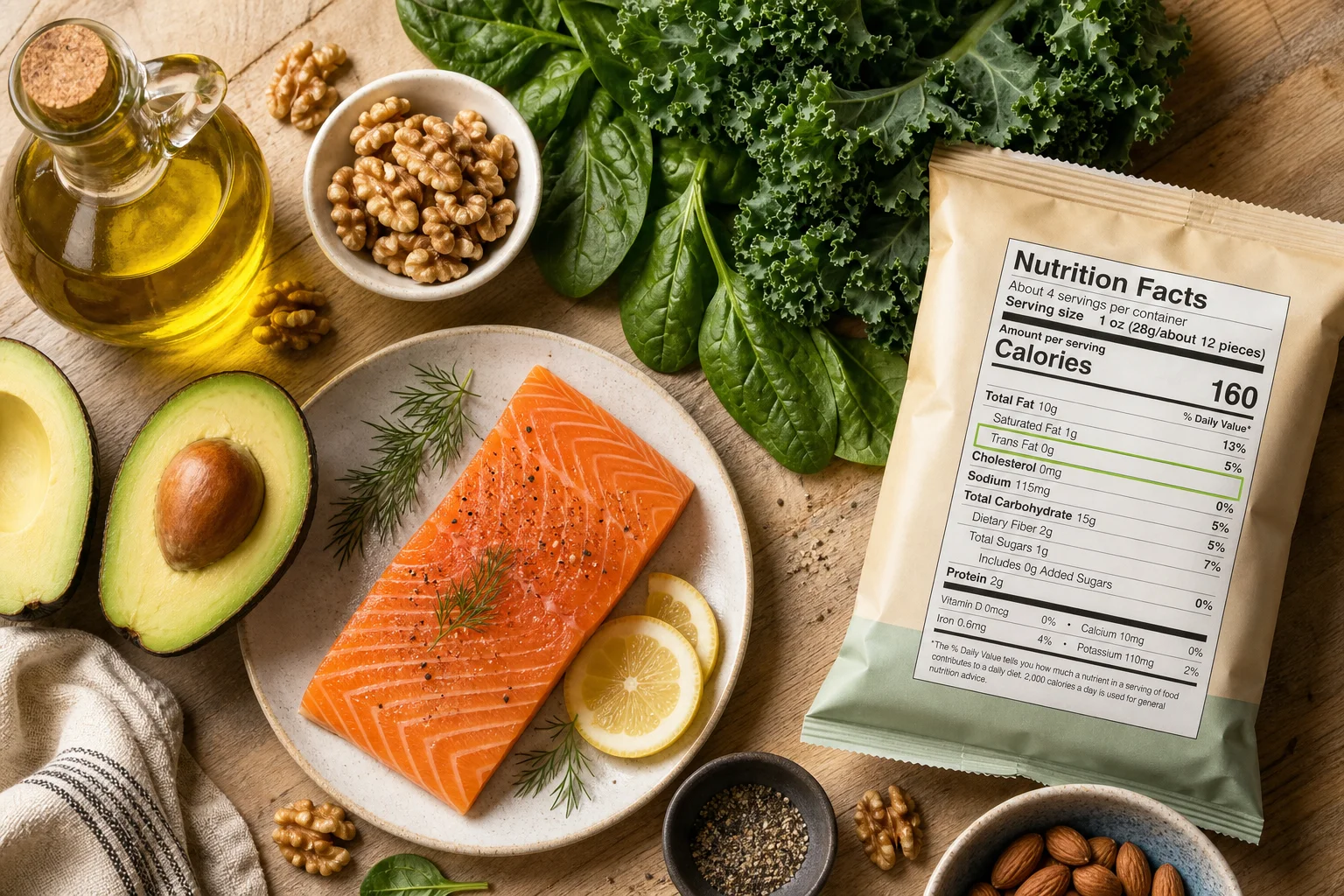
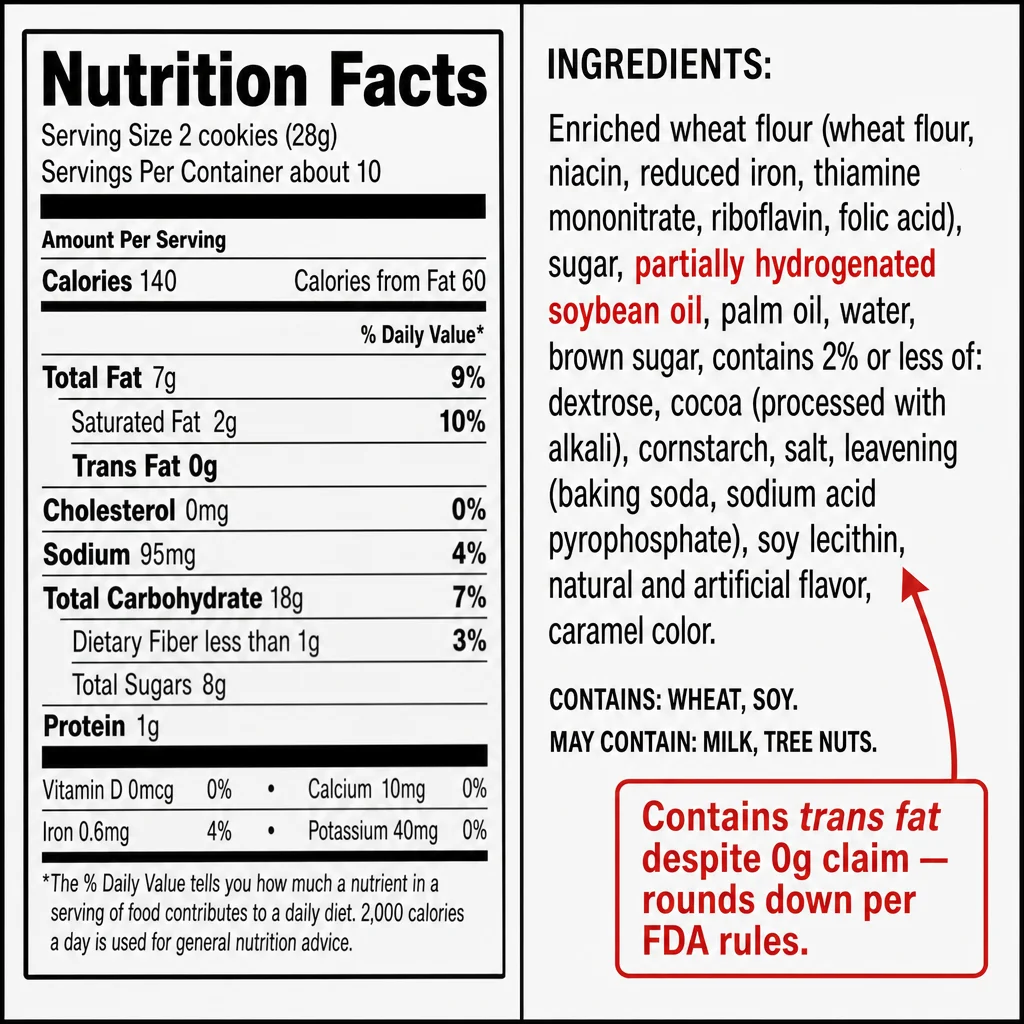
The FDA ban did not eliminate the 0g trans fat rounding loophole. Under 21 CFR 101.9, any food with less than 0.5 grams of trans fat per serving can be listed as "0g trans fat" on the Nutrition Facts panel. A serving that contains 0.49 grams rounds to zero.

Because the 2018 ban targeted PHOs as an ingredient, not trans fat as a nutrient, products that received a specific use authorization from FDA (a small number of applications) may still contain trace PHOs. More practically, the loophole means that a product with multiple small servings can legally show "0g" while cumulatively delivering meaningful trans fat intake.

How to detect hidden trans fat: The definitive method is reading the ingredient list for the phrase "partially hydrogenated." Any product containing any amount of partially hydrogenated oil, vegetable shortening, soybean oil, cottonseed oil, or any other, contains trans fat, regardless of whether the Nutrition Facts panel shows 0g.

Common sources of residual trans fat to check via ingredient lists: microwave popcorn, certain crackers and cookies, non-dairy creamers, frosting and cake mixes, some margarines and shortenings, fried fast food items.

FDA Saturated Fat Label Claim Thresholds

FDA defines saturated fat claims under 21 CFR 101.62:

Saturated Fat-Free / Zero Saturated Fat: less than 0.5 grams of saturated fat AND less than 0.5 grams of trans fat per serving

Low in Saturated Fat: 1 gram or less of saturated fat per serving AND saturated fat accounts for 15 percent or fewer of total calories

Reduced / Less Saturated Fat: at least 25 percent less saturated fat per serving than the regular version

Light: at least 50 percent less fat than the regular version (if fat accounts for more than 50% of calories from the regular food)

The Daily Value for saturated fat is 20 grams. A product labeled "low in saturated fat" at 1 gram per serving still provides 5 percent of the daily limit in that serving alone.

The AHA Heart-Check food certification uses its own thresholds: products must have 1 gram or less of saturated fat per serving, less than 0.5 grams of trans fat, and a maximum of 480 mg sodium per serving. The certification is voluntary and fee-based.

Cholesterol Claims: The 2015 DGA Change

In 2015, the Dietary Guidelines Advisory Committee removed the 300 mg/day dietary cholesterol limit, stating that "cholesterol is not a nutrient of concern for overconsumption." FDA updated the Nutrition Facts panel but retained cholesterol as a mandatory declaration. The regulatory definition of "cholesterol-free" is still: less than 2 mg per serving.

The practical implication: dietary cholesterol from whole eggs has less impact on serum LDL than saturated fat in the same meal. Egg yolks raise both LDL and HDL; the net effect on LDL-to-HDL ratio (the more cardiovascular-relevant measure) is relatively small for most people. The dominant driver of LDL elevation in typical Western diets is saturated fat and trans fat, not dietary cholesterol.

Plant Sterols: The FDA-Authorized Health Claim

Plant sterols and stanols are structurally similar to cholesterol and compete with it for intestinal absorption. The FDA has authorized a health claim for plant sterol esters at intakes of at least 0.65 grams per serving, twice a day (1.3 grams per day total): reduced risk of coronary heart disease.

This is one of the few cardiovascular health claims with genuine regulatory authorization. A food bearing this claim must:

  • Contain at least 0.65 grams of plant sterol esters per serving
  • Be low in saturated fat (no more than 1 gram per serving)
  • Be low in cholesterol (no more than 60 mg per serving)

Clinical trials consistently show 10 to 15 percent LDL reduction with regular consumption of 2 grams of plant sterols per day. They appear in fortified orange juices, margarine spreads, and some yogurts.

The PREDIMED Trial and What It Actually Showed

The PREDIMED Trial and What It Actually Showed

The PREDIMED (Prevención con Dieta Mediterránea) trial followed 7,447 high-risk participants in Spain, randomly assigned to one of three diets: a Mediterranean diet supplemented with extra-virgin olive oil (EVOO), a Mediterranean diet supplemented with nuts, or a low-fat control diet.

The trial was retracted and republished in 2018 due to a randomization irregularity at one site; the republished analysis with corrected data showed the same primary finding: the Mediterranean diet groups had approximately 30 percent fewer major cardiovascular events (myocardial infarction, stroke, or cardiovascular death) than the low-fat control group.

Key findings relevant to label reading:

  • The EVOO group consumed approximately 4 tablespoons (50 mL) of extra-virgin olive oil per day
  • The nuts group consumed 30 grams of mixed nuts (walnuts, almonds, hazelnuts) per day
  • Neither supplemented group received calorie restriction advice, they were not following a low-fat diet
  • The primary benefit appeared attributable to the quality of fat (monounsaturated, polyphenol-rich) rather than fat quantity

The PREDIMED findings do not support the general category of "low-fat" as heart-protective. The control group following a low-fat diet had worse cardiovascular outcomes than the groups consuming more fat from olive oil and nuts.

Omega-3 Claims: EPA, DHA, and ALA Are Not Equivalent

The term "omega-3" covers three distinct fatty acids with meaningfully different evidence bases:

ALA (alpha-linolenic acid): The plant-based omega-3 found in flaxseed, chia, hemp, and walnuts. The body can convert ALA to EPA and DHA, but conversion efficiency is very low: typically 5 to 10 percent for EPA and less than 1 percent for DHA. ALA has weak independent cardiovascular evidence.

EPA (eicosapentaenoic acid) and DHA (docosahexaenoic acid): The marine omega-3s found in fatty fish (salmon, sardines, mackerel, anchovies) and fish oil supplements. EPA and DHA are the biologically active forms with documented cardiovascular effects: triglyceride reduction, anti-inflammatory effects, and plaque stabilization.

FDA allows "excellent source of omega-3" claims for products containing ALA from plant sources, even though these do not deliver the EPA and DHA with clinical evidence. A product labeled "rich in omega-3" may contain only ALA, providing no appreciable cardiovascular benefit.

How to read omega-3 supplement labels: Look for the specific declaration of EPA and DHA in milligrams per serving, not "total omega-3s," which may include ALA. A standard fish oil capsule containing 1,000 mg of fish oil may contain only 180 mg EPA and 120 mg DHA, with the remainder being other fatty acids. High-concentration fish oil provides 500 to 1,000 mg EPA+DHA per capsule.

The prescription drug Vascepa (icosapentaenoic acid, pure EPA at 4 grams/day) showed a 25 percent reduction in cardiovascular events in the REDUCE-IT trial in patients with elevated triglycerides already on statins. This clinical benefit does not extrapolate to standard over-the-counter omega-3 supplements at typical doses.
A Practical Label-Reading Strategy

This section is designed to work as a standalone reference when reading food labels for cardiovascular health.

Ingredients and Additives to Avoid

The following ingredients are associated with cardiovascular risk and should be flagged when managing heart health:

Trans fats (strict avoidance)

  • Partially hydrogenated oil / partially hydrogenated vegetable oil (any variety)
  • Partially hydrogenated soybean oil
  • Partially hydrogenated cottonseed oil
  • Partially hydrogenated palm oil
  • Partially hydrogenated canola oil
  • Shortening / vegetable shortening (verify label; may contain PHOs)
  • Hydrogenated fat (fully hydrogenated does not contain trans fat, but confirm "partially" vs "fully")

LDL-raising saturated fat sources (limit, not strictly avoid)

  • Palm oil / palm kernel oil (high in palmitic and lauric acid)
  • Coconut oil (high in lauric acid; raises both LDL and HDL)
  • Lard, tallow, beef fat, pork fat
  • Butter, cream, full-fat dairy in large quantities
  • Cocoa butter (stearic acid; relatively neutral for LDL)

Pro-inflammatory additives (limit)

  • Refined vegetable oils high in omega-6 (soybean oil, corn oil, sunflower oil, safflower oil, cottonseed oil), not harmful in moderation but worsen omega-6:omega-3 ratio in excess
  • Artificial trans fats as above
  • Advanced glycation end products (AGEs) from high-heat-processed foods (indicators: "caramelized," "browned," heavily fried)

Cholesterol-raising combinations (be cautious)

  • Full-fat dairy + high sugar, both independently affect cardiovascular markers
  • Processed meats with both saturated fat AND sodium nitrate (E251) / sodium nitrite (E250)

Sodium contributors to limit for cardiovascular health

  • Salt / sodium chloride above 400 mg per serving
  • Any product where sodium exceeds 20% of Daily Value per serving (above 460 mg)

Misleading cardiovascular claims

  • "Heart-healthy" without AHA Heart-Check certification or FDA nutrient content claim (unregulated marketing term)
  • "Cholesterol-free" (does not indicate low saturated fat, which is a stronger LDL driver)
  • "Low fat" (may be high in refined carbohydrates, which raise triglycerides)
  • "Made with olive oil" (does not indicate that olive oil is the primary fat, may be the minor ingredient)
  • "Rich in omega-3" without specifying EPA/DHA content (may contain only ALA from plant sources)
  • "0g trans fat" without ingredient list check (may still contain partially hydrogenated oil)

Heart-supportive ingredients to prioritize

  • Extra-virgin olive oil (MUFA + polyphenols)
  • Plant sterol esters (if bearing FDA-authorized health claim at 0.65g+ per serving)
  • Oat bran / beta-glucan (FDA-authorized health claim for LDL reduction at 3g/day)
  • Nuts (walnuts, almonds, hazelnuts)
  • Fatty fish ingredients (salmon, sardines, mackerel, anchovies, herring) with EPA and DHA declared

Step-by-step checklist:

  1. Check the ingredient list for "partially hydrogenated." This is the definitive test for hidden trans fat. Do this before looking at the Nutrition Facts panel.
  1. Evaluate saturated fat in milligrams, not percent. The Daily Value is 20g per day. For heart health, the AHA recommends 5 to 6 percent of total calories from saturated fat, approximately 11 to 13g per day on a 2,000-calorie diet.
  1. Read omega-3 claims critically. If a product claims omega-3 content, verify whether it specifies EPA and DHA (marine-source, clinically active) or only ALA (plant-source, poorly converted). Look for milligrams of EPA and DHA on the Nutrition Facts panel.
  1. Look for plant sterol claims. FDA-authorized claims require at least 0.65g per serving. This is one of the few food-level cardiovascular claims with genuine regulatory backing.
  1. Assess sodium. Target under 1,500 mg/day for those with existing cardiovascular disease; under 2,300 mg for primary prevention. Read actual milligrams per serving, not percent DV, since your personal target may be lower.
  1. Distinguish between heart-healthy certifications. AHA Heart-Check has defined criteria. The phrase "heart-healthy" without certification has no regulatory definition and requires independent label verification.

IngrediCheck can detect partially hydrogenated oils in ingredient lists, distinguish between EPA/DHA and ALA omega-3 claims, flag sodium and saturated fat levels against your personal targets, and identify pro-inflammatory additives.

If you also manage high blood pressure, the Hypertension Dietary Guide covers FDA's 15+ regulated sodium claim thresholds and the hidden sodium forms that don't say "salt" on the label.

Next Label Check

Follow the scanner, hub, and ingredient paths connected to this guide

Get the app for clearer label decisions.

Scan labels, see what fits your food notes, and read the why in plain English.

IngrediCheck app