Dietary Guides

Kidney Disease Dietary Guide: Phosphate Additives, Potassium Chloride, and the E-Number Loophole

An encyclopedic guide to dietary management of chronic kidney disease covering CKD stages and diet, the phosphorus labeling gap on US Nutrition Facts panels, inorganic vs organic phosphate absorption, potassium chloride salt substitute hazards, and the EU E-number disclosure advantage.

Jun 9, 2026|15 min read
By Sanket Patel|Updated 2026-06-09|8 sources|Editorial standards
Kidney Disease Dietary Guide: Phosphate Additives, Potassium Chloride, and the E-Number Loophole

Chronic kidney disease (CKD) affects an estimated 10 to 13 percent of the global adult population, more than 850 million people worldwide. Its dietary management involves one of the most complex intersections of nutrition science and food regulation of any common health condition. Three minerals, phosphorus, potassium, and sodium, all require tight management, and all three hide in processed food in ways that current US label regulations fail to adequately disclose.

The most dangerous example is potassium chloride. Widely marketed as a "healthy" salt substitute for people managing high blood pressure, it is capable of causing fatal cardiac arrest in patients with impaired kidney function. A 2003 BMJ case report documented a patient with CKD whose potassium level reached 9.7 mmol/L, nearly twice the upper limit of the normal range, after switching to a potassium chloride salt substitute, resulting in two cardiac arrests. The patient survived, but the incident illustrates precisely why kidney disease requires a different framework for reading food labels than any other condition.
What Chronic Kidney Disease Is: Stages and Dietary Implications

The kidneys perform three functions critical to dietary management: filtering waste products from the blood, regulating fluid and electrolyte balance, and activating vitamin D for calcium and phosphorus metabolism. As kidney function declines, all three fail progressively.

CKD is staged by GFR (glomerular filtration rate), a measure of how much blood the kidneys filter per minute:

  • Stage 1: GFR 90 or above, kidney damage present but function near normal
  • Stage 2: GFR 60-89, mildly reduced
  • Stage 3a/3b: GFR 30-59, moderately reduced; dietary restrictions typically begin
  • Stage 4: GFR 15-29, severely reduced; careful restriction of phosphorus, potassium, and sodium
  • Stage 5 (kidney failure): GFR below 15, dialysis or transplant required

The 2024 KDIGO (Kidney Disease: Improving Global Outcomes) clinical practice guidelines recommend sodium intake below 2 grams per day for all CKD patients. Phosphorus restriction is recommended when serum phosphorus levels rise above normal range, typically from Stage 3 onward. Potassium restriction is recommended when serum potassium levels become elevated (hyperkalemia), which typically occurs in Stage 3-4 and is nearly universal in Stage 5.

A critical counterintuitive point: dialysis patients are the exception to protein restriction. Pre-dialysis CKD patients are often advised to limit protein to 0.6 to 0.8 g/kg body weight per day to reduce uremic waste. Once on dialysis, the recommendation reverses: dialysis removes amino acids from the blood, and patients need 1.2 g/kg body weight or more per day to prevent malnutrition.

The Phosphorus Problem: Why It's Not on the US Nutrition Facts Panel

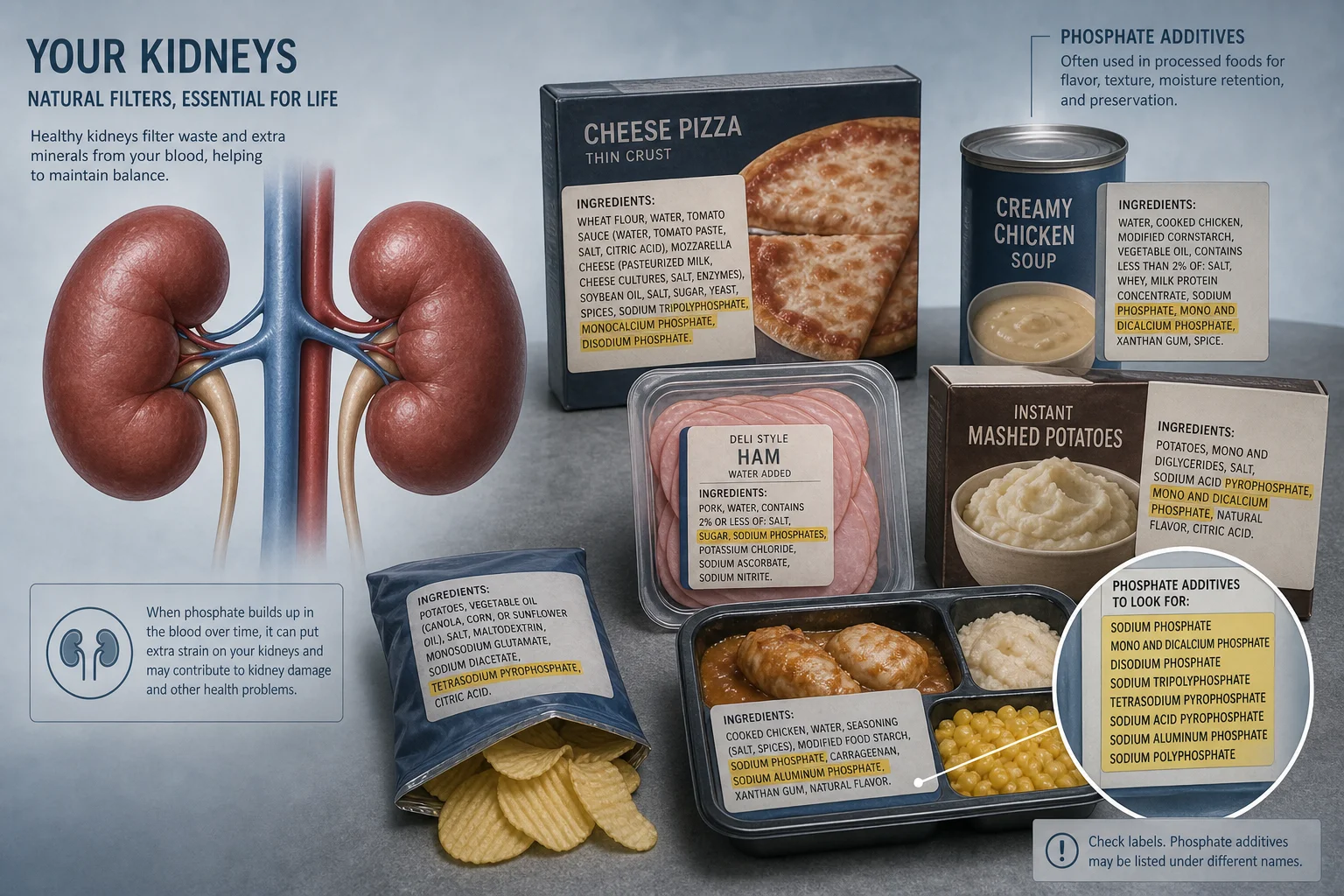
Phosphorus is one of the most critical dietary restrictions for CKD patients, yet it is not required to appear on the US Nutrition Facts panel. Since the 2016 label updates that added potassium and vitamin D as mandatory disclosures, phosphorus remains voluntary, manufacturers may list it, but most do not.

This creates a dangerous information gap. A patient in CKD Stage 4 who is carefully monitoring potassium and sodium based on the Nutrition Facts panel may be unknowingly consuming 3 to 5 times their phosphorus limit through phosphate additives that appear only in the ingredient list.

There are two categories of phosphorus in food with dramatically different absorption rates:

Organic phosphorus occurs naturally in protein-containing foods (meat, dairy, legumes, grains). It is bound to organic compounds and must be enzymatically cleaved during digestion. Only 40 to 60 percent of organic phosphorus is absorbed.

Inorganic phosphorus additives are salts added during processing for texture, preservation, shelf life, and moisture retention. Because they are already in ionic form, they require no enzymatic release. Absorption exceeds 90 percent, more than double the natural form.

The clinical implications are severe. Sullivan et al. (2009) in the American Journal of Clinical Nutrition demonstrated that dietary phosphate additives significantly elevate serum phosphorus levels independently of natural food phosphorus intake. For a dialysis patient with a serum phosphorus target of 3.5 to 5.5 mg/dL, consuming processed meats containing phosphate additives can push levels to 7 to 8 mg/dL, a range associated with accelerated vascular calcification, bone loss, and increased cardiovascular mortality.

EU vs. US Phosphate Labeling: The E-Number Advantage

EU vs. US Phosphate Labeling: The E-Number Advantage

This is one of the starkest regulatory differences between US and EU food labeling for CKD patients.

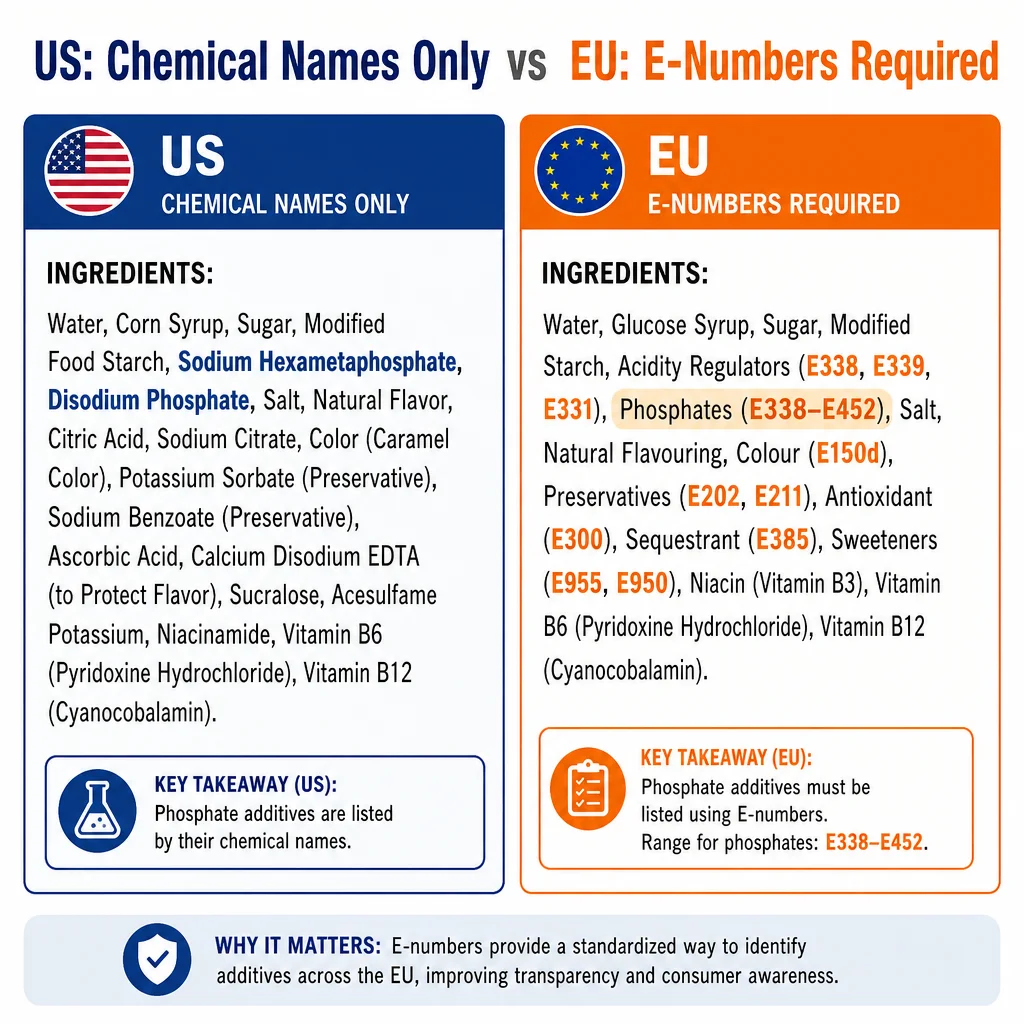
In the United States, phosphate additives must be declared by their chemical name in the ingredient list (for example, "sodium hexametaphosphate" or "disodium phosphate"). But because they appear only in the ingredient list, not on the Nutrition Facts panel, and because most consumers do not recognize the 15-plus chemical names that indicate phosphate salts, the information is effectively invisible to casual label readers.

In the European Union, food additives must be declared by their E-number (the EU's systematic classification system for approved additives) alongside their function category. All phosphate additives fall within the E338-E452 range and must be labeled with both their function (e.g., "acidity regulator," "emulsifier," "stabilizer") and their E-number. This means a European CKD patient who knows the range E338 to E452 can immediately identify any phosphate additive in any product, regardless of the specific chemical name used.

Potassium Chloride: The Hidden Danger in "Healthy" Salt Substitutes

Potassium Chloride: The Hidden Danger in "Healthy" Salt Substitutes

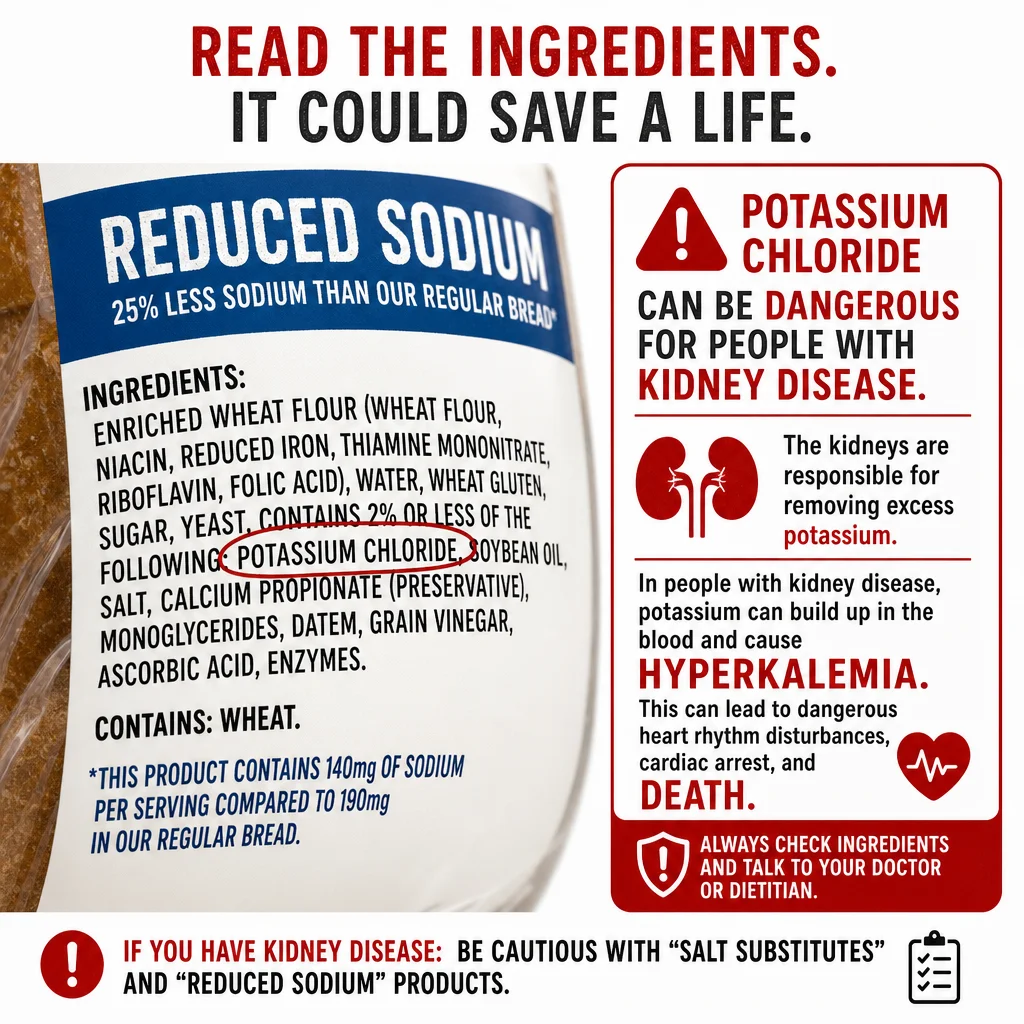
Potassium chloride is the active ingredient in products sold under names like Nu-Salt, No Salt, and Morton Salt Substitute, as well as an increasingly common ingredient in "reduced sodium" and "heart-healthy" processed foods. As manufacturers reformulate products to meet FDA's voluntary sodium reduction targets, potassium chloride is frequently used to replace a portion of the sodium chloride.

For the general population and for people with hypertension who have healthy kidneys, potassium chloride is generally beneficial. For CKD patients, it is a potentially lethal ingredient.

Healthy kidneys excrete excess potassium through the urine. Damaged kidneys cannot, allowing potassium to accumulate in the blood. Hyperkalemia, elevated blood potassium, disrupts the electrical signals that control heart rhythm. Above approximately 6 mmol/L, life-threatening arrhythmias can occur. Above 7 to 8 mmol/L, cardiac arrest is possible without emergency intervention.

The 2003 BMJ case report involved a 62-year-old patient with Stage 4 CKD who was advised by their physician to reduce sodium intake. The patient independently chose a potassium chloride salt substitute at the recommendation of a pharmacist who was unaware of the CKD diagnosis. Within weeks, serum potassium had risen from 5.0 mmol/L to 9.2 mmol/L, and the patient required emergency treatment for two cardiac arrests.

The ingredient "potassium chloride" appears in an expanding list of products including commercial breads, cereals, soups, processed meats, and sports drinks, not just salt substitute products. CKD patients and their caregivers must check ingredient lists across all processed food categories.

Phosphorus and CKD Medications: The Binder Interaction

Most CKD patients at Stage 3 and above are prescribed phosphate binders, medications taken with meals to bind dietary phosphorus in the gut and prevent its absorption. Common binders include calcium carbonate (Tums), sevelamer (Renagel), and lanthanum carbonate (Fosrenol).

The timing and quantity of phosphate binders must be matched to the phosphorus content of each meal. A patient who unknowingly consumes a high-phosphate processed food may have taken an insufficient binder dose for that meal, allowing the excess phosphorus to be absorbed and elevating serum levels.

This makes the phosphate additive identification problem even more clinically urgent. The patient is not just choosing foods, they are managing a drug-nutrient interaction at every meal.

A Practical Label-Reading Strategy

This section is designed to work as a standalone reference when reading food labels with chronic kidney disease.

Ingredients and Additives to Avoid

The following ingredients directly affect kidney disease management and must be checked on every processed food label:

Phosphate additives (strict avoidance; inorganic phosphorus with 90%+ absorption)

  • Phosphoric acid (E338), common in colas and carbonated beverages
  • Sodium phosphate / monosodium phosphate (E339)
  • Disodium phosphate / trisodium phosphate (E339)
  • Potassium phosphate / monopotassium phosphate / dipotassium phosphate (E340)
  • Calcium phosphate / dicalcium phosphate / tricalcium phosphate (E341)
  • Ammonium phosphate (E342)
  • Magnesium phosphate (E343)
  • Sodium hexametaphosphate (E452)
  • Sodium tripolyphosphate / STPP (E451), found in processed meats, seafood
  • Tetrasodium pyrophosphate (E450)
  • Disodium pyrophosphate (E450)
  • Calcium pyrophosphate (E450)
  • Sodium aluminum phosphate (E541), leavening agent in baked goods
  • Polyphosphates (any additive with "polyphosphate" in the name)

Potassium-contributing ingredients (limit based on serum potassium levels)

  • Potassium chloride (KCl; primary salt substitute, potentially fatal in CKD)
  • Potassium citrate (E332)
  • Potassium sorbate (E202; preservative)
  • Potassium benzoate (E212)
  • Potassium bicarbonate (E501)
  • Potassium nitrate / potassium nitrite (E252 / E249), cured meats
  • Potassium lactate (E326), meat preservative
  • Potassium alginate (E402)
  • Dipotassium phosphate (E340), also a phosphate source

Sodium contributors (limit to under 2,000 mg/day per KDIGO 2024)

  • Salt / sodium chloride
  • Monosodium glutamate (MSG / E621)
  • Sodium benzoate (E211)
  • Sodium nitrate (E251) / sodium nitrite (E250)
  • Sodium phosphates (E339), double risk: sodium AND phosphate
  • Sodium bicarbonate (E500)
  • Disodium inosinate (E631) / disodium guanylate (E627)

High-phosphorus food categories requiring label scrutiny

  • Processed cheeses ("cheese food," "cheese product," "cheese sauce"), contain phosphate emulsifiers
  • Enhanced or "plumped" poultry and meats (injected with phosphate solutions for moisture retention)
  • Processed deli meats and hot dogs
  • Cola and dark sodas (phosphoric acid)
  • Fast food items (very frequently contain phosphate additives)
  • Instant and boxed meals

Misleading label terms for CKD patients

  • "Heart-healthy" (typically refers to low sodium/saturated fat; does not address phosphorus or potassium)
  • "Reduced sodium" (may have replaced sodium with potassium chloride)
  • "No salt added" (may still contain potassium chloride)
  • "Natural flavors" (may contain yeast extracts or protein derivatives that contribute phosphorus and potassium)

Step-by-step checklist:

  1. Scan the ingredient list for every phosphate compound name. These are listed by chemical name in the US, not on the Nutrition Facts panel. Any ingredient containing "phosphate," "phosphoric," "pyrophosphate," or "polyphosphate" is an inorganic phosphate additive with very high absorption.
  1. Check for potassium chloride in every "reduced sodium" product. As manufacturers reformulate for lower sodium, potassium chloride appears in breads, soups, cereals, and processed meats. The ingredient list is the only reliable place to identify it.
  1. Read the Potassium line on the Nutrition Facts panel. Since 2016, potassium is a mandatory declaration on US labels. Use this as your first screening step, then verify potassium chloride is not the source by checking the ingredient list.
  1. Calculate sodium from the panel in absolute milligrams. Target under 2,000 mg per day. Multiply the per-serving value by your realistic serving size.
  1. Identify enhanced meats. Poultry and meats labeled "up to X% solution added," "retained moisture," "enhanced," or "self-basting" have been injected with phosphate solutions. The phosphorus content of enhanced chicken can be 3 to 4 times higher than unenhanced chicken.
  1. In the EU, scan for E338 to E452. Any E-number in this range is a phosphate additive. This single rule covers all phosphate forms.

IngrediCheck can scan ingredient lists for all phosphate chemical names, flag potassium chloride in "reduced sodium" products, and calculate cumulative potassium and sodium content per realistic serving to support your daily targets.

For people managing both CKD and high blood pressure, the Hypertension Dietary Guide covers the full landscape of sodium labeling and the DASH diet evidence, but read the kidney disease caveats here first before following any general advice to increase potassium intake.

Next Label Check

Follow the scanner, hub, and ingredient paths connected to this guide

Get the app for clearer label decisions.

Scan labels, see what fits your food notes, and read the why in plain English.

IngrediCheck app
