Label Reading Guides

Is Coconut a Tree Nut? Food Label Rules by Country

See how the United States, Canada, United Kingdom, and European Union classify coconut on allergen labels, including the FDA's 2025 change.

Aug 23, 2026|9 min read
By Sanket Patel|Updated 2026-08-23|5 sources|Editorial standards
Is Coconut a Tree Nut? Food Label Rules by Country

Is coconut a tree nut? Botanists, allergists, and food regulators can answer that question in different ways because they are classifying coconut for different purposes. For a shopper reading a package, the practical question is narrower: does the country’s allergen-labeling system treat coconut as a regulated tree nut or nut?

As of August 2026, the answer is no in the United States under current FDA guidance, and no in the priority-allergen lists used in Canada, the United Kingdom, and the European Union. That does not mean coconut cannot cause allergy. It means coconut does not receive the same mandatory allergen treatment as the tree nuts named by those systems.

Quick Country Comparison

MarketIs coconut in the regulated tree-nut or nut list?Practical label consequence
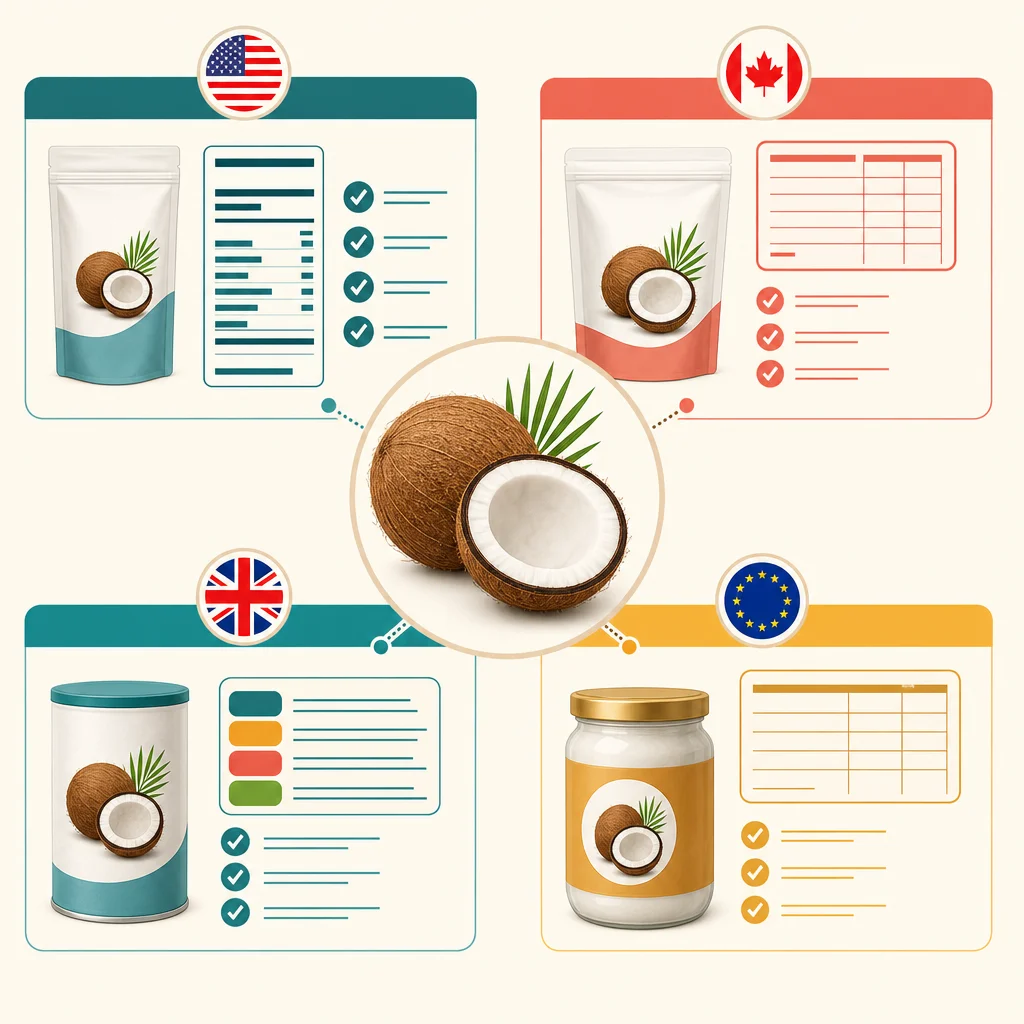
United StatesNo, under FDA's January 2025 Edition 5 guidanceCoconut should not enter a Contains statement solely as a major tree-nut allergen, but an intentionally used coconut ingredient still belongs in the ingredient list
CanadaNoA priority-allergen statement is not a coconut screen; read the ingredients
European UnionNoCoconut does not receive Annex II nut emphasis solely as coconut
United KingdomNoCoconut is outside the retained specified-nut category; read the full ingredients

These are food-label classifications. They are not botanical rulings, allergy tests, or statements that coconut is harmless.

What Changed in the United States in 2025

Older U.S. allergy resources often list coconut as a tree nut. That advice reflected an earlier FDA tree-nut list, not the agency's current position.

In January 2025, FDA issued Edition 5 of its food-allergen guidance. The Federal Register notice announced the final guidance, which narrowed the tree nuts the agency considers major food allergens for enforcement purposes. Coconut was removed.

The underlying U.S. statute still names “tree nuts” as one of the major food-allergen categories without enumerating every nut in the statute itself. FDA guidance supplies the agency’s current list and enforcement interpretation. That distinction matters: the 2025 change was guidance about allergen labeling, not a congressional amendment and not a botanical declaration.

What a Current U.S. Label May Show

If coconut is intentionally used in a packaged food, it still appears under its common or usual name in the ingredient list, subject to the ordinary ingredient rules. Examples include:

  • coconut
  • coconut milk or coconut cream
  • coconut oil
  • coconut flour
  • dried or desiccated coconut
  • coconut water
  • coconut sugar or coconut nectar

A manufacturer should not place coconut in “Contains: tree nuts” solely because it is coconut under the current FDA guidance. Some packages designed before the change may still use older wording, and manufacturers can revise packaging on different schedules. The ingredient list is the more durable coconut check.

Canada Treats Coconut Separately From Priority Tree Nuts

Canada's priority-allergen rules name the tree nuts that receive special allergen declaration treatment. Coconut is not one of them.

The Canadian Food Inspection Agency's allergen guidance gives an unusually direct example: a food containing coconut may make a truthful claim that it does not contain tree nuts or peanuts, provided the claim is otherwise accurate. Coconut must still be identified in the ingredient list when it is used as an ingredient.

That example separates two questions shoppers often merge:

  1. Does the product contain coconut?
  2. Does the product contain a regulated priority tree nut?

Canadian law does not make those questions equivalent. Someone avoiding coconut should search the full ingredient list, not just the Contains statement or a “tree-nut-free” claim.

The EU Nut List Does Not Include Coconut

The EU Nut List Does Not Include Coconut

The European Union uses a named list rather than an open-ended everyday definition of nut. Annex II of Regulation 1169/2011 identifies almond, hazelnut, walnut, cashew, pecan, Brazil nut, pistachio, and macadamia or Queensland nut.

Coconut is absent. As a result, coconut does not receive the bold type, contrasting style, or other Annex II emphasis required for those named nuts solely because it is coconut. It remains an ordinary ingredient that must be declared under the general ingredient-list rules when used intentionally.

The United Kingdom Uses the Same Specified-Nut Approach

UK food businesses work with the familiar list of 14 regulated allergens. The nut category covers the specified nuts inherited from the European framework and does not include coconut.

That means a UK package can contain coconut without presenting coconut in the same emphasized style required for almond, cashew, or walnut. The label should still name the coconut ingredient. A shopper who scans only bold words can therefore miss it.

For foods sold loose or served by a restaurant, ask directly about coconut. Allergen information systems are designed around the regulated list, so a staff member may answer a “nuts” question without treating coconut as part of it. Naming coconut specifically avoids that ambiguity.

Regulatory Classification Is Not Clinical Allergy

Priority-allergen lists are risk-management tools. They determine which foods receive special declarations, emphasis, and compliance attention. They do not list every food capable of causing an allergic reaction.

Coconut allergy can occur. A person with a known coconut allergy should not interpret its absence from a priority list as evidence that a food is safe. At the same time, a diagnosis involving almond, cashew, walnut, or another tree nut does not automatically establish coconut allergy.

For the regulated nuts themselves, the tree nut allergy dietary guide maps current U.S. names and common hidden sources. Keeping that list separate prevents coconut's jurisdiction-specific question from blurring the broader tree-nut label workflow.

The right individual conclusion depends on reaction history, testing, and advice from an allergist. The label conclusion is simpler: if coconut is your concern, look for coconut by name rather than relying on a tree-nut warning.

Coconut Ingredients That Can Be Easy to Miss

Coconut is often obvious in coconut milk or macaroons, but it also appears in foods marketed around texture, plant-based formulation, or alternative sweeteners. Check:

  • dairy-free yogurt, ice cream, cheese alternatives, and creamers
  • protein bars and meal-replacement drinks
  • granola, cereal, trail mix, and energy bites
  • curry sauces, soups, and ready meals
  • confectionery coatings and filled chocolates
  • gluten-free baking mixes and snack bars
  • powdered drink mixes and electrolyte products
  • coconut aminos, coconut sugar, and coconut nectar
  • medium-chain triglyceride products when the source matters
  • soaps, lip products, and supplements if your avoidance plan extends beyond food

Refined coconut oil and MCT oil can raise individual questions about residual protein. The ingredient name alone cannot tell a person how they will react. If your allergy plan distinguishes refined oils or source-specific MCT ingredients, use manufacturer information and your allergist's guidance.

A Better Coconut Label Workflow

A Better Coconut Label Workflow
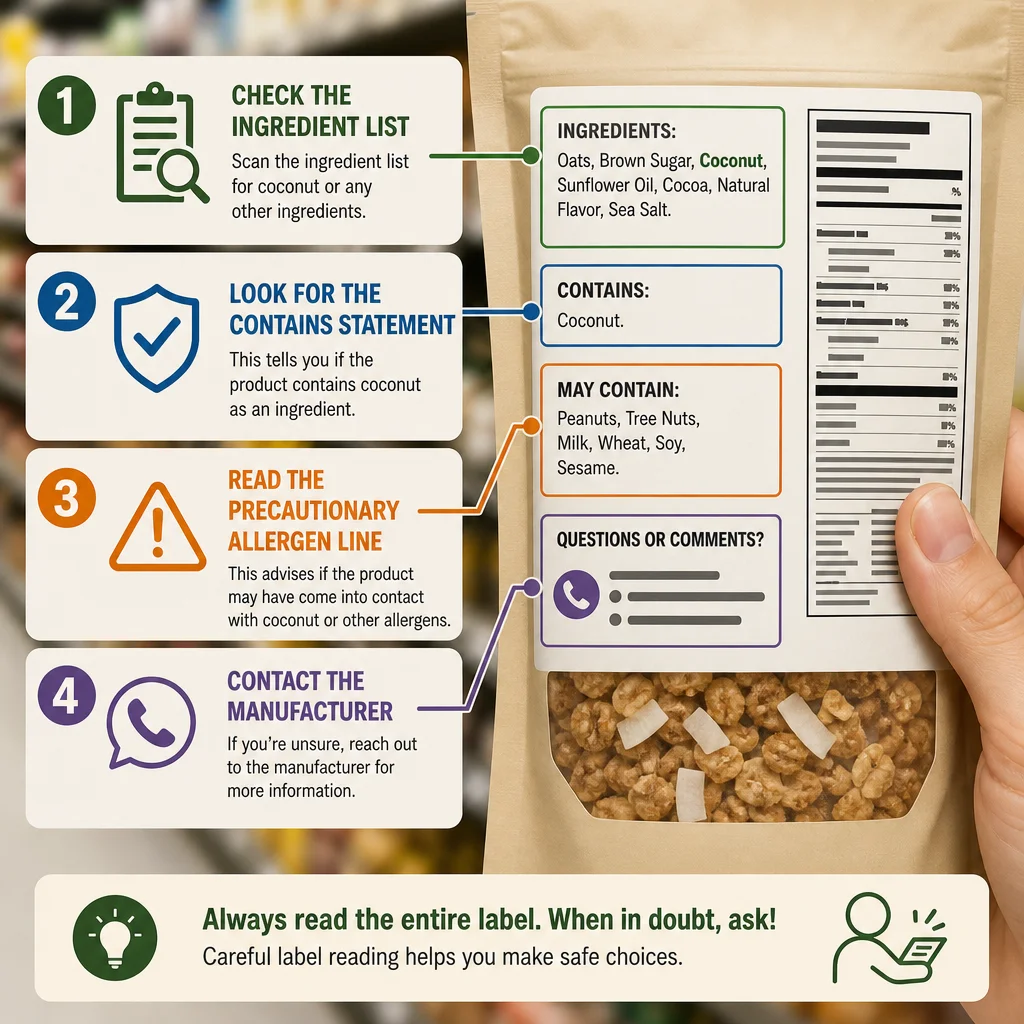
  1. Read the complete ingredient list. Search for coconut, coconut milk, coconut cream, coconut oil, coconut flour, dried coconut, coconut sugar, coconut nectar, and coconut water.
  2. Do not stop at the Contains statement. In the four jurisdictions compared here, coconut does not receive the regulated nut treatment that many shoppers expect.
  3. Treat advisory wording separately. “May contain” language concerns possible cross-contact and is not a replacement for the intentional ingredient list.
  4. Check the country of sale. Imported packages may follow another jurisdiction's terminology and packaging conventions.
  5. Name coconut when asking a business. Ask “Does this contain coconut or use coconut milk, cream, flour, or oil?” rather than asking only whether it contains nuts.
  6. Confirm unresolved derivatives. Contact the manufacturer when an ingredient such as MCT oil or a composite flavor could matter to your established coconut-avoidance plan.

Restaurants, Bakeries, and Foods Without a Package

The full-ingredient strategy becomes harder when no package is available. Restaurant and bakery allergen systems are normally organized around the jurisdiction's regulated allergens. Because coconut sits outside the named nut category in the four markets reviewed here, a standard nut-allergy matrix may not answer the coconut question.

Ask about the actual recipe and preparation, not only the nut column. Coconut milk can be used in curry, soup, smoothies, desserts, and whipped toppings. Coconut flour can appear in gluten-free baking. Coconut oil may be used in frying, confectionery coatings, or plant-based products. Shared utensils and preparation surfaces can create separate cross-contact questions.

Use direct wording: “I need to avoid coconut, including coconut milk, cream, flour, flakes, and oil. Can you check the recipe and preparation process?” That phrasing is more likely to produce a useful answer than asking whether a dish is nut free.

Why Old Search Results Still Cause Confusion

The U.S. change is recent enough that many clinic handouts, retailer filters, manufacturer FAQs, and older articles still say FDA classifies coconut as a tree nut. Search results can surface those pages without displaying their date.

When checking U.S. advice, look for a reference to FDA Edition 5 or a publication date after January 2025. For Canada, the EU, and the UK, prefer current regulator pages over generic international charts. A global chart that combines all “nuts” into one column can erase the jurisdiction-specific detail that actually controls the label.

Coconut's label status is easier to manage once you separate regulatory categories from individual allergy. IngrediCheck can help find coconut terms in the full ingredient list and apply your saved coconut rule even when the package does not highlight coconut as a regulated tree nut.

Frequently Asked Questions

Is coconut considered a tree nut by the FDA?

FDA's January 2025 Edition 5 allergen guidance removed coconut from the agency's list of tree nuts treated as major food allergens. Coconut ingredients still belong in the ordinary ingredient list.

Does a Contains: tree nuts statement cover coconut?

Not reliably. Current US guidance and Canadian, UK, and EU mandatory allergen lists do not place coconut in their regulated tree-nut or nut categories. Read the full ingredient list when avoiding coconut.

Can someone have a coconut allergy even though coconut is not a priority allergen?

Yes. Regulatory priority lists determine special label treatment, not whether an individual food can cause an allergic reaction. Coconut allergy can occur.

Does tree-nut allergy automatically mean coconut allergy?

No. A tree-nut diagnosis does not by itself establish coconut allergy. An allergist can interpret a person's history and testing when the relationship is uncertain.

Next Label Check

Follow the scanner, hub, and ingredient paths connected to this guide

Get the app for clearer label decisions.

Scan labels, see what fits your food notes, and read the why in plain English.

IngrediCheck app