Dairy: The Sanitizer, Not the Milk
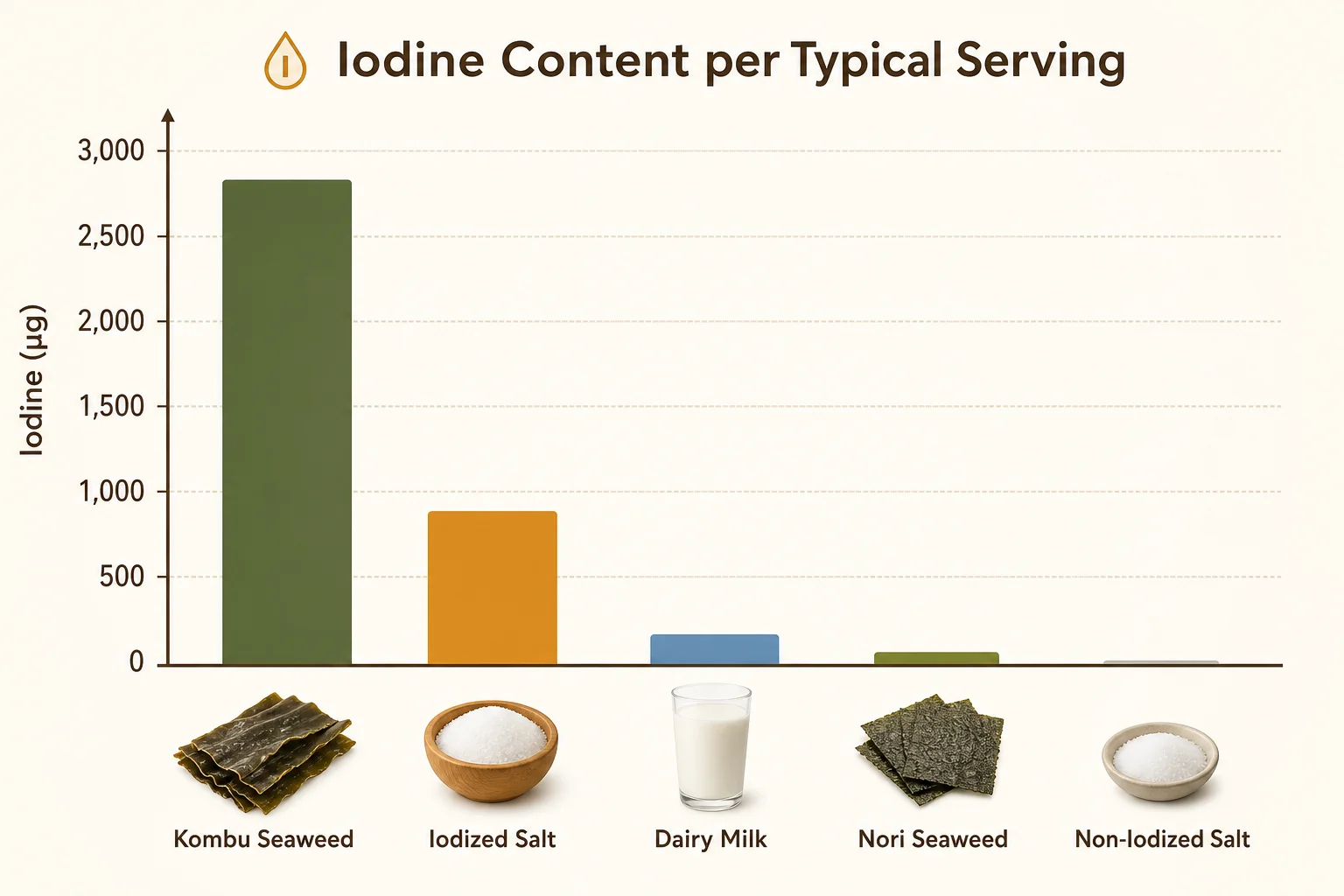
Milk itself does not naturally carry much iodine, but modern dairy farming does. Iodine-based sanitizers, called iodophors, are routinely used to disinfect cow teats before and after milking and to clean milking equipment, and a controlled trial in the Journal of Dairy Science found that spraying an iodine-based post-milking dip measurably raised milk iodine concentrations, with levels ranging from roughly 164 to 252 micrograms per kilogram depending on the dipping method. Combine that with iodine-fortified cattle feed and dairy becomes, per the Healio historical retrospective on US salt iodization, one of the largest and most unpredictable sources of dietary iodine in industrialized countries today, milk, cheese, yogurt, butter, and milk chocolate included. Anyone who has already learned to spot hidden dairy names on a label for a milk allergy has a head start here, though the LID cares about the presence of dairy itself rather than casein or whey specifically.
Seafood and Seaweed, in Wildly Different Amounts
Fish, shellfish, sushi, and anything harvested from the sea are on every LID avoid list, and for good reason: ocean life concentrates iodine directly from seawater. But the concentration varies enormously by species. A GC-ECD analysis of commercial seaweed products found kombu (kelp) at extraordinarily high levels, commonly measured in the thousands of milligrams per kilogram, while nori, the seaweed used to wrap sushi rolls, measured far lower. Both are still restricted on the LID, because even nori's comparatively modest iodine content adds up quickly against a 50 microgram daily ceiling.
Eggs, Soy, and the Additives Nobody Expects
Whole eggs and egg yolks are restricted; egg whites are not, and are one of the diet's few reliable protein staples. Soy is restricted for a different reason entirely: the ATA notes that soy itself is not a meaningful iodine source, but high soy intake has been shown in animal studies to interfere with how efficiently the thyroid takes up radioactive iodine, so soy sauce, soy milk, and tofu are cut regardless.
Then there is the additive list that reads like a chemistry exam. Potassium iodate and calcium iodate are used by some large commercial bakeries as dough conditioners, which is why "commercially prepared bakery products" carry their own specific warning on the ATA's brochure. Carrageenan, agar-agar, and alginate, all derived from seaweed, are grouped with kelp and nori as precautionary avoid items even though no controlled study in our research turned up a precise quantification of how much iodine these processed extracts actually retain; it appears to be a caution based on origin rather than a measured risk. Blackstrap molasses is specifically flagged as high in iodine, while regular unsulfured molasses is fine. Any vitamin, supplement, or herbal product containing iodine, kelp, or dulse is off-limits, and patients are told to check with a doctor before stopping any red-colored or iodine-containing medication.
The strangest item on the list is a food dye. FD&C Red #3, also called erythrosine, is a genuine organoiodine compound: its molecular structure contains four iodine atoms bonded directly to a xanthene ring. It shows up in maraschino cherries and occasionally in pink or red beverages, cereals, candies, and vitamins, which is why ATA and ThyCa both call it out by name. In a twist that will slowly retire this item from LID lists, the FDA revoked authorization for Red #3 in food and ingestible drugs on January 15, 2025, citing carcinogenicity data under the Delaney Clause, with manufacturers required to reformulate by January 2027.