Dietary Guides

Preservatives Dietary Guide: Sulfites, Benzoates, Nitrites, and the E-Numbers Hiding in Your Pantry

An encyclopedic guide to chemical food preservatives covering antioxidants (BHA, BHT, TBHQ), benzoates, sulfites, nitrates and nitrites, propionates, and parabens, with every E-number, hidden label name, and the US vs EU regulatory gaps between them.

Jun 19, 2026|14 min read
By Sanket Patel|Updated 2026-06-19|6 sources|Editorial standards
Preservatives Dietary Guide: Sulfites, Benzoates, Nitrites, and the E-Numbers Hiding in Your Pantry

Preservatives keep food from spoiling, going rancid, or growing dangerous bacteria between the factory and your kitchen. They are one of the few additive categories where the safety tradeoff runs in both directions: removing them entirely can make food less safe, not more. But that does not mean every preservative belongs in the same risk category, and the rules governing them differ sharply between the US and the EU.

This guide organizes every major chemical preservative by function, decodes its E-number and label aliases, and lays out exactly where the regulatory disagreements sit.

Synthetic Antioxidants: BHA, BHT, and TBHQ

Synthetic Antioxidants: BHA, BHT, and TBHQ

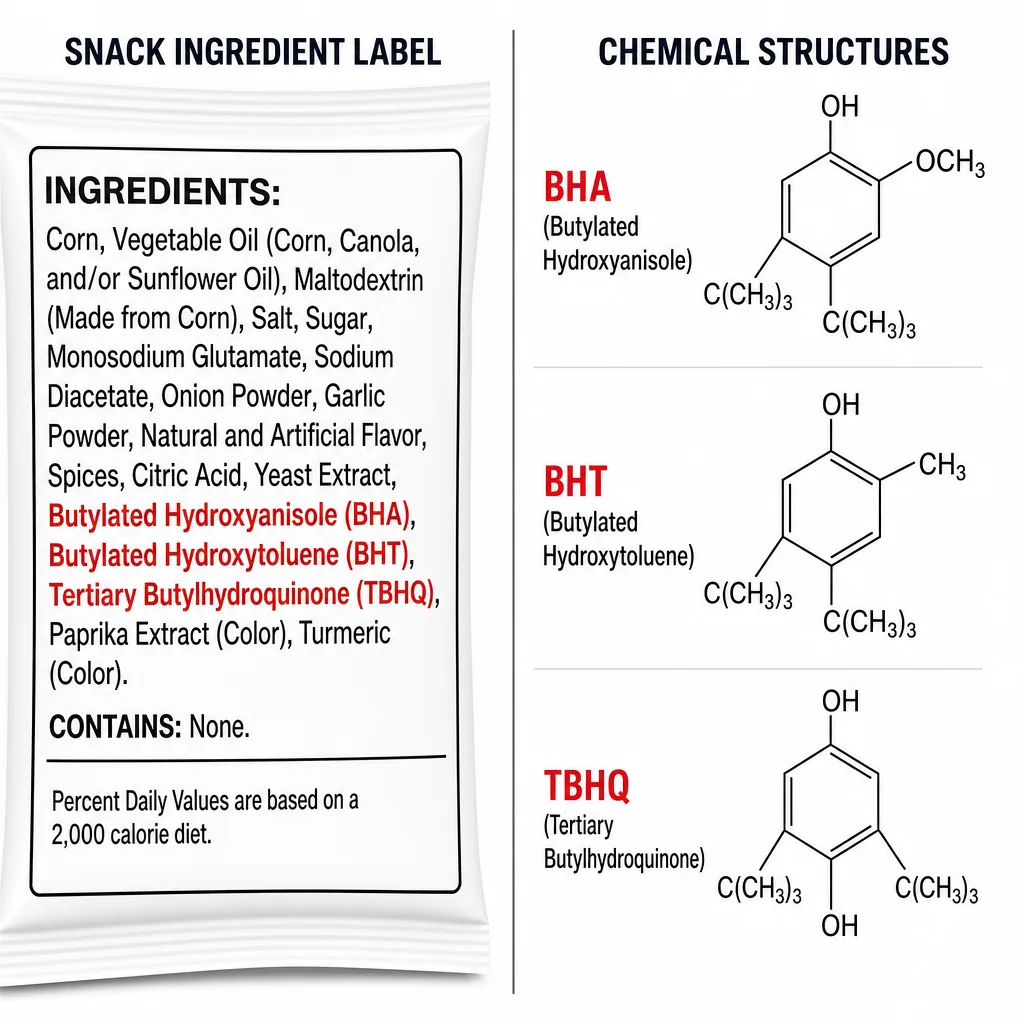
This trio prevents fats and oils from oxidizing and turning rancid, extending shelf life in cereals, snack foods, chewing gum, and fried products.

BHA, butylated hydroxyanisole (E320), has been used since 1947. It carries the most contentious regulatory history of the three: IARC classified it as a possible human carcinogen (Group 2B) in 1986, based on tumor formation in the forestomach of rodents, a tissue type humans do not have. The FDA maintains BHA as GRAS, capped at 0.02 percent of the fat or oil content of a food. California's Proposition 65 requires a cancer warning label on products containing BHA above a set threshold, even though the ingredient remains legal nationwide.

BHT, butylated hydroxytoluene (E321), is chemically similar and commonly used in cereals, vegetable oils, and chewing gum. The EU has not banned BHT in food but restricts its concentration in cosmetics due to potential endocrine-disrupting properties, and the UK added BHT to its list of restricted cosmetic substances in 2024. BHT can also migrate into food from packaging materials as an "incidental additive," which under US rules does not require ingredient-list disclosure.

TBHQ, tertiary butylhydroquinone (E319), is the most heat-stable of the three and shows up in frying oils, frozen foods, and snack chips. Under 21 CFR 172.185, the FDA caps TBHQ at 0.02 percent of a food's oil or fat content, not a flat concentration in the finished product; for a food that is 10 percent fat, that works out to roughly 20 mg/kg of the whole product. FSSAI in India uses a different framework, setting limits category by category rather than a single oils-versus-other-foods split: most categories, including bakery products, cereal products, snacks, sauces, and fats and oils, permit up to 200 mg/kg, while specified processed-meat categories are limited to 100 mg/kg. Ongoing research, including work highlighted by Michigan State University's Center for Research on Ingredient Safety, has examined TBHQ's effects on immune system signaling, though no regulatory body has changed its approved status as a result.
Benzoates: The Soda and Salad Dressing Preservative

Sodium benzoate (E211), potassium benzoate (E212), benzoic acid (E210), and calcium benzoate (E213) inhibit mold, yeast, and bacterial growth in acidic foods such as soft drinks, fruit juices, pickles, and salad dressings.

The most publicized concern involves benzene, a known human carcinogen. When sodium benzoate is combined with ascorbic acid (vitamin C) in a beverage and exposed to heat or light over time, the two can react to form small amounts of benzene. The FDA tested a range of beverages after this was first identified in the early 2000s; most products fell below the EPA's 5 ppb drinking water limit for benzene, but some exceeded it, and several manufacturers reformulated their products in response. EFSA's 2016 re-evaluation of benzoic acid and its salts concluded the additives do not raise genotoxicity concerns at current authorized use levels, though the benzene-formation reaction under specific storage conditions remains a separate, narrower issue from the additive's baseline safety profile.

Sulfites: A Non-Allergy Sensitivity With Its Own Labeling Rule

Sulfur dioxide (E220), sodium sulfite (E221), sodium bisulfite (E222), sodium metabisulfite (E223), and potassium metabisulfite (E224) prevent browning and microbial spoilage, and appear heavily in dried fruit, wine, frozen potato products, and shrimp.

Sulfites are not one of the FALCPA major allergens; they trigger a distinct, non-IgE sensitivity that mainly affects asthmatics, at an estimated rate of 3 to 10 percent of that population. The FDA requires sulfite disclosure on any label when the concentration reaches 10 ppm or more of total sulfur dioxide, and TTB enforces the same 10 ppm threshold specifically for wine, where a "Contains Sulfites" statement is mandatory above that level regardless of whether the winemaker added sulfites directly, since fermentation itself produces some naturally. Following a wave of sulfite-induced asthmatic reactions and at least 13 deaths linked to sulfite-treated salad bar produce in the 1980s, the FDA banned sulfite use on fresh fruits and vegetables intended to be sold or served raw, with a narrow exception carved out for sliced or shredded raw potatoes destined for frying.

Nitrates and Nitrites: Cured Meat's Double-Edged Preservative

Nitrates and Nitrites: Cured Meat's Double-Edged Preservative

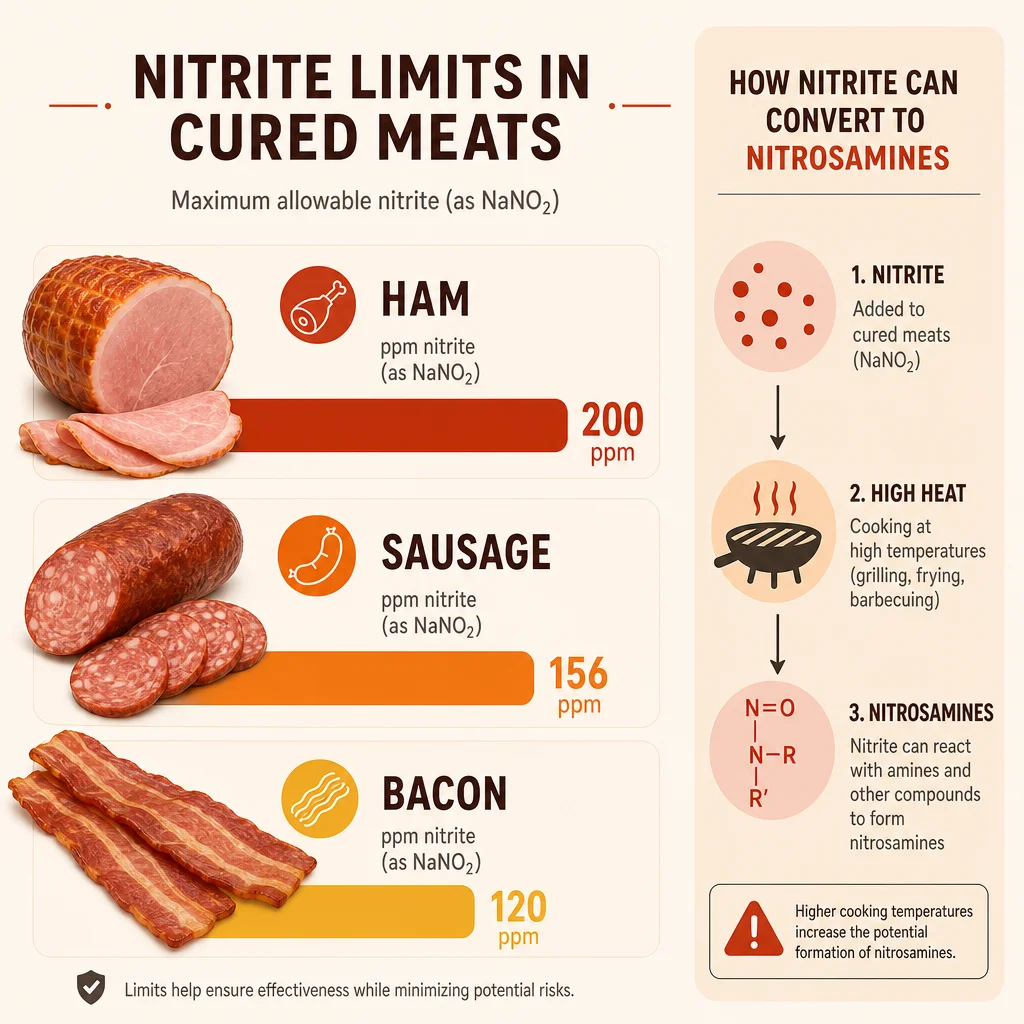
Sodium nitrite (E250), potassium nitrite (E249), sodium nitrate (E251), and potassium nitrate (E252) do two jobs at once in cured meat: they prevent growth of Clostridium botulinum, the bacterium responsible for botulism, and they produce the characteristic pink color of ham, bacon, and hot dogs. USDA sets strict legal ceilings on how much can be added: 200 ppm for ham and whole-muscle products, 156 ppm for sausage, and 120 ppm for bacon.

The concern is not the nitrite itself but what it can become. Under high heat or in the presence of certain amines, nitrites can form nitrosamines, compounds with clear carcinogenic activity in animal studies. This chemistry is central to why the IARC classified processed meat as a Group 1 carcinogen in 2015, its highest-confidence category, based on sufficient evidence that consumption causes colorectal cancer in humans. The Working Group estimated that each 50-gram portion of processed meat eaten daily raises colorectal cancer risk by 18 percent. A labeling wrinkle worth knowing: products marketed as "uncured" or "no nitrates or nitrites added" often use celery powder or celery juice extract instead, which is naturally high in nitrates. Once converted by bacterial culture during processing, the resulting nitrite performs an identical chemical function to the synthetic version. The FDA requires an additional disclaimer statement on these products, but the front-of-package "uncured" claim frequently misleads shoppers into believing the product is nitrite-free. Anyone managing sodium and cured-meat intake together may also want the Heart Health Dietary Guide, which covers how sodium and trans-fat claims hide on the same labels.

Propionates: The Bread Mold Inhibitor

Calcium propionate (E282) and sodium propionate (E281) prevent mold growth in bread and baked goods without affecting yeast fermentation during production, which is why they are typically sprayed on or added after the dough has already risen. Both are widely considered among the lower-concern preservatives, though some parent-reported and small observational studies have raised questions about a possible association with irritability or behavioral changes in sensitive children; the evidence has not been consistent enough to change GRAS status in the US or authorized status in the EU.

Parabens: Where the US and EU Genuinely Disagree

Methylparaben (E218), ethylparaben (E214), and propylparaben (E216) are used far more often in cosmetics and pharmaceuticals than in food, but they still appear in some baked goods, beverages, and flavor extracts as antimicrobial preservatives.

This is one of the clearest US-EU regulatory splits in the entire preservative category. Following an EFSA safety review that could not establish an adequate margin of safety for propylparaben and butylparaben, the European Union removed both from its authorized food additive list in 2006. Methylparaben and ethylparaben remain authorized in the EU. In the United States, the FDA still permits methylparaben and propylparaben as GRAS food preservatives, with no equivalent restriction, meaning a product legally sold in the US may contain an ingredient banned from the EU food supply entirely.

Sorbates: Generally the Safer Choice

Potassium sorbate (E202), sodium sorbate (E201), and calcium sorbate (E203) inhibit mold and yeast in cheese, wine, dried fruit, and baked goods, and are broadly regarded as one of the milder preservative categories from a toxicology standpoint. Contact dermatitis in sensitive individuals is the most commonly reported adverse reaction, and it is uncommon.

A Practical Label-Reading Strategy

This section is designed to work as a standalone reference when reading food labels for chemical preservatives.

Synthetic antioxidants to identify:

  • BHA / butylated hydroxyanisole (E320): FDA cap of 0.02% of fat/oil content; IARC Group 2B classification since 1986; triggers a Prop 65 warning label in California above threshold levels
  • BHT / butylated hydroxytoluene (E321): may appear as an "incidental additive" from packaging without ingredient-list disclosure
  • TBHQ / tert-butylhydroquinone (E319): FDA caps it at 0.02% of the food's oil/fat content (21 CFR 172.185, not a flat mg/kg figure); FSSAI sets category-specific limits, commonly 200 mg/kg, with 100 mg/kg for specified processed-meat categories
  • Propyl gallate (E310): often paired with BHA/BHT in the same product

Benzoates to identify (watch for pairing with vitamin C in beverages):

  • Sodium benzoate (E211)
  • Potassium benzoate (E212)
  • Benzoic acid (E210)
  • Calcium benzoate (E213)
  • Ascorbic acid / vitamin C listed alongside any benzoate on a beverage label, since heat and light exposure over time can generate trace benzene

Sulfites to identify (mandatory disclosure at 10 ppm or above under FDA and TTB rules):

  • Sulfur dioxide (E220)
  • Sodium sulfite (E221)
  • Sodium / potassium bisulfite (E222 / E228)
  • Sodium / potassium metabisulfite (E223 / E224)
  • Common sources: dried fruit, wine, frozen potato products, shrimp, bottled lemon or lime juice

Nitrates and nitrites to identify (and the "uncured" labeling loophole):

  • Sodium nitrite (E250) / potassium nitrite (E249)
  • Sodium nitrate (E251) / potassium nitrate (E252)
  • Celery powder / celery juice extract / cultured celery extract: naturally derived nitrate sources used in "uncured" or "no nitrates or nitrites added" products, functionally equivalent once bacterially converted
  • Sodium erythorbate (E316): a curing accelerant often listed alongside nitrite, not itself a preservative

Other preservatives to identify:

  • Calcium propionate (E282) / sodium propionate (E281): bread mold inhibitors
  • Methylparaben (E218) / propylparaben (E216): propylparaben is banned from food in the EU (2006) but still GRAS-permitted in the US
  • Potassium sorbate (E202) / sodium sorbate (E201) / calcium sorbate (E203): among the lower-concern preservative options

Step-by-step scanning checklist:

  1. For sodas and juices, check whether sodium benzoate is listed together with ascorbic acid, and favor products that use potassium sorbate or refrigeration-based preservation instead if this combination concerns you.
  2. For cured meats, look past the front-of-package "uncured" or "no nitrates or nitrites added" claim and read the fine-print disclaimer statement required beneath it; celery-powder-cured products still contain functional nitrites.
  3. For baked snacks and cereals, scan for BHA specifically if you are trying to avoid IARC's Group 2B "possibly carcinogenic" classification; BHT is a separate IARC Group 3 (not classifiable) and TBHQ has not been evaluated by IARC at all, so the 2B concern applies to BHA alone. Note that "antioxidant (320)" or "(321)" on imported packaging refers to BHA and BHT respectively.
  4. For wine, dried fruit, and bottled citrus juice, check for a sulfite declaration if you have asthma or a known sulfite sensitivity; the 10 ppm threshold applies regardless of product type.
  5. For any imported product using EU E-number labeling, cross-reference the number against the categories above rather than assuming an unfamiliar code is unregulated.
  6. If avoiding parabens specifically for EU-equivalent standards, check for propylparaben or butylparaben by name, since US labels are not required to flag them as restricted elsewhere.

IngrediCheck can scan an ingredient list and flag every synthetic preservative by name or E-number, including celery-derived nitrite sources hiding behind "uncured" claims and paraben variants that carry different legal status between the US and EU, so you can shop according to your own risk tolerance rather than a front-of-package claim.

Next Label Check

Follow the scanner, hub, and ingredient paths connected to this guide

Get the app for clearer label decisions.

Scan labels, see what fits your food notes, and read the why in plain English.

IngrediCheck app