Dietary Guides

Pollo Pescatarian Diet Guide: Cutting Red Meat While Keeping Poultry and Seafood

Pollo pescatarians eat chicken, turkey, fish, and shellfish but cut out beef, pork, and lamb entirely. The catch is that red-meat derivatives, gelatin, lard, tallow, and hidden beef stock, still turn up in products that look poultry- or seafood-based.

Jun 25, 2026|13 min read
By Sanket Patel|Updated 2026-06-25|3 sources|Editorial standards
Pollo Pescatarian Diet Guide: Cutting Red Meat While Keeping Poultry and Seafood

Of all the diets that trim animal protein without eliminating it, pollo pescatarian is the most permissive. Chicken is fine. Turkey is fine. Duck, shrimp, salmon, mussels, eggs, and dairy are all fine. The single line drawn is against red meat: no beef, no pork, no lamb, no goat, and no venison or other game. It is often the easiest diet in this family to adopt, since two of the three major animal protein categories, poultry and seafood, stay completely on the table.

That breadth narrows the label-reading problem without eliminating it. Red meat itself is easy to spot on a package. The real risk sits where it does for pescatarians and pollotarians: rendered fats, gelatin, and stock concentrates that never announce their species of origin. A "chicken" soup base can still rest on a beef stock foundation, and a gummy vitamin sold next to fish oil capsules can still use pork gelatin. This guide covers where those hidden red-meat ingredients show up, what regulators do and do not require manufacturers to disclose, and how to scan a label with confidence.

What the Pollo Pescatarian Diet Actually Requires

What the Pollo Pescatarian Diet Actually Requires

"Pollo pescatarian" combines two roots familiar from other flexible diets: pollo (chicken, used generically for poultry) and pesce (fish). The term describes someone who eats poultry and all forms of fish and seafood, typically also eats eggs and dairy, and excludes only the mammalian meats grouped as "red meat."

Permitted:

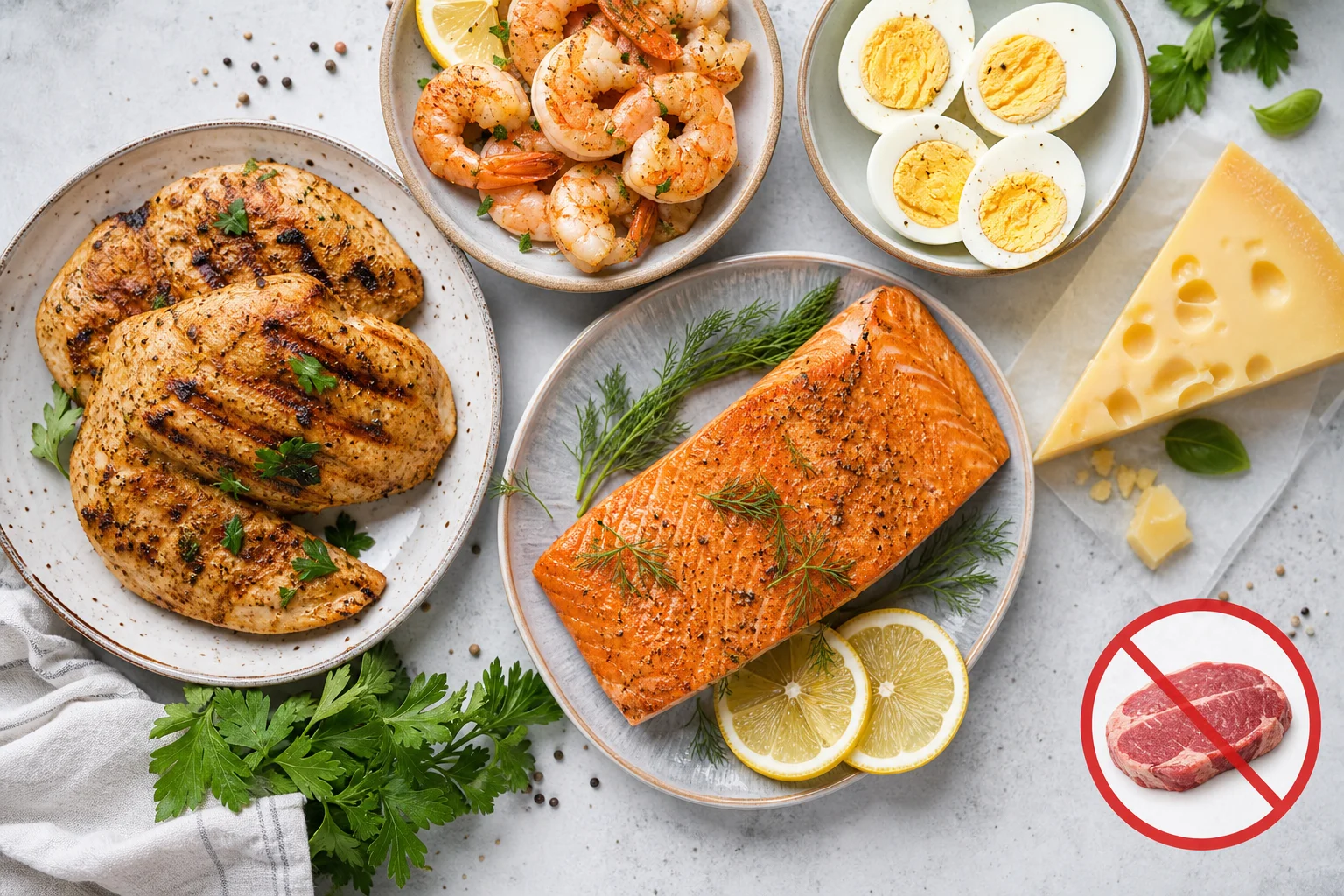
  • All poultry: chicken, turkey, duck, goose, quail, and other domesticated birds, in any cut or preparation
  • All fish: fresh, frozen, canned, smoked, or cured
  • All shellfish and other seafood: shrimp, crab, lobster, clams, oysters, mussels, scallops, squid, octopus
  • Eggs, in any form
  • Dairy: milk, cheese, butter, yogurt, cream
  • All plant foods

Not permitted:

  • Beef, veal, pork (including bacon, ham, and prosciutto), lamb, mutton, and goat
  • Venison, bison, rabbit, and other game or farmed mammal meat
  • Processed products made primarily from any of the above: salami, pepperoni, beef jerky, pork sausage

No government body or third-party certifier verifies "pollo pescatarian" as a labeling claim, so the responsibility for checking ingredient lists sits entirely with the shopper.

How It Differs From Pescatarian and Pollotarian

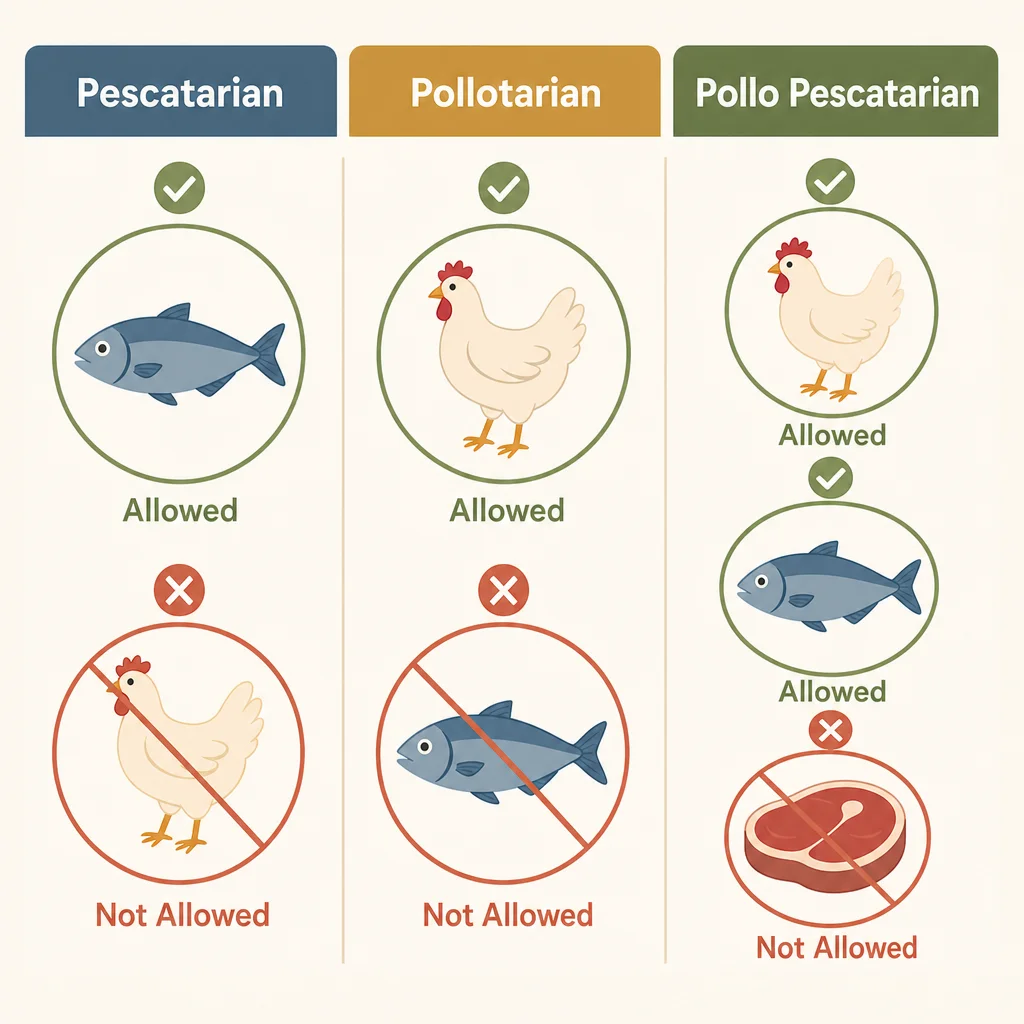
These three diets sound similar and overlap substantially, but each draws its line in a different place. A pescatarian eats fish and seafood but excludes all land animal flesh, so poultry is off-limits along with red meat. A pollotarian eats poultry but excludes both red meat and fish or seafood. A pollo pescatarian sits at the union of the two: poultry is in, seafood is in, and only red meat is excluded. The ingredient-label vigilance required is narrower than either sibling diet, but the categories that do apply, gelatin, rendered fat, and meat-based flavor bases, carry the same blind spots.

USDA and FDA Rules: What Counts as "Meat," "Poultry," and "Seafood"

USDA and FDA Rules: What Counts as "Meat," "Poultry," and "Seafood"

Hidden red-meat ingredients are easy to miss partly because federal regulators never built a single definition around this diet's dividing line.

Under the Federal Meat Inspection Act, USDA's regulations at 9 CFR 301.2 define "livestock" as cattle, sheep, swine, goat, horse, mule, or other equine, and define "meat" in terms of the carcasses of those animals. Poultry is carved out entirely and regulated under a separate law: USDA's regulations at 9 CFR 381.1, under the Poultry Products Inspection Act, define "poultry" as any domesticated bird, including chickens, turkeys, ducks, geese, guineas, and ratites, whether live or dead. Both schemes sit with USDA's Food Safety and Inspection Service, but neither treats birds as "meat."

USDA's own glossary of meat and poultry labeling terms exists because consumers misread label language built around this legal split rather than common usage. A product can be marketed as "all natural chicken broth" while containing a beef-derived flavor concentrate, since poultry inspection rules do not restrict what flavoring gets blended in.

Seafood sits under a third regulator: the FDA is responsible for the safety and labeling of fish and shellfish. No single federal definition maps cleanly onto "red meat" the way pollo pescatarians use the term.

The World Health Organization offers the clearest working definition. WHO's guidance on red meat and processed meat describes red meat as "all mammalian muscle meat, including beef, veal, pork, lamb, mutton, horse, and goat," a useful reference point even though it was built for a cancer-risk classification, not a dietary label. None of this regulatory patchwork requires disclosing whether "gelatin," "natural flavor," or "beef stock concentrate" appears in a product marketed around chicken or fish, which is where the real work of label reading begins.

Hidden Red-Meat Ingredients That Don't Look Like Meat

Because poultry and fish are both allowed, a pollo pescatarian scanning a label is looking for one thing: signs that a beef, pork, lamb, or goat derivative snuck into a product that otherwise reads as chicken- or seafood-friendly.

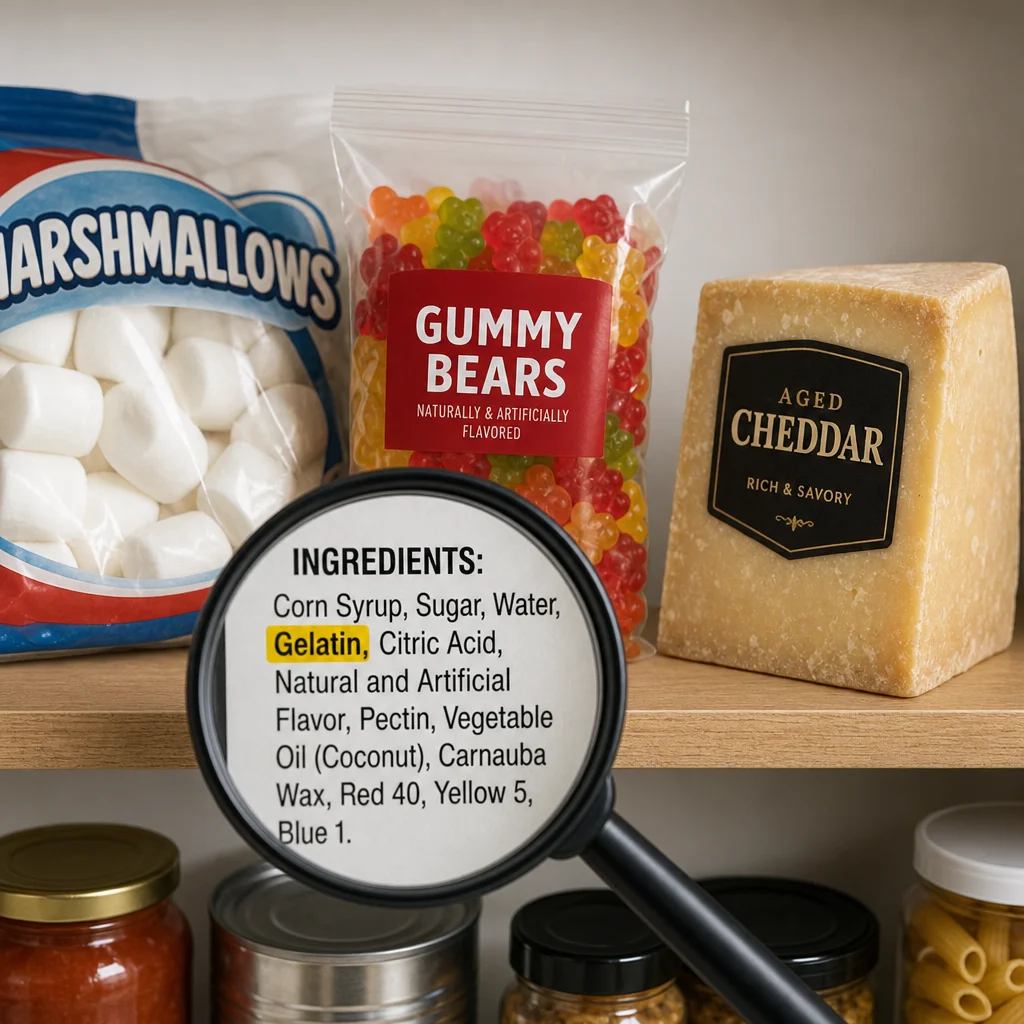
Gelatin. Collagen extracted from an animal's skin, bones, and connective tissue, most commonly pigs or cattle, though fish and poultry gelatin exist as distinct products. A label that just says "gelatin" gives no indication of species. It turns up in marshmallows, gummy candies, Jell-O and similar desserts, some yogurts, and gel capsules, where a fish oil softgel's shell can be a different species than its contents. Fish and poultry gelatin are both fine; unqualified "gelatin" almost always means pork or beef and should be treated as off-limits until confirmed otherwise.

Lard. Rendered pork fat, listed as "lard," "lard oil," or "animal shortening." A traditional ingredient in flour tortillas, refried beans, pie crusts, and tamale masa. Plain canned or dried beans without added seasoning are unaffected.

Tallow and suet. Tallow is rendered beef fat, listed as "tallow," "beef tallow," or "edible tallow," historically used in deep-fryer oil (classic fast-food fries used beef tallow before 1990s reformulations) and still found in some pastry shortenings. Suet, raw beef or mutton kidney fat, appears in traditional British puddings and mincemeat pie fillings.

Animal rennet and pepsin. Rennet coagulates milk into cheese and is traditionally extracted from a calf's stomach lining; pepsin, from pig stomach, plays a similar role in fewer cheeses and baked goods. Both usually appear only as "enzymes" or "animal rennet," with no qualifier. Microbial rennet and fermentation-produced chymosin are animal-free and acceptable.

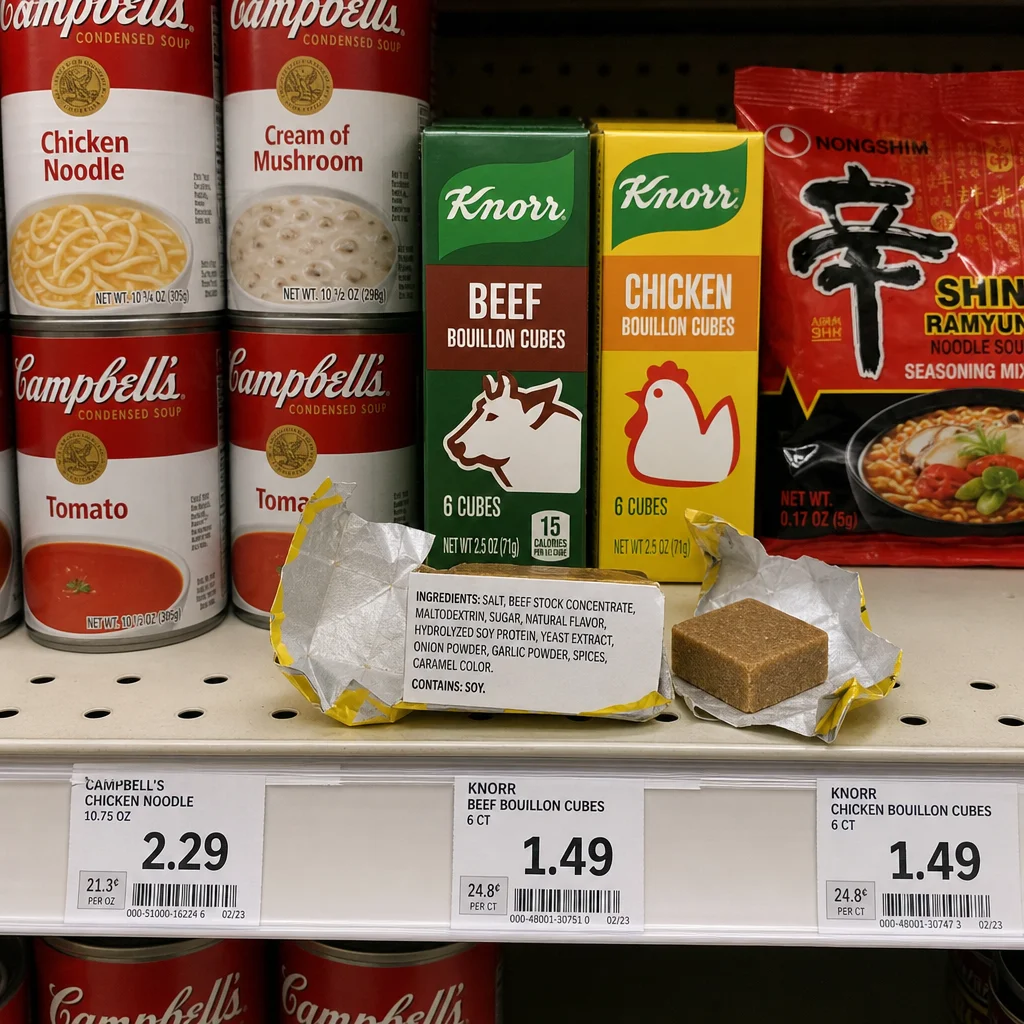
Beef and pork stock, broth, and extract. These flavor bouillon cubes, canned soups, seasoning packets, and sauce mixes, sometimes in products whose front label emphasizes chicken or seafood. A seafood ramen packet or a "chicken and vegetable" soup base can list beef extract as a secondary flavoring ingredient with no mention up front.

Bacon bits and bacon flavoring. Real bacon bits are explicitly pork. Imitation soy-based versions are usually fine, but some carry a rendered pork fat extract, so "imitation" alone is not a guarantee.

Worcestershire sauce. The classic recipe centers on tamarind, vinegar, molasses, and anchovies, which is entirely acceptable. Some commercial versions add a beef stock concentrate alongside the anchovy base for extra umami, which would not be, and it hides inside Caesar dressing and French onion soup mixes.

Mono- and diglycerides (E471), glycerin/glycerol (E422), and stearic or oleic acid. These emulsifiers and fatty acids appear across baked goods, margarine, and confectionery, and can be derived from beef tallow, pork lard, or vegetable oil, with the source rarely specified.

Natural flavors. Under FDA's regulatory definition at 21 CFR 101.22, "natural flavor" can legally include a compound derived from meat, seafood, poultry, eggs, or dairy, all under one catch-all phrase. The entry could be entirely poultry-derived, or it could include a beef or pork extract, and the label does not distinguish the two.
Why Cut Red Meat but Keep Poultry and Seafood

Why Cut Red Meat but Keep Poultry and Seafood

Pollo pescatarian eating fits within the broader flexitarian family of diets that reduce, rather than eliminate, animal protein. Cleveland Clinic describes flexitarian-style eating as centered on plant foods while leaving room for meat, and many people land on cutting red meat specifically because the case against it is better documented than the case against poultry or fish.

The World Health Organization's International Agency for Research on Cancer has classified red meat as "probably carcinogenic to humans" (Group 2A), based on evidence linking it to colorectal cancer risk; poultry and fish were not included in that finding. Separately, analysis from Our World in Data shows beef production carries a dramatically larger carbon footprint than chicken, even after accounting for methane's shorter atmospheric lifetime. Neither rationale requires excluding poultry or seafood, which is exactly why pollo pescatarian eating exists as its own distinct pattern rather than collapsing into pescatarianism or full vegetarianism.

A Practical Label-Reading Strategy

A pollo pescatarian diet permits poultry (chicken, turkey, duck, and other domesticated birds) and all fish and seafood, along with eggs and dairy, and excludes only red meat: beef, veal, pork, lamb, mutton, and goat. USDA regulates meat and poultry as two separate categories under two separate statutes, and neither definition treats birds as "meat"; FDA separately regulates seafood. No agency requires disclosing the animal source behind terms like "gelatin," "enzymes," or "natural flavor," which is why those catch-all names are where red meat hides in an otherwise poultry- or seafood-friendly product.

Strictly avoid:

  • Beef, veal, pork, lamb, mutton, goat, venison, bison, or rabbit, in any named form
  • Lard / lard oil / animal shortening: rendered pork fat in tortillas, pastry, and refried beans
  • Tallow / beef tallow / edible tallow: rendered beef fat in frying oil, shortening, and baked goods
  • Suet: raw beef or mutton kidney fat in traditional pastry and puddings
  • Gelatin or hydrolyzed gelatin (unqualified, or specified as pork or beef): in gummies, marshmallows, some yogurts, capsules, and gummy vitamins; fish or poultry gelatin is acceptable
  • Beef broth / beef stock / beef extract / beef fat: often hidden inside chicken- or seafood-branded soups and seasoning packets
  • Pork broth / pork stock / ham stock / pork extract: same concern, pork-sourced
  • Bacon / bacon fat / real bacon flavoring: explicitly pork
  • Animal rennet: enzyme from a calf's stomach in cheesemaking, listed as "enzymes" without a microbial or vegetable qualifier
  • Pepsin: digestive enzyme from pig stomach used in some cheeses and baked goods

Limit or verify before buying:

  • Gelatin with no source specified: could be pork, beef, fish, or poultry; look for "fish gelatin" explicitly
  • Natural flavors: under FDA rules this term can legally include meat, poultry, seafood, dairy, or egg-derived compounds with no distinction required
  • Enzymes in cheese: may be animal rennet, microbial rennet, or fermentation-produced chymosin; look for "microbial," "vegetable," or "FPC"
  • Glycerin / glycerol (E422) and mono- and diglycerides (E471): may be plant- or animal-fat derived, including beef tallow or pork lard
  • Worcestershire sauce and Worcestershire-based dressings: the anchovy base is fine, but some versions add beef extract alongside it
  • Stearic acid / oleic acid: fatty acids occasionally tallow-derived rather than plant-derived
  • Fried foods from restaurants or shared fryers: may be cooked in beef tallow

Confirmed safe:

  • Chicken, turkey, duck, and all other poultry, in any cut or preparation
  • All fish and shellfish: salmon, tuna, shrimp, crab, lobster, clams, oysters, mussels, scallops, squid, octopus
  • Fish gelatin and poultry-derived gelatin, when explicitly labeled
  • Eggs and all egg products; dairy: milk, cheese, butter, yogurt, cream
  • Microbial rennet / fermentation-produced chymosin (FPC) / vegetable rennet: non-mammalian cheese coagulants
  • Pectin, agar, carrageenan, konjac/glucomannan: plant-derived gelatin substitutes
  • Chicken broth, chicken stock, chicken fat, and schmaltz: poultry-sourced
  • Fish sauce, fish stock, and dashi made with bonito: seafood-derived
  • Soy lecithin and sunflower lecithin: plant-derived alternatives to animal-derived mono- and diglycerides

Ignore these label claims on their own:

  • "Natural": does not exclude lard, tallow, or beef-derived flavoring
  • "No preservatives" or "no artificial flavors": says nothing about the species source of a natural flavor or fat
  • "Farm fresh" or "homestyle": marketing language with no bearing on sourcing
  • "Gluten-free": a different concern entirely, unrelated to animal-derived ingredients

Scanning checklist:

  1. Read the entire ingredient list, not just the front-of-pack description; a chicken- or seafood-branded product can still list a beef- or pork-derived ingredient further down.
  2. Treat any unqualified "gelatin" as suspect until it names "fish gelatin" or a poultry source.
  3. Check the fat or shortening entry in tortillas, pie crusts, and fried snacks for "lard," "tallow," or "animal shortening."
  4. Look at soup bases, bouillon cubes, and ramen packets for "beef broth," "beef extract," "beef fat," or "pork extract," even when the name emphasizes chicken or seafood.
  5. For cheese, check whether "enzymes" or "rennet" is qualified as "microbial," "vegetable," or "FPC." If not, verify with the manufacturer or pick a different product.
  6. For Worcestershire sauce and anything built on it, confirm the ingredient list does not add beef extract alongside the anchovy base.
  7. For gummy vitamins and supplement capsules, check the capsule shell separately from the contents; a fish oil softgel can still have a beef- or pork-gelatin shell.

IngrediCheck scans full ingredient lists against a database of red-meat-derived aliases, including lard, tallow, unqualified gelatin, and beef- or pork-based stock and extract entries, and flags them for a pollo pescatarian profile without also flagging the poultry and seafood ingredients this diet allows. That distinction matters here more than in stricter diets: a scanner tuned only to "meat" in general would wrongly reject a perfectly acceptable chicken broth or fish stock product.

Pollo pescatarian eating is one of the more forgiving diets to shop for, since two entire categories of animal protein, poultry and seafood, stay fully available. The remaining risk is narrow but real: lard in tortillas, beef stock hiding inside a chicken-branded soup base, unqualified gelatin in a gummy vitamin, or Worcestershire sauce quietly fortified with beef extract alongside its anchovies. None of this shows up on the front of the package, and federal labeling rules do not require spelling out the species behind a "natural flavor" or an "enzyme." IngrediCheck reads the full ingredient list against a database built to catch red-meat-derived aliases like these, so a pollo pescatarian can trust a chicken broth or fish stock product without tracking down the manufacturer every time.

Next Label Check

Follow the scanner, hub, and ingredient paths connected to this guide

Get the app for clearer label decisions.

Scan labels, see what fits your food notes, and read the why in plain English.

IngrediCheck app