Quick answer: The Swaminarayan diet is a strict lacto-vegetarian practice followed by members of the Swaminarayan sampradaya, a Vaishnav Hindu tradition founded by Bhagwan Swaminarayan. Followers avoid meat, poultry, fish, and eggs, avoid all alcohol, and, distinctively, avoid onion and garlic, which are classified as rajasic and tamasic foods that agitate the mind. On packaged labels, onion and garlic hide inside "natural flavor," "spices," dehydrated vegetable blends, and savory seasoning bases. Hidden animal ingredients like gelatin and L-cysteine, and alcohol-derived ingredients like vanilla extract, add another layer of scrutiny. See "A Practical Label-Reading Strategy" below for the full checklist.
Dietary Guides
Swaminarayan Diet Guide: Onion, Garlic, and Hidden Animal Ingredients on Food Labels
A guide to the Swaminarayan diet's satvik food principles, its no-meat, no-onion-garlic, no-alcohol rules, and how to spot hidden allium, animal, and alcohol-derived ingredients on packaged food labels.
Jun 26, 2026|13 min read
Start from the cluster
Try it yourself
Does this conflict with Swaminarayan?
The Philosophy Behind the Restrictions
The Swaminarayan sampradaya traces its origin to Bhagwan Swaminarayan, who established the tradition in Gujarat in the early 19th century. Today the community is represented by several branches, including BAPS Swaminarayan Sanstha, Swaminarayan Vadtal Gadi, and Swaminarayan Gadi (Maninagar), each tracing its lineage back to the same founder and scripture. Across these branches, diet is not treated as a side detail of religious life. It is one of the central disciplines through which a devotee practices ahimsa, non-violence toward all living beings, and cultivates a clear, undisturbed mind suited to devotion.
The reasoning draws on the older Hindu framework of the three gunas, qualities said to run through all matter, including food. Sattvic foods are fresh, light, and considered to promote clarity and calm. Rajasic foods are stimulating, associated with restlessness and passion. Tamasic foods are heavy or stale, associated with dullness and inertia. Onion and garlic occupy an unusual place in this framework. Despite being plant foods, they are classified as rajasic or tamasic depending on the tradition, believed to overstimulate the senses and cloud the mind rather than nourish it. BAPS Swaminarayan Sanstha describes this reasoning directly, noting that "purity of diet purifies the antahkaran," the inner faculty of mind and conscience, and that a stabilized mind is what makes meditation and devotion possible.
The core dietary code for the tradition traces back to the Shikshapatri, a 212-verse text of conduct attributed to Bhagwan Swaminarayan. Its verses instruct followers never to eat meat, even as part of a religious offering, and never to drink liquor or wine, even if it has been offered to a deity first. This is a meaningful distinction from many other vegetarian traditions: the prohibition on alcohol is not a modern health preference layered onto an older diet, it is written into the same scriptural code that establishes the meat and vegetarian rules.
Swaminarayan Diet Rules: What's Prohibited and Why
The core, year-round rules that define the Swaminarayan diet are consistent across the major branches of the tradition:
- No meat, poultry, fish, or seafood. All animal flesh is prohibited without exception, tied directly to ahimsa.
- No eggs. Eggs are treated the same as meat in most Swaminarayan communities, regardless of whether they are fertilized.
- No onion or garlic. This extends in many households to related alliums such as leeks, chives, and shallots, which share the same rajasic or tamasic classification.
- No alcohol. This includes wine, liquor, and beer in any quantity, and it applies even to alcohol used in a religious context.
- Purity in preparation. Food should be cooked by a devotee in a clean environment and, in many households, offered to God before it is eaten as prasad.
Observance intensity varies by role within the community. Initiated sadhus and sants, monastics who have taken formal vows, follow the strictest version of the code, extending discipline to details of food preparation, timing, and contact that go beyond what is expected of a lay household. Lay devotees, or grihasthas, are expected to hold the core rules, no meat, no onion or garlic, no alcohol, but generally have more flexibility around processed and packaged convenience foods, provided the ingredients themselves don't violate the code. Many devotees also observe additional restrictions during fasting days such as ekadashi, when grains are sometimes avoided in favor of specific fasting foods, though this is a periodic practice layered on top of the year-round rules rather than a replacement for them.
Onion and Garlic on Labels: The Hidden Forms
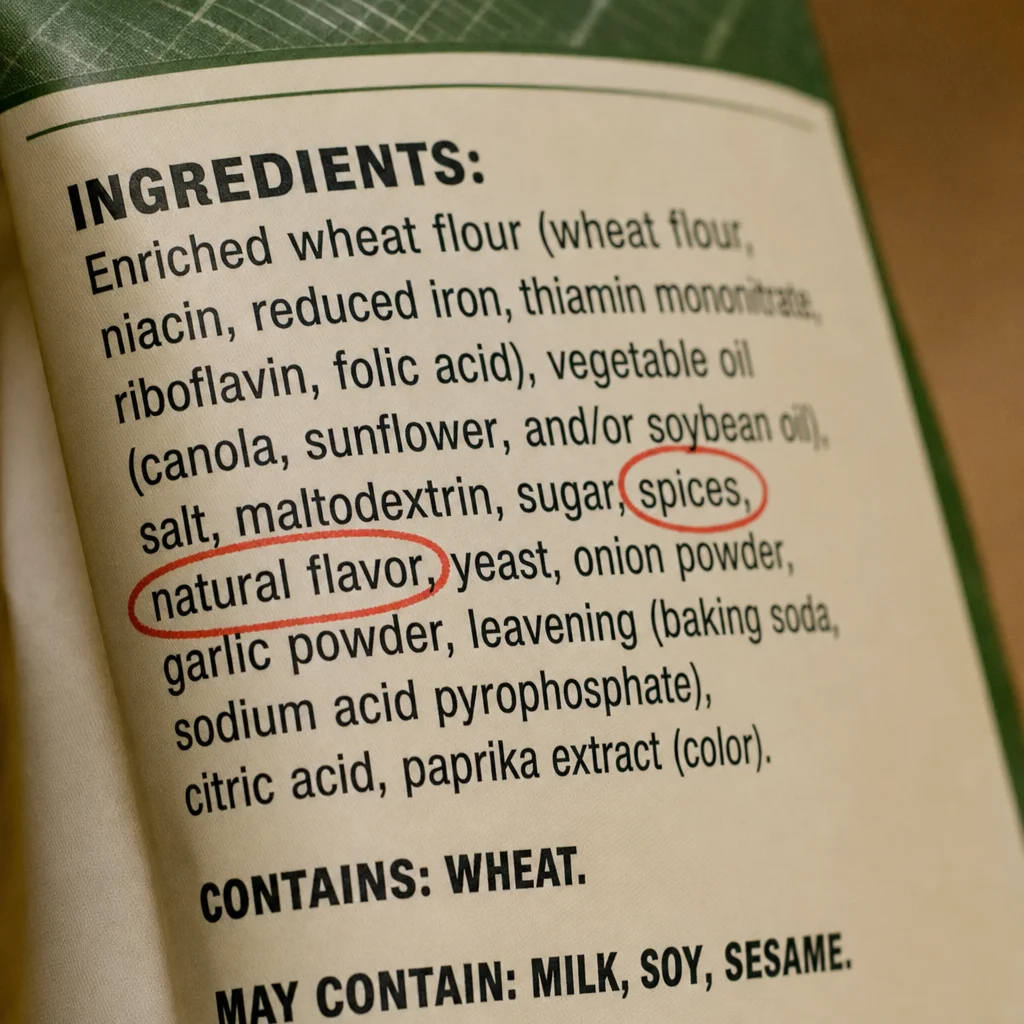
Reading a packaged food label for onion and garlic content is harder than it sounds, mostly because neither ingredient is a recognized allergen under US or EU law. Manufacturers have no legal obligation to call them out, so they appear under a wide range of names and buried inside composite terms.
Onion derivatives to watch for: onion powder, dehydrated onion, onion flakes, onion extract, onion oil, onion salt, toasted onion, fried onion, onion juice concentrate.
Garlic derivatives to watch for: garlic powder, dehydrated garlic, garlic flakes, garlic extract, garlic oil, garlic salt, roasted garlic, garlic juice concentrate.
The bigger challenge sits in vague, composite category terms. Under FDA regulation 21 CFR 101.22, a manufacturer may declare spice, natural flavor, and artificial flavor collectively as "spice," "natural flavor," or "artificial flavor," without listing each individual botanical source. That same regulation does carve out an exception for onion and garlic powders specifically, since they're considered food rather than flavor when added for bulk. But manufacturers don't always follow that distinction cleanly in practice, and onion or garlic extracts used purely for flavoring can still be absorbed into a "natural flavor" declaration. The EU's food information regulation governs allergen disclosure and general labeling accuracy across Europe, but it likewise has no requirement to itemize individual spices or flavor components within a blend.
That leaves a handful of terms that require extra caution: "spice blend," "seasoning," "vegetable powder," "vegetable extract," "bouillon," "stock," and "broth flavoring." Nearly all commercially prepared broths and bouillon cubes contain onion, and most contain garlic as well, whether or not either word appears on the front label.
Asafoetida: The Traditional Onion-Garlic Substitute
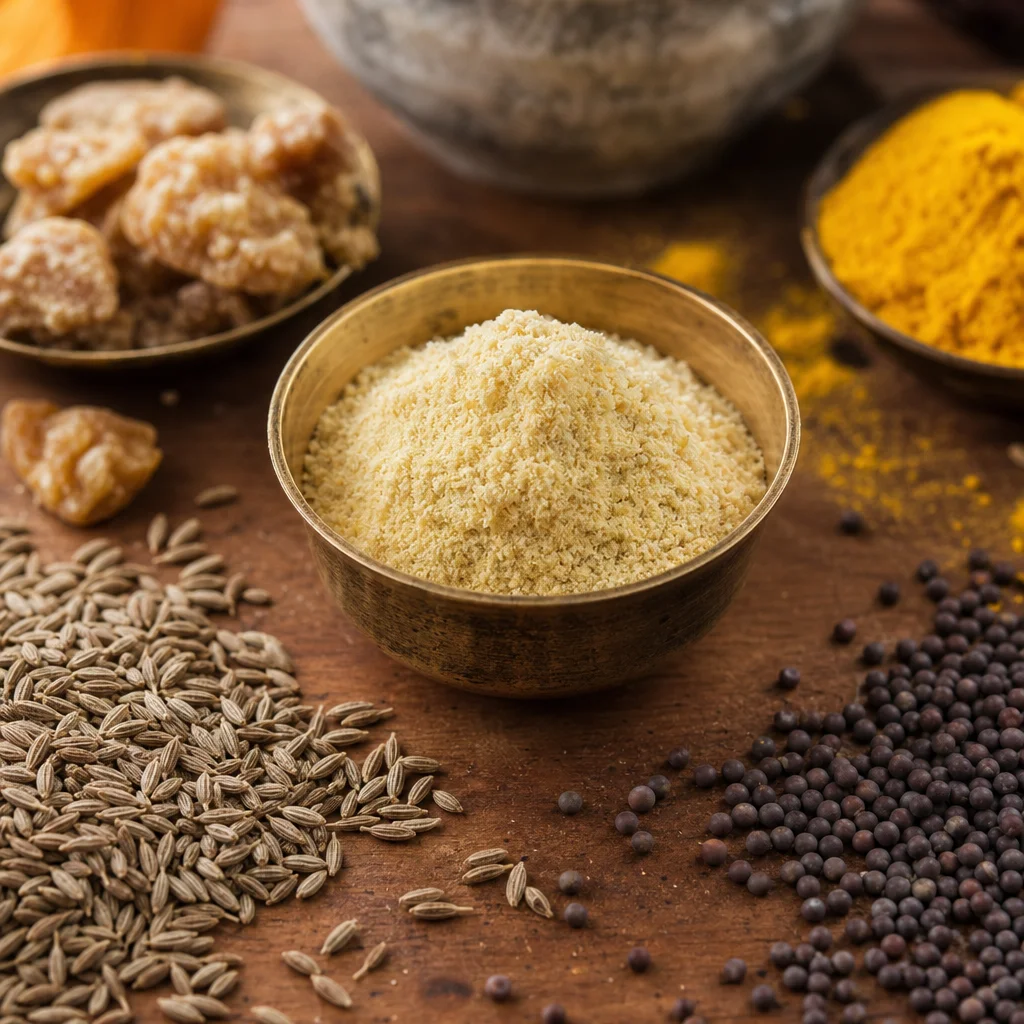
Swaminarayan cooking, like Jain and many Brahmin culinary traditions, relies heavily on asafoetida, known in Hindi as hing, to fill the savory role that onion and garlic play in most other South Asian cuisines. Asafoetida is a dried resin from the root of a giant fennel plant, ground into a powder and typically blended with a small amount of wheat or rice flour to stabilize it. Used raw, it has a sharp, sulfurous smell, but a small pinch bloomed in hot ghee or oil during the tempering stage turns savory and onion-like, adding depth to dals, vegetable curries, and rice dishes without introducing a rajasic or tamasic ingredient.
Because asafoetida is not itself classified as rajasic or tamasic, it functions as an accepted bridge ingredient. It gives Swaminarayan cooking, and Jain cooking alongside it, a way to reach the umami depth that onion and garlic typically provide, which is one reason the two culinary traditions overlap so heavily in practice even though their underlying reasoning for avoiding alliums differs.
Hidden Animal-Derived Ingredients on Vegetarian Labels
Beyond onion, garlic, and meat itself, several animal-derived ingredients turn up in packaged foods under names that don't obviously signal their origin.
Gelatin comes from boiled animal bone, skin, and connective tissue. It shows up in gummy candy, marshmallows, some yogurts, and capsule shells used in supplements and over-the-counter medication.
Animal rennet is an enzyme taken from the stomach lining of young ruminants and used to coagulate milk during cheese production. Many hard and aged cheeses rely on it. Labels that specify "microbial rennet" or "vegetable rennet" are the safer choice; the absence of that qualifier is a signal to look closer.
L-cysteine, sometimes listed as E920, is an amino acid used as a dough conditioner in commercial bread and baked goods. Industrially, most L-cysteine is produced by hydrolyzing animal material such as poultry feathers or hog hair, although synthetic, fermentation-derived versions also exist. The source is rarely specified on a US label.
Carmine and cochineal extract are red colorants derived from the dried, crushed bodies of the cochineal insect. Since 2011, the FDA has required these color additives to be declared by their common name on any food or cosmetic label, so "carmine" or "cochineal extract" listed by name is a reliable flag rather than something hidden under "color added."
Isinglass, a collagen product made from the dried swim bladders of fish, is used to clarify beer and wine during production. It's rarely present in detectable form in the finished drink and is almost never listed as an ingredient, which makes it one of the harder animal derivatives to catch through label reading alone.
Fish sauce, oyster sauce, and Worcestershire sauce are built around fermented fish or anchovies and turn up as flavor components in marinades, dressings, and many Asian-inspired sauce bases, sometimes without an obvious seafood reference in the product name.
Alcohol-Derived Ingredients to Watch For
Because the Swaminarayan code prohibits alcohol outright, not just as a beverage but as an ingredient category, a few common flavoring choices deserve specific attention.
Vanilla extract is the most common one. Under its FDA standard of identity, true vanilla extract must contain no less than 35 percent ethyl alcohol by volume, making it an alcohol-based product by legal definition rather than an occasional formulation choice. Vanilla flavoring (as opposed to extract) can legally contain less alcohol, and vanilla powder or vanilla bean paste typically contain none, so these are the safer alternatives to look for on a label.
Wine vinegar, sherry vinegar, and cooking wine used in sauces, marinades, and dressings are alcohol-derived, even though most of the alcohol evaporates during cooking. Strict observance treats these as ingredients to avoid rather than a matter of final alcohol content.
Rum extract, brandy extract, and other alcohol-based flavor carriers are used in baked goods and confections and function much like vanilla extract: the flavor compound is dissolved in an alcohol solvent that remains part of the finished ingredient list.
How Swaminarayan Differs from Jain and Sattvic Practice
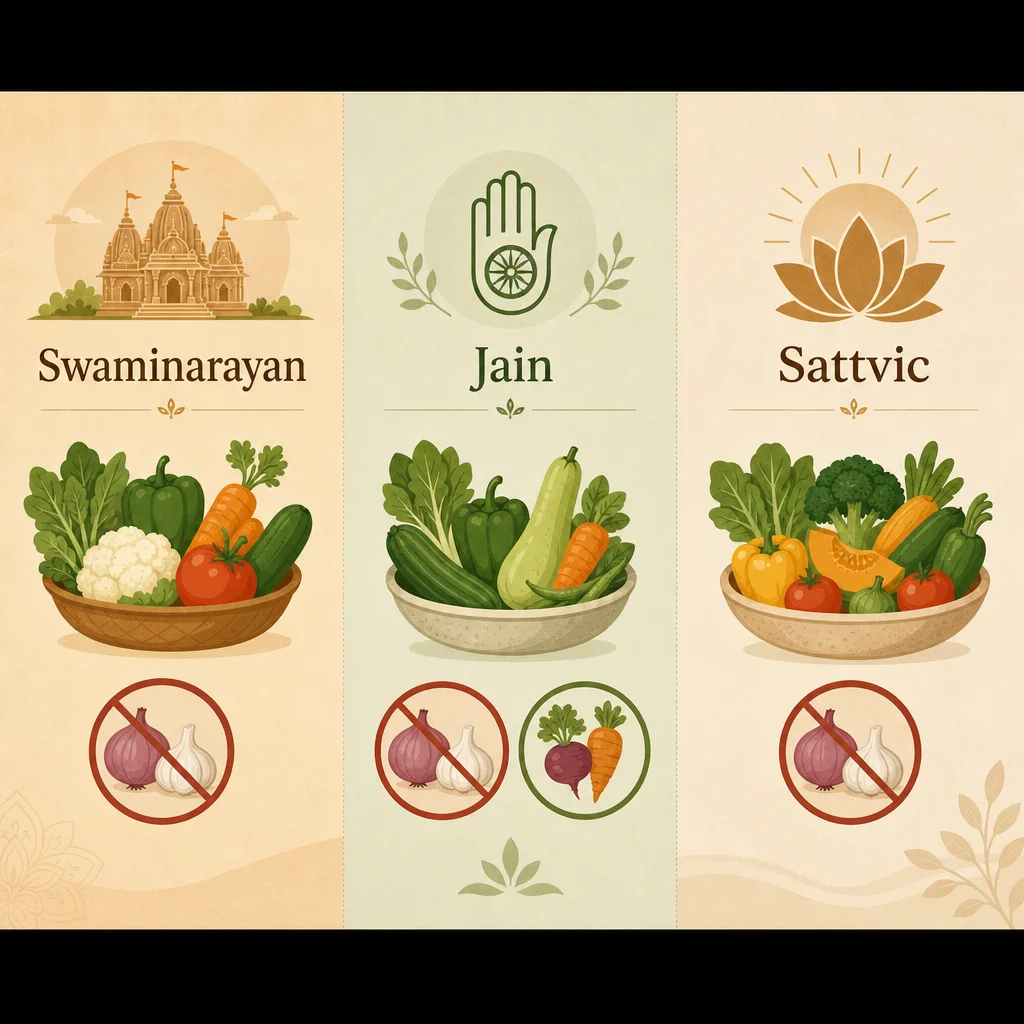
Swaminarayan, Jain, and sattvic eating overlap so heavily in daily practice, no meat, no onion, no garlic, an emphasis on freshly prepared food, that they're often mistaken for the same thing. The reasoning behind each is different, and that difference matters for how far the restrictions extend.
Jain dietary practice goes further than Swaminarayan practice in one specific direction: root vegetables. Jains avoid not just onion and garlic but also potato, carrot, beet, radish, and other underground vegetables, because uprooting them is believed to destroy large numbers of microscopic organisms living in the root and surrounding soil. Swaminarayan practice has no such rule. Potatoes, carrots, and other root vegetables are fully acceptable; onion and garlic are avoided specifically because of their rajasic and tamasic classification, a question of the food's effect on mind and temperament rather than harm to organisms in the soil.
Sattvic eating, by contrast, is a broader wellness and philosophical framework rather than a specific religious community's code. Anyone, regardless of religious affiliation, can choose to eat sattvic foods as a personal practice aimed at mental clarity and physical balance. The Swaminarayan diet shares the sattvic vocabulary and much of its food logic, but it is the formal dietary code of a defined religious tradition, rooted in the Shikshapatri and observed as a matter of religious discipline. The no-alcohol and no-meat/fish/egg rules are treated as core religious observance for Swaminarayan followers, not optional wellness choices that can be adjusted to taste.
A Practical Label-Reading Strategy
A Swaminarayan-compliant label check has to cover four separate categories at once: direct meat/poultry/fish/egg content, onion and garlic derivatives, hidden animal-derived ingredients, and alcohol-derived ingredients. The first of these is the most basic check and should be applied before anything else: not all of the rest are guaranteed to appear under an obvious name, and US and EU labeling rules both allow manufacturers to declare spices and flavors under vague collective terms rather than itemizing every component.
Direct meat, poultry, fish, and egg to search for: chicken, beef, pork, lamb, mutton, goat, turkey, duck, poultry, meat, fish, seafood, shrimp, prawn, crab, shellfish, egg, egg white, egg yolk, egg powder, and any ingredient or product name built directly around an animal or cut of meat (e.g. "chicken breast," "poultry meat," "fish fillet," "beef stock" as a named, not ambiguous, ingredient). This is not a hidden-ingredient case: Swaminarayan excludes all meat, poultry, fish, and eggs outright as a baseline rule, so a product whose ingredient list names flesh or egg directly fails the check immediately, regardless of whether any onion, garlic, alcohol, or hidden animal-derived additive is also present.
Onion and garlic derivatives to search for: onion, garlic, onion powder, garlic powder, dehydrated onion, dehydrated garlic, onion extract, garlic extract, onion oil, garlic oil, onion salt, garlic salt, toasted onion, roasted garlic, leek, chive, shallot, allium.
Ambiguous catch-all terms that may contain onion or garlic: natural flavor, spice, spice blend, seasoning, vegetable powder, vegetable extract, bouillon, stock, broth, broth flavoring. Under FDA rules, manufacturers can declare these collectively without naming individual botanical sources; EU rules carry a similar gap for blended spice and flavor components. In India, where a large share of the Swaminarayan community shops, FSSAI's mandatory green-dot and brown-dot packaging system confirms whether a product contains meat, fish, or egg, but it says nothing about onion, garlic, or alcohol content, so a green dot alone is not sufficient confirmation for a Swaminarayan household.
Animal-derived ingredients to search for: gelatin, animal rennet (versus microbial or vegetable rennet), L-cysteine or E920, carmine, cochineal extract, isinglass, fish sauce, oyster sauce, Worcestershire sauce, anchovy, anchovy paste, lard, tallow, whey (check source if labeled non-vegetarian), animal-derived lecithin.
Alcohol-derived ingredients to search for: vanilla extract, wine vinegar, sherry vinegar, cooking wine, mirin, rum extract, brandy extract, beer-based marinades, any ingredient listing "alcohol" or "ethyl alcohol" directly.
Numbered scanning checklist:
- First, check whether the product itself is or contains meat, poultry, fish, seafood, or egg as a direct, named ingredient (not a hidden derivative). If so, it fails the check immediately; skip the remaining steps.
- Read the entire ingredient list front to back rather than scanning only the first few items, since onion, garlic, and animal derivatives often appear mid-list or near the end.
- Search specifically for the words "onion," "garlic," "allium," "leek," "chive," and "shallot" in any form, powder, extract, oil, or flake.
- Flag any occurrence of "natural flavor," "spice," "spice blend," "seasoning," "vegetable powder," or "broth," and treat these as requiring manufacturer confirmation rather than automatic approval.
- Scan for animal-derived terms: "gelatin," "rennet," "L-cysteine," "carmine," "cochineal," "isinglass," "anchovy," "fish sauce," "oyster sauce," and "Worcestershire."
- Scan for alcohol-derived terms: "vanilla extract," "wine vinegar," "cooking wine," "mirin," "rum extract," and any direct mention of alcohol or ethanol.
- For cheese, check whether rennet is specified as microbial or vegetable; the absence of a qualifier is a reason for caution.
- For baked goods, check for L-cysteine and for vanilla extract specifically, since vanilla flavoring and vanilla powder are common lower-alcohol or alcohol-free alternatives.
- When a product's sourcing is unclear, contact the manufacturer directly. Many companies will confirm whether a "natural flavor" or "spice blend" includes onion, garlic, or alcohol-based components on request.
IngrediCheck scans a product's full ingredient list for direct meat, poultry, fish, and egg content first, then against a database built to catch onion and garlic derivatives, hidden animal-derived ingredients like gelatin and L-cysteine, and alcohol-derived flavorings like vanilla extract, flagging ambiguous catch-all terms that would otherwise require a phone call to the manufacturer to resolve.
Related Guides
- Jain Diet Food Restrictions List: Root Vegetables & Labels
- Sattvic Diet Guide: Foods to Eat, Avoid & Labels
- Vegetarian Diet Guide: Rennet, Gelatin, L-Cysteine, and Every Hidden Animal Ingredient on Labels
- Vegan Diet Guide: Hidden Animal Derivatives, E-Numbers, and Every Non-Vegan Ingredient on Labels
Following a Swaminarayan diet in a modern grocery store means checking a packaged label against three separate lists at once: onion and garlic in all their disguised forms, animal-derived ingredients that never announce themselves as such, and alcohol-based flavorings hidden inside otherwise ordinary-looking products. IngrediCheck was built to handle exactly that kind of layered check, scanning a full ingredient list at once and flagging the onion, garlic, animal-derived, and alcohol-derived ingredients that a Swaminarayan household needs to catch, so shopping decisions don't depend on memorizing every alias for every restricted ingredient.
On this page
Sources
Source lists are maintained with our editorial policy.
Next Label Check
Follow the scanner, hub, and ingredient paths connected to this guide
Scanner workflows
Sattvic scannerScanner workflow
Sattvic Ingredient Checker App
Scan labels for sattvic food rules, onion, garlic, preservatives, alcohol-based extracts, refined sugars, and additives with IngrediCheck.
Gluten-free scannerScanner workflow
Gluten-Free Barcode Scanner
Scan barcodes and labels for gluten clues, hidden wheat, barley, rye, malt, and celiac-relevant ingredient risks with IngrediCheck's gluten-free workflow.
Alpha-gal scannerScanner workflow
Alpha-Gal Ingredient Checker App
Scan labels for alpha-gal shopping rules, gelatin, lard, broth, dairy clues, and mammalian-source ingredients with IngrediCheck.
Topic hubs
Topic hub
Ingredient Safety
Explore IngrediCheck's ingredient safety hub for additives, contaminants, preservatives, and evidence-based label guidance.
Topic hub
Gluten-Free Label Reading
Find IngrediCheck's gluten-free topic hub covering hidden gluten, celiac-safe label reading, and ingredient-level guidance.
Topic hub
Ingredient Checker & Food Scanner Guides
Explore IngrediCheck's ingredient checker and food scanner guides for allergies, halal and kosher shopping, gluten-free label reading, low FODMAP screening, vegan checks, and family-specific food rules.
Related articles
Dietary GuidesArticle
Lacto Vegetarian Diet Guide: Hidden Egg Derivatives in a Dairy-Friendly Diet
Lacto vegetarians eat dairy freely but exclude eggs entirely, and packaged food rarely makes that distinction obvious. Albumin, lysozyme, and egg lecithin hide inside products labeled simply as vegetarian.
Dietary GuidesArticle
Lacto-Ovo Vegetarian Diet Guide: The Full Dairy-and-Egg Vegetarian Standard Explained
Lacto-ovo vegetarian is the diet most people mean when they say 'vegetarian': no meat, poultry, or fish, but dairy and eggs are both allowed. The real risk is the animal-derived ingredients that are neither.
Dietary GuidesArticle
Ovo Vegetarian Diet Guide: Hidden Dairy Names When Eggs Are Still on the Menu
Ovo vegetarians eat eggs but exclude every form of dairy, which makes casein, whey, ghee, and the 'non-dairy' labeling loophole the real label-reading challenge, not meat.
Get the app for clearer label decisions.
Scan labels, see what fits your food notes, and read the why in plain English.