30 Hidden Names for Sugar: What to Look for on Food Labels

Sugar hides on food labels under dozens of names. Here are 30 of the most common aliases and how to spot them before you buy.

Apr 16, 2026|9 min read
By Sanket Patel|Updated 2026-04-16|4 sources|Editorial standards
30 Hidden Names for Sugar: What to Look for on Food Labels

Walk down any grocery aisle and you will find products marketed as healthy, natural, or low fat that still contain plenty of added sugar. The reason is simple. Manufacturers have dozens of legal names they can use on an ingredient list, and most of them do not include the word "sugar" at all. Once you learn the patterns, the disguise stops working.

This guide breaks down 30 of the most common aliases for added sugar, why each one shows up in different categories of food, and how to use the Nutrition Facts label to spot the total amount even when the ingredient names are unfamiliar.
Why So Many Names?

Why So Many Names?

Two forces drive the sheer number of sugar aliases. The first is chemistry. Sugar is a family of carbohydrates that includes sucrose, glucose, fructose, lactose, maltose, and dozens of derivatives. Each one has a distinct chemical structure and a distinct industrial use, so manufacturers list them by their specific names rather than a generic term.

The second force is marketing. Words like "evaporated cane juice," "rice malt syrup," and "fruit juice concentrate" sound wholesome. They appear on packaging that wants to project a clean-label image. Functionally, your body processes most of these the same way it processes table sugar. The names are different. The metabolic effect is largely the same.

Federal labeling rules acknowledge the problem. Since the Nutrition Facts label was updated by the FDA, manufacturers must declare an "Added Sugars" line in grams and as a percent Daily Value. That line is the single most useful number on the package, and it is what we recommend you check first.

How Much Added Sugar Is Too Much?

Before you go hunting for hidden sugar, it helps to know the targets you are working against.

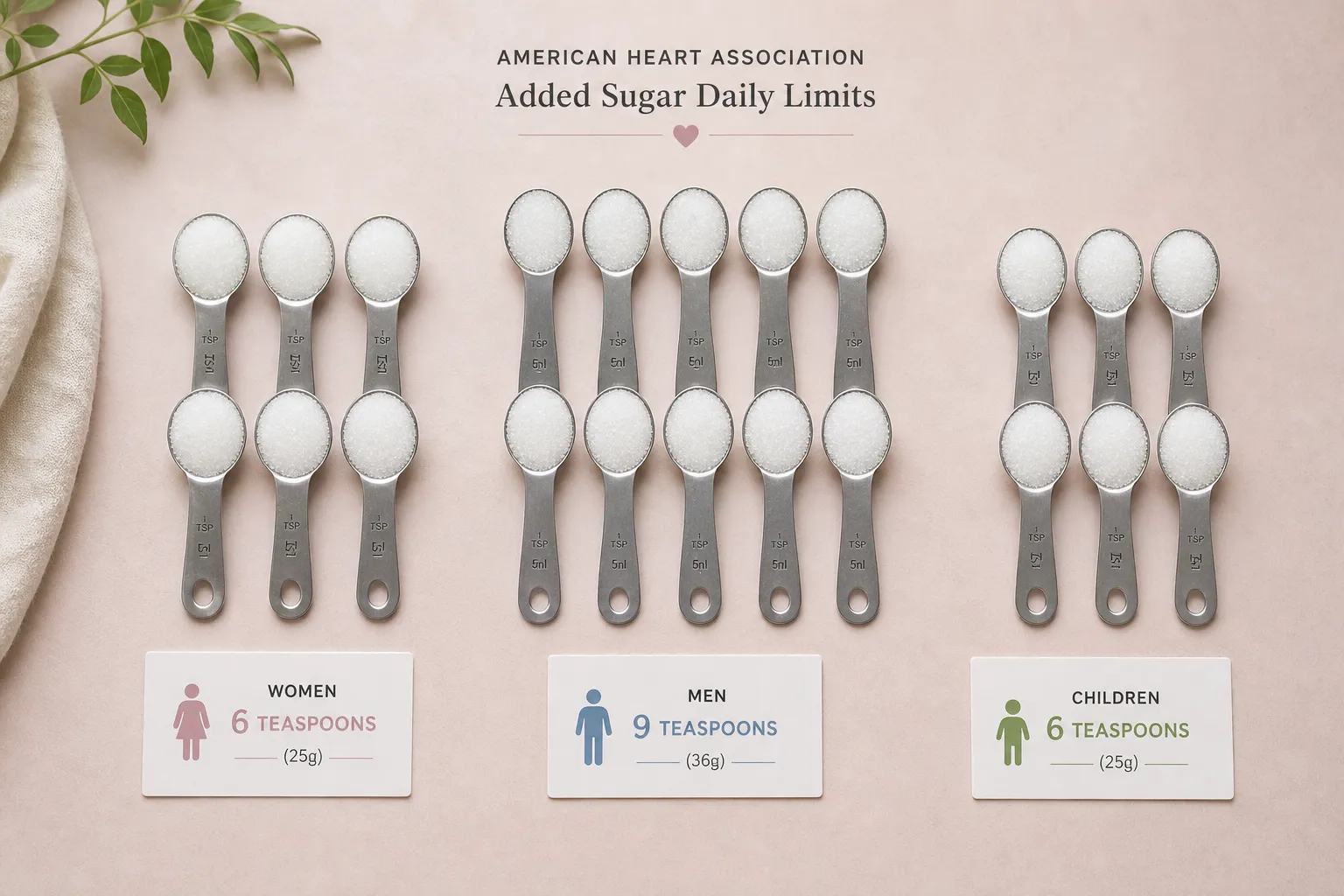
The American Heart Association recommends:

  • Men: no more than 36 grams (9 teaspoons) of added sugar per day
  • Women: no more than 25 grams (6 teaspoons) per day
  • Children ages 2 to 18: less than 24 grams (6 teaspoons) per day

The World Health Organization sets the ceiling at 10 percent of total daily calories from free sugars, with a stronger recommendation to stay under 5 percent. For a 2,000 calorie diet, that 10 percent ceiling is 50 grams.

One 12-ounce can of regular soda contains roughly 39 grams of added sugar. That single can puts a woman over the AHA daily limit and a man within 3 grams of his.

The CDC reports that average added sugar intake in the United States still exceeds these recommendations across most age groups, and a large share of that intake comes from packaged foods rather than obvious sources like candy and dessert.

The 30 Names to Know

The 30 Names to Know

The list below groups sugar aliases by family. The chemistry differs in detail, but for the purposes of a daily diet, treat every entry on this list as added sugar.

Common syrups

These are concentrated liquid sugars, often used to sweeten beverages, sauces, baked goods, and breakfast foods.

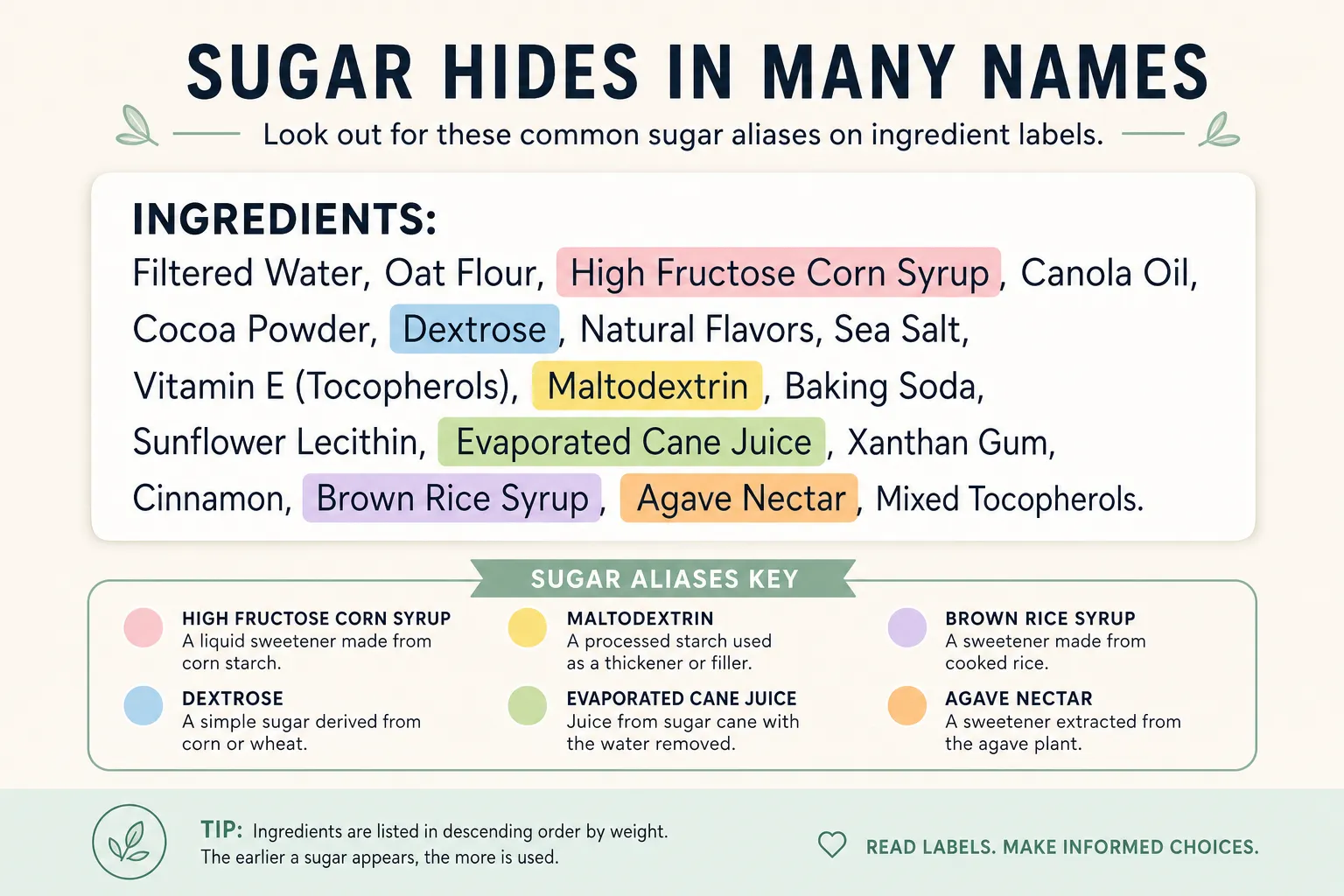
  1. High fructose corn syrup (HFCS). A blend of glucose and fructose derived from corn starch. Found in soda, sweetened yogurt, ketchup, and many breads.
  2. Corn syrup. Glucose syrup made from corn. Common in candy, baked goods, and frosting.
  3. Brown rice syrup (rice malt syrup). A glucose-rich syrup marketed as natural. Common in granola bars and "healthy" snack products.
  4. Maple syrup. A natural concentrated sugar from maple sap. Still added sugar from a metabolic standpoint.
  5. Agave nectar (agave syrup). Predominantly fructose. Often sold as a low-glycemic sweetener, though the high fructose load offsets that benefit.
  6. Golden syrup. An inverted sugar syrup popular in British baking and treacle tart.
  7. Date syrup. Concentrated sugar from dates. Marketed as natural, but it is still concentrated fructose and glucose.
  8. Cane syrup. Liquid sugar pressed from sugarcane.

Crystalline sugars

If the ingredient ends in "-ose" or contains the word "sugar," it is almost certainly added sugar.

  1. Sucrose. The chemical name for table sugar.
  2. Glucose. Also called dextrose. A simple sugar that appears in candies, baked goods, and sports drinks.
  3. Dextrose. Another name for glucose, often used in baking and processed snacks.
  4. Fructose. The sugar naturally found in fruit, also produced industrially and added to processed foods.
  5. Maltose. A two-glucose sugar produced during malting and brewing.
  6. Lactose. The sugar in milk. Naturally present in dairy, but also added to some processed foods.
  7. Galactose. Another simple sugar, often paired with glucose to form lactose.
  8. Turbinado sugar. A partially refined cane sugar with a light brown color.
  9. Demerara sugar. A coarse-grained, partially refined cane sugar.
  10. Muscovado sugar. A dark, unrefined cane sugar with strong molasses flavor.
  11. Coconut sugar (coconut palm sugar). Made from coconut palm sap. Marketed as a natural alternative, but its sugar content is similar to white sugar.

Marketing-friendly aliases

These names show up on packaging that wants to imply natural or whole-food sourcing. The ingredient is still added sugar.

  1. Evaporated cane juice. A name for a less-refined cane sugar. The FDA has stated this term is misleading and asks manufacturers to declare it as "sugar" or "cane sugar," but you may still see it on imported products and older inventory.
  2. Fruit juice concentrate. Concentrated sugars from fruit, with much of the fiber and water removed. Functions the same as syrup in baked goods and drinks.
  3. Cane juice (cane juice solids). Another less-refined cane sugar.
  4. Beet sugar. Sucrose from sugar beets. Chemically identical to cane sugar.
  5. Sorghum syrup. A concentrated syrup made from sorghum cane.
  6. Molasses. A byproduct of sugar refining. Contains some minerals, but it is still mostly sugar.
  7. Treacle. A British term for syrups produced during sugar refining.
  8. Caramel. When listed as an ingredient (not the color additive), caramel is sugar that has been heated and concentrated.

Sugar-related additives

These ingredients are technically sugars or behave like them in the body.

  1. Maltodextrin. A polysaccharide produced from corn, rice, or wheat starch. It has a glycemic index higher than table sugar in many products and behaves like added sugar metabolically.
  2. Diastatic malt powder (malt extract). Used in baking. Provides maltose and maltotriose, both sugars.
  3. Honey. Predominantly fructose and glucose. Counts as added sugar when used as an ingredient in packaged foods.

Why Manufacturers Split Sugars Across Multiple Names

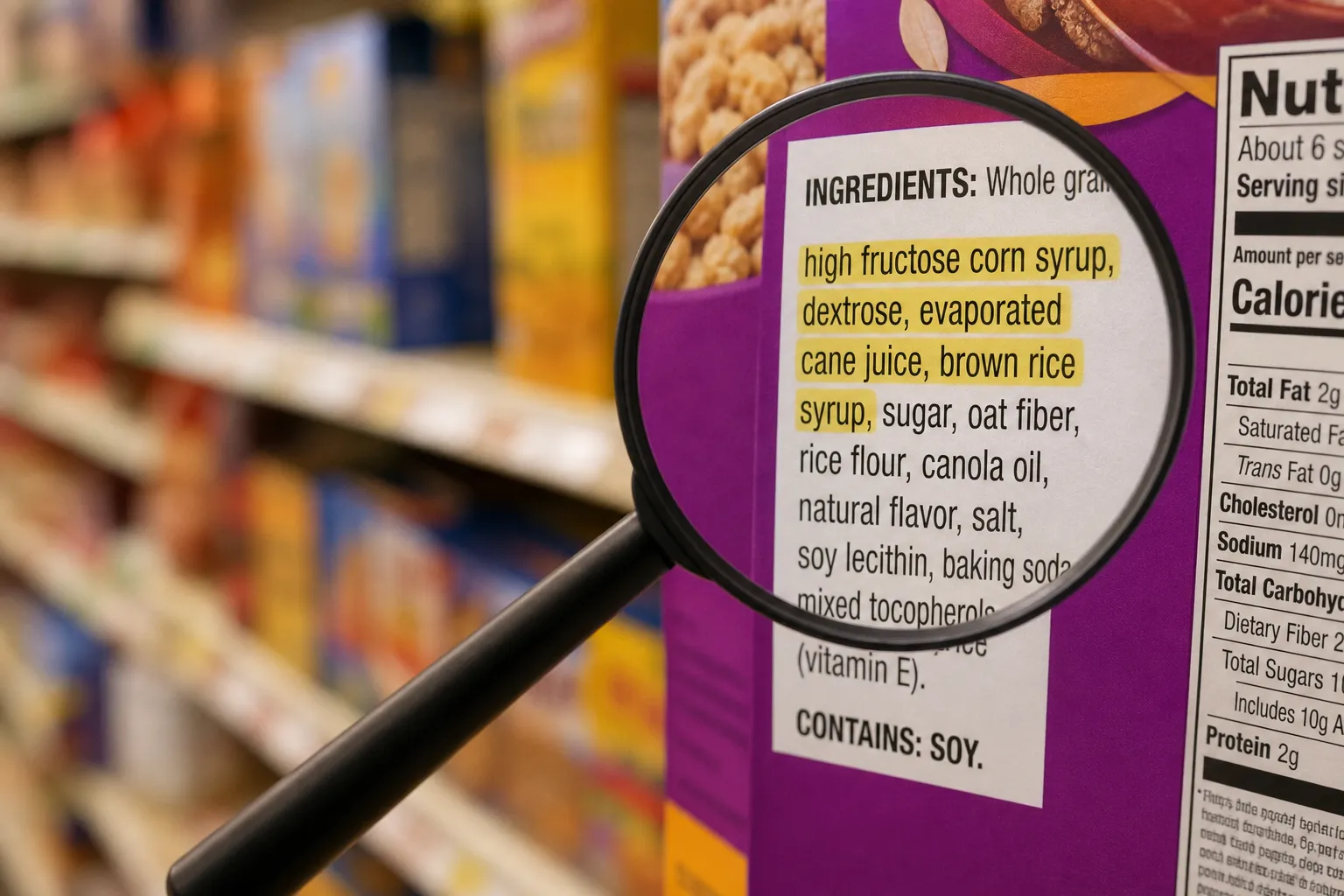
Ingredient lists are required to be ordered by weight, with the heaviest ingredients first. If a single sugar would appear at the top of the list, manufacturers sometimes split the total across two or three different sugar names so that no individual sugar is heavy enough to lead. The result is a label that lists "whole grain oats, brown rice flour, evaporated cane juice, brown rice syrup, honey, salt, natural flavor" instead of "whole grain oats, sugar, brown rice flour, salt, natural flavor."

The total sugar content is often the same. The position on the label is different, and the perception is different.

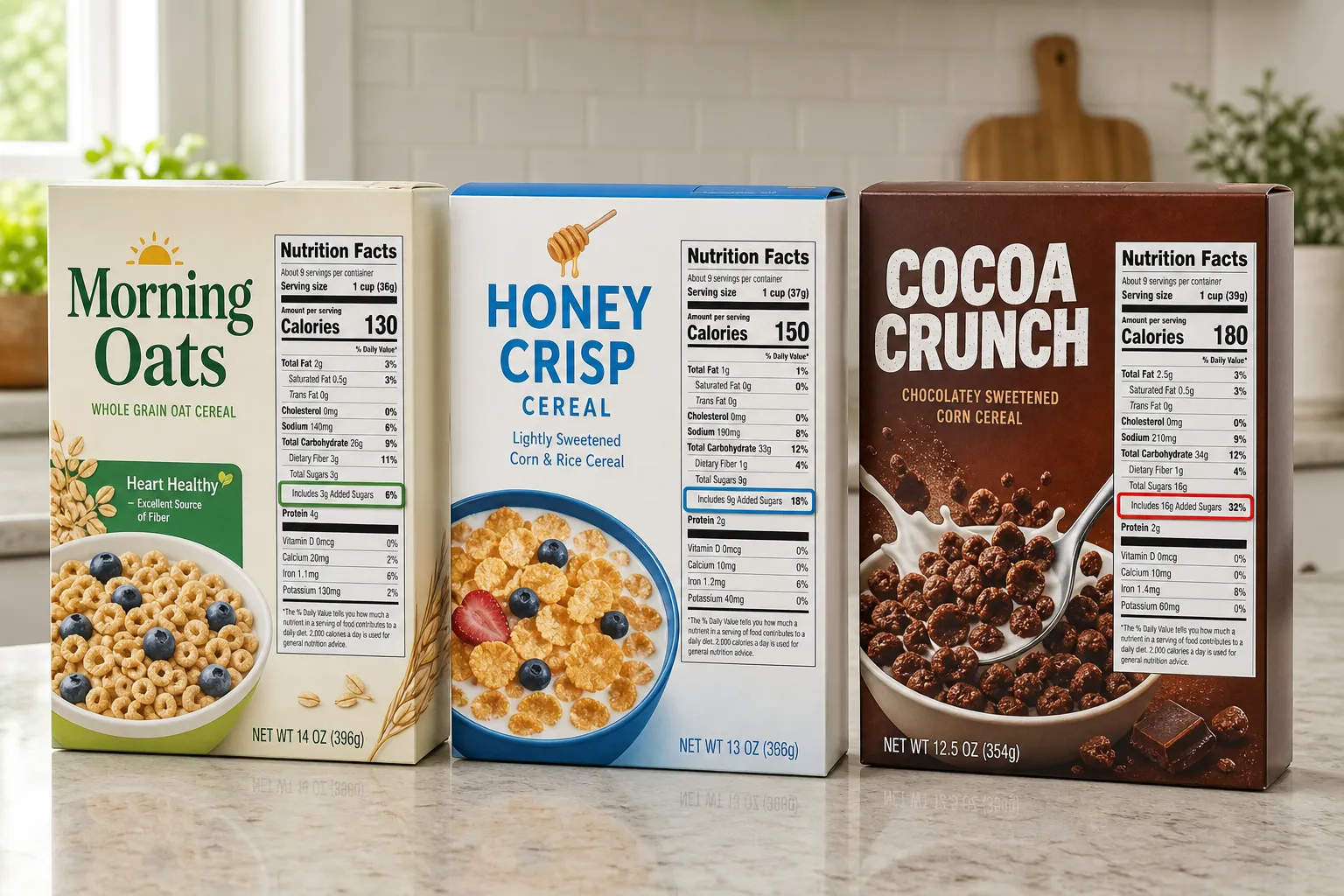
This is why the Added Sugars line on the Nutrition Facts label is so valuable. It collapses every alias into one number in grams. A product that lists 18 grams of added sugar per serving is delivering 18 grams regardless of how many ingredient lines it took to get there.

Practical Reading Strategy

Practical Reading Strategy

Use this three-step pattern when you scan a product.

Step 1: Check the Added Sugars line

Open the Nutrition Facts panel and look for "Added Sugars." Compare the gram value to the daily limits above. A serving with more than 12 grams of added sugar is a meaningful share of the daily ceiling for a woman or a child.

Step 2: Scan the ingredient list for the patterns

Look for any word ending in "-ose," any word with "syrup" or "juice concentrate," and any of the marketing-friendly names from the list above. Count how many distinct sugar ingredients are present. If you see two or more, the label is probably split.

Step 3: Compare across the category

Pick up two or three products in the same category (granola bars, breakfast cereals, pasta sauces, salad dressings, plant milks). Compare the Added Sugars lines. Within a category, the spread between the lowest and highest added sugar product is often 8 to 25 grams per serving. The lowest is rarely the most expensive option.

Categories Where Hidden Sugar Is Most Common

A few aisles are responsible for a disproportionate share of the added sugar in a typical pantry.

  • Breakfast cereals and granola. "Heart-healthy" and "whole grain" cereals frequently carry 9 to 15 grams of added sugar per serving.
  • Yogurt. Flavored yogurts, including Greek and plant-based varieties, often contain 12 to 20 grams of added sugar per cup.
  • Plant-based milks. Sweetened almond, oat, and coconut milks can hold 6 to 15 grams per cup. Look for the "unsweetened" version.
  • Sauces and condiments. Ketchup, barbecue sauce, teriyaki sauce, and many pasta sauces are surprisingly sweet.
  • Salad dressings. Many vinaigrettes and creamy dressings include corn syrup or honey as a major ingredient.
  • Bread. Sandwich loaves and hot dog buns often include sugar or HFCS for color, browning, and shelf life.
  • Protein and granola bars. "Performance" labeling does not exempt a bar from carrying 14 to 22 grams of added sugar.

What About Sugar Alcohols and Non-Nutritive Sweeteners?

Names ending in "-ol" (sorbitol, maltitol, xylitol, erythritol) are sugar alcohols. They are not classified as added sugar on the Nutrition Facts label and provide fewer calories per gram. They can cause digestive distress in larger doses.

Non-nutritive sweeteners (sucralose, aspartame, acesulfame potassium, saccharin, stevia leaf extract, monk fruit extract) provide intense sweetness with negligible calories. They are not added sugars, but they often appear in products that also contain added sugar, so the ingredient list still warrants a careful read.

These categories deserve their own scrutiny, but they are not what this guide is about. The 30 names above are the ones that count toward your daily added sugar limit.

A Note on "Naturally Occurring" vs. "Added"

Whole fruit, plain dairy, and unsweetened vegetables contain naturally occurring sugars. Those sugars come packaged with fiber, water, protein, and micronutrients that change how your body processes them. The labeling rules account for this. Naturally occurring sugars show up under "Total Sugars" but not under "Added Sugars."

When in doubt, the structure of the food matters as much as the chemistry. An apple delivers fructose alongside fiber that slows absorption. Apple juice concentrate, used as a sweetener in a granola bar, behaves like syrup.

The Bottom Line

There are not really 30 different sugars hiding in your pantry. There is one ingredient with 30 different names. Once you can recognize the patterns, the disguise loses most of its power, and the Added Sugars line on the Nutrition Facts label becomes the simple yardstick it was designed to be.

Reading every label in the store by hand is impractical. Using IngrediCheck, you can scan a product and instantly see every form of added sugar in the ingredient list, regardless of which alias the manufacturer chose, along with totals you can compare against your daily limit. That makes it easier to spot products that load up on hidden sugar before they reach your cart, and easier to choose options that fit the way you actually want to eat.

Get the app for clearer label decisions.

Scan labels, see what fits your food notes, and read the why in plain English.

IngrediCheck app