Dietary Guides

Alpha-Gal Syndrome Dietary Guide: Every Mammal-Derived Ingredient Hidden on Labels

An encyclopedic dietary guide to managing alpha-gal syndrome covering all mammal-derived meats, dairy, gelatin, animal fats, hidden additives, medication capsules, and the US labeling gap that leaves most alpha-gal ingredients undisclosed.

Jun 12, 2026|15 min read
By Sanket Patel|Updated 2026-06-12|6 sources|Editorial standards
Alpha-Gal Syndrome Dietary Guide: Every Mammal-Derived Ingredient Hidden on Labels

What Alpha-Gal Syndrome Actually Is

What Alpha-Gal Syndrome Actually Is

Alpha-gal syndrome (AGS) is a tick-triggered allergy to a sugar molecule called galactose-alpha-1,3-galactose, commonly known as alpha-gal. This molecule sits on the surface of cells in nearly all non-primate mammals, including cows, pigs, sheep, deer, and rabbits. Humans don't produce it. That evolutionary quirk is precisely why the immune system can learn to treat it as a threat.

The sensitization happens through a tick bite, not through food. When the lone star tick (Amblyomma americanum) bites, alpha-gal from the tick's saliva is injected directly under the skin. This bypasses the gut's normal tolerance mechanisms and triggers the immune system to produce IgE antibodies against alpha-gal. After that, eating mammal products causes those antibodies to activate, releasing histamine and triggering an allergic reaction.

The most disorienting feature of AGS is the delay. Because alpha-gal is a carbohydrate rather than a protein, digestion is slower. Alpha-gal from a meal reaches the bloodstream several hours after eating, not within minutes. Reactions typically appear 2 to 6 hours after consuming mammal products, and sometimes up to 8 hours later. Many people wake up in the middle of the night covered in hives after a normal dinner and don't connect the dots for months.

AGS is significantly underdiagnosed. The CDC estimates that up to 450,000 Americans may have it. A 2023 MMWR report found that 42% of surveyed US healthcare providers had never heard of AGS. The lone star tick is most common in the south-central and southeastern United States, but its range is expanding into states like New York and Pennsylvania.
Meats and Organ Meats to Avoid

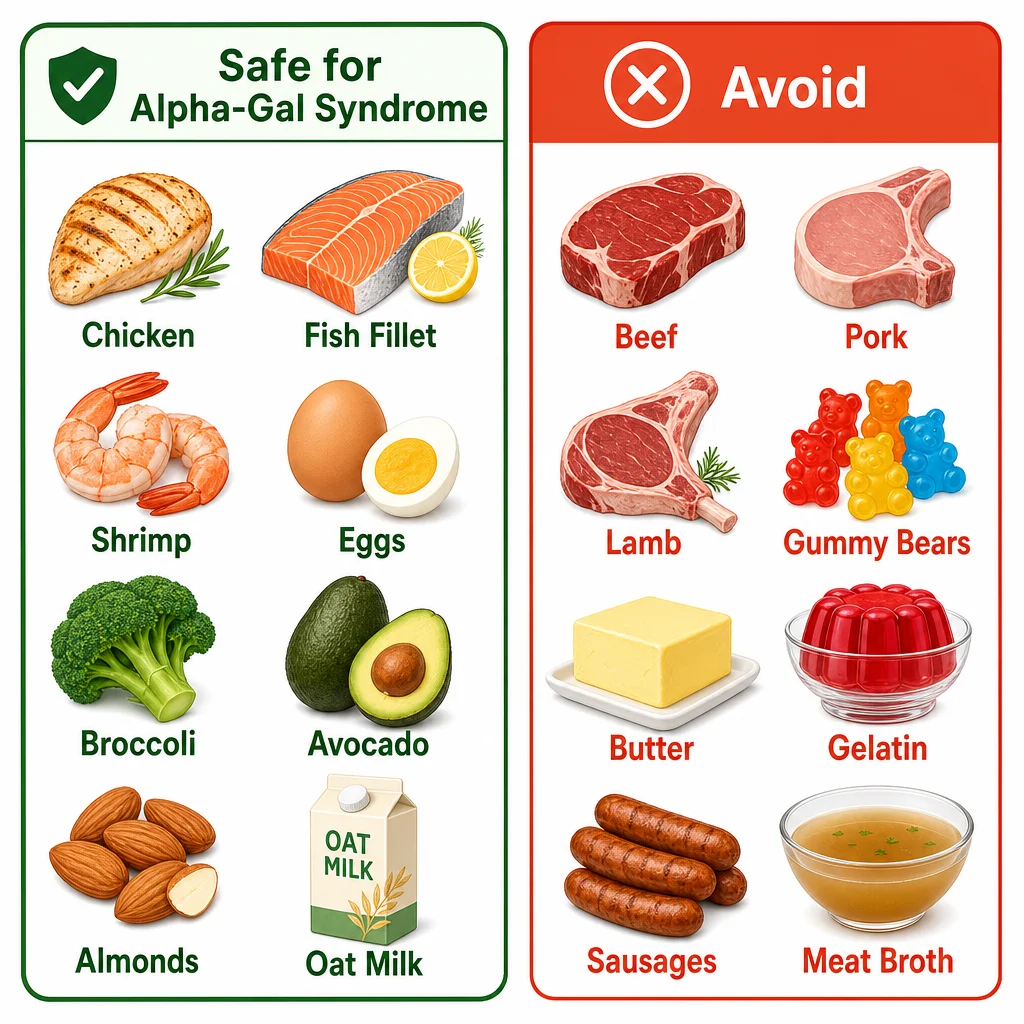
All red meats and organ meats from mammals contain alpha-gal. The list is longer than most people expect when they first receive the diagnosis:

  • Beef (all cuts, ground beef, jerky, roast, steak)
  • Pork (all cuts, bacon, ham, sausage, pepperoni, prosciutto, chorizo)
  • Lamb and mutton
  • Venison (deer)
  • Bison and buffalo
  • Veal
  • Rabbit
  • Goat
  • Wild game: bear, elk, moose, wild boar

Organ meats are particularly high in alpha-gal: liver, kidneys, heart, tripe, sweetbreads (thymus or pancreas), blood sausage, scrapple, and any product made from offal. If you eat out at restaurants that serve traditional cuisines relying heavily on organ meats, pork fat, or meat broths, specific inquiry is essential.

What is safe: Poultry, fish, and all seafood. Chicken, turkey, duck, salmon, tuna, shrimp, crab, oysters, and all other fish and shellfish do not produce alpha-gal.

Dairy: A Gray Area for Most Patients

Dairy products from cows, goats, and sheep do contain alpha-gal, primarily associated with the fat fraction. However, clinical data from over 2,500 AGS patients indicates that fewer than 10% of patients react to dairy. The majority of people with AGS tolerate cow's milk, cheese, butter, and yogurt without difficulty.

If you have eliminated all red meat and still experience reactions, dairy is the next category to systematically remove. Products to consider:

  • Cow's milk (whole, 2%, skim, lactose-free)
  • Cream, heavy cream, sour cream, crème fraîche
  • Butter and ghee
  • All cheese varieties (cow, goat, sheep), cream cheese, cottage cheese, ricotta
  • Yogurt (note: many yogurt brands also add gelatin as a stabilizer, a separate mammal-derived concern)
  • Ice cream (may also contain gelatin)
  • Whey, whey protein concentrate, whey protein isolate (found in protein powders, bread, and processed foods)
  • Casein and sodium caseinate (milk protein used extensively in processed foods)
  • Lactalbumin, lactoglobulin, lactoferrin

One important advantage for dairy tracking: cow's milk is one of the nine major allergens required to be disclosed on US food labels under FALCPA. It is the only alpha-gal-containing ingredient with mandatory label disclosure. All forms of milk and dairy derivatives must appear in the ingredient list or in a "Contains" statement. This makes dairy significantly easier to track on labels than most other mammal-derived ingredients.

Gelatin: The Hidden Ingredient in Hundreds of Products

Gelatin: The Hidden Ingredient in Hundreds of Products

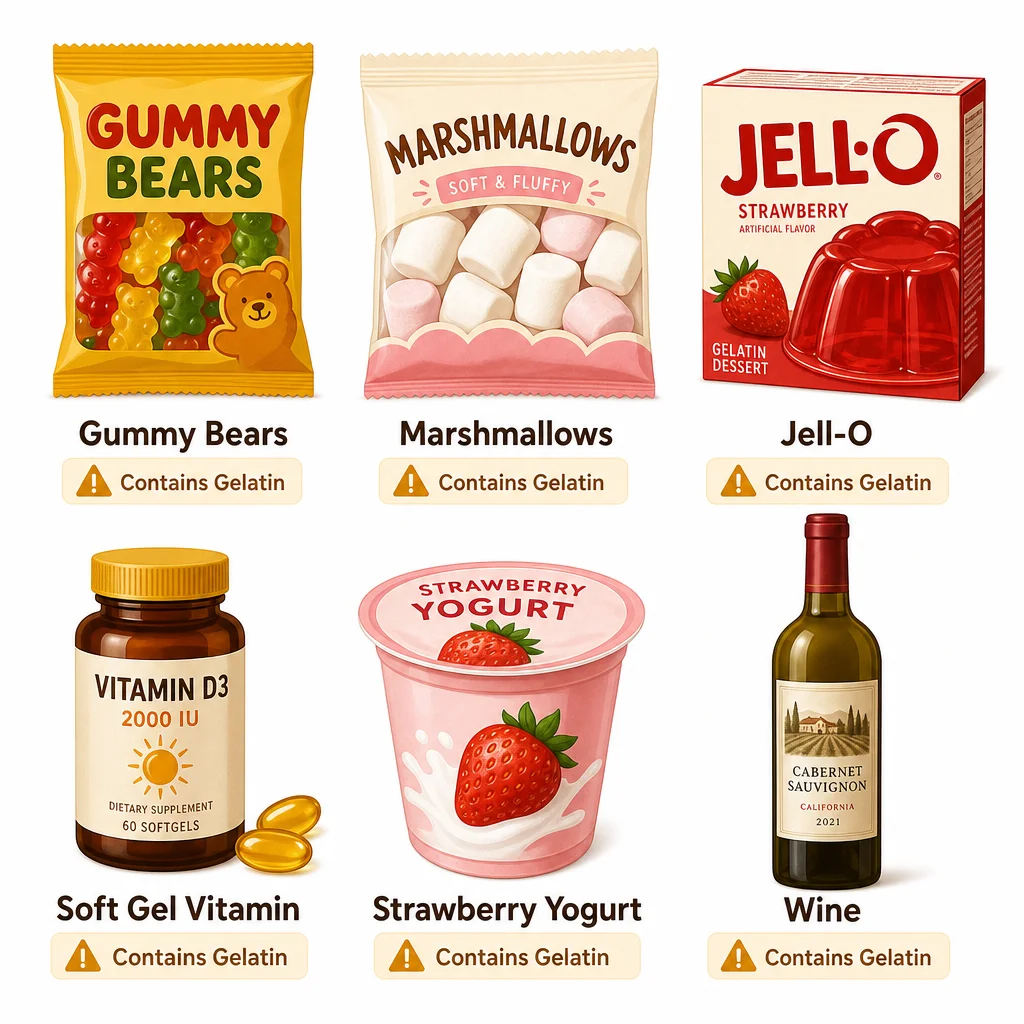
Gelatin is derived from collagen extracted from mammalian bones, skin, and connective tissue, typically pork or beef. It's one of the most widely used food additives in the world and appears in places most people would never expect.

Foods that commonly contain gelatin:

  • Jell-O and flavored gelatin desserts
  • Gummy candies, gummy bears, gummy vitamins
  • Marshmallows (nearly all commercial brands use pork gelatin)
  • Some yogurts (gelatin is used as a thickener and stabilizer)
  • Some ice creams and frozen desserts
  • Cheesecake and no-bake desserts
  • Panna cotta, mousse, aspic
  • Some fruit snacks and fruit chews
  • Some frosted cereals (a gelatin coating gives the frost its structure)
  • Wine and juice (gelatin is used as a fining/clarifying processing aid and does not appear on the label)

Gelatin capsules matter just as much. Most prescription medications and over-the-counter supplements use hard gelatin capsules (from pork or beef) or soft gel capsules. The capsule material is almost never disclosed on the product label. Ask your pharmacist about hydroxypropyl methylcellulose (HPMC) or pullulan capsule alternatives. These are vegetarian-grade and contain no alpha-gal. Some pharmacies can reformulate medications into HPMC capsules on request.

Agar agar (from seaweed) and pectin (from fruit) are plant-based alternatives to gelatin that are safe for AGS.

Animal Fats in Everyday Foods

Lard and tallow appear in more processed foods than most consumers realize, and there is no regulatory requirement to flag them beyond using their generic ingredient names.

Lard (rendered pork fat) is traditional in:

  • Flour tortillas (extremely common in commercial brands)
  • Refried beans (many canned brands still use lard)
  • Biscuits at some fast-food chains
  • Tamales and tamale masa
  • Some pie crusts and pastry doughs
  • Some crackers and savory baked goods

Tallow (rendered beef fat) appears in some shortenings and was historically used for french fries. Some fast-food operators still use beef flavoring in their cooking oil. Check individual chain websites or contact their customer service line.

Schmaltz is rendered poultry fat (typically chicken or goose). Since poultry does not produce alpha-gal, schmaltz is safe, but verify the source before using any unfamiliar commercial version.

Broths, Stocks, and "Natural Flavors"

This is where AGS management gets substantially harder. Mammal-derived flavors are embedded deeply in processed food formulations, often without any obvious label signal.

Ingredients to check on every processed food label:

  • Beef broth, beef stock, beef extract (found in soups, ramen packets, packaged rice, gravies, sauces, seasoning blends)
  • Pork broth and pork stock
  • Lamb or veal stock
  • Bouillon cubes and seasoning packets (the majority contain beef or pork)
  • Pre-packaged ramen broth: tonkotsu is pork bone-based; beef broth is common; chicken broth is safe
  • Pre-made gravies and dry gravy mixes

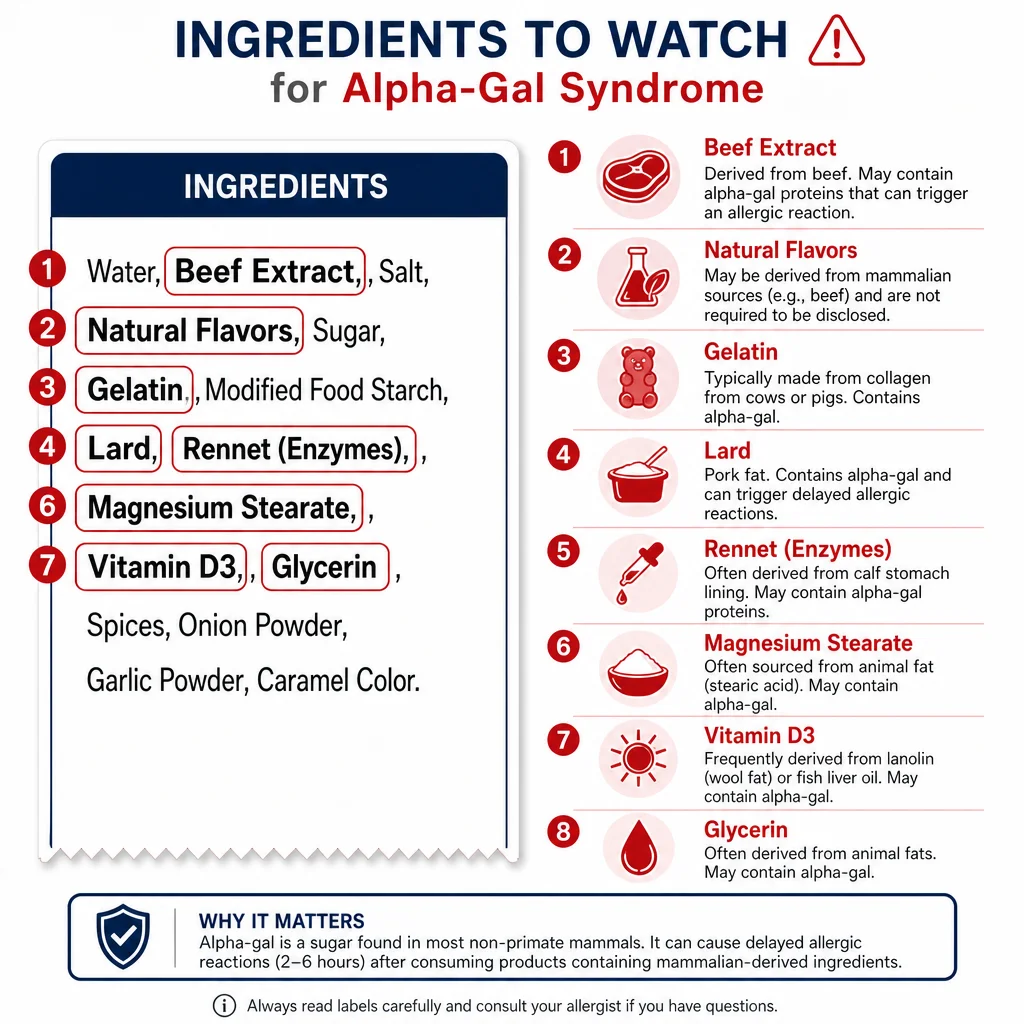
The most significant labeling challenge for AGS patients is the term "natural flavors." Under FDA regulations, this broad category can legally include beef extract, pork flavoring, dairy derivatives, and other mammal-sourced compounds. Manufacturers are not required to specify the animal source. When "natural flavors" appears on a product that otherwise seems mammal-free, the only way to verify is to contact the manufacturer directly. Many companies have allergen helplines for this purpose.

Other Mammal-Derived Additives Worth Knowing

Several common food and supplement additives can be sourced from mammals, with little to no indication on the label.

Rennet and rennet casein: Used in cheese making, animal rennet is derived from the stomach lining of young calves. On US cheese labels, it appears only as "enzymes," with no indication of animal versus microbial origin. Microbial rennet and fermentation-produced chymosin are the safe plant-derived alternatives. Cheese labeled "suitable for vegetarians" or "kosher" almost always uses microbial rennet.

Mono- and diglycerides (E471): One of the most common emulsifiers in processed food, found in commercial bread, margarine, ice cream, and peanut butter. The fat source, whether animal or plant-derived, is not disclosed on the label. Contact the manufacturer to verify.

Glycerin / glycerol (E422): Can come from tallow or from plant oils. Found in candy, baked goods, toothpaste, and supplements. Source is rarely disclosed.

Vitamin D3 (cholecalciferol): Nearly all vitamin D3 in supplements and fortified foods is derived from lanolin, a wax secreted from sheep wool. Vegan D3 derived from lichen is the safe alternative. Vitamin D2 (ergocalciferol), made from yeast, is also safe.

Magnesium stearate: A lubricant used in the manufacturing of most tablets and capsules. The stearic acid from which it's derived can come from tallow or from plant sources. The CDC explicitly lists magnesium stearate as an ingredient AGS patients should check in medications and supplements.

Collagen: Commercially available collagen supplements, collagen-fortified foods, bone broth, and many cosmetic products use bovine or porcine collagen. Marine collagen, derived from fish skin and scales, is safe from an alpha-gal standpoint.

L-cysteine (E920): A dough conditioner used in commercial bread and baked goods. It can be derived from hog hair, duck feathers (not mammalian, therefore safe), or synthesized. The source is not disclosed on US bread labels.

A note on two ingredients that sometimes cause confusion: carmine (E120) is derived from cochineal insects, not mammals, and does not contain alpha-gal. Isinglass is derived from fish swim bladders and is used to clarify some wines and beers. Neither is a mammalian source. Carmine can cause its own rare allergic reactions in some individuals, but those are unrelated to AGS.

The Cofactor Problem

Some AGS patients only experience reactions when consuming mammal products in combination with a cofactor. This explains why reactions can seem inconsistently triggered. The major cofactors that lower the reaction threshold include:

  • Alcohol: Substantially increases reaction risk, even with exposures that would normally be tolerated
  • Exercise within a few hours of eating
  • NSAIDs: Aspirin, ibuprofen, naproxen
  • Illness or infection
  • Lack of sleep or significant stress
  • Additional tick bites: New bites can reinstate or worsen sensitivity, even in patients who had previously recovered partial tolerance

Patients who find reactions inconsistent should track not just what they ate but when they exercised, whether they consumed alcohol, and whether they had taken any over-the-counter pain medication that day. Histamine release is a common thread between AGS reactions and other food sensitivities; if you're experiencing GI symptoms alongside hives, the Histamine Intolerance Dietary Guide covers the overlap between histamine and mast cell activation that can complicate AGS diagnosis.

A Practical Label-Reading Strategy

A Practical Label-Reading Strategy

This section is designed to work as a standalone reference when reading food labels with alpha-gal syndrome.

All Ingredients and Foods to Avoid

Direct mammal meat and organ-derived ingredients:

  • Beef, beef broth, beef extract, beef fat, beef flavoring, beef stock, ground beef
  • Pork, pork broth, pork extract, pork flavoring, pork lard, pork gelatin, pork stock
  • Bacon, ham, sausage, pepperoni, prosciutto, chorizo, salami
  • Lamb, mutton, venison, bison, veal, rabbit, goat (and all broth, extract, or stock of each)
  • Liver, kidney, heart, tripe, sweetbreads, blood sausage, scrapple, black pudding
  • All organ meats and offal

Dairy ingredients (for the approximately 10% who react to dairy):

  • Milk, skim milk, whole milk, buttermilk, evaporated milk, condensed milk
  • Cream, heavy cream, sour cream, half-and-half, crème fraîche
  • Butter, ghee, butter oil, butter flavoring
  • Cheese (all varieties), cream cheese, cottage cheese, ricotta, mascarpone, quark
  • Yogurt
  • Ice cream, gelato (may also contain gelatin)
  • Whey, whey protein, whey protein concentrate, whey protein isolate
  • Casein, sodium caseinate, calcium caseinate
  • Lactalbumin, lactoglobulin, lactoferrin
  • Lactose (a dairy sugar; its presence confirms dairy)

Gelatin and collagen-derived ingredients:

  • Gelatin (listed as "gelatin," "hydrolyzed gelatin," "bovine gelatin," "porcine gelatin")
  • Collagen (bovine or porcine; marine collagen from fish is safe)
  • Collagen hydrolysate, hydrolyzed collagen
  • Note: isinglass is fish-derived and safe for AGS

Animal fats:

  • Lard, rendered lard, lard shortening
  • Tallow, beef tallow, suet, dripping, schmaltz (when sourced from mammals, not poultry)

Hidden mammal-derived additives:

  • Natural flavors (when derived from beef, pork, or other mammal sources; source not disclosed on label)
  • Rennet, animal rennet, rennet casein (appears as "enzymes" on cheese labels; ask manufacturer whether animal or microbial)
  • Mono- and diglycerides / E471 (when animal-derived; source not disclosed on label)
  • Glycerin / glycerol / E422 (when animal-derived from tallow; source not disclosed)
  • Magnesium stearate / E572 (when stearic acid is tallow-derived)
  • Stearic acid / E570 (when tallow-derived)
  • L-cysteine / E920 (when hog-hair-derived; appears as "dough conditioner" or "L-cysteine" on bread labels; duck feather and synthetic sources are safe)
  • Vitamin D3 / cholecalciferol (when lanolin-derived; look for "vegan D3" or "lichen-sourced D3" as safe alternatives; vitamin D2 is also safe)
  • Bone broth (always mammal-derived; "chicken broth" or "vegetable broth" are safe)
  • Carmine / E120 is insect-derived and NOT an alpha-gal concern

Medications and supplements:

  • Hard gelatin capsules (used in most prescription and OTC medications and the majority of dietary supplements)
  • Softgel and soft-gel capsules (almost all are gelatin-derived from pork or beef)
  • Request HPMC (hydroxypropyl methylcellulose), pullulan, or vegetarian capsule alternatives from your pharmacist
  • Gummy vitamins and chewable supplements (most commercial brands use gelatin; look for "vegan" or "pectin-based" on the label)
  • Heparin and low molecular weight heparins (derived from porcine intestinal mucosa; discuss with prescribing physician)
  • Pancreatic enzyme replacements (derived from porcine pancreas)
  • Some vaccines stabilized with gelatin (MMR, varicella, some influenza; discuss risk-benefit with your provider)
  • Desiccated thyroid medications sourced from porcine glands (e.g., Armour Thyroid)

US Labeling Rules for Alpha-Gal

Under FALCPA and the FASTER Act (2023), US law requires mandatory label disclosure of nine major allergens: milk, eggs, fish, shellfish (crustacean), tree nuts, peanuts, wheat, soybeans, and sesame. Alpha-gal and mammal origin are not separately required disclosures under US law.

Cow's milk is the only alpha-gal-containing ingredient with mandatory label disclosure. All other mammal-derived ingredients, including lard, gelatin, tallow, beef broth, pork flavoring, animal rennet, glycerin, and natural flavors from meat, have no mandatory disclosure requirement. FALCPA also does not apply to USDA-regulated products (fresh and processed meat and poultry), alcohol, OTC drugs, cosmetics, or dietary supplements in their entirety.

In the EU, Regulation 1169/2011 requires the 14 major allergens to be visually emphasized in ingredient lists. Milk is on that EU list. However, the EU also does not have an alpha-gal-specific disclosure requirement beyond milk. Neither the US nor the EU requires disclosure of mammal-derived gelatin, lard, tallow, animal rennet, or natural flavors by their mammal source.

A note on bone char: some cane sugar is refined through bone char made from cattle bones. Because bone char is a processing aid rather than an ingredient, it does not appear on food labels anywhere. This is a theoretical concern for highly reactive patients; beet sugar, coconut sugar, and certified organic cane sugar avoid the issue.

Step-by-Step Label-Scanning Checklist

  1. Scan the full ingredient list for any form of beef, pork, lamb, venison, or other red meat. Look beyond the meat name itself. Check for broth, extract, stock, fat, flavoring, and drippings derived from each.
  1. Search for "gelatin" anywhere in the ingredient list. Gelatin appears as a stabilizer in yogurt, ice cream, and fruit snacks, not just in obvious gelatin desserts.
  1. Check for "lard," "tallow," "suet," and "beef fat." These are standard ingredients in flour tortillas, refried beans, biscuits, tamales, and pie crusts. Many brands use them without highlighting them.
  1. Flag every instance of "natural flavors." If the product is heavily processed and lacks any indication that flavors are plant-derived, contact the manufacturer's allergen helpline to verify the source.
  1. Verify "enzymes" in any cheese. "Enzymes" on a cheese label means rennet. Ask the manufacturer or check their website whether they use animal rennet or microbial/fermentation-produced chymosin.
  1. Check capsule material in every supplement and medication. "Capsules" in a drug description almost always means gelatin. Ask your pharmacist about HPMC or pullulan capsule alternatives.
  1. Treat vitamin D3 as potentially lanolin-derived unless the label says "vegan," "plant-based," or "lichen-derived." Vitamin D2 (ergocalciferol) is a safe alternative.
  1. Track cofactors alongside ingredients. Even a confirmed safe exposure can trigger a reaction when combined with alcohol, exercise, or NSAIDs. Document both the food and the context when evaluating reactions.

IngrediCheck can scan ingredient lists for beef, pork, lamb, gelatin, lard, tallow, dairy derivatives, and the full spectrum of hidden mammal-derived additives listed above, flagging alpha-gal risks in packaged foods in real time so you can shop and eat with confidence.

Next Label Check

Follow the scanner, hub, and ingredient paths connected to this guide

Get the app for clearer label decisions.

Scan labels, see what fits your food notes, and read the why in plain English.

IngrediCheck app