Ingredient Deep Dives

Food Preservatives Linked to Hypertension: What a New Study Found

A large French cohort study following more than 112,000 adults found that people eating the most nitrites, sulfites, and sorbates had a 29% higher risk of developing high blood pressure. Here's what the preservatives are, where they hide, and what the research does and doesn't prove.

Jun 17, 2026|9 min read
By Sanket Patel|Updated 2026-06-17|4 sources|Editorial standards
Food Preservatives Linked to Hypertension: What a New Study Found

A study published in the European Heart Journal followed 112,395 adults in France for a median of nearly eight years and found something specific enough to matter to anyone who reads an ingredients label: people who ate the most preservative additives, particularly nitrites, sulfites, and sorbates, had a 29% higher risk of developing hypertension than those who ate the least. The researchers, led by Anaïs Hasenböhler and Mathilde Touvier at INSERM, Sorbonne Paris Nord, and Université Paris Cité, drew on the long-running NutriNet-Santé cohort to reach that number, and they described it as the first study of its kind to examine a wide range of preservatives against cardiovascular outcomes rather than looking at one additive in isolation.

This is not the same finding as "salt causes high blood pressure." Sodium is its own well-documented risk factor, covered by a large and separate body of research. This new study is about the chemical preservatives that keep packaged food from spoiling, and it draws a sharper distinction than most consumers expect: not all preservatives showed the same risk.
Two Groups of Preservatives, Two Different Results

The researchers split additives into two categories. The first, "non-antioxidant preservatives," includes nitrites, sulfites, sorbates, and benzoates. People in the highest intake group for this category had a 29% higher hypertension risk (hazard ratio 1.29) and a 16% higher cardiovascular disease risk. The second category, "antioxidant preservatives," includes ascorbic acid, citric acid, and rosemary extract. High intake of this group was also linked to elevated hypertension risk, though somewhat lower, at a hazard ratio of 1.22.

Eight individual additives showed up as independently associated with the findings: potassium sorbate (E202), potassium metabisulphite (E224), sodium nitrite (E250), ascorbic acid (E300), sodium ascorbate (E301), sodium erythorbate (E316), citric acid (E330), and rosemary extract (E392). That list is worth sitting with for a moment, because several of these, especially ascorbic acid and citric acid, sound like the kind of "natural" ingredients a health-conscious shopper would wave through without a second look. The study's authors, in their public comments, pointed out that this is exactly the blind spot: additives marketed or perceived as benign can still show up in a population-level pattern tied to hypertension risk, likely because their presence correlates with a broader style of heavily processed eating rather than acting entirely alone.

"People who ate the largest amounts of 'non-antioxidant' preservatives had a 29% higher risk of hypertension, compared to those who ate the least." — European Society of Cardiology, on the NutriNet-Santé findings

How Nitrites May Actually Raise Blood Pressure

How Nitrites May Actually Raise Blood Pressure

The proposed mechanism for nitrites centers on the nitrate-nitrite-nitric oxide pathway, the same chemical system the body uses to keep blood vessels relaxed and functioning normally. Nitric oxide signals the smooth muscle in vessel walls to relax, which helps regulate blood pressure. When that pathway is disrupted, whether by disease or by an influx of preservative-derived nitrites reacting unpredictably in the body, the result can be endothelial dysfunction, a well-established early step on the path toward hypertension. Nitrites can also form N-nitroso compounds, a family of chemicals already linked to oxidative stress in the body. Touvier, one of the study's co-authors, summarized the broader hypothesis this way: "Experimental research has consistently suggested that preservatives may cause oxidative stress in the body."

This mechanism is not new to nitrites specifically. The International Agency for Research on Cancer classified processed meat as a Group 1 carcinogen in 2015, largely because of N-nitroso compounds that form during meat curing. That classification was about cancer risk, not blood pressure, and the two findings should not be conflated as the same evidence. But the underlying chemistry, nitrite-driven compound formation, is the same, and it gives the new hypertension findings a plausible biological backstory rather than leaving them as an unexplained statistical pattern.

Sulfites Have Their Own Open Question

Sulfites, the second implicated group, already carried a data gap flag before this study. A 2022 EFSA re-evaluation found that systemic sulfite exposure, meaning the portion of a dose that gets absorbed rather than passing through, can reach roughly 25% of the amount consumed, and that sulfites distribute into heart tissue after absorption. EFSA's conclusion at the time was that there was a "safety concern for high consumers, but data lacking," essentially flagging the possibility of a cardiovascular effect without having the direct evidence to confirm it. The NutriNet-Santé finding, in which potassium metabisulphite independently associated with hypertension risk, is now one of the more direct pieces of human evidence connecting sulfite intake to blood pressure specifically, rather than to the general category of allergic-type reactions sulfites are more commonly discussed for.

Where These Preservatives Actually Show Up

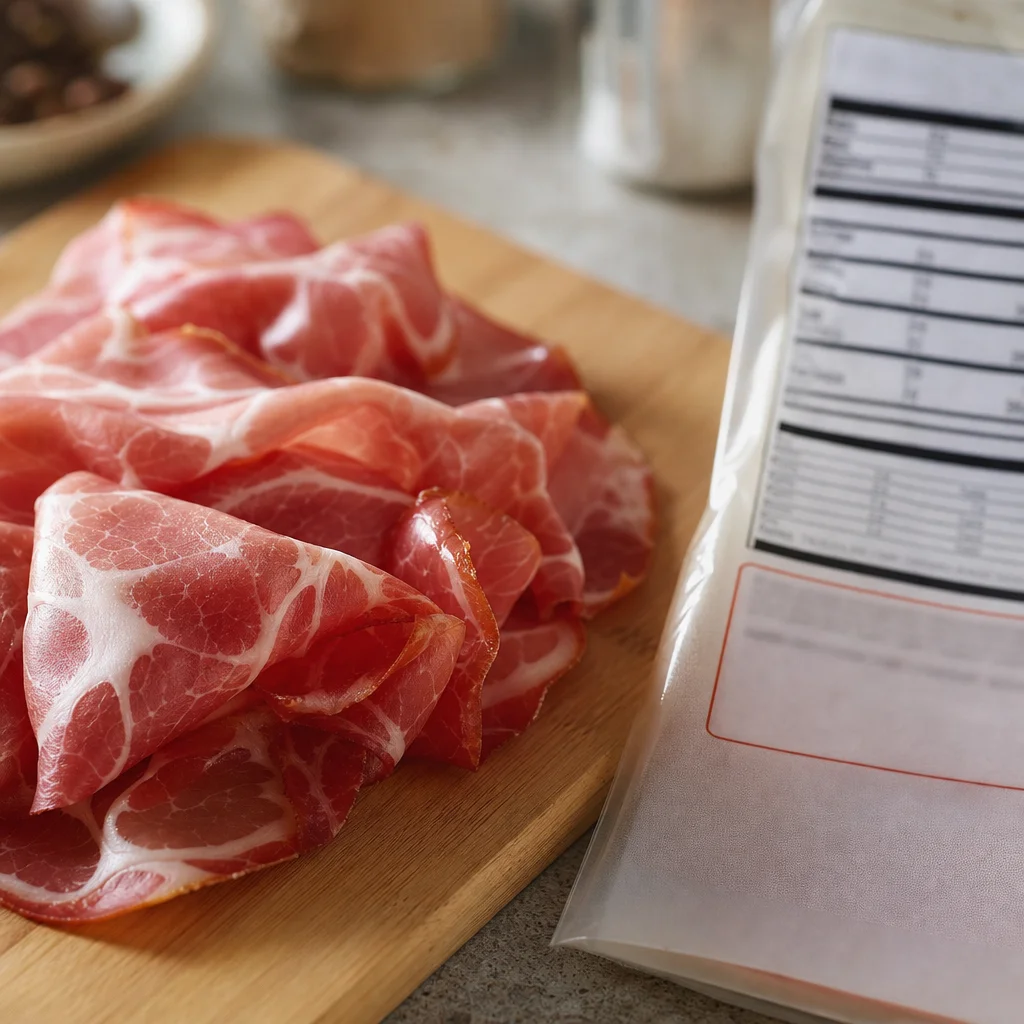
Non-antioxidant preservatives cluster heavily in cured and processed meats: bacon, deli meat, hot dogs, and sausages rely on sodium nitrite for both preservation and their characteristic pink color. Sulfites turn up in dried fruit, wine, and some packaged fruit and vegetable products, where they prevent browning and inhibit microbial growth. Sorbates and benzoates are common in baked goods, cheese products, dressings, condiments, and ready meals, where they extend shelf life against mold and yeast.

Antioxidant preservatives are less obviously "processed food" ingredients, which is part of why the study's findings around ascorbic acid and citric acid are notable. These show up in breads, breakfast cereals, and sodas, often as functional additives that also happen to double as vitamin C fortification or acidity regulators, which can make their presence feel more like a nutritional plus than a preservative to watch.

Regulatory Limits, and Where the US and EU Differ

In the United States, federal regulation under 21 CFR 172.175 caps sodium nitrite at 200 parts per million in most finished cured meat products, with a stricter 10 ppm limit for smoked cured tuna products specifically. Sodium nitrate is capped separately at 500 ppm. These limits exist primarily to control the risk of nitrosamine formation and botulism prevention, both longstanding food safety concerns, rather than blood pressure. The EU has generally taken a more cautious posture on sulfites, with EFSA's 2022 re-evaluation explicitly flagging high-consumer exposure as a concern warranting more data, a step the US regulatory framework has not mirrored with the same urgency.

Neither the FDA nor EFSA has yet issued a formal response specifically addressing this new hypertension research, though the European Society of Cardiology's release around the study calls on both agencies to reassess the risk-benefit balance of these preservatives given the new findings.

Every Name These Preservatives Hide Behind

Every Name These Preservatives Hide Behind

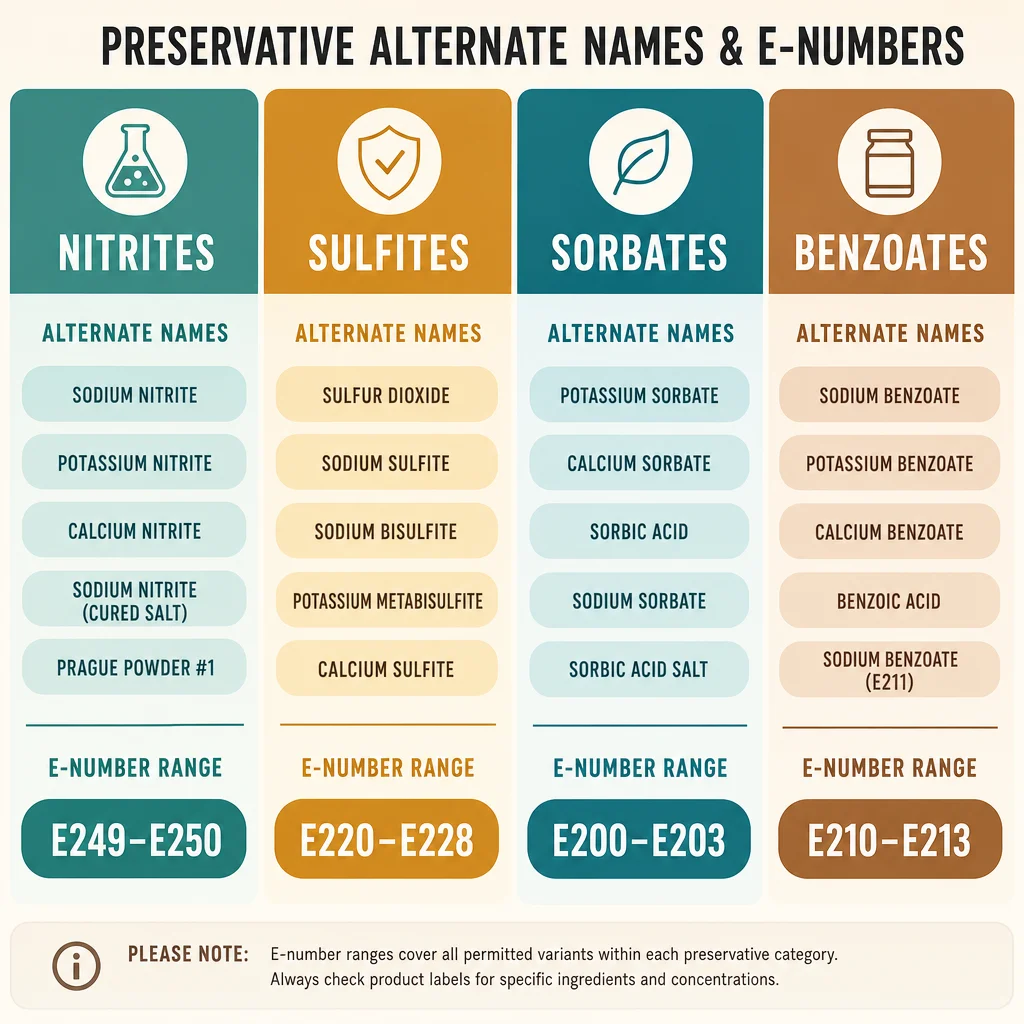
If you want to identify these additives on a label, the ingredient list will use one of several interchangeable names or E-numbers. For nitrites and nitrates: sodium nitrite, sodium nitrate, potassium nitrite, or E249 through E252. For sulfites: sulfur dioxide, sodium bisulfite, sodium metabisulfite, potassium bisulfite, potassium metabisulfite, or E220 through E228. For sorbates: sorbic acid, potassium sorbate, calcium sorbate, or E200 through E203. For benzoates: sodium benzoate, potassium benzoate, or E210 through E213. For the antioxidant group implicated in the study: ascorbic acid, sodium ascorbate, sodium erythorbate, citric acid, or rosemary extract, listed as E300, E301, E316, E330, and E392 respectively.

What the Study Doesn't Prove

Touvier and her co-authors were direct about the limits of their own findings: "This study has some limitations inherent to its observational design." An observational cohort study can identify a strong statistical association, but it cannot, on its own, prove that a given preservative causes hypertension in a way separate from the overall dietary pattern it travels with. People who eat the most nitrite-preserved deli meat and the most sulfite-treated packaged snacks are also, generally, eating more ultra-processed food overall, and untangling the preservative's individual contribution from the broader pattern of a highly processed diet is genuinely difficult. Coverage of the study has specifically flagged this as "a link, not cause and effect," and that framing is worth carrying with you rather than treating the 29% figure as a settled, isolated causal fact.

What makes the study valuable despite that limitation is its scale and its breadth. Following more than 112,000 people for close to eight years, and looking at a wide panel of preservatives rather than one additive at a time, gives this research more weight than a small or narrowly scoped study would carry, even while causality remains an open question.

How to Read a Label With This in Mind

None of this requires eliminating every packaged food that contains a preservative. It does mean paying closer attention to how often nitrite-cured meats, sulfite-treated dried fruit or wine, and heavily preserved packaged snacks show up in your regular routine, rather than treating any single product as the problem. Checking the ingredients list for sodium nitrite, potassium metabisulfite, potassium sorbate, and their related E-numbers gives you a concrete way to spot the additives this research singled out, rather than relying on vague instincts about which foods count as "processed." And because the antioxidant preservative group, ascorbic acid and citric acid among them, also showed an association in this study, it's worth remembering that a preservative doesn't have to sound synthetic to be worth tracking.

Using IngrediCheck, you can scan packaged foods and instantly see which preservatives are listed, including the E-numbers and alternate names covered here, so you can make an informed choice about how often nitrite, sulfite, and sorbate-preserved products show up in your diet.

Next Label Check

Follow the scanner, hub, and ingredient paths connected to this guide

Get the app for clearer label decisions.

Scan labels, see what fits your food notes, and read the why in plain English.

IngrediCheck app