Glycerol in Slush Drinks: A Hidden Risk for Young Children

EFSA's May 2026 assessment found that a single slush drink can push young children over the safe threshold for glycerol — a sweetener that replaced sugar but carries its own acute risks for children under seven.

May 18, 2026|8 min read
By Sanket Patel|Updated 2026-05-18|3 sources|Editorial standards
Glycerol in Slush Drinks: A Hidden Risk for Young Children

On May 11, 2026, the European Food Safety Authority published a new risk assessment concluding that a single slush drink can push young children — particularly those under seven — over the acute reference dose for glycerol. The finding has renewed attention on an ingredient that quietly displaced sugar in many cold drinks following the introduction of sugar taxes in the UK and Ireland, with consequences for children that are now well-documented in published case series and regulatory guidance.

Glycerol, also listed as E 422 or glycerin, is not new to the food supply. It has been used as a humectant, sweetener, and solvent in food products for decades, and has long been considered safe at typical dietary levels. What changed is the dose. When glycerol is used as a bulk sweetener to replace sugar in slush drinks — at concentrations that can reach 142 grams per litre in commercially measured products — the quantities consumed in a single serving can exceed the acute reference dose for a small child within a cup or two.

What EFSA Found

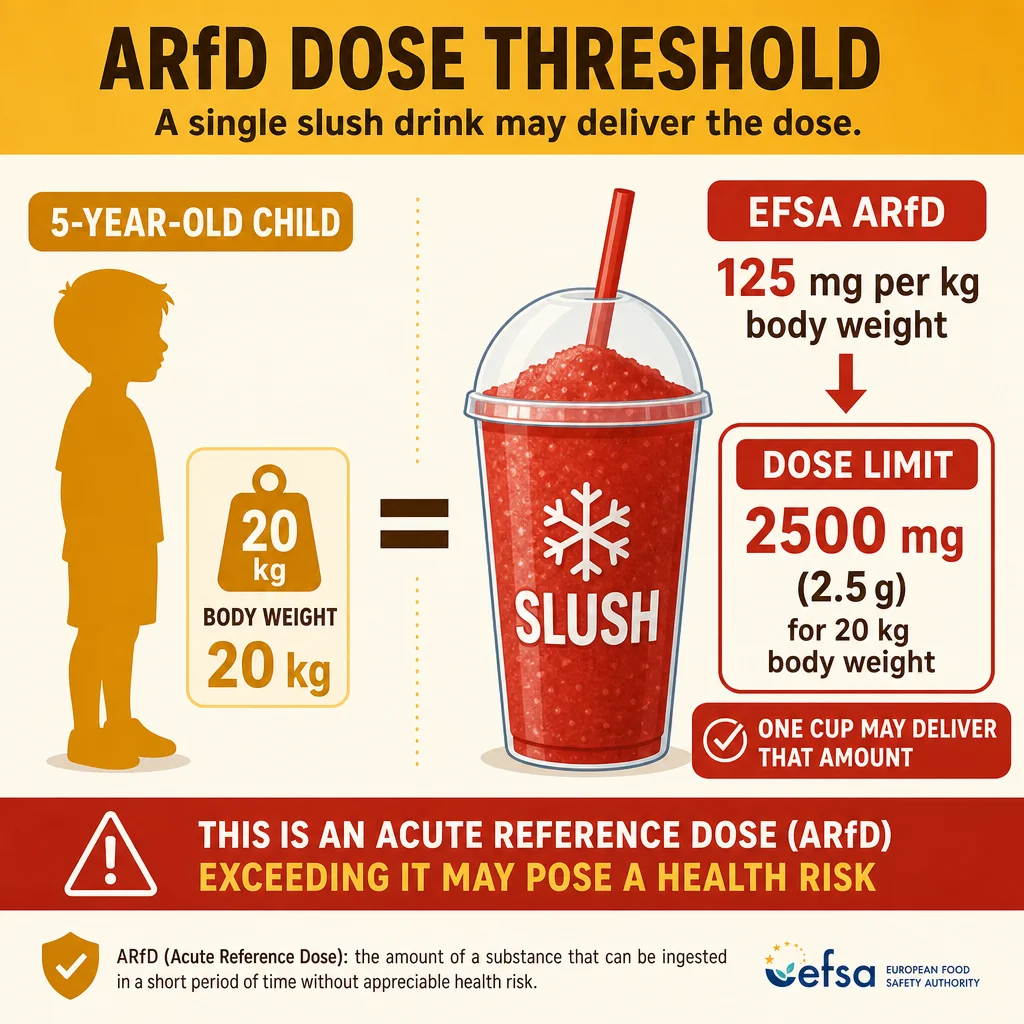
The EFSA assessment published in May 2026 established an acute reference dose (ARfD) for glycerol of 125 milligrams per kilogram of body weight per single consumption event. That threshold applies specifically to acute exposure — a single sitting — rather than long-term daily intake.

For a five-year-old weighing approximately 20 kilograms, the ARfD corresponds to a total glycerol dose of 2,500 milligrams. At measured concentrations in slush drinks — German food authorities had sampled 62 commercial slushy products and found concentrations up to 142 grams per litre — that dose can be reached in under 200 millilitres of beverage. A standard-sized slush drink for a child is typically 300 to 400 millilitres, placing it comfortably above the ARfD threshold for the age group most likely to consume it.

EFSA recommended that the European Commission consider establishing maximum glycerol concentration levels in slush drinks, noting that no maximum level is currently defined in EU law. The assessment specifically flagged children under seven as the population group for whom the risk was most acute.

Why Glycerol Replaced Sugar in Slush Drinks

Why Glycerol Replaced Sugar in Slush Drinks

The connection between sugar taxes and glycerol is direct. The UK Soft Drinks Industry Levy, introduced in 2018, applies to drinks containing added sugar above defined thresholds. Slush drinks reformulated to reduce sugar needed a replacement that would maintain the characteristic texture — the slow-crystallizing, spoonable-or-drinkable consistency — that gives slush its appeal. Glycerol does this effectively. It is a polyol that depresses the freezing point of water, which keeps slush from freezing solid and gives it a smooth, icy flow at serving temperature.

Sugar-free slush drinks that use glycerol are also marketed as lower-calorie alternatives, reinforcing their appeal to parents who might otherwise be cautious about high-sugar treats for young children. The reformulation therefore created a substitution that appeared beneficial on one dimension — reduced sugar — while introducing a different acute exposure risk that was not anticipated when the additive approval framework for glycerol was written.

Ireland introduced a similar sugar tax in 2018, and it was UK and Irish hospitalized cases that first drew clinical attention to glycerol intoxication in children.

The Clinical Picture: Glycerol Intoxication Syndrome

The Clinical Picture: Glycerol Intoxication Syndrome

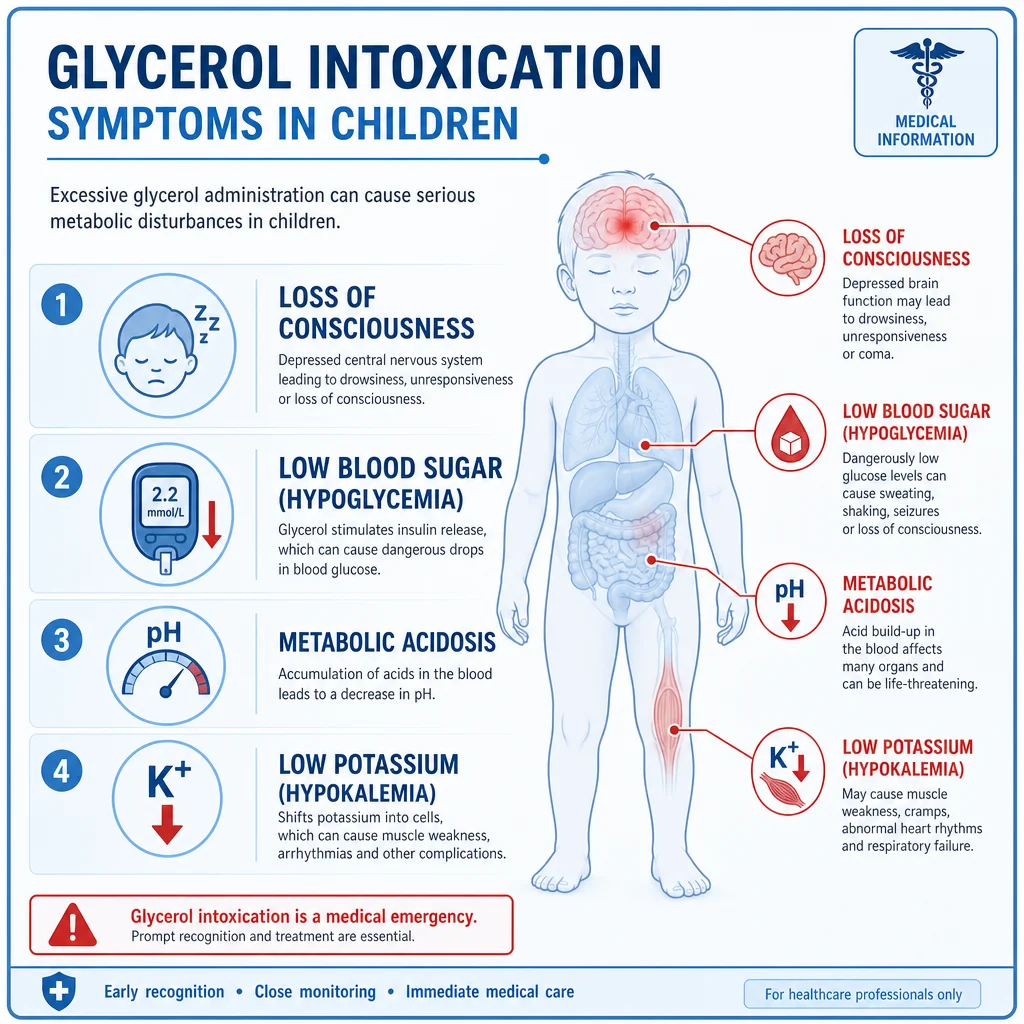
A case series published in BMJ Paediatrics Open documented 21 children hospitalized in the UK and Ireland between 2009 and 2024 following consumption of glycerol-containing slush drinks. The clinical profile was striking in both its consistency and its severity.

Loss of consciousness was recorded in 93% of cases. Hypoglycemia (dangerously low blood sugar) was present in 95% of children at admission. Metabolic acidosis — a disruption of the body's acid-base balance — occurred in 94%. Hypokalemia (low potassium) was found in 80%. The onset of symptoms was typically rapid, following consumption of the slush drink, and children recovered in all documented cases once treated in hospital.

The glycerol-hypoglycemia connection is not entirely straightforward. Glycerol at high doses can interfere with glucose metabolism, and in small children with limited glycogen reserves, this interference can rapidly produce clinically significant hypoglycemia. The combination of metabolic disruption, loss of consciousness in an otherwise healthy child, and recovery upon hospital treatment was distinctive enough for clinicians to recognize a syndrome pattern and trace it back to a common exposure.

The FSA UK had issued guidance in 2021 advising that children under seven should not be given slush ice drinks containing glycerol. That guidance was reinforced after the case series and remains current. It is not a prohibition on adults, for whom the dose-to-body-weight ratio produces a materially different risk profile.

What the Label Will and Will Not Tell You

Glycerol must be declared on ingredient labels in the EU and UK under its name or E number (E 422). It appears in the ingredient list of any product where it is used as a food additive. The problem for parents at a slush drink stall is that slush drinks sold at fairgrounds, cinemas, sports venues, and amusement parks are frequently served from bulk machines where no packaged label is visible. A cup handed to a child at a ride-along stall does not come with an ingredient list or an allergen notice. The child receives the drink; the parent may not know glycerol is present.

Even where glycerol is declared on a label, there is no current legal requirement to state the concentration per serving. A label that lists "glycerol (E 422)" conveys that the ingredient is present but provides no information about dose. Without knowing the concentration and the serving size, a parent cannot calculate whether a specific cup of slush drink exceeds the ARfD for their child's weight.

This is precisely the gap the EFSA recommendation is intended to address: establishing maximum concentration levels that would give manufacturers a compliance target and give regulators an enforcement mechanism. Until that happens, the only practical signal available to consumers is the FSA guidance: children under seven should not be given slush drinks containing glycerol.

Where Glycerol Appears Beyond Slush Drinks

Where Glycerol Appears Beyond Slush Drinks

Slush drinks are the acute risk scenario, but glycerol is a widely used food additive that appears in a much broader range of products. It functions as a humectant in baked goods, keeping cakes and muffins moist. It appears in confectionery — particularly fudge, certain soft candies, and chewing gum — as a sweetener and texture agent. It is used in some ice creams and frozen desserts to improve texture. In the pharmaceutical and supplement space, it appears in liquid medications, throat sprays, and capsule coatings.

For most of these applications, the concentrations are lower and the serving sizes are smaller, making acute exposure less of a concern. The slush drink scenario is unusual in combining high concentrations with large single-serving volumes and a consumer population — young children — whose body weight amplifies the dose-to-body ratio significantly.

Using IngrediCheck to scan packaged food ingredients will flag E 422 whenever it appears in a declared ingredient list. For slush drinks served from unlabeled machines, the scanner has no label to read — which is where awareness of the FSA guidance matters most.

What Parents Should Do

The FSA UK guidance is clear: children under seven should not be given slush ice drinks that contain glycerol. This applies regardless of whether the drink is sugar-free or not. The risk is not about sugar content; it is about glycerol dose relative to body weight.

For children over seven, the dose-to-weight ratio is more favorable, but the FSA still recommends limiting consumption and being aware that the additive is present.

At venues where slush drinks are sold — fairgrounds, cinemas, leisure centers, fast-food outlets — staff may not be trained to advise on glycerol content. The practical question to ask is whether the slush drink is sugar-free: sugar-free slush drinks are significantly more likely to contain glycerol as a replacement sweetener. If the answer is yes, or if the staff cannot confirm, the FSA guidance advises avoiding the product for children under seven.

For packaged slush drink products sold in supermarkets, the ingredient list will declare glycerol if it is present. This is a check that takes seconds and is worth making before a product designed to appeal to children reaches them. IngrediCheck can read ingredient lists and flag E 422 instantly when a product is scanned, removing the need to manually identify the additive by name or number.

The Regulatory Gap EFSA Has Flagged

The EFSA assessment closes with a recommendation that the European Commission consider establishing maximum glycerol levels in slush drinks specifically. This is a significant regulatory signal. Maximum levels exist for many food additives in specific food categories; glycerol does not currently have one defined for slush drinks. Setting one would allow national food enforcement agencies to test commercial products against a legal threshold and take action against products that exceed it.

Until a maximum level is set, slush drink manufacturers are operating under general additive approval — glycerol is permitted, but no specific ceiling applies to these high-concentration applications. The FSA UK guidance is advisory rather than regulatory enforcement, which means compliance is voluntary. The gap between advisory guidance and enforceable limits is where children remain exposed in the interim.

The EFSA report is one step in a process that moves through the European Commission before becoming law. The outcome and timeline are not yet determined. For now, the ARfD of 125 mg/kg body weight is the established scientific benchmark, and the FSA guidance on children under seven is the most actionable consumer-facing signal from the regulatory system.

Next Label Check

Follow the scanner, hub, and ingredient paths connected to this guide

Get the app for clearer label decisions.

Scan labels, see what fits your food notes, and read the why in plain English.

IngrediCheck app