Food Policy Watch

The 2026 State Food Ingredient Ban Wave: What Consumers Should Know

Fourteen states are considering bills to ban or restrict food dyes and additives in 2026. Here is a breakdown of what ingredients are targeted, which states are leading, and what this patchwork of laws means for what is on your grocery shelves.

May 15, 2026|10 min read
By Sanket Patel|Updated 2026-05-15|3 sources|Editorial standards
The 2026 State Food Ingredient Ban Wave: What Consumers Should Know

Walk through a grocery store in the United States and pick up a brightly colored sports drink, a bag of candy, or a box of fruit-flavored cereal. There is a good chance it contains synthetic food dyes: Red 40, Yellow 5, Yellow 6, Blue 1, Blue 2, or Green 3. These petroleum-derived colorants have been standard in American processed foods for decades.

Now walk through a grocery store in Europe. That same product, from the same manufacturer, will often look different. It might use beet juice for red coloring instead of Red 40. It might use turmeric or beta-carotene. The flavor is the same. The recipe was reformulated. Because Europe took a different regulatory path.

That transatlantic divide is now arriving in America, not through the FDA in Washington, but through state legislatures from Sacramento to Albany.

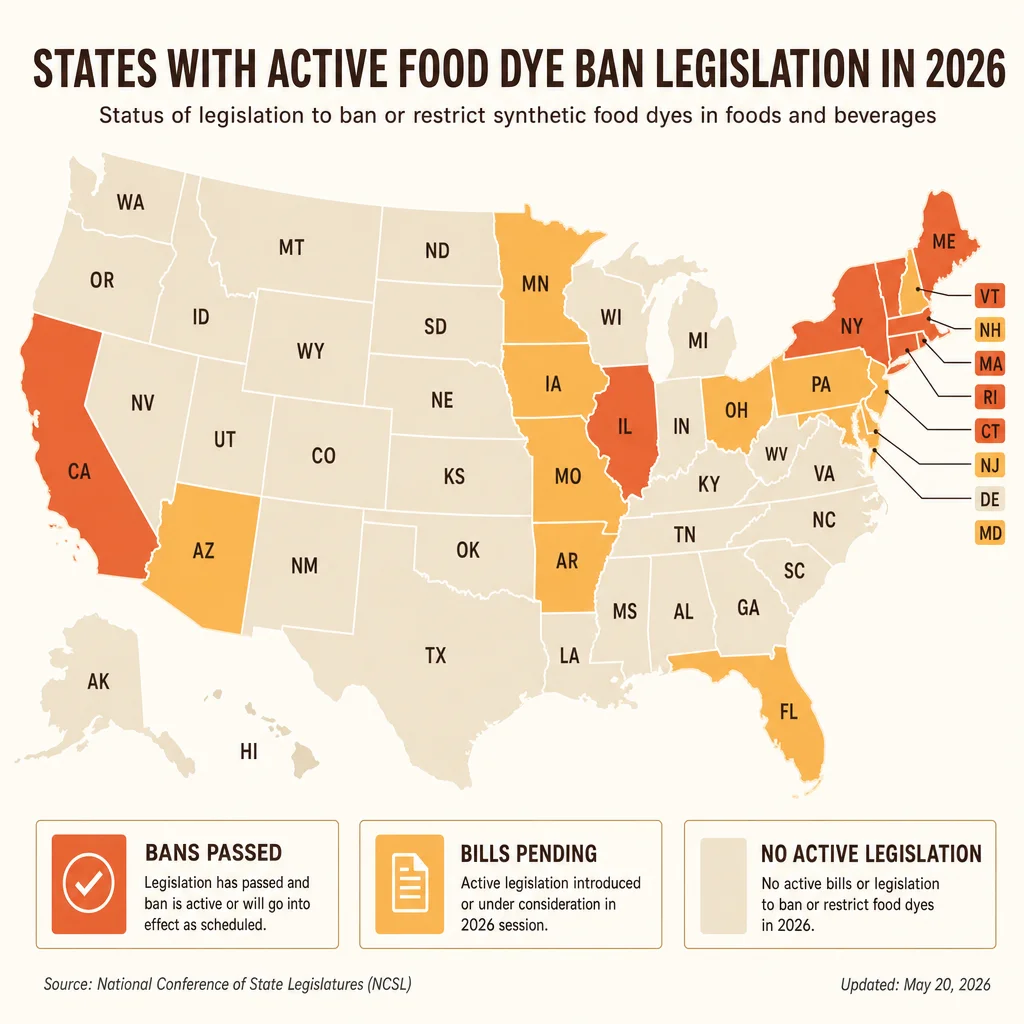
In 2026, at least 14 states are considering bills to ban or restrict certain food ingredients and additives. Eleven states have introduced school-specific bans on dyes and other ingredients. The movement, driven by the Make America Healthy Again agenda and growing consumer skepticism about synthetic additives, represents the most significant challenge to the American food ingredient status quo in decades.
Why States Are Acting Now

The state-level push has several converging drivers. First, the FDA banned Red No. 3 in January 2025, acting on a 2022 petition from the Center for Science in the Public Interest and other consumer groups. The ban, effective January 2027 for food manufacturers, was triggered by the Delaney Clause, a 1958 law that prohibits any color additive found to cause cancer in humans or animals. Red No. 3 had been known to cause thyroid cancer in male lab rats since the 1980s.

That FDA action opened a door. If Red No. 3 could be banned at the federal level after decades of use, what about the other synthetic dyes? What about other additives that European regulators have restricted? For more on the differences between US and EU food regulation, see our guide on food additives banned in the EU but still allowed in the US.

Second, the MAHA movement has given the issue political momentum. President Trump's Executive Order 14212 established the Make America Healthy Again Commission in February 2025, chaired by Health and Human Services Secretary Robert F. Kennedy Jr. The Commission's report, published in May 2025, explicitly targets chronic disease prevention through nutrition policy. Kennedy himself announced a plan in April 2025 for the FDA to phase out six petroleum-based synthetic dyes, encouraging industry cooperation by the end of 2026.

Third, California already proved it was possible. In 2024, California passed the California Food Safety Act, banning six synthetic dyes from food served in public schools starting at the end of 2027. The law targeted Red 40, Yellow 5, Yellow 6, Blue 1, Blue 2, and Green 3. If the largest state economy in the U.S. can do it, the reasoning goes, other states can follow.

Which States Are Leading

Which States Are Leading

The legislative activity in 2026 is extensive. According to the Environmental Working Group, 20 states introduced nearly 40 bills targeting food dyes and additives in the first three months of 2025 alone, and the momentum has carried into 2026.

West Virginia passed a bill in early 2025 banning seven synthetic dyes, including Red 40 and Green 3, set to take effect in 2028 pending the governor's signature. Lawmakers explicitly cited the MAHA movement and concerns about behavioral effects in children.

New York has active legislation to ban harmful food dyes including Red 40, Yellow 5, Yellow 6, Blue 1, and Blue 2. The bill passed its first committee hurdle in April 2026.

Oklahoma, Utah, Tennessee, Florida, Texas, and Arizona all have bills at various stages of consideration. The specific ingredients targeted and the scope of the bans vary by state. Some bills target only school food. Others apply to all products sold within the state.

Wisconsin and South Carolina have emerged as early movers on broader ingredient restrictions, going beyond dyes to include additives like brominated vegetable oil and potassium bromate.

The patchwork is complex, and food manufacturers are watching closely. As the law firm Michael Best noted, "the lack of uniformity when it comes to state-level bans adds a layer of compliance complexity to the food sector."

What Ingredients Are Being Targeted

The bills generally fall into several categories.

Synthetic food dyes. Red 40, Yellow 5, Yellow 6, Blue 1, Blue 2, and Green 3 are the most commonly targeted. These dyes appear in thousands of products, from breakfast cereals and snack chips to sports drinks and children's medications. The concern centers on potential behavioral effects in children, particularly hyperactivity. The FDA has stated it is monitoring the issue but has not established a causal link. In Europe, products containing certain dyes must carry a warning label stating they "may have an adverse effect on activity and attention in children."

Brominated vegetable oil. Already banned by the FDA effective August 2024, BVO was used to keep citrus flavoring from separating in sodas and sports drinks. Some state bills include it to close any remaining loopholes.

Potassium bromate. Used as a dough conditioner in bread and baked goods, potassium bromate has been banned in the European Union, Canada, Brazil, and many other countries due to cancer concerns. It remains legal in the United States.

Titanium dioxide. Used as a whitening agent in candies, coffee creamers, and salad dressings, titanium dioxide was banned as a food additive in the European Union in 2022. The FDA continues to permit its use.

Butylated hydroxyanisole and butylated hydroxytoluene. These preservatives, often called BHA and BHT, are used to prevent oils from going rancid. The FDA is currently reviewing BHA's safety status, and California is considering adding them to its restricted list.

The Federal Preemption Question

A central legal question hangs over the entire state-level movement: can states ban food ingredients that the FDA has approved as safe?

The short answer, according to legal analysis from the Center for Health Law and Policy Innovation at Harvard Law School, is yes. The Federal Food, Drug, and Cosmetic Act does not expressly preempt state laws banning food and color additives. Unlike medical devices or nutrition labeling, where Congress included explicit preemption language, food additive regulation contains no such provision. States retain their traditional police power to legislate for public health and safety.

This means the patchwork is likely to persist. A national food manufacturer could face a reality where a product is legal in Texas, restricted in California schools, and banned entirely in West Virginia. The compliance burden is significant, and the practical effect may be national reformulation: if enough large states restrict an ingredient, manufacturers will reformulate for the entire country rather than maintain separate product lines.

The FRESH Act of 2026, currently being debated in Congress, could change this dynamic. The bill proposes significant FDA food safety reforms, including changes to the GRAS notification system. One controversial element is a potential preemption provision that would override state-level ingredient bans in favor of a uniform federal standard. Consumer advocacy groups have raised concerns that federal preemption could weaken food safety by eliminating the state-level experimentation that has historically driven federal action.

What This Means for Your Grocery Cart

What This Means for Your Grocery Cart

For consumers, the practical impact depends on where you live and what you buy. If you shop in California, you may already see products reformulated to comply with the state's school food dye ban. If you shop in West Virginia, changes will arrive by 2028. If you shop nationally, you may notice certain products changing their ingredient lists as manufacturers get ahead of the regulatory trend.

Some changes are already visible. Following the Red No. 3 ban, several major candy and snack manufacturers announced reformulations replacing the dye with natural alternatives like beet juice concentrate and carrot extract.

The transition is gradual. Products manufactured before the compliance deadline can still be sold.

The shift toward natural colorants is not seamless. Natural dyes can be less vibrant, more expensive, and less stable over time. They can also introduce new allergens: annatto, a natural orange-red dye derived from achiote seeds, can trigger allergic reactions in some people. Beet-derived colors can add an earthy flavor note that formulators must mask. These are solvable problems, but they require investment.

The Consumer's Role

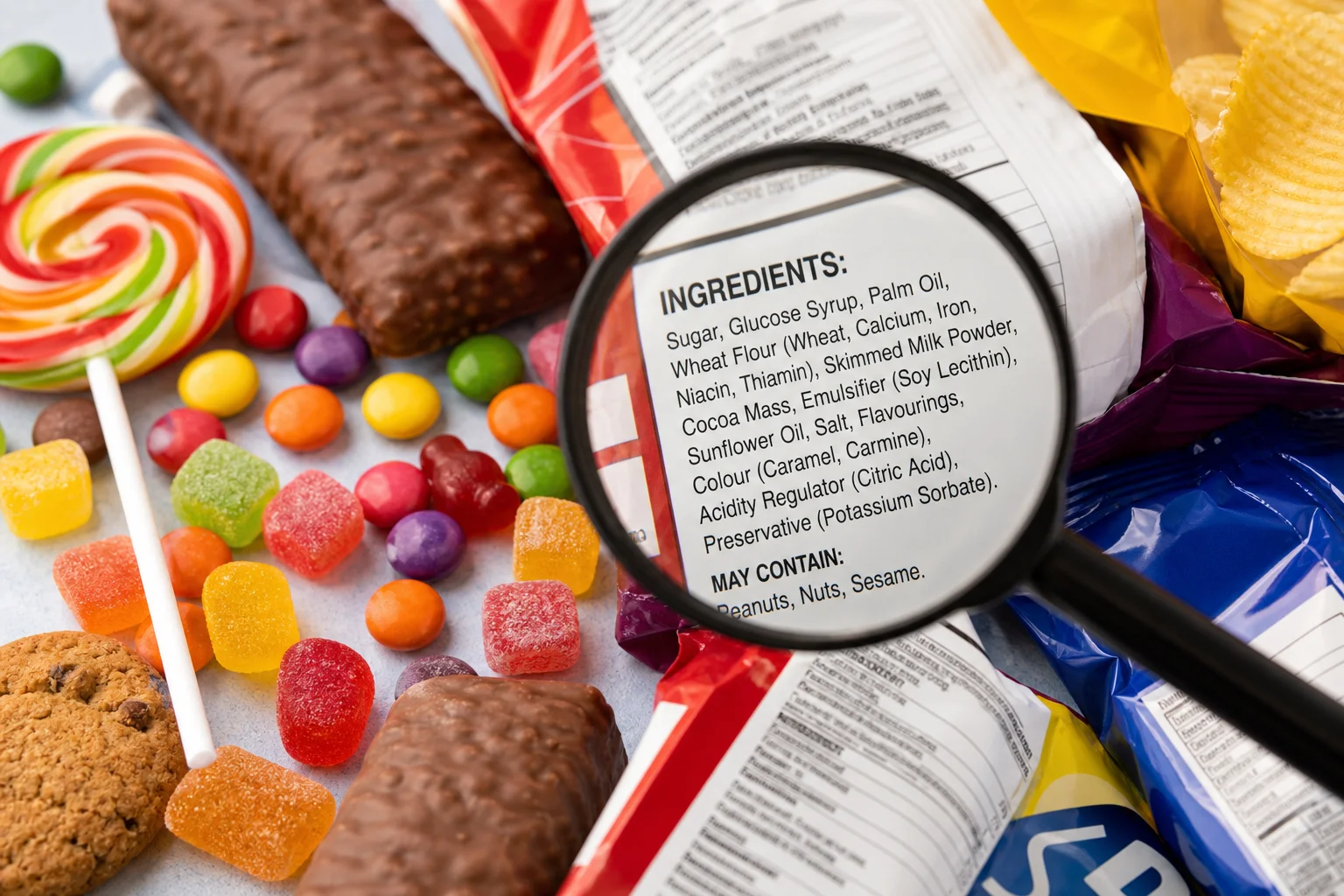
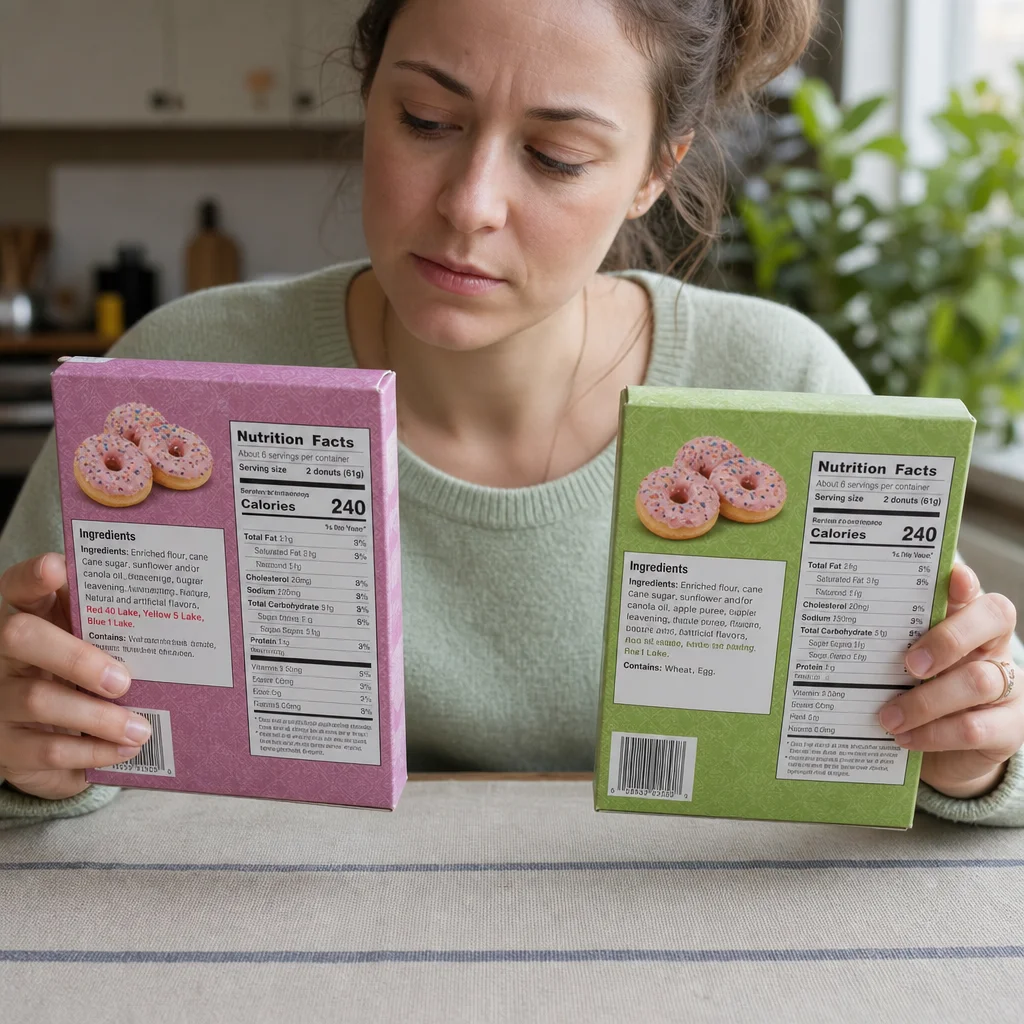
For consumers who want to avoid synthetic dyes and questionable additives now, rather than waiting for state legislation to take effect, the most practical strategy is reading ingredient labels. Synthetic dyes are listed by their FDA names in ingredient panels. If you see Red 40, Yellow 5, Yellow 6, Blue 1, Blue 2, Green 3, or any color followed by a number, the product contains synthetic dyes.

BHA and BHT appear as preservatives. Potassium bromate appears in bread ingredient lists. Titanium dioxide appears as a color additive. These are all identifiable if you know what to look for.

The challenge is that ingredient lists are dense, printed in small type, and often hidden on the back or side of packaging. For a parent trying to shop quickly with a child in tow, scanning every label is not realistic.

Using IngrediCheck, you can scan a product and instantly see whether it contains synthetic dyes, BHA, BHT, potassium bromate, titanium dioxide, or any of the dozens of additives that state legislatures are now scrutinizing. The app translates dense ingredient panels into clear information, helping you decide whether a product meets your family's standards.

Get the app for clearer label decisions.

Scan labels, see what fits your food notes, and read the why in plain English.

IngrediCheck app